|
|
Having dodged the misfortune of convening on Friday the thirteenth, Team Echinacea had a fruitful day in the field.
The morning was occupied by independent projects. Kory, Jennifer, and Jon went to CG2 at Hegg Lake to look for pollinators visiting flowering Echinacea. Dayvis and Marie also went to Hegg Lake to gather data for their respective projects. Sarah B. once again visited multiple remnants to monitor flowering dates. Meanwhile, Lydia, Ilse, and Gretel assessed phenology and flowering head count in the Common Garden and ’99 South Garden to gear up for this summer’s pollination experiment.
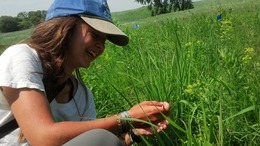
In the afternoon, Pam and Reina finished taking measurements of plants in INB2 for their study. The progress of their work benefited greatly from the recent acquisition of a Red Flyer wagon. Lydia (shown below) braved the wrath of protective ants in her quest to acquire blue aphids for her addition/ exclusion experiment. The rest of the team returned to CG2 to finish measuring plant fitness traits.

After a long day’s work, Dayvis cooked up a delicious meal of split pea soup and arepas (Venezuelan corn cakes). Many crew members are experiencing discomfort due to chigger bites, although some are more prone to vocalize their displeasure than others.
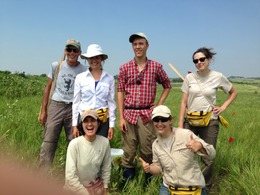
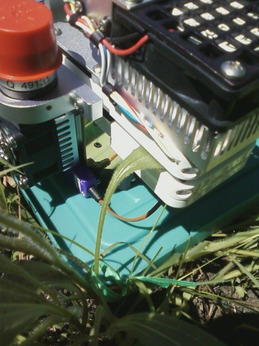
Today was a great day for Team Echinacea. Most of us began our mornings searching for stipa and then went out to Hegg Lake where we finished measuring plants in Jennifer’s common garden! Woot woot! I took an photo of the group and was so excited that my finger made it into the photo…whoops! Dayvis continued to observed pollinators and Reina and Pam were super productive measuring photosynthetic rates of plants in INB2 (maybe it’s the new wagon they got for lugging around Helga).

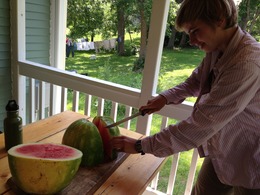
At lunch Kory updated us with his progress on his pollinator efficiency project and Jennifer surprised us with a delicious watermelon as a treat for finishing up stuff at Hegg Lake. Marie did the honors of cutting up the watermelon (little did we know it was her first time).
The afternoon felt a bit like deja vu of the morning. We did another round of searching for stipa (rumor has it we’re just about half way done!) and then returned to Hegg Lake. Turns out we didn’t actually “finish” measuring plants…now it’s time to double check all the ones we didn’t find the first time. Looks like we’ll finish that up tomorrow though, and then be actually done with Hegg Lake for the weekend.
Happy Thursday!
Today, the weather was beautiful and the team was able to make a lot of progress on several projects. In the morning, twist-tieing the heads in the common garden was finished up after several days of working on it. Most of the team then headed out to Hegg Lake to make a ton of progress inventorying the status of all the echinacea plants in common garden 2. My day consisted on making huge strides in gathering data on photosynthetic rate of the echinacea in the INB2 part of the common garden. We are almost 2/3 of the way done measuring! Later that day and back at the town hall, the team feasted on some delicious fajitas that Sarah Z. prepared for supper. 
-Reina
Today in Douglas County, Minnesota, Team Echinacea labored under a cloudless sky and oppressively high temperatures and humidity levels.
First thing in the morning, Sarah B. visited the remnants she is monitoring to study flowering phenology. Dayvis also departed to work on his own project, and was not seen again until 1pm. Today is the second day of flowering for Echinacea pallida at Hegg Lake, and Dayvis appeared elated to finally observe pollinators at work. Kory and Jennifer also went to Hegg Lake in the morning to visit Common Garden 2.
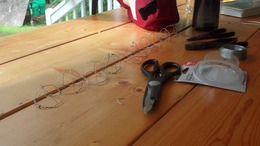
Those who did not have morning projects to attend to flagged and twist-tied flowering plants in the Common Garden. After lunch, the team departed to CG2 to measure plants. Throughout the day, Pam and Reina measured photosynthesis rates in the basal leaves of Echinacea in INB2. Marie and Reina also made/improvised pollinator exclusion cages. The technique for doing so remains unperfected.
This morning, I went out to Staffanson to collect flowering phenology data and saw my first flowering Echinacea of the summer! Some had started flowering yesterday but a few started today. Awesome! 😀
Sarah B
Hello all,
This is the first draft of my research proposal regarding fitness and heritability in the offspring from Shona’s crosses last summer. I still have a bit more research to complete – in particular, brushing up on quantitative genetics. Nevertheless, I have enough information to go forward, and hope to get a good chunk of my measurements done by next week.
Schaedel_ResearchProposal.pdf
-Marie
Today the team accomplished a variety of projects. The morning began by searching for grasses in the common garden. A decent amount of grasses were located and the garden was resounding with choruses of “woots” shouted out when the grasses were located. The rest of the morning the team worked on individual projects. Throughout the day, Pam and I measured the Amax, transpiration, and conductance of echinacea plant leaves in the hybrid garden within the common garden. We managed to measure 42 plants before Helga (our fabulous machine) needed to take a rest and recharge until tomorrow. In the afternoon, more grasses searches were done. The team also ventured out to Hegg Lake to help Kory find echinacea plants about to flower in common garden 2 and to help Davis find flowering echinacea pallida plants. Overall the day was beautiful to be outside, and it was a very productive day! -Reina
|
|