I drove from the Chicago Botanic Garden to our field site in western Minnesota hoping for a window of appropriate burning weather on Thursday afternoon or Friday afternoon. I also brought 297 Echinacea seedlings to plant as part of an experiment that investigates hybridization between native and non-native Echinacea. Several gallons of side-oats grama grass seed were waiting to be hand broadcast at two sites after the burn.
Why burn?
We want to burn our large Echinacea “common garden experiment.” In this abandoned field we have planted about 14000 individual Echinacea plants, starting in 1996, and measured their growth and flowering every year. We have burned this ~6 acre plot every other spring from 1998 to 2008. The weather didn’t cooperate in 2010, so we burned in 2011. We are trying to burn this year! Burning in the spring really increases the chance that an Echinacea plant will flower. We are planning a big crossing experiment this summer, so we want as many plants to flower as possible. Also, burning sets back the weeds–and that is a good thing.
Here’s the quick recap of major activities.
1. Packing
2. Driving to MN
3. Preparing to burn
4. The burn
5. Seeding after the burn
6. Preparing to plant
7. Planting
8. Seeding the phenology plot
9. Driving to IL

Dwight makes sure the fire stays where it belongs
Read the gory details…
1. Packing
I loaded the truck with lots of field equipment to use during the summer. The seedlings in the hybridization experiment fit in three trays. I had two trays of “extra” seedlings that were still hanging on from Jill’s agar/blotter seed germination experiment. For the burn, I brought three backpack sprayers, the DNR burn permit, and batteries for radios. I forgot to bring a back-up drip torch.
2. Driving to MN
The drive to Minneapolis was generally uneventful, which is just what one wants when driving an 18-year old truck. Very early on Thursday I drove to the site. Shortly before arriving, I saw two Sandhill Cranes landing in a wet field near Holmes City. I think that’s the first time I’ve seen cranes on the ground in Douglas County–auspicious! I should mention that I also saw a Common Loon and Pelicans, which are common every summer in Douglas County. Seeing them makes for an auspicious day too.
3. Preparing to burn
Thursday morning the ground was wet and the wet grass duff (fuel) didn’t look very promising for burning. The erosion in the surrounding corn fields indicated it had rained a lot. Our rain gauge confirmed that showing 3.65 inches (93 mm) of precipitation in the previous week. Light winds and cool temps weren’t helping dry it out, but the sun and low humidity offered a glimmer of hope. It’s rather stressful trying to predict burn weather and decide whether to rally folks to make a long trip to help burn.

The plot before the burn
Dwight and I began preparations for the burn. Just after noon, it looked like the fuel might dry out enough to burn and the weather forecast looked great, so I let folks know that we were going to attempt to burn in late afternoon. I should add that the fire forecast for Friday was getting worse, so that a burn was going to happen on Thursday or never (well, June or 2014).
Here’s our pre-burn to do list:
Prepare burn break (mower, weed whip, chain saw)
Fill water tank on truck (70 – 80 gallons)
Put six buckets in tractor trailer
Set up hoses [I forgot to set up hoses this year, thus this list]
Fill backpack sprayers
Fill drip torch(es)
Get matches
Activate burn permit
Call sheriff
Call neighbors
Walk burn break with crew & place buckets
Check radios
What to wear during a burn:
100% cotton long-sleeved shirt and long pants
Hat
Leather boots (over ankle, if you have them)
Leather work gloves
4. The burn
Amy, Brad, Dwight, Jean, and I conducted the burn and it went smoothly. Amy made a nice post with photos. The burn was slow and thorough. Ignition initiated at 5:20 and we were done at 8:20. Winds were light ESE ~ 8 mph. We had a great dinner afterward.
Amy keeps the fire from jumping the road
Brad and Amy through the smoke
A slow and thorough burn
Post burn to do list:
Call sheriff
Put everything away–dry out tanks
Broadcast seed
Some grass is still green right after the fire
5. Seeding after the burn
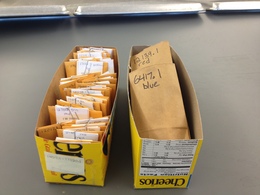
On Friday I hand broadcast about 2 gallons (8 liters) of native grass seed. More warm season grasses will provide fuel for future fires! The Soras chattering in the neighboring wetland kept me company. Here’s the seed sources–keeping it local!
grocery bag: Bouteloua curtipendula from cg1 10 Aug 2012
grocery bag: Bouteloua curtipendula from Krus 14 Aug 2012
#1 bag: Bouteloua curtipendula (& some Elymus canadensis) from Backhill 19 Aug 2012
#2 bag: Bouteloua curtipendula from Backhill 19 Aug 2012
#2 bag: Bouteloua curtipendula from cg1 22 Aug 2012
Much of the grass that was green right after the fire is now brown
I found this Sharpie while broadcasting side-oats grama
6. Preparing to plant
Next job was getting those seedlings in the ground! The forecast was for lots of rain during the upcoming week, which is great for seedlings, and for lots of rain in the afternoon, which is not so great for a person planting seedlings. I had to hurry.
I was quite efficient, except that I paused to watch a pair of Trumpeter Swans at Hegg Lake WMA–another first for me in Douglas County. I got a very nice look at the birds up close and saw the shape and color of their bills–straight and all black. I didn’t hear them, so I’m not 100% positive they were trumpeters. Tundra swans apparently look similar, but I haven’t seen them up close for years.
I chose a uniform location in an area that was planted with warm season grasses in 2000 for this experimental plot. I was considering mowing the area, or at least the rows to facilitate making straight rows and putting the plugs in, but I decided against it.
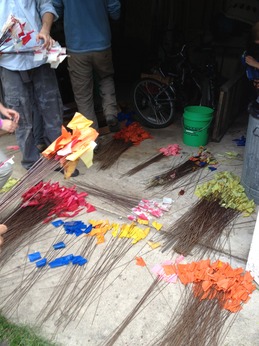
I laid out 300 planting locations (10 m x 30 m) with meter tapes and pin flags. A 9m x 29m grid would be sufficient for 300 locations, but I don’t like to plant at 0m on a tape and I planned to leave a few flags at locations with no plants.
Setting up planting locations
7. Planting
These seedlings all originate from plants that flowered at Hegg Lake last summer. Shona conducted the summer experiment and prepared the seeds for germination. Read about Shona’s project. Jill germinated the seeds this spring and measured the seedlings multiple times. Read about Jill’s project.
I ended up planting one tray (~100 seedlings) on Friday before getting rained out. Planting in the light rain worked for a while, but it was slow. When it really started coming down, I bagged it.
tools of the trade
On Saturday morning I saw the pair of Trumpeters at the flooded field SW of MN27 & CR1. The nearby Canada Geese were much smaller. A black tern flew overhead. When I arrived at Hegg, I saw fresh truck tracks and what looked like a can of beer and a pair of underwear right in the middle of the parking area. They were not there the day before! Upon closer inspection I realized that it was a can of Nos energy drink, not beer.
Saturday proved to be cold but not too cold. It was 54 degrees F and very windy. I wore nitrile gloves and that kept my hands warm. I planted almost twice as fast as I did when it was raining. The Bobolinks kept me entertained all morning with their bubbling songs.
8. Seeding the phenology plot Saturday 1:11 – 1:42 pm
Right after finishing planting I went to the phenology plot and broadcast some native seeds that we collected last fall. I broadcast the seed fast and it dispersed well in the strong and gusty wind. There is a new fox den with a big pile of dirt in the middle of the plot. The only plants I saw flowering were Sambucus, Dandelion, and Antennaria. I’m sure others have been flowering, but it was overcast and cold and I was moving fast. As I left Hegg Lake a wild Turkey walked out in the road in front of my truck. So nice to see.
I planted ~ 2.5 gallons of seed from three collections:
1. Bouteloua curtipendula from Hegg Lake WMA 13 Aug 2012 (#4 bag). 2. Bouteloua curtipendula from NE corner of Hegg Lake WMA 27 Aug 2012 (grocery bag). 3. Schizachyrium scoparium (& some Bouteloua curtipendula) from along CR 15 at Hegg Lake WMA 16 Sept 2012 (grocery bag).
9. Driving to IL
I left around 5:45 AM on Sunday. As I climbed in the truck I heard a Great-crested flycatcher–first of the season–so, I suspected it would be an auspicious trip. It was a boring drive, just the way I like it. I talked to myself about mating isolation and asynchrony to help prepare for writing a proposal to NSF on this topic.
Postscript. I didn’t have time to plant a few of Maria’s left-over Dichanthelium plants. Jean said she would be glad to plant them in her prairie garden.
Maria’s Dichanthelium plants. Some have been exposed to cold temperatures for the past month or so.

May2013-thumb-260x346-155541.jpg)
May2013-thumb-260x195-155537.jpg)
May2013-thumb-260x346-155538.jpg)
May2013-thumb-260x195-155552.jpg)
May2013-thumb-260x346-155546.jpg)
May2013-thumb-260x195-155549.jpg)
May2013-thumb-260x195-155555.jpg)
May2013-thumb-260x346-155558.jpg)
May2013-thumb-260x195-155561.jpg)
May2013-thumb-260x346-155564.jpg)
May2013-thumb-260x346-155567.jpg)