Last summer I conducted a biweekly survey of aphids and ants in the common garden, an experimental prairie restoration containing Echinacea from various remnant populations. I was interested in the spatial distribution of aphids and ants within and across years. This year I plan to scale down my survey to once a month, beginning next Friday. Here’s a detailed protocol:
|
||||
|
Hello all! A lot has happened since my last post, so here is a brief update! After returning to school with my phenology data and experimental seed heads in the fall of 2011, I began work on my senior thesis using that data as a foundation. In April of this year I defended my thesis, “Flowering Phenology and Seed Set in Fragmented Populations of the Prairie Plant Echinacea angustifolia” and was awarded Distinction by my committee! Stuart and I continued to work on my data after my defense and are planning to continue the project and potentially incorporate data from this summer in the hopes of publishing it! Here are some of the very interesting results that we’ve gotten so far: > aggregate(ss ~ nndist + pdtime, data = mm, mean) We found that there’s a relationship between seed set (ss), peak flowering date (pdtime), AND distance to the 6th nearest neighbor (nndist). Seed set was higher in plants that had a combination of close 6th nearest neighbor (near) and early peak flowering date or far 6th nearest neighbor (far) and late flowering date. Very interesting! If anyone has any questions, is interested in continuing this exciting project this summer, or would like a copy of my thesis, feel free to contact me! (Amber Zahler at ambermzahler@gmail.com) What’s this in plug 156? A young seedling with fused cotyledons and a true leaf just peeping up. in the nearby corner is a more typical seedling. Both plants come from florets of Echinacea angustifolia that were pollinated with pollen from Echinacea pallida.
Click image to embiggen! In a paper just published in Restoration Ecology, Echinacea Project researchers report that establishing Echinacea angustifolia in existing prairie restorations and abandoned agricultural fields requires more than 20 seeds for each plant that germinates and survives to flowering. Plants start flowering about 10 years after sowing. Also, burning the prairie before broadcasting seeds helps emergence and survival. Wagenius, S., A. B. Dykstra, C. E. Ridley, and R. G. Shaw. 2012. Seedling recruitment in the long-lived perennial, Echinacea angustifolia: a 10-year experiment. Restoration Ecology 20: 352-359. Available here: https://echinaceaproject.org/
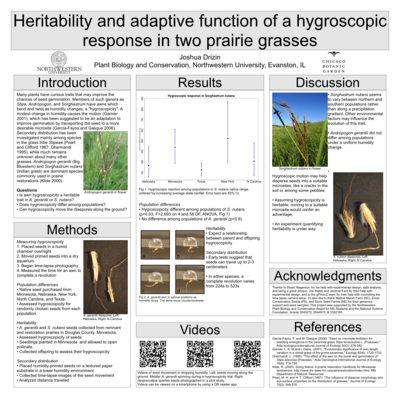
Click to embiggen the poster. This isn’t the full poster, but I’m not uploading a 30MB PDF. The videos can be read with a smartphone and a QR reader, or flip through my posts, as all the videos are on the flog somewhere. I couldn’t make the Midwest Ecology and Evolution Conference, but I made a poster. It describes preliminary results from an aphid addition/exclusion experiment I conducted in the summer of 2011. Specifically, it examines the question of whether aphid infestation influences the presence of leaf damage by other herbivores. Hi everyone! Maria here. Sorry that I have not posted since the end of summer, but please rest assured that I’ve not run away with my Dichanthelium seeds, but have been working on them for the past -what? 6 months? A long and intimate relationship indeed. Brief summary of what has happened: I did a pilot germination & growth study using bulk Dichanthelium seeds. The results of germination study is nicely summarized in this poster that I presented at Midwest Ecology and Evolution Conference (MEEC) in Cincinnati 2 weekends ago(?). MEEC was fun and presenting (yapping about) my poster was a lot less nerve-wracking than I had expected: The seedlings are currently growing in the growth chamber at CBG. (There’s pictures in the poster of seedlings in agar and in plug trays!) I shall put up some more pictures sometime in the future. I should also post the R script I used to analyze data and produce the graphs on the flog – unfortunately don’t have the file on this computer. Right now I’m working on scarifying Dichanthelium seeds for my maternal lines growth and germination experiment (probably should explain in better detail later, likely in another poster). Other good news you might find interesting: If you have any questions about Dichanthelium or anything I talked about, you’re welcome to get in touch. My email is right under the entry title. Here is the protocol that we plan to use for measuring in 2012: Here’s a link to the protocol that we used for measuring CG1 in 2011: In 2012 we plan to measure in “review mode” (as we did for CG2 in 2011) — all location records will be on the Visors with Status=”Staple” or “Skip” populated. We should not spend as much time searching for plants that have not been present for 3 or more years.This should speed up measuring. I’ll post the planned 2012 protocol next. Now that we’ve inventoried all the CG1 heads, I checked to see just how many we have. There were about 3009 twist-ties put out, and 119 heads were duds or missing, so our (estimated) total number of good heads is about 2890. CG2 had something like 140 heads, but we haven’t inventoried those yet. |
||||
|
© 2026 The Echinacea Project - All Rights Reserved - Log in Powered by WordPress & Atahualpa |
||||