|
|
So, a while back when GPS-ing the recruitment plots, there were a number of places where no nail was found in our initial survey. Here’s the list of those point numbers in the GPS:
250
257
276
278
302
319
395
406
These were supposed to have nails, but we were unable to find them.
407
422
428
434
435
Here’s an improved version of my poster on my pilot study of Dichanthelium germination, which I presented at the Undergraduate Research & Arts Expo at Northwestern. It’s pretty much the same content, but less text and neater.
MWangURGExpo2012poster_44_x_36.ppt
Howdy folks,
Maria reporting from K-town.
Sunday we had a real day off =)
The weather was good and sunny, but not too hot.
Random tidbits from the town hall:
Shona made oatmeal pancakes for breakfast – they were really yummy – thanks Shona!
Kelly and Shona went swimming at Elk Lake and bumped into the Wagenius family
Katherine found a new trail in the forest at the Runestone Park on her biking adventure
Andrew had a great time at home and arrived at the town hall before 11pm
Lydia spent the day helping out in the kitchen at the camp in Alexandria
I made Irish Soda Bread to use up some sour milk, but still have ~1 cup sour milk (turned into buttermilk substitute, any ideas what to do with it? Pancakes would be easiest, but we just had them)
After the weekend break, it’s time for work again! Monday (today) we divided and conquered.
AM – Greg set out his yellow pan traps in his remnants. Stuart, Katherine, Jill, Lydia and I did demo in the remnants. Ruth and Greg came to join us. We found many Echinacea flowering at Loeffler’s Corner East, an okay number at Loeffler’s Corner West, 2 at Railroad Crossing (Douglas County), and ~6 at Yellow Orchid Hill.
The others (Shona, Kelly, Andrew) did CG1 rechecks and then worked on their independent projects.
Ruth bought some delicious fluffy spongy chocolate cake which we cleaned off the dish.
PM – The two teams switched jobs. Stuart led Shona, Kelly, Andrew, Ruth and Greg in demo at KJs and On 27. The rest of us did CG1 rechecks, and then worked on independent projects.
Here’s a file called “Crash Course in R”, which might be helpful to folks
crashR.2.pdf
Now for some photos!
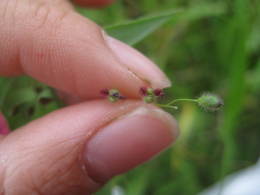
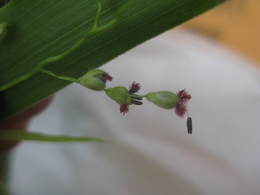
Flowering Dichanthelium!

I think this is a super cool picture as it shows 3 stages of Dichanthelium stigmas/anthers emergence. See how the bottom-most spikelet has the stigma just emerging, while the anthers are still inside; the middle spikelet is open and has both stigma and anthers well-exserted; and the top spikelet is closed and the anthers are drooping out from the spikelet.
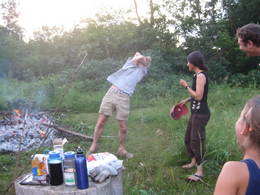
Last but not least here’s an epic picture from our bonfire last year 😀
Now that the vast majority of Echinacea are finished flowering (except for the populations at Staffanson and one lonely plant at Northwest of Landfill), I’ve started piecing together a master datasheet with the first and last day of flowering for every Echinacea head that I have been studying. Please let me know if you have any comments or recommendations for statistical analysis, possible comparisons to other data sets, or better organizational methods!
phen_mastersheet_2012.csv
phen_mastersheet_2012_metadata.doc
RAIN!!! After weeks of very little in the way of precipitation, Team Echinacea was rained out on Wednesday morning. Instead of the usual field work and phenology, we worked on data entry and other analyses for our individual projects. Fortunately, it stopped raining around 10 AM and I was able to head out to Staffanson Prairie Preserve to collect data for my phenology project. West Staffanson was burned this past spring and a lot of the plants are flowering later than usual. This rain seemed to have jump started flowering and it seemed like all of West Staffanson went from young, green sprouts to beautiful flowering plants over night. Walking into West Staffanson, I felt like Dorothy entering the land of Oz! Below I’ve attached a few pictures of the flowering plants and pollinators that I saw. Because West Staffanson was burned pretty late in the spring, many of the flowers that have already finished blooming in other remnants were in their prime on Wednesday. In the afternoon, we started working on phenology in Jennifer’s Plot at Hegg Lake.

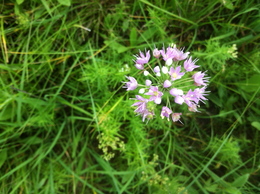
Allium

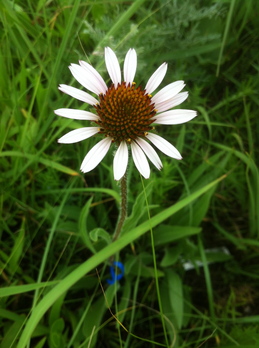
An Echinacea on its first day of flowering.
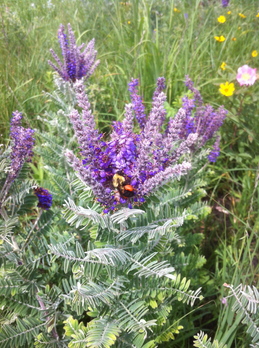
Flowering Amorpha canescens with a pollinator!
After last week’s sultry weather, we’ve been enjoying a “dry heat”, as Greg Diersen so artfully put it. This morning everyone went their separate ways to pursue their individual projects:
Shona, Maria, and Lydia went directly to Hegg Lake and combined forces to measure plants and take GPS points. Shona also photographed Echinacea pallida and E. angustifolia plants as part of her project to assess species traits.
Andrew searched the main experimental plot (C1) for plants where he can observe pollinators. Because peak flowering has passed, his selection of flowering heads is growing slimmer by the day. Fortunately, he has some good observations under his belt and will be able to collect more before plants stop flowering.
Jill and Greg joined forces in operation pit-fall trap. Greg’s traps are bowls full of soapy water that he sets on the ground and leaves out for a couple of days. Jill’s are tubes full of propylene glycol that she submerges in the soil and leaves out for a week. Today, they set out Greg’s traps and collected from Jill’s. I have to say: the smell of dead insects stewing in propylene glycol for a week is probably one of the worst smells I have experienced.
I spent the morning removing aphids from plants in my aphid addition/exclusion experiment. Even though it has been three days since my last exclusion, there were aphids on 11 out of 50 plants in my exclusion group. One plant had 67 aphids–all in three days! Those aphids are moving and breeding fast.
This afternoon we joined together in our common goal of measuring every plant in C1. My mother used to say that the only way to eat an elephant is one bite at a time. Well, today we bit a big chunk off of our elephant, finishing up the sections planted in 1997, 1998, and 1999. We have less than half an elephant to go!
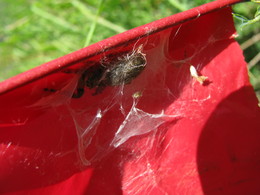
And now for a picture. In addition to helping us keep track of plants, pin flags make great habitat for spiders:
(Aghh I just finished writing and then when i tried to publish the site told me that my session had expired and of course I lost the whole blog post T___T )
Anyways…
Today was a very hot and humid day. Temperatures into the 90s, feeling like 100. Sweaty sweaty sweaty.
Some of us accomplished field work.
Andrew was in C1 this morning painting bracts and bagging Ech flowers.
Katherine was also in C1 doing her aphid add/exclude experiment.
Shona was out at Hegg Lake for 4 hours painting bracts and observing crossed styles.
I (Maria) was also at Hegg Lake (for my own reference from around 10.30 – 4.40pm) surveying Dichanthelium inflorescences I’ve been tracking for the past week or so, and more importantly, finding plants for my pollen limitation experiment. I have 31 plants flagged and 62 inflorescences twist-tied. I’ll be initiating the experiment tomorrow, so I should be in bed now (hence, I’ll give more details in a later post).
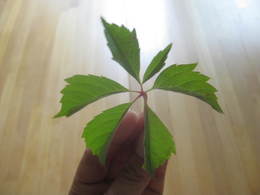
To end off the week, here’s a special 6-leaved Virginia Creeper (they are usually 5-leaved) I found in the 99 south garden. Hope it brings everyone good luck!

This summer I’m building off of Nicholas’ work with E. angustifolia and E. pallida hybridization. I uploaded my proposal last week, but I’ve already learned a lot since then.
First of all, after first thinking that I should be collecting pollen, painting bracts, observing styles and crossing all on the same day, Stuart pointed out that it would be better to do crosses one day and everything else the next. It makes things go faster, and it is also easier to tell which bracts were painted when. With that in mind I made a bare bones materials and protocol sheet to keep myself organized:
angustifolia_pallidaCrossingProtocol.doc
It worked wonderfully for a few days, when most of the heads were flowering and I didn’t have to keep track of which plant had been sufficiently crossed and which needed more, and then it started getting a little complicated, especially when Gretel found another pallida head to add in….
Talking to Stuart and Gretel a few days into my crossing I found out that I had been crossing in a less efficient manner than I could have been. I had been trying to fit all of my potential crosses onto each head, every time I crossed. This meant that I would have five or six different colors to paint, each with three or four bracts, and that I would have to do the same the next time to have enough styles. Then I had to look back and forth between data sheets to see whether style shriveling was consistent. What I’ve switched to now (for the most part) I think is closer to what Stuart had in mind. Now I try to paint six bracts for each cross, and just alternate crosses. For example, I’ll do three of the crosses one day and three the next time if there are 18 anthers on a head.
Today, Gretel came out to Hegg Lake to help paint bracts, and combined with less switching between colors, it took us about half as long as it has been for the painting and observing.
It also seems like most of my plants will be done flowering soon. A few have already finished, and a few of the plants with large or multiple heads have already been crossed with every possible cross.
This summer I’m going to continue with Amber Z’s phenology research from last year. I’ve added on two new sites: North Northwest of Landfill and Around Landfill. I started taking data on June 18th when there were only a couple of plants beginning to flower, but now, many more plants have started flowering and a couple are even close to finishing!
Kelly’s Flowering Phenology Project Proposal.doc
As a continuation of Katie Koch’s experiment in the summer of 2010, I am investigating the pollinator efficiency of bees that visit Echinacea.Project Proposal AK 2012.pdf
|
|