|
|
Uff da! I believe the first round of Dichanthelium seed collection is done. Thanks to Gretel and everyone who helped. And for all the times you waited for me after 5pm.
Collected seeds from 158 plants from 5 sites – Jul 7 Hegg Lake south of parking lot, Jul 8 near Hegg Lake PHEN plot, Jul 9 Hegg Lake field trip area, Jul 11 (yesterday) Loeffler’s Corner (west) and Staffanson’s (old field).
112 plants had spreading/expanded panicles (not sure what’s the correct term) and 47 were not spreading/erect.
Here’s the maternal lines data from the plants I sampled, if you’re interested:
Dichant_DE_All.xls
I’m planning to return to some of these plants a week (or perhaps a little earlier/later, depending on scheduling) after I first collected the seeds. Hopefully there’s still some seeds left on the culms for me to harvest!
July 14 update: It is actually 158 plants, not 159. Sorry for the arithmetic error! 😛
A quick list of flowering plants I noticed while assessing phenology in Jennifer’s experimental plot at Hegg Lake WMA on 10 July. I list only plants observed in the plot. Asclepias speciosa is flowering just outside the SE corner of the plot.
F = flowering
X = done flowering/in fruit
N = not yet
Heliopsis helianthoides F
Amorpha canescens N
Coreopsis palmata F
Rosa arkansana F
Anemone cylindrica X
Silene F
Asclepias syriaca F
Amphicarpea bracteata F
Morning glory sp F
Apocyanum F
Tragopogon F
Cirsium arvense F
Lathyrus venosus XF (almost all done flowering)
Galium boreale F
Psoralea argophylla F
Medicago sativa F
Linum sulcatum F
Carduus acanthoides F
Senecio X
Liatris N
Achillea F
Zizea X
Red field clover F
Yellow fl lactucid F
Potentiall arguta F
Desmodium F
Physalis F
Dichanthelium leibergii XF
No Phlox pilosa in the plot!
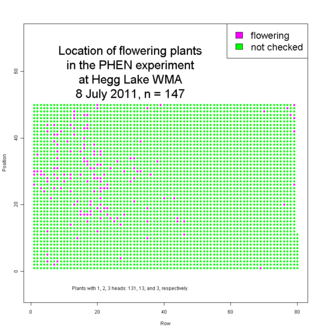
We found 147 flowering plants in Jennifer’s Phenology Experiment during a thorough, but not exhaustive, search on Friday. Most of these plants have buds only and will start shedding pollen later. I posted a map of locations of all plants to flower this year.
 Click on thumbnail to see a larger map. Click on thumbnail to see a larger map.
Jennifer planted this experiment to investigate heritability of flowering timing (phenology) in spring 2006.
Last year eight plants flowered and about 2700 plants were alive. Read about measuring last year.
Assuming that almost all of those plants are still alive and that we didn’t find all the flowering plants, then about 6% of surviving plants will flower this year (>147/2700).
For kicks, I made maps of the paths of data enterers. We usually worked in pairs and used one person’s PDA to enter data. Here are the paths…
Josh D’s visor, Amber E’s, Nicholas G’s visor, Gretel K’s visor, Lee R’s visor, Callin S’s, Stuart W’s visor, Maria W’s visor, Amber Z’s visor. For the record Katherine M’s visor had only one record and we didn’t use Karen T’s visor.
Hi everyone, Maria here again. Today was a particularly happening day in my opinion. Everyone had something to do. Amber E. is back from Alaska with Ruth! Karen arrived from Evanston in the afternoon!
In the morning those of us who hadn’t finished our Stipa searches in the common garden finished that! (So Stipa is done! – we scaled back though and only searched for the 2011(?) cohort). After that Gretel, Ruth, Amber E and I put Position/Row signs in the common garden and made the signs face East/Westwards so now it’s so much easier to read the signs while you are walking in the common garden. Then we got started on looking at the phenology of Echinacea in the common garden. We systematically walked through each row, looking out for flowering Echinacea with emerged anthers and pollen, twist-tying the heads and recording them in our visors. Josh joined us when he finished his Stipa searches. We found quite a few flowering heads – bet there’ll be more soon.
While we were looking for flowering Echinacea, we saw Stuart, Callin, Amber Z and Nicholas crowded around ‘Joe’ – the pet name given to the prominently flowering Echinacea at row 28, position 860. As described by Callin in the previous post, they were practicing bract-painting for their independent projects on Joe.
When we finished looking at all the rows, it was time for lunch and short presentations of our projects. It was good to hear about everyone’s projects and talk about my own projects and get feedback. After lunch, we got started on our independent projects or worked on the New Media Initiative.
Gretel and I headed to Hegg Lake to look for Dichanthelium (Panic Grass) seeds for my second project. This summer I will be collecting seeds from Dichanthelium plants from different remnants, including Hegg Lake and Loettler’s Corner (I might not have spelt that right – sorry). My plan is to collect seeds from 30 individuals from each “site”, as there are several places at Hegg Lake that seem to have a lot of Dichanthelium. After collecting the seeds, I will be bringing them back to Chicago Botanic Garden and do more work on them in the fall/later.
Click here for the
Google doc of my summer project proposals
I am super super indebted/thankful/grateful for Gretel. Without her guidance, I’d probably be in a big mess/not knowing what to do/still be at Hegg Lake as this is my first time doing independent field work.
When we reached the place at Hegg Lake (it was near the road, area with ditch, south of the parking lot), a lot fo the Dichanthelium seeds had already fallen off the culms. It was quite disheartening. We walked a little north and found a patch of Dichanthelium with most of their seeds intact, then we laid out the tape measure for 20m in a roughly north-south direction (I kept thinking it was 2m while Gretel patiently corrected me ^^;;). Initial plan was to do every plant within arm’s length from transect, or every other plant if population was dense. However, that was not quite possible given the circumstances. After Gretel and I collected seed from the first plant and did all the measurements, she continued measuring/collecting while I picked ~30 plants near the transect (more than my arm’s length) that had at least one culm with 8 or more seeds to collect from and flagged them with a blank flag. I started measuring/collecting after I finished flagging. Around 4pm, Lee called – reinforcements were coming! Ruth and Lee arrived with Karen and they helped us finished the rest of the plants (by that time Gretel had completed 17 plants (!!) and I was on my 6th plant). It turned out that we had 31 flags so 31 envelopes with data and samples! We also collected some “random” samples – ie seeds from various random plants away from transect. Finished around 5pm – thanks to Gretel, Lee, Ruth and Karen! Really excited to get the first 30 done!
Take a look at the simple data entry for today’s collection for more technical details if you’re interested. I might also do the seed count for today’s samples just to see how many seeds we can get from 30 plants using the ‘8 or more’ rule. (I just need to be rreally careful not to lose any seed >.<)
Dichant_DE-HL1001-31.xlsx
We left 11 flags (labelled with sample number) at the site that we will return to later to collect more seeds from.
Now that I have more experience, I’ll definitely be more systematic+efficient about it.
Notes to self for tomorrow/next time:
– “just-in-case” extras (extra equipment, envelopes, pens, sharpies, flags) do come in handy! Meter sticks are probably more efficient than tape measures. More flags would be good. Maybe use a different color for “done” or for extras.
– Extra samples are good too. Maybe do 32 plants per site?
– Bring a plastic bag/something to put a plant specimen in – I need to get a sample of the other Dichanthelium species (“hairy leaved”) to press and identify.
– Equipment list would be useful esp when I have more than 5 things to remember.
Lesson of the Day: Having an experienced person around and helpers is always always always helpful! =D
Thanks again to Gretel and everyone who helped!
I wrote this up last week, but neglected to post it on the flog. Here is a detailed protocol for the 2011 recruitment searches. See Wagenius et al. 2011* for a description of the seedling recruitment study.
RecruitmentProtocol2011.doc
*Wagenius, S., A.B. Dykstra, C.E. Ridley, and R.G. Shaw. 2011. Seedling recruitment in the long-lived perennial, Echinacea angustifolia: A 10-year experiment. Restoration Ecology.
Attached is the “weather-tested” search protocol. While my partner found more than a dozen out of 75 or so, I found two out of 100. Maybe I am not the right person to write a protocol about finding these plants.?!
It is very neat to think about these things being seedlings a year or two ago and now they are 20+ cm tall? plants that will produce seed…….sometime.
Hesperostipa spartea Search Protocol.docx
This is the 3rd summer in a row that I have taken part of the Echinacea project! I teach 9-12 sciences (10th grade Biology)at Great Plains Lutheran High in Watertown, SD. Conducting summer research is the best way to incorporate real science into my classroom! While I was a pollen collector and image maker the first summer and a pollen crosser last summer; this summer I am going to collect insects that may or may not be moving pollen. Following the floral neighborhood study of 2009, I will collect and categorize insects from different sites to make an inventory of insect life. I hope it will shed some light on exactly which insects can be found and relate it to the diversity of the plants at sites. It will also be a useful collection for my students in the future.
This afternoon, Amber E. and I (others joined in later) started organizing the data sheets from the seedling searches we have completed so far this season. We are sorting the new maps and other data sheets for each site by focal plant number, and adding the new pages to the end of each site’s notebook. As we organize data sheets for each site, we are also reconciling the maps with the master data sheet for each site.
The data we have recorded on the frame data sheets will need to be entered into a spreadsheet, so that we can use the measurements to generate maps and distance matrices for those focal plants.
slingDataEntryBlank.xls
Here’s an Excel file we can use to do the data entry. For each frame data sheet, 2 people should enter the data. The first person will enter data in the DE_1 worksheet, and the second person will enter data in the DE_2 worksheet. The check columns in DE_1 will then allow us to check for data entry errors. The file should be saved as “slingDataEntry2011Page[page number]”.
I’ll put together a master list with all the frame data sheet page numbers. The frame data sheets will be in the seedling notebooks. People will enter their initials when they have completed data entry for a page number.
Let me know if you have suggestions to make the data entry work better.
Today we started the seedling search at Steven’s Approach (SAP). The wind was strong and air temperature was chilly. We searched 3 circles; in one of the circles we found 6 seedlings! We drew a map and filled in a matrix, as we have done in previous years. We also tried out the new coordinate frame.
I (Amy) have revised the protocol. Please read it and feel free to suggest ways it can be improved.
Seedling Search Protocol 2011.doc
I’ve been working with the Stipa germination data we collected from the common garden over the summer for Stuart’s R class and, among other things, have come up with a little plot of the common garden. Filled-in blue circles are where we found Stipa alive, empty circles had no seedlings. A neat thing would be some kind of heat map for longest leaf or number of leaves, but I’ll try that later.
View image
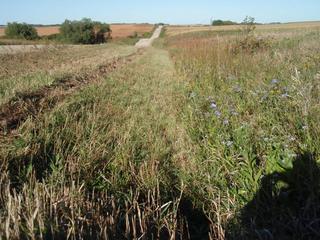
Kate and I have had some beautiful weather for field work (except today–it rained most of the day). Here’s a picture of the roadside site we call East Riley. Notice that our ambitious mower has mowed TWO swaths of the roadside. The mowed area includes most of the circles I am searching to re-find and measure plants we had identified in years past.

We do seedling searches every spring at 14 prairie remnants. We search within 41 cm (or 50 cm for smaller populations) of randomly selected Echinacea plants that flowered the previous summer. Since 2006 we have used these spring searches to find new seedlings (identifiable by the presence of cotyledons). When we find seedlings, we draw circle maps showing the seedling locations with respect to the focal plant, and make measurements to other tagged plants. In 2009 and 2010 we mapped ALL Echinacea plants within the 41/50-cm radius circles. Late in the growing season, we return to the 14 sites and re-find the seedlings and other plants. We update the circle maps, and measure the surviving plants.
Why go to all this trouble? I plan to use the data to estimate the growth rate for these small Echinacea populations. Are the Echinacea producing enough offspring to maintain their populations? That’s the question I hope to answer!
The re-finds are complete at eelr, lih, nessman, nwlf, randt, sap, sgc and spp. I am currently working at eri; still remaining are eth, kj’s, lc, lf and ri. Some of the sites are disappointing. There has been a lot of gopher activity at lih, and most of the Echinacea plants, big and small, are gone. I was only able to find 1 of the 12 seedlings we had previously mapped. Other sites (eri, ri, nessman) are disturbed by frequent roadside mowing and scraping. In spite of that, we were able to find 18 of the 23 previously identified seedlings at nessman. In total (so far), we have found 54/85 seedlings. Some of the survivors were first identified in 2007 (I don’t think I’ve found any 2006 seedlings yet–but there weren’t many to begin with).
I’ll post an update when I finish entering all the data…or the next time I get rained out!
|
|