Hey All,
It’s been a very busy couple of weeks:
On July 27th I spoke at the Garden Club of America Zone 11 Annual Meeting in Lake Geneva. I was there for less than 48hrs, but I still had a wonderful time. I received the GCA’s Fellowship in Ecological Restoration to support my Master’s project, which is why I was asked to attend at all. I was pretty nervous about the speech, but in the end I think it went pretty well. They were a great audience and after this experience I feel much more confident about public speaking.
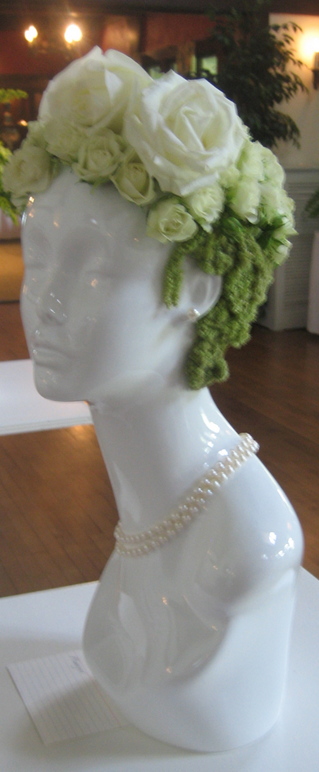
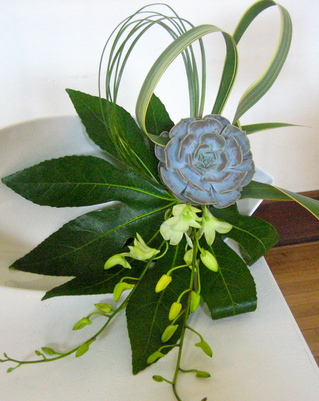
After I gave my talk, I was able go see the GCA flower show, which was really interesting. There were some pretty cool displays. I especially like the hats made of flowers, the miniatures, and the photography. They also had these challenge events where everyone was given the same supplies and theme and had a fixed amount of time to create a display. The GCA has some very creative members.
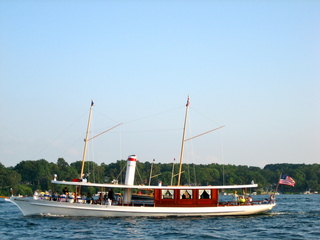
That evening we were given a tour of the lake on a boat called the Louise, where we had h’ors d’oeuvres and cocktails. The boat dropped us off at a GCA member’s house for dinner. It was a lot of fun!
The next day I got to hear Kathryn Kennedy, the president of the Center for Plant Conservation, speak. She gave an excellent talk about endangered species and the challenges we face in protecting these high-risk plants in the coming decades. I was totally revved afterwords, so she did her job.
Pictures from the GCA trip:


After I got back from Wisconsin, I had to turn around and finish working on the poster for the ESA conference. After much work, and help from Stuart, Amy, and Josh, I finally finished the poster.
I drove to St. Cloud to print both the FNC poster and Allegra’s poster, and then on Sunday Stuart and I went to the ESA conference in Pittsburgh. Mimi, the REU intern from last year, was able to join us for the conference on Monday. It was great to see her again. She’s currently working at Frick park as a Outdoorsy type summer camp counselor. She’ll be leaving in September to teach English in Guadalupe. Should be fun!
Mimi and I got a lot of great feedback on our poster during the poster session, and I’m pretty confident that with everyone’s help we can write an interesting paper.
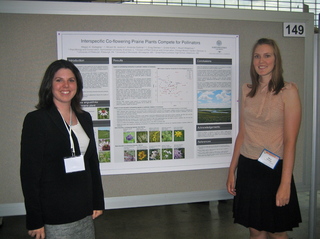
The poster is entitled: Interspecific Co-flowering Prairie Plants Compete for Pollinators.
Here’s the abstract we submitted:
Background/Question/Methods:
Pollen limitation is prevalent in many species, and can be especially worrisome in fragmented landscapes. Reproduction in the purple coneflower, Echinacea angustifolia (Asteraceae), which grows in small remnant patches of tallgrass prairie in North America, is pollen limited, but not pollinator limited.
Pollen limitation of Echinacea increases with isolation of individual plants, decreases with size of population, and has a strong negative impact on reproduction. However, pollinator visitation does not explain the reduced reproductive success. Wagenius and Lyon (2010), found that plants in the densest and largest populations of Echinacea receive fewer pollinator visits yet have greater reproductive success than plants in small isolated populations, which receive more visits but have decreased reproductive success. Among the many prairie plants pollinated by native solitary generalist bees, interspecific co-flowering plants may either enhance pollination by attracting more pollinators, or reduce reproductive success through competition or interference with compatible pollen receipt (Feldman 2008, Mitchell et al 2009).
Results/Conclusions
We investigated the community of co-flowering species surrounding a plant (floral neighborhood). We measured the effect of floral neighborhood on pollinator visitation, pollinator diversity, and pollination success of Echinacea. We randomly selected 8 focal plants at each of 10 remnant prairie sites in Douglas Co., Minnesota and observed and collected insect pollinators four times during summer 2009. We also identified and counted inflorescences of nearby co-flowering species.
We found strong evidence that floral neighborhood composition influences pollinator visitation of Echinacea. Forty species co-flowered with Echinacea, nine of which are invasive. Co-flowering species richness ranged from 14 in the largest remnant to five in the smallest. Alfalfa, Medicago sativa (Fabaceae), the most abundant exotic co-flowering species, occurred at seven of the sites, while leadplant, Amorpha canescens (Fabaceae), the most abundant native species (besides Echinacea), was only found at three remnants. The presence of alfalfa within a focal plant’s floral neighborhood increased the probability of a pollinator visit by 7% (according to a glm with binomial response p<0.03). In contrast, native leadplant decreased pollinator visits by 9% (p<0.02). There is no evidence that alfalfa, leadplant, and Echinacea interact in their effect on pollinator visits. We also collected pollen from Echinacea insect pollinators and flower parts to see if patterns in floral neighborhood composition and pollinator visitation are reflected in pollen loads on pollinators or stigmas.
Here’s a small copy of the actual poster:
Gallagher_ESA_Poster_Final_sm.pdf
The main conclusions were:
Neither the community of co-flowering species nor the presence of non-native plants was associated with variation in pollinator visitation.
Co-flowering species diversity was a predictor of pollinator visitation only late in the flowering season. Floral communities, as quantified by NMS analysis, were associated with the presence of non-natives all season long and overall diversity only in the early season. NMS characterizations of species co-flowering with Echinacea did not predict pollinator visitation at any time.
Echinacea neighborhoods with Amorpha, a native, had lower pollinator visitation, while the neighborhoods with Medicago, a non-native, had higher pollinator visitation.
We found no compelling evidence that interspecific co-flowering species influence pollinator visitation to Echinacea in small prairie remnants. The previously observed high pollinator visitation and concurrent pollen limitation might result from low quality of pollinator visits, an hypothesis we are now investigating.
Here’s a picture of Mimi and I in front of the poster at the conference:

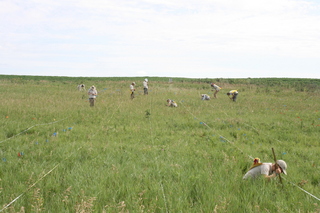
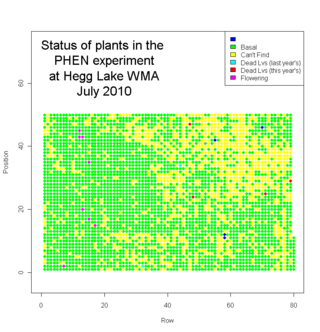
Now that I’m back in Kensington, it’s time to get back to my master’s project. The work is never done! This week I’m hoping to do seedling checks for my three plots. Hope I can count on lots of help getting it done!
-Kate