Staples mark positions in the Common Garden where plants have died. Our policy has been to add a staple to a position where a plant has not been found for 3 years. This year, we’ve followed that protocol for the Inbreeding and INB2 gardens. However, we have added staples in Big Batch, 2001, SPP, Monica’s, 1996, 1997, 1998, 1999, and 1999s where plants have only been “Can’t Find” for TWO years. This should minimize the time it takes to search positions. We hope that plants and staples won’t both be found at the same position in the future.
|
||||
|
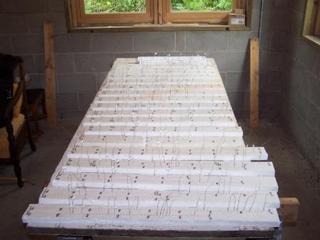
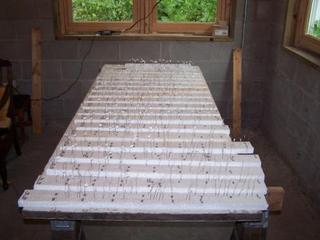
In response to Caroline’s request for more locations to plant Stipa in the common garden, I have selected 208 new locations at random. This map shows the new locations in green. (Blue dots are the previously selected locations.) Here’s a file listing all 208 location. It’s suitable for making 208 labels for 208 seeds! stipaSeedLabels2.csv I’m about half-way through scanning Stipa seeds and organizing them for planting, and may have underestimated how many we have! I thought we’d have approximately 6 seeds per maternal plant and, if we collected from 400 maternal plants in the field, that’s 2400 seeds. Stuart picked ~2600 positions to plant in. Plenty, right? Well, after assigning positions to seeds from 208 plants, I have 214 to go. That means I underestimated the number of plants we collected from. Also, we’re averaging more like 6.4 seeds per maternal plant. Another underestimation. I think we need another 200 positions to comfortably assign all seeds to their new homes the garden. What do you think? Here are files with presence/absence of species within the 2m floral neighborhoods I am slowly moving up from the basement to rejoin the world at ground level. Thanks to Caroline for the labels – three sets of slides of co-flowering plants of E. ang. are complete. The pictures are waiting to appear online. Meanwhile, succession of the Hjelm house basement table (door) occurs. As a flowering plant replaces another on the prairie, Stipa spartea seeds have replaced the slides. I attached a map of locations in the CG where we will plant Stipa seeds. Black dots are Echinacea locations, red circles are potential Stipa locations, and blue dots are locations we will plant this year. We will plant each Stipa seed relative to an Echinacea location, maybe 10 cm South or 20 cm North. Any thoughts? This week we are going to make big dents in CG measurements and our independent projects. We will measure the CG MWF morning and TTH afternoon. We’ll start T & Th morning with Phenology assessments and end off each morning with time to work on independent projects. Afternoons on MWF will be devoted to independent projects. Be ready 8:30 Monday morning–with sunscreen on & visors synced–for a pep talk (it’ll be about efficiency & the well-oiled machine)! day AM PM Monday measure CG ind. proj. Tuesday phenology & i.p. measure CG Wednesday measure CG ind. proj. Thursday phenology & i.p. measure CG Friday measure CG ind. proj. Saturday phenology & off off I was glad to participate in assessing floral phenology Wed morning and, with Amy, checking to resolve uncertainties remaining from this year’s monitoring of the first recruitment experiment (not to mention a very fun lunch with the team!). We sampled tissue from closely neighboring rosettes, where it isn’t clear whether they are the same or different plants, for eventual molecular analysis in Chicago by Jennifer and her team. Resolution of those plant identities should certainly help reduce the problem of counts of survivors *increasing* between censuses. But, in retrospect, I wondered whether the info we recorded was crystal-clear in terms of how this year’s counts should be adjusted, depending on the outcome of the IDing, particularly for the zones where many seedlings were recorded. When the remaining double-checking is done, it would be good to keep this in mind… Of the many, many other terrific things that I’m excited are being accomplished, I’ll just comment that I’m happy to see Megan’s post that she has sampled pollen and stored it in different conditions to check its long-term viability. Finding a way to keep pollen viable for a month to a year would pave the way for experiments I thought up while observing pollinators out at LF on July 7. I see that Megan noted the amount of pollen available for that sample wasn’t large, so it would be great if another set of samples could be taken, also so other plants are represented.
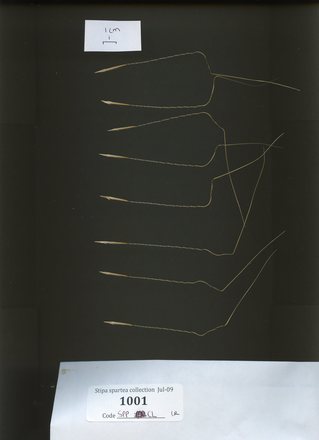
Apparently there is some question about what I have been doing lately. Daniel was partly right–data entry has been on my list. Remember checking the recruitment zones earlier this summer? And being rewarded with all those six packs? Well, there were some ambiguities in the data. I compiled a list 2009 zones to check.xls of all the things we need to check in the recruitment zones. Some of these (checking burn status) can be taken care of with a visit to the plot; other ambiguities may be cleared up by taking some tissue samples and sending them to Chicago for microsatellite analysis. Below is one of the scans of Stipa seeds collected from Douglas County. This particular set of seeds was collected from a plant at Staffenson Prairie Preserve. The seeds themselves are pointed towards the left side of the image, and extending from them are the long awns that give Stipa it’s common name (porcupine grass). At this stage, they look less like quills, though, because they have dried and started to coil (click on the picture to see it full resolution and you can actually observe the coils and lots of other neat features of the seed, like hair and a dagger tip!). Out in nature, the coiling action would allow the seeds to attach to a disperser or to drill themselves into the ground in preparation for overwintering and germinating the next spring. We’ll be scanning all of the seeds we collected (an estimated 3,000+ seeds from 431 plants), making digital measurements of seed length and width, and planting around 2,500 of them interspersed with Echinacea in the common garden.
|
||||
|
© 2026 The Echinacea Project - All Rights Reserved - Log in Powered by WordPress & Atahualpa |
||||