Thank you all for your hard work when we measured my Hegg Lake common garden a week back. It was by far the fastest the Hegg garden was ever measured and there were no rechecks besides can’t finds! Below is some information regarding the Hegg garden.
Total plants planted in May 2006: 3,945
Number alive in August 2006: 3,699 (94%)
Number alive in August 2007: 3,320 (84%)
Number alive in August 2008: 3,008 (76%)
Number alive in August 2009: 2,834 (72%)
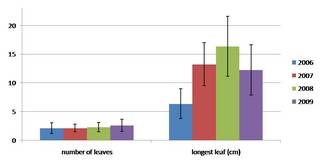
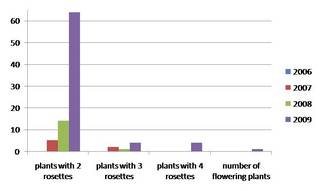
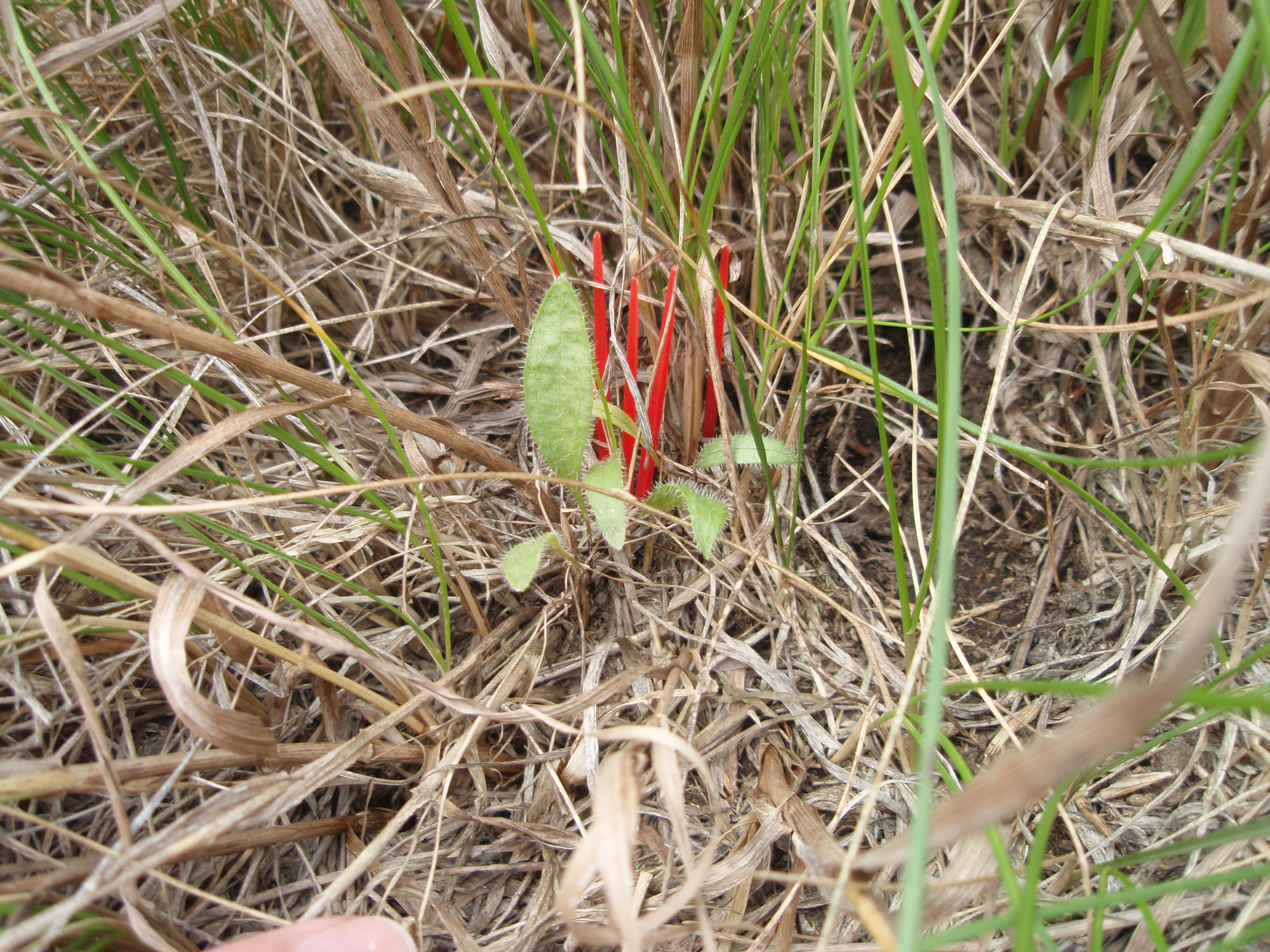
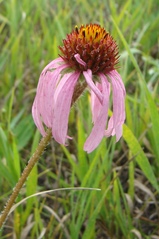
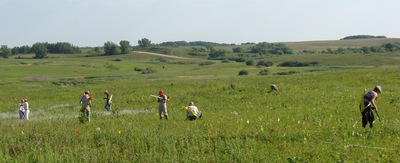
As you can see the length of the longest leaf actually decreases from 2008 to 2009. However, there were way more plants with multiple rosettes this year than in years past. I think the leaf length decreased because last year there was so much duff on the ground that the petioles of the leaves grew really long. The plants definitely looked healthy this year after the spring burn than they did last year. What was really exciting was I had my first flowering plant this year in row 7 position 44! Below is a picture of that flowering plant, and one of everyone measuring at Hegg.
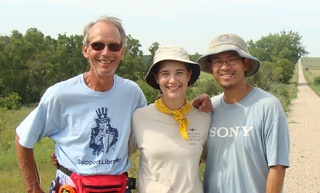
Also, thank you to everyone in the town hall for being so hospitable to my dad, Oscar, and me. We had a great week and except my weird heat rash (it eventually went away) it was a lot of fun. Best of luck with the final push at the end of the season!
Regards,
Jennifer, Oscar, and John
|
||||
|
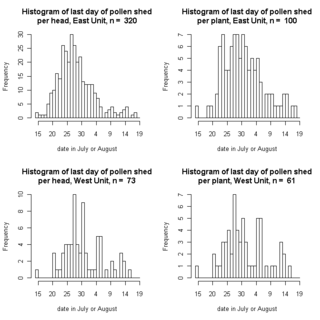
Echinacea plants on our transect at Staffanson Preserve are done shedding pollen for the year. A few still have persistent, receptive styles, but August 18th was the last day pollen was shed. This graph show how many heads (left panels) or plants (right panels) finished on each day. The earliest heads finished on 15 July. I divided the preserve according to the burn unit: burned East (top panels) and unburned West (bottom panels):
Final date of flowering for 393 heads on 161 Echinacea plants
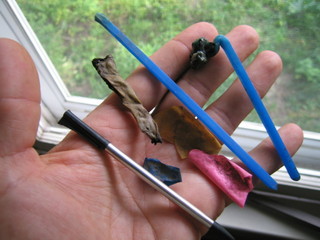
from a burned and unburned unit of a prairie preserve This graph is based on preliminary, raw data, but I wanted to share. Click on the thumbnail to see a larger version of the graph. Just a quick note to say that Stipa planting was completed by lunch on Wednesday. We were able to plant the vast majority of seeds where they were randomly assigned in the CG, 10 cm north of existing Echinacea positions on the whole meter throughout the garden. I think only two seeds were not planted at all; one was lost off the board and one was missing its awn and ID sticker. About a dozen seeds had to be assigned new locations, either because there was a hole or a rock in the way or because the plant/staple/can’t find flag that we were measuring from could not be located. Not bad! To assign new random positions, I simply grabbed an ID sticker from the sheet of leftover, unused positions, removed the old sticker, stuck the new and marched around the garden planting the last of my legacy to the Echinacea project. The final task will be to replace the can’t find flags that are associated with a Stipa seed with short pins. Hopefully, this will up the chances of finding seedlings next summer. To this end, we also put a toothpick 1 cm north of every seed. Best of luck to the crew put to this test! Here is a draft version of a protocol for seedling re-finds in the prairie remnants. Please read and critique. Protocol for seedling refinds 2009.docx Today I found some healthy-looking Echinacea seedlings at my experimental plot in Perch Lake WPA near Leola, SD. Here’s another picture: I found a few things besides Echinacea plants, while searching for plants that may have died in the common garden. I found a fossil shell. I gave it to Per and he held on to it for a while but dropped it. Someone else will find it! I found a stylus (for a handspring visor). It’s probably Gretel’s; she lost hers earlier this year. I found a snake skin with an intact top of head–the eyes were transparent-cool! Per gave to Hattie, I think. I found a mouse in a mouse nest (right on top of dead Echinacea leaves from last year). The mouse bounded away. Also, Ruth called while I was searching to say that she had just found the serial cord for the survey station data collector that we couldn’t find–we had been looking for that for a few days. Wahoo! Finally, I emptied my pockets of litter that I had picked up: three pieces of flagging, one melted plastic plug label, and 2 blue plastic cocktail stirrers.
Stuff from Stuart’s pocket: stylus (1), flagging bits (3),
melted plastic plug label (1), blue plastic cocktail stirrers (2) We are making great progress on annual measurements of plant in the common garden. On Monday we finished measuring all plants (~10000). On Tuesday we finished placing staples at all locations where plants died overwinter in 2007-2008 (>700). Today we made a huge dent in “rechecks.” Rechecking is when we revisit all the locations where we recorded a “can’t find” and left a flag while measuring. We placed about 1500 flags. About 700 of those “can’t finds” were stapled this year. So, we just verified that staples were in the correct locations and pulled flags. Some locations had staples from previous years that a measurer didn’t find. We pulled flags there too. Then there were the plants that were alive last year. We rechecked those and found quite a few plants. Each time someone found one, they yelled “wahoo” and the rest of us responded with a whoop and a holler. Shucks, it was fun!! Actually I was burned out by the end. Next year we should plan two 2h sessions instead of one 4h session. A list of equipment we need for demo was posted here: https://echinaceaproject.org/wp-content/uploads/2008/08/demography.html Yesterday we finished measuring in the Common Garden! Here are some details about the protocol used for 2009: Gardens: Inbreeding & INB2 we used the same form as in 2008. Basal and Flowering Rosettes were counted separately. Crisp leaves were included in the leaf counts. Gardens: 2001, Monica’s, SPP, Big Batch, and 96-99 we used an abbreviated form. We did not record data on insect damage. Insects on all rosettes (basal and flowering) were recorded on the main form. Insects on the heads were recorded on the subform. Cauline leaves were not counted. The longest cauline leaf (longest leaf on the tallest flowering rosette) was recorded on the main form. For basal leaves, crisp leaves were included in leaf counts and also noted, as were leaves that were “gone.” Pips or duds with no florets were only recorded if there was a peduncle long enough for a twist-tie collar. |
||||
|
© 2026 The Echinacea Project - All Rights Reserved - Log in Powered by WordPress & Atahualpa |
||||