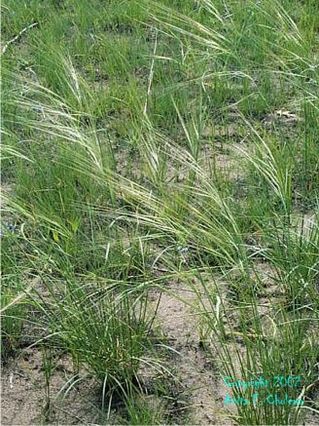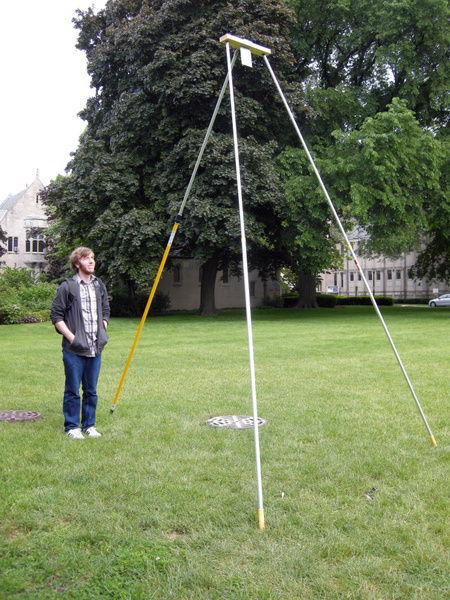
We are going to plant Stipa spartea seeds into the common garden. Here is a
file with target locations for ~2600 seeds. The seeds will be planting in ~269 batches. Here’s a list of the batches: allStipaStarts.csv Sometime before we plant, Caroline will share a photo of one of those Stipa seeds.
|
||||
|
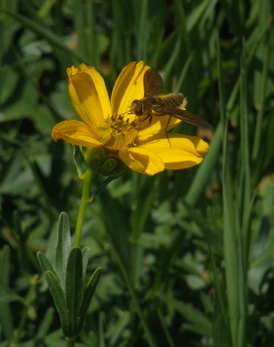
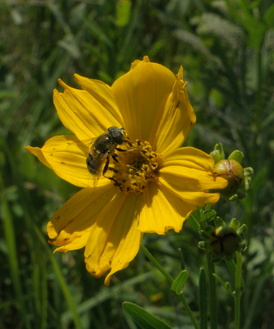
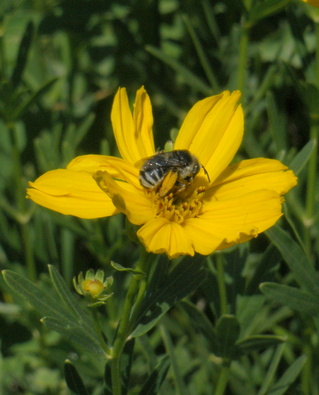
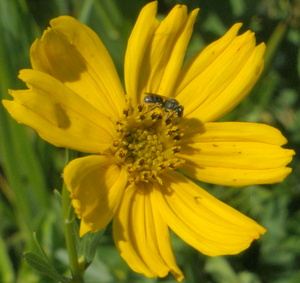
Here’s some of the work I’ve done with organizing my data. I still need to figure out how to organize it to be able to analyze it, so this is mostly just preliminary work. I have about 2 weeks to put this all together….any help/advice is appreciated because right now, the data I have is a little overwhelming. There are 3 sheets in this document. For next week, it looks like the weather should hold up for Tues and Thurs to be able to do pollinator observations. So we will need to flag the sites on Monday and have everything ready to go for Tuesday. Remember, you ALWAYS record something for each observation you make, regardless of whether or not you observed/caught a pollinator. Select No for poll. observed and No for pollinator caught if this is the case. Some things I wanted to clear up for people helping with FNC: Here’s some of the pollinators I saw on Coreopsis near Hegg Lake. They seemed to only be pollinating Coreopsis although there were other species like Achillea, Amorpha, and Echinacea around. The common garden hit peak flowering status on July 13, 2009. The graph below shows how many heads have started and ended flowering each day. Approx. 197 heads have yet to shed pollen of the 1,614 found.
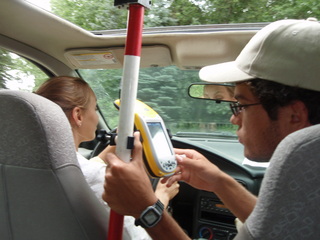
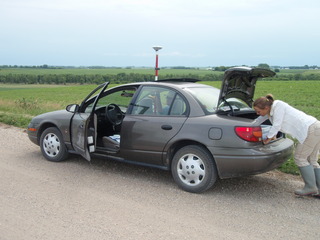
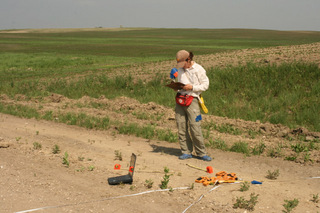
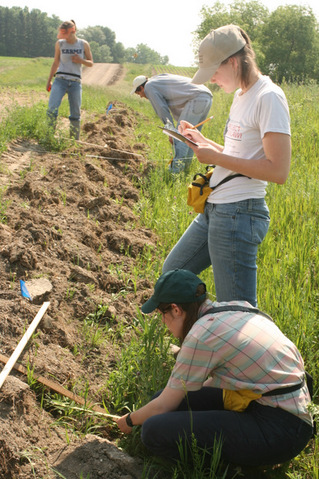
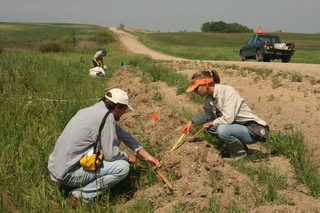
Please review this protocol for measuring plants in the common garden. Ech jenkins FNC protocol revised.doc I have a photo guide but I can’t upload it b/c the file is too large. If you plan on helping with FNC, please read the documents above. It’s important that everyone counts inflorescences the same way. Thanks! Also, for tomorrow, there are a couple of notes I thought I’d add: So, for those of you who were wondering what Team Echinacea will be doing tomorrow, here is the field protocol for the transect searches that we will be using. Any questions, please let us know! Also, we were searching for Stipa today (a prairie grass that Dr. Ridley is planning to add to the common garden), and this is the setup we used to mark the sites with the GPS:
The antenna allowed us to get about a 9 cm margin of error when using the Trimble. And yes, that is yours truly manning the antenna, ensuring that the carrier lock is not lost. We were all ready to tell the next person who asked us what it was that we were searching for nuclear waste.
For some time, the powers that be on the Echinacea project have thought, “Wouldn’t it be nice to compare all we’ve learned from coneflower with another important native component of the prairie?” Well, this summer, study of habitat fragmentation and its ecological and evolutionary impacts broadens to include an additional species. And the winner is … Stipa spartea aka porcupine grass! The time is right now to collect the seed, which will be sown into the common garden later this summer.
Here’s a link to a page from the Bell Museum of Natural History about Stipa spartea. Below, you will find the sampling protocol that Greg and I used to collect seeds from Staffenson Prairie this afternoon. Stuart may have thoughts to add and the strategy might change a bit as we run into the reality of different Stipa remnant populations. In addition to remnants, we will also be collecting seeds from roadside transects. Expect that challenge to be met later next week. We finished searching for seedlings at the last site (Staffanson Prairie Preserve) on Monday. All the datasheets & maps (163 pages) are now organized in a 3-ring binder. Here are a few highlights: We found total of … In August we’ll go back and check the fate of every one of those seedlings. I hope we can find them all! Mimi, Amanda, Greg, Allegra, Daniel, Caroline, and Gretel
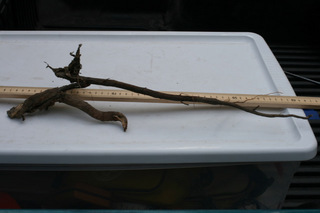
looking for seedlings on the scraped roadside at Riley’s site. (They didn’t find any here.) Two possible Echinacea seedlings (not counted above) were noted. We should go back to check their identity within the next week. At site NWLF we left a pin flag at focal plant #13073. At site ERI the possible Echinacea seedling was at R102 (see page 97). Help me remember to check these! We found about 500 other Echinacea plants within the circles, mostly juvenile plants and some adults (flowering and not). The roadsides at sites ER and ERI were scraped. In the area that was scraped, all the tags are gone. We did see many little Echinacea leaves peeking through the gravel, but no seedlings. In some areas the scraping was deeper and some roots of old plants were pulled out. I collected one pulled root from the S side of the road on the W half of RI; I couldn’t tell from where it was yanked. The root was huge!
With our very precise maps of plants from previous years, we will be able to identify which plants are gone and which persist. It will be a challenge though. In some dense areas we may not be able to figure it out. Stay tuned, we’ll bring the detailed maps and try to figure it all out in August, after peak flowering.
Gretel determining the identity of individual Echinacea plants
at the scraped roadside at Riley’s. The scraped gravel was piled in the ditches. Some plants in the ditches were buried and I expect that many of them will die. There will probably be a lot of weeds in and around those piles for the next few years (until the perennials take over again). Two images (above & below) of the piles of gravel deposited
in the ditch on the S side of the road at Riley’s.
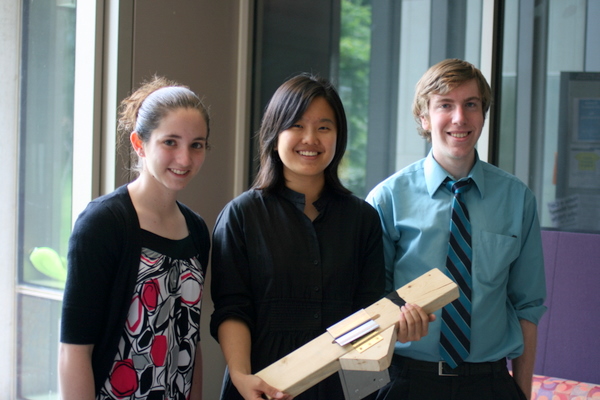
Another highlight (no photos though): It was a pleasure to visit Staffanson. Gretel and I mapped the focal locations on Sunday and saw a patch of Cypripedium calceolus in flower (past prime). Almost every focal plant in the West unit (unburned) had spittlebug spittle on it. Almost none of the focal plants in the East unit (burned) had spit. We didn’t use the tripod to take photos. The camera didn’t attach well and the remotetrip feature isn’t ready yet. We’ll need to work on the tripod and practice using it. I think it holds great potential to speed up and improve our protocol. Three engineering students from Northwestern’s Engineering Design and Communication class built a specialized camera stand for the Echinacea project. Michelle Pineda, Christopher Moran, and HengJie Tan designed and built a giant tripod which we will use to improve our protocol for relocating Echinacea seedlings. I told them about the paper maps we made by hand and how last summer Ben & Christine worked out a method to flag seedlings and make maps from digital images. To avoid issues with parallax they determined that photos had to be taken from fairly high up (at least 2.9 m from the ground). Then the main problem was taking photos straight down from such a height. The hang-a-camera-from-a-pole method wasn’t stable enough (or safe). Michelle, Chris & Heng designed several scaled-down prototypes for their class project. Christine and I looked them over and then, based on our feedback and class feedback, they built this stand…
They presented the stand to their class and me on Saturday, along with a detailed report. I can’t wait to try it out! We will try it out this summer. We hope to avoid making paper maps altogether. We’ll see if it works! |
||||
|
© 2026 The Echinacea Project - All Rights Reserved - Log in Powered by WordPress & Atahualpa |
||||