|
|
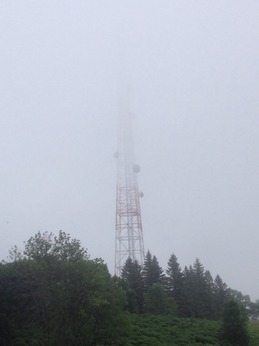
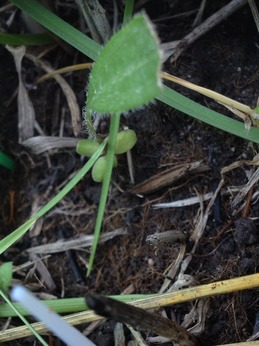
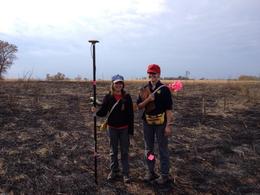
Tuesday’s morning started out similar to the past few mornings. The team worked on finding Echinacea seedlings and measuring them in the Quantitative Genetics plot 2 (a.k.a. Q2). We were a little worried that we would be rained out, but the gloomy, foggy weather quickly passed and the sun emerged to make for a beautiful day. The team split into pairs and measured multiple segments of seedlings. During this time, two members of the team, Jared Beck and Will Reed, discovered a rare Echinacea seedling with 3 cotyledons, also known as a tricot.
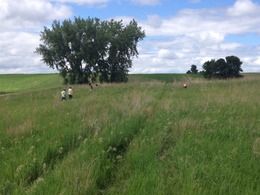
For the afternoon portion of Tuesday’s workday, we were introduced to Common Garden 1 (a.k.a. Experimental Plot 1), a site that has lead to numerous important findings concerning the biology of Echinacea. Some of these plants were planted as early as 1996! (fun fact: some of these plants may be as old as our youngest team member, Will Reed) The majority of the team spent the afternoon flagging a plethora of Echinacea plants, or points where Echinacea had once thrived but now cease to exist (may those plants now rest in peace). While we worked on flagging, Stuart was hard at work mowing in between the transects, creating an easily visible and safe walkway. Personally, I had the pleasure of working with Stuart and Gretel’s son Per. There was never a dull moment as we discussed funny pranks, the joys of having uncommon names, and the mystery/absurdity that is art. During this time, Per managed to concoct a ninja/airplane/bird out of old, flag-less pins (we couldn’t decide which one it was). All in all, it was a very productive, pleasant day in the field for Team Echinacea.
A picture of the electric tower near Q2 which illustrates the gloomy start to our day.

Here you can see the tricot discovered by Will and Jared.
The team hard at work in Experimental Plot 1

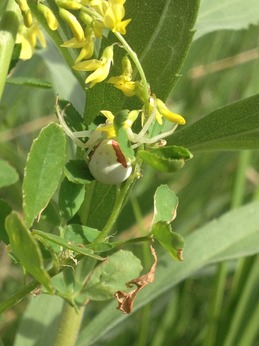
Finally, an interesting spider that Per and I found later identified as a Goldenrod Crab Spider
I graduated this May from Colorado College with a B.A. in biology focused on Organisms, Evolution & Ecology and with a minor in Environmental Issues. In Colorado I learned about forest ecology, forest-fire ecology and short grass prairie ecology. I have also studied ecosystems abroad including the Mongolian Steppe and Altai Mountain range, the Ecuadorian mountain range, coastal range and tropical rain forest. Most recently I studied the Patagonian steppe in Argentina. I love traveling and learning about new ecosystems and cultures. I’m originally from the northern suburbs of Chicago where I grew to love prairies and Lake Michigan.
This summer I hope to study intrafloral seed set variation by observing stigma persistence and pollinator visitation frequency. I’m happy to be back working in the tall grass prairie!
You can learn more about my research interests by looking at my profile on the Echinacea Project website profile. https://echinaceaproject.org/people/2014-team-members/elizabeth-mays/

In a Lenga forest near Bariloche, Argentina
Hello all,
My name is Jared Beck and I am joining Team Echinacea for 2014. I graduated from Carleton College in March 2014 with degree in Biology. While at Carleton, I worked extensively in tallgrass prairies studying herbivore effects on plant communities and edge effects in grassland bird communities.
Although my roots lie in plant community ecology (please excuse the pun), I am broadly interested in how anthropogenic changes influence the ecological and evolutionary dynamics of natural communities. This summer, I would like to explore how fire influences the spatial and temporal flowering dynamics of Echinacea angustifolia populations in remnant prairies.
I am excited to join the Echinacea Project and I am eager to continue learning about the prairie and its inhabitants!
Today is my last day working for Stuart at the Chicago Botanic Garden and I can’t stress enough how wonderful an experience this year has been! I’m not quite sure where my next adventures will take me, but I’m very grateful to have worked here and I know I’ll take all the skills I’ve learned onto whatever comes my way in the future. Good luck to team Echinacea 2014!
Alex Yeaney, our intern from Lake Forest College this spring, finished up his report on the effects of a specialist aphid on Echinacea. Check out his report to find out his results!
AphidReport.pdf
Our host, UThink, is retiring at the end of December 2014. This June will be the last month we post flogs here. We’ll let you know where we are moving when we find a new host!
You can always learn what we are up to on our website and on twitter.
Spring has caught up with us quickly and now it’s almost summer. We’re getting prepared for a new field season and finishing up some of our lab projects.
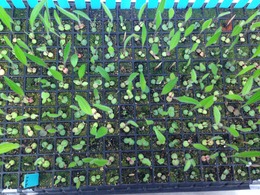
Our sprouts are in the ground! It’s been quite the germination process. We had an overall germination rate of 97% for all sprouts with a E. pallida mother and an overall germination rate of 87% for sprouts with an E. angustifolia mother. That’s a lot higher than we expected! Consequently, our plug trays were very full.
Germination also spanned more than a month, with our first radicals emerging on April 7th and our last emerging on May 8th. We measured all sprouts when they were 21 days old and decided to take leaf tissue samples when they were 28 days old. The tallest sprout was a whopping 7.4 cm. We took leaf samples primarily to be able to analyze the sprouts’ DNA and perform paternity tests since we also have tissue from their parents. This will be a project for a future date.
Alex, our Lake Forest College intern, has finished up his analysis on the heads in the aphid addition/exclusion experiment and is working on a report that we will post in the coming weeks.
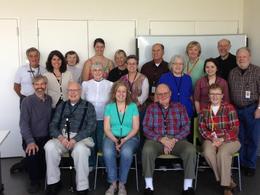
We had our annual Volunteer Appreciation Potluck last week. Gia came and presented some of her ant data and Gretel and I talked about some of our recent research. We’re so lucky for all the help we receive from our volunteers, we really couldn’t do our research without them. Although there are many steps in Echinacea workflow process (cleaning, scanning, counting, randomizing, and weighing/x-raying) we decided to recognize one of our volunteers, Lois, as the “Achene Queen.” Since we’ve transferred all our counting to an online database, Lois has counted over 350,000 achenes!
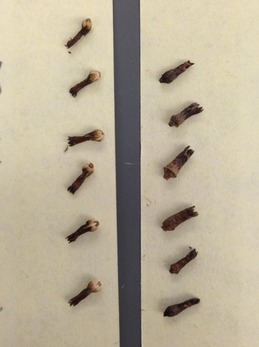
While it may seem obvious, here at the Echinacea Project we look at a lot of Echinacea. With such large numbers–thousands of plants each summer and heads each winter– we’re used to a certain degree of variation. Bracts differ in length and degree of “pokey-ness”, trichome density varies among leaves, and achenes range in size and color (see the post “A Palette of Pallida” from March 21st for an example).
This morning one of our volunteers, Suzie, noticed that the florets on the head she was cleaning had a distinctly different shape and color. The florets come from CG-6152 wht, or plant 27, 915 in the quantitative genetics (qGen) section of the common garden. Below is is a side by side view of these unusual florets (on the left) compared with what we typically see.

This is the first time we’ve seen this sort of variation in floret shape and color in the lab. Right now we can’t say for certain what caused it, whether it’s natural variation or a response to insect herbivory, for example. It’ll be interesting to visit this plant next year, however, and see if this variation persists and is conspicuous when the plant is flowering.
It’s finally beginning to feel like spring here at the Chicago Botanic Garden and with the change in seasons, we’ve got some new projects in the lab.
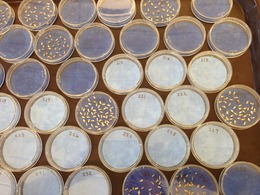
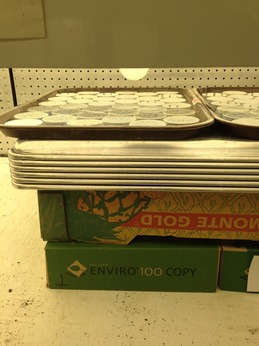
All those E. pallida and E. angustifolia seeds I was weighing a couple weeks ago have been germinated and I’m in the process of transferring the sprouts to plug trays. The achenes first went through a two week cold-stratification, pre-germination treatment. I kept the achenes in petri dishes, evenly spread on blotter paper and put them in the refrigerator (4 degrees C), making sure to keep them well moistened throughout this time period.
After two weeks I transferred the achenes to the growth chamber where it was significantly warmer (25 degrees C) and put them close to the light.
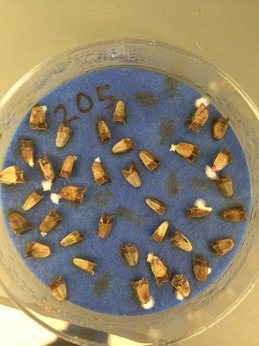
Sprouts are ready once their radicle emerges 1 mm. Nearly 20% of the seeds germinated within 24 hours of being transferred to the growth chamber, and even more germinated the following day.
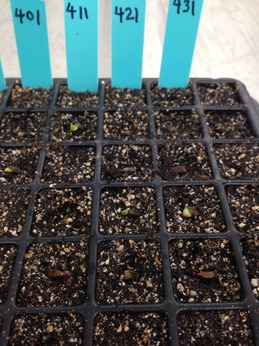
We place sprouts in plug trays were they’ll grow up for the next 5-7 weeks before being transplanted in the ground. And man oh man do they grow up fast! Can you spot the sprouts in this section of the plug tay?
|
|