|
|
Trevor here and reporting that me and Nina are very “hatisfied” with our progress from the day. As we sat alongside each other, working on our various tasks, we invented a new word in the english dictionary: “hatisfied.” It translates to, roughly, being satisfied with being at or around halfway done. I am around halfway done cleaning my solidago samples and will most likely finish tomorrow. After that, I will move on to arranging my baggies on x-ray sheets and then x-raying them to discern if there is an actual embryo in the achene. How exciting!
 On the other hand, Nina moved on to randomizing today to prepare her samples for x-raying, which she admits was a more tedious task than she had initially anticipated. But she is very enamored with her randomization wheel that she has so much that it makes up for the meticulous task it is (see exhibit A to the left). She finished about half of her bags and reports feeling “hatisfied” with her progress. She hopes to be done by tomorrow so she can prepare het sheets for x-raying for Wednesday. She also reports that she is looking forward to counting because it is a beautiful, non thought-provoking task. On the other hand, Nina moved on to randomizing today to prepare her samples for x-raying, which she admits was a more tedious task than she had initially anticipated. But she is very enamored with her randomization wheel that she has so much that it makes up for the meticulous task it is (see exhibit A to the left). She finished about half of her bags and reports feeling “hatisfied” with her progress. She hopes to be done by tomorrow so she can prepare het sheets for x-raying for Wednesday. She also reports that she is looking forward to counting because it is a beautiful, non thought-provoking task.
It seems as if we are nearing the end of phase one for both of our projects and both Nina and I are so excited to see what comes next! See you soon—and remember to stay “hatisfied!”
 Alex and Tracie search for juvenile Echinacea plants in experiments qGen2 & qGen3. In 2017, we found 1006 three-year-old plants out of the 2526 original seedlings found in 2014 (we found 1724 plants in 2016) in the qGen2 cohort. In the qGen3 cohort we found 248 of the 644 seedlings.
The main goal of the qGen2 and qGen3 experiments is to quantify the evolutionary potential of two remnant prairie populations of Echinacea angustifolia by estimating the additive genetic variance of fitness. We make estimates for two mating scenarios. The first scenario is an experimental crossing design with all matings among plants from two “core” sites: SPP and LF (core x core). The second design uses sires (pollen donors) from the core and dams from sites peripheral to the core. The crosses performed (core x core, core x periphery) in this experiment will quantify additive genetic variance for fitness in each site and each experimental group. Additionally, we will test for differentiation among families; do progeny from sires differ after accounting for maternal (dam) effects?
Comparing germination and first year survival between the qGen2 & qGen3 cohorts:
| exp |
approxFullAcheneCt |
totalAcheneCt |
seedlingCt |
germination |
firstYrSurvival |
| qGen2 |
6300 |
26144 |
2581 |
41% |
84% |
| qGen3 |
6200 |
19777 |
644 |
10% |
38% |
Start year qGen3: 2015
Start year qGen2: 2013
Location: The sires (pollen donors) are in the remnants Landfill and Staffanson. The dams (seed plants) are in exPt 1 and they originate from remnants. Specifically, the grand-dams (seed plants of dams) are from remnants Landfill (core) & around Landfill (peripheral) and remnants Staffanson (core) & railroad crossing sites (peripheral). All progeny are in exPt 8.
Overlaps with: Heritability of fitness–qGen1
Data collected: We used handheld computers to collect data on juvenile plants.
You can find more information about Heritability of fitness–qGen2 & qGen3 and links to previous flog posts regarding this experiment at the background page for the experiment.
Nina here! Today, Trevor continued cleaning his Solidago heads, which have very small and delicate achenes. However, because his achenes are so small and fluffy, they tend to fly everywhere, including onto the bread that Trevor was eating! He cleaned 28 heads today, which was very impressive. Meanwhile, I finished re-checking my Echinacea heads for any stray achenes that were stubbornly clinging to the heads and proceeded to scanning the achenes for counting. While I was re-checking, I found quite a few miscellaneous bees and spiders, some of which are pictured below. Also, a picture of one of my scans below – for this site, the achenes needed to be separated according the the location that they came from on the head, so ‘top,’ ‘mid,’ ‘bot,’ and ‘other’ achenes were segregated. Next week, I hope to start randomizing my samples for X-raying and counting the scans that I took. Trevor hopes to finish counting and move on to X-raying next week as well.
We also had a lab meeting today to discuss a draft of a paper on Echinacea pollination, specifically analyzing the number of pollinators over the course of the season as well as type of pollinator and quality of pollination. The paper had some interesting (and confusing!) results, so it was nice to discuss the draft with others from the lab and look at the feedback that the draft received from reviewers.
 
 Team Echinacea measuring plants in big batch In 2017 we assessed survival and fitness measures of the qGen1 plants. 1,991 plants in qGen1 were alive in 2017. Of those, 3% flowered in 2017 and 46% have yet to flower ever. All were planted in 2003.
The qGen1 (quantitative genetics) experiment is designed to quantify the heritability of traits in Echinacea angustifolia. We are especially interested in Darwinian fitness. Could fitness be heritable? During the summer of 2002 we crossed plants from the 1996 & 1997 cohorts of exPt1. We harvested heads, dissected achenes, and germinated seeds over the winter. In the Spring of 2003 we planted the resulting 4468 seedlings (this great number gave rise to this experiment’s nickname “big batch”).
Start year: 2003
Location: Experimental plot 1
Overlaps with: qGen2 & qGen3
Physical specimens: We harvested 46 heads from qGen1 in 2017. These heads will be processed in the lab to determine achene counts and seed set.
Data collected: We collected fitness measures using handheld computers.
Products: We have an awesome dataset that we will share once the paper is published. Ruth Shaw is working on an analysis of the qGen1 dataset.
You can find more information about Heritability of fitness–qGen1 and links to previous flog posts regarding this experiment at the background page for the experiment.
Trevor here, reporting on a day of momentous occasions; Nina and I completed step one in each of our projects! After being told, for the third time, that we look related to each other (hence the title), we decided that we had to get focused and finish cleaning—and so we did. I completed cleaning the 89 buds for the liatris species whilst Nina finished completed her 78 buds for the echinacea species; we were very excited! After taking a quick lunch break, we got back on the grind to begin phase two. Nina, being the diligent worker she is, began rechecking her echinacea buds for missed achenes. As for myself, I progressed onto the second species in my study: solidago.

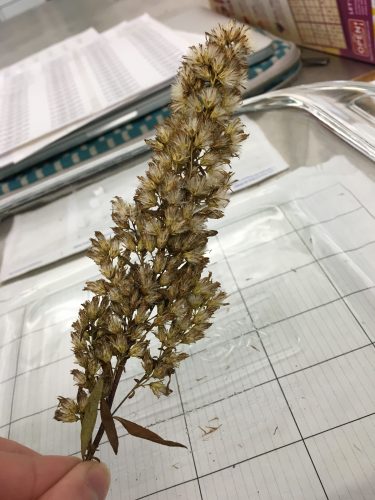
Here is an image of one of the buds from the solidago species I’m working on; isn’t it beautiful?! While liatris and solidago are generally similar in biological makeup, they do possess some noticeable differences. First of all, the achenes in solidago are quite tiny (think half the size of a mosquito), which makes them extremely difficult to separate efficiently for future x-raying. Additionally, they have so many achenes that it makes it impossible to effectively pull out all the achenes from the bud. Instead, I get to do a fun shaking method where I shake off achenes into the tray. Just shaking my way to success; I guess.
 Nina began meticulously rechecking her achenes. As you can see above, she was very focused. She actually invented a fun game where she would tally how many buds were missed by various people that assisted her in cleaning. As is stands now, Lea is in lead with 2 missed, Tracie second with 3 missed, and Nina (who did 60 of them mind you) is third with 4 missed. Max. On some, she even missed none! Marisol is in fourth with 5 missed, but who knows? She’s still counting! Updates to follow. Nina began meticulously rechecking her achenes. As you can see above, she was very focused. She actually invented a fun game where she would tally how many buds were missed by various people that assisted her in cleaning. As is stands now, Lea is in lead with 2 missed, Tracie second with 3 missed, and Nina (who did 60 of them mind you) is third with 4 missed. Max. On some, she even missed none! Marisol is in fourth with 5 missed, but who knows? She’s still counting! Updates to follow.
Until Next Time,
Trevor
Hey, this is Nina! Today at the Chicago Botanic Garden, Trevor and I continued cleaning Echinacea, Liatris, and Solidago heads. We learned a new technique to clean seed heads today, which involves sorting the achenes based on the location on the head. For my Echinacea heads, I separated 30 achenes from the top of each head and 30 from the bottom of each head (not including any ray achenes present at the bottom of the head). Here’s a timelapse of me cleaning one of the heads. I got some help today when Marisol, a lovely intern from Lake Forest College, helped me clean some of my Echinacea heads. Trevor separated achenes based on location on and counted the number present on each head. From preliminary data, Trevor thinks there is a lot of variation from plant to plant, but no trend between numbers of achenes based on location on the stem. Tomorrow, I hope to finish cleaning my seed heads and move on to scanning!
This summer we found 52 basal Stipa plants and 209 flowering plants! The flowering Stipa plants had a median of 15 fruit per plant. Our largest flowering Stipa plant had 301 fruits and 31 culms. We harvested around 5000 fruits from experimental plot 1! These Stipa plants, or porcupine grass (Hesperostipa spartea) were planted as seeds in 2009 and 2010.
 A Stipa collage created by Anna with collected fruits, a flowering plant, and Will and Wes searching for stipa. Start year: 2009
Location: Experimental plot 1
Physical specimens: Fruits from the 209 flowering plants were broadcasted in experimental plot 2.
Data collected: There are currently 3 datasets in the Stipa folder in CGData (~Dropbox/CGData/Stipa/225_measure/measure2017/)
- 20170628StipaSearchData.csv: 50 records from 28 June 2017. We searched for basal and flowering Stipa and recorded row and position, culm count, fruit count, aborted fruit count, missing fruit count, and notes.
- exPt1StipaSearch20170705.csv: 200 records from 28-29 June 2017. This csv includes rows with position 859 and status “Other (Note)”, indicating the row was searched but no stipa was found. When Stipa was found, status, row, position, culm count, fruit count, aborted fruit count, missing fruit count, and notes were recorded.
- 20171109StipaSearchData.csv: 69 records from 2 August 2017 and 9 August 2017. In this csv, predetermined rows and positions (where Stipa were found in previous years) were searched and the same information was collected as the other csvs. Since this was later in the season, all fruits had already dropped–but they could still be counted.
Products:
- Josh Drizin’s MS thesis included a section on the hygroscopicity (reaction to humidity) of Stipa awns. View his presentation or watch his short video.
- Joseph Campagna and Jamie Sauer (Lake Forest College) did a report on variation in Stipa’s physical traits within and among families in 2009
You can find out more about Stipa in the common garden and links to previous flog posts about this project on the background page for this experiment.
Hello, my name is Nina Denne and I am currently a freshman at Carleton College. I will be working as an extern at the Chicago Botanic Garden for the next 3 weeks, specifically looking at the relationship between reproductive fitness of Echinacea and the diversity of the surrounding habitat. For now, I’m mostly cleaning Echinacea heads and then I will be counting the achenes and X-raying achenes to determine whether they are viable. I’m very excited to be back at the Botanic Garden after having conducted a germination experiment with two species of Echinacea in high school.
Trevor here! Today, me and Nina began our journey to clean the achenes of our respective species. I worked on my Liatris and Solidago species whilst Nina continued work on the echinacea species. A task of mental endurance, we did take a lunch break and another break to take bio photos on the green deck, which you can find on our introduction posts.

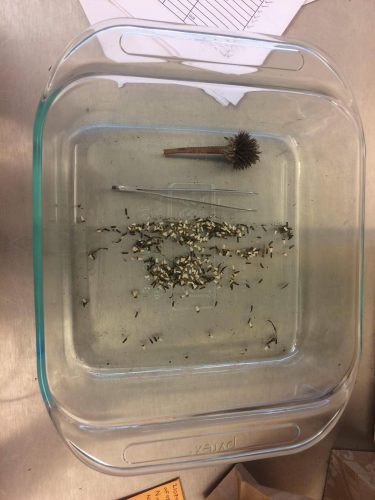
This is a picture displaying the echinacea bud (upper) and the respective achenes that Nina cleaned from the bud (lower). Nina admits that some of the buds were quite “stubborn” and she has to individually pluck each achene, which is not preferable. Nina prefers when the buds “behave themselves.”
 My buds are much less stubborn and the achenes easily fall off. In fact, my buds actually look quite different from the echinacea achenes, resembling a miniature version of the capitulum often emitted from dandelions, making them quite fun to work with! Pictured to the right, these are the achenes I separated into baggies for future x-raying (notice the formation!) My buds are much less stubborn and the achenes easily fall off. In fact, my buds actually look quite different from the echinacea achenes, resembling a miniature version of the capitulum often emitted from dandelions, making them quite fun to work with! Pictured to the right, these are the achenes I separated into baggies for future x-raying (notice the formation!)
Either way, Nina and I are extremely excited to begin our projects and continue cleaning first thing tomorrow! More updates to follow!
– Trevor
 Hello! My name is Trevor Hughes and I am a freshman at Carleton College in Northfield, MN. I am super fortunate to be joining Project Echinacea for an internship over my winter break; I’m super excited about it! Prior to my time at Carleton, I spent most of my time in high school working on the Conservation Ambassadors Board at Lincoln Park Zoo, planning events related to conservation. Fun fact: one of my events concerned urban prairie plant species (including echinacea!); how cool is that?! And through my time there, I grew to develop a passion for conservation, which will continue to grow in fortitude during my time at the Chicago Botanical Garden. Over the course of my internship, I will be working on cleaning, scanning, and counting achenes from the Liatris and Solidago species, hoping to discover findings comparable to echinacea, proving that conclusions made with regards to echinacea can be generalized to other prairie plant species in the future. Hello! My name is Trevor Hughes and I am a freshman at Carleton College in Northfield, MN. I am super fortunate to be joining Project Echinacea for an internship over my winter break; I’m super excited about it! Prior to my time at Carleton, I spent most of my time in high school working on the Conservation Ambassadors Board at Lincoln Park Zoo, planning events related to conservation. Fun fact: one of my events concerned urban prairie plant species (including echinacea!); how cool is that?! And through my time there, I grew to develop a passion for conservation, which will continue to grow in fortitude during my time at the Chicago Botanical Garden. Over the course of my internship, I will be working on cleaning, scanning, and counting achenes from the Liatris and Solidago species, hoping to discover findings comparable to echinacea, proving that conclusions made with regards to echinacea can be generalized to other prairie plant species in the future.
|
|

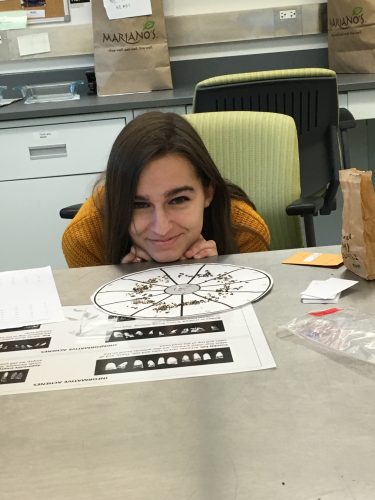 On the other hand, Nina moved on to randomizing today to prepare her samples for x-raying, which she admits was a more tedious task than she had initially anticipated. But she is very enamored with her randomization wheel that she has so much that it makes up for the meticulous task it is (see exhibit A to the left). She finished about half of her bags and reports feeling “hatisfied” with her progress. She hopes to be done by tomorrow so she can prepare het sheets for x-raying for Wednesday. She also reports that she is looking forward to counting because it is a beautiful, non thought-provoking task.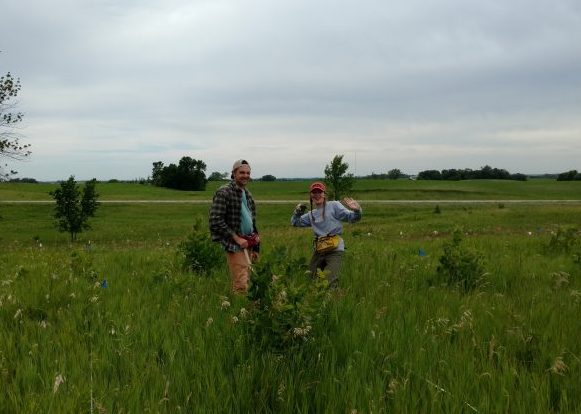


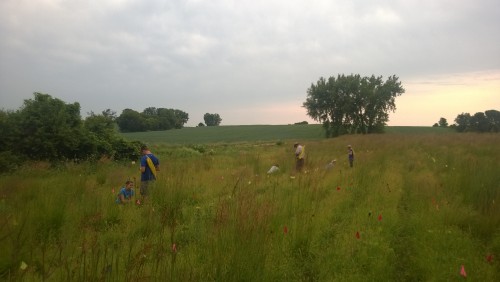
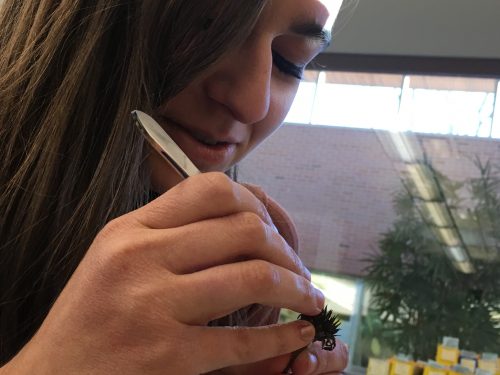 Nina began meticulously rechecking her achenes. As you can see above, she was very focused. She actually invented a fun game where she would tally how many buds were missed by various people that assisted her in cleaning. As is stands now, Lea is in lead with 2 missed, Tracie second with 3 missed, and Nina (who did 60 of them mind you) is third with 4 missed. Max. On some, she even missed none! Marisol is in fourth with 5 missed, but who knows? She’s still counting! Updates to follow.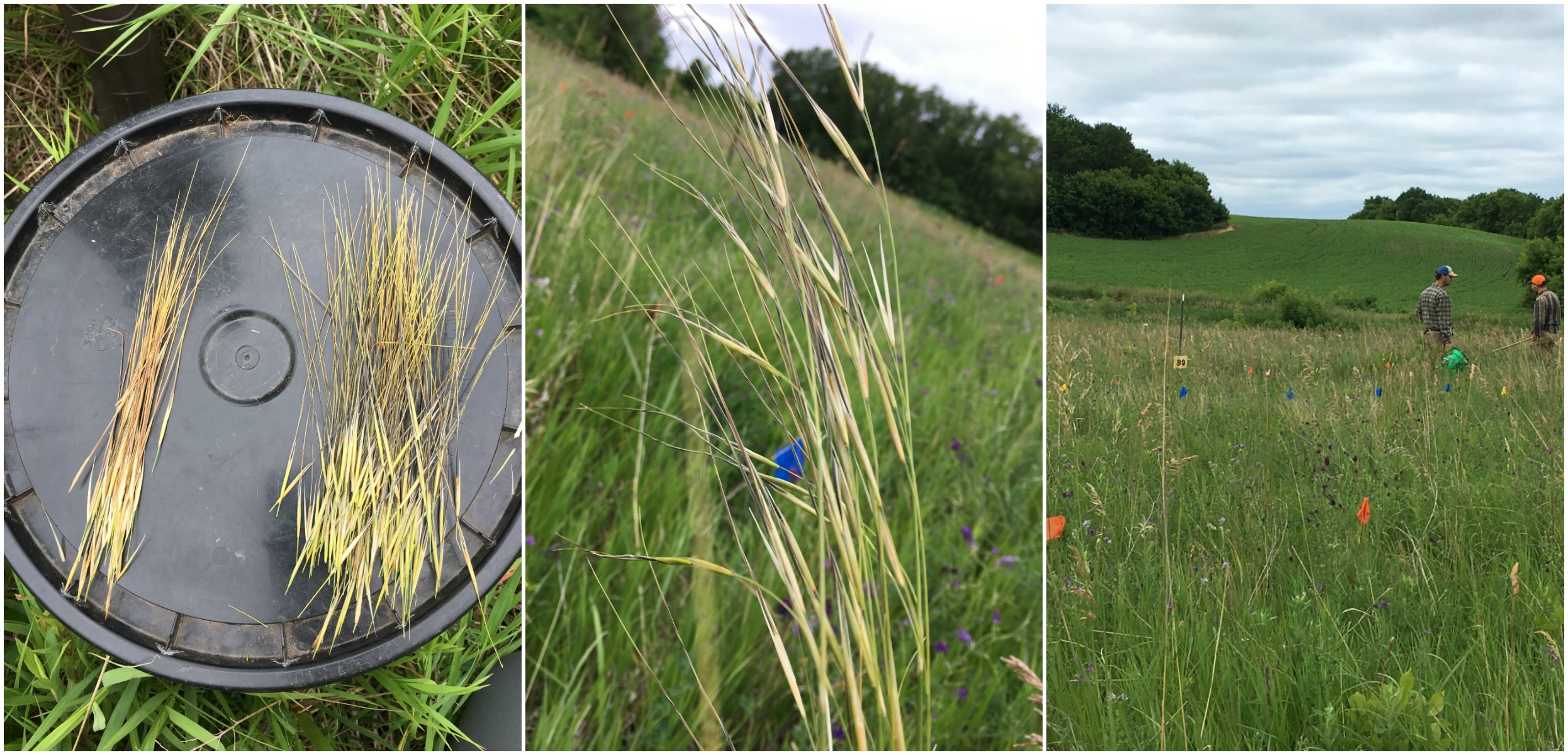

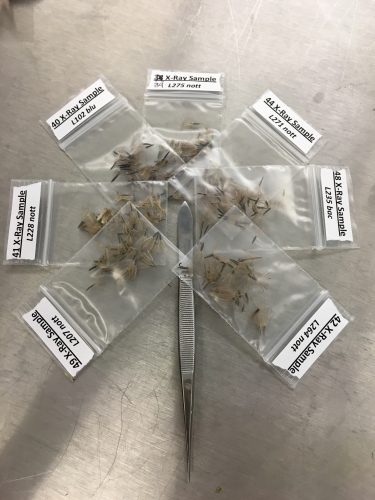 My buds are much less stubborn and the achenes easily fall off. In fact, my buds actually look quite different from the echinacea achenes, resembling a miniature version of the capitulum often emitted from dandelions, making them quite fun to work with! Pictured to the right, these are the achenes I separated into baggies for future x-raying (notice the formation!)
 Hello! My name is Trevor Hughes and I am a freshman at Carleton College in Northfield, MN. I am super fortunate to be joining Project Echinacea for an internship over my winter break; I’m super excited about it! Prior to my time at Carleton, I spent most of my time in high school working on the Conservation Ambassadors Board at Lincoln Park Zoo, planning events related to conservation. Fun fact: one of my events concerned urban prairie plant species (including echinacea!); how cool is that?! And through my time there, I grew to develop a passion for conservation, which will continue to grow in fortitude during my time at the Chicago Botanical Garden. Over the course of my internship, I will be working on cleaning, scanning, and counting achenes from the Liatris and Solidago species, hoping to discover findings comparable to echinacea, proving that conclusions made with regards to echinacea can be generalized to other prairie plant species in the future.