|
|
Yesterday was my last day with the Echinacea Project and on Tuesday, I presented what I worked on this summer. Using R Studio, Google Earth, and Soil Web, I learned a lot about programming and soil in general. After plotting the plant points on Google Earth, I found 9 different soil codes in 8 sites. The most common type was BaC2 with 51% of the plants followed by LeF with 20%. These two soils were both classified as well-drained and have slopes or hills. However, the horizon of the main series of soil they are each made up of is quite different. I included my powerpoint with some of the information I found. Soil is a very large topic, so I am hoping to continue learning!
I had a blast this summer learning and working with everyone! Thanks again!!
soil types in Echinacea
P.S. Plexipus and Angustus both transformed into beautiful butterflies!:)
Flog post for August 29th, 2017.
This morning we broke into two teams to do flowering demography at three sites. The team I was on went to Around Landfill. Normally the cows at Around Landfill stay unseen in a different part of their pasture, but today a few of them cam right up to the fence. Maybe they were telling us to stay away from their calves? We combed the site for any Echinacea that had flowered that previous year, and while we’ve been visiting the site often to collect phenology data, we still managed to find a few previously missed flowers. Both groups converged on the On 27 site after an hour or two and collaborated to sort through the sumac and uncover the Echinacea there.
After lunch, the majority of the team went to harvest Echinacea heads and Bouteloua grass. The county has recently been cutting roadsides in preparation for winter, so we thought we had to act fast to snap up the Bouteloua seed. As it turns out, the mower didn’t reach us yesterday, but we still managed to gather another gallon of seed to spread on P1 after the fall burn.
In an effort to spice up head harvest, we tried to communicate the head I.D.s via the NATO phonetic alphabet. We decided at one point to make some more creative changes to the typical code.
A-Alpha
B- Bravo
C-Charlie
D-Dingo
E-Echo (echo, echo, echo)
F-Foxtrot
G-Gopher
H-Haute
I-Indigo
J-Joey
K-Kangaroo
L-Linda
M-Mancy
N-Norbert
O-Oscar
P-Papa
Q-Quebec (said in a heavy Irish Accent)
R-Roscoe
S-Shwifty
T-Tango
U-Uniform
V-victor
W-whiskey
X-Xylophone or Xray (depending on how confused you are on the spelling of Xylophone)
Y-Yankee
Z-Zulu (or Xylophone, don’t judge us on our spelling).
I think this adapted version is far superior to the current version, and NATO needs to update it stat.
We finished the day with a cookout at Elk Lake. The Andes crew supplied chocolate cake and some CSA veggies, and Stuart supplied vegetables from the garden and cooked. The lake was absolutely beautiful, and everyone went home happy and full of food.
Today was my last day of work with the Echinacea Project. We spent all of it doing total demo at Landfill and it was great! We had beautiful weather and many flowering individuals to investigate. In the morning the manager of the landfill came and talked with Stuart for a bit about the project and the remnants at the landfill. At lunch I gave the group a little presentation on my project for the summer. After another afternoon of total demo the Andes crew went into Alexandria for a night of wings.
 Stuart pointing out where Echinacea are at Landfill for total demo. Tracie, Anna, and Kristen doing total demo at Landfill. My project this summer had several aspects to it. In the first part, I was curious to look into the plant community diversity between various types of land based on their land use history. At Hegg Lake Waterfowl Production Area there are remnants, restorations, and abandoned agricultural fields. I conducted vegetative analysis on several areas with these land use histories and I will be analyzing that data in the next couple weeks. Along with vegetative analysis, I also collected data on flowering resources between each type of land as a measure of pollinator habitat quality. Another aspect of my project was to build a list of species whose populations were large enough to collect seed from without heavily damaging the population. I built this list and gave it to the local DNR for their use. Along with the seed collection list, I am currently putting together a species list for all known species at Hegg Lake to provide for the DNR.
I learned a ton this summer and I am so happy to have had this amazing opportunity to participate in ecological science. There is so much fantastic research and good science coming out of the Echinacea Project. Thanks for everything!
-Wes
So, today is the first day of my last week and also my last flog!:( This summer has been super fun and educational! I’ve had the opportunity to meet so many awesome people and learn a lot about the area I live in!
However, today was also the official last day of phenology! The last plant was at Steven’s approach and Lea had the honor of double checking its status as done flowering. This morning we worked on demo and seedling searches at Loeffler’s corner. In this particular area, someone decided to dump a bunch of woodchips and not just in one spot, no no spread out. This made it slightly depressing since there were a number of points totally covered by wood. Despite this challenge, plenty of flowering plants were still found! After lunch, the team also worked on demo.
 Tracie, Alex, and Wes working on demo It’s crazy how fast this summer went and I already start school in a week! I’m looking forward to my senior year and finalizing my college decision. Wish me luck!
Thanks again to everyone on the Echinacea Project Team!
Today was a pretty good Sunday. I did a lot of knitting and and hung out with Huxley and Bellamy. Some of us went into Alex to grab groceries, do laundry, and do work in Caribou. Wes came back from a camping trip with his parents and brought along delicious quiches for dinner. Kristen, Lea and I got excited talking about stuff we are going to do back in Chicago together. The summer is nearing its end! I’m going to miss the prairie, but I’m getting geared up to start working at the garden.
 Huxalito and Bobo enjoying a stroll around Andes.
Today was pretty relaxed here at Andes. Wes is gone for the weekend on a camping trip with his family and by mid-morning most of the team was out in Alex running errands. Lea spent some time with her plots at Staffanson but unfortunately the humidity meant the mosquitoes were out as well.
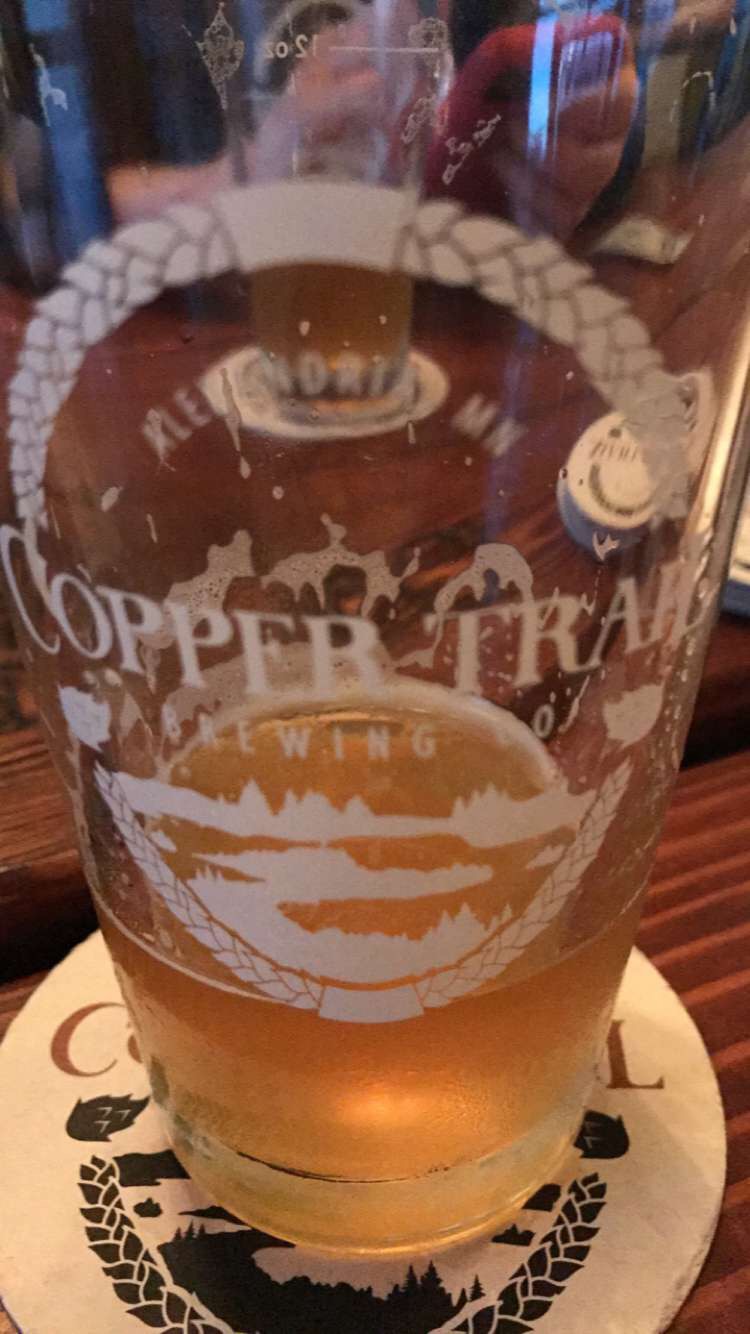
This evening, Lea and Tracie graciously took me to try Copper Trail Brewing Co. If anyone needs a good recommendation for craft brew in the greater Alex metro area, I would highly recommend it.

After checking our IDs, we were first mistaken for members of the notoriously famous “Bee Crew” (Amy’s team) although we quickly explained that we are actually part of the just as fun and exciting “Plant Crew.”
Our numbers are slowly dwindling (if only temporarily), as Stuart headed back to Illinois for the weekend. Many of us only have a few days left. It’s hard to believe that the field season is almost over, and we have so much to do!
We started off the day by doing doing total demo at our Aanenson remnant and harvesting some Echinacea heads from the remnants so that we can estimate seed set in natural populations!
We finished total demo at Aanenson and after some mishaps with a two ton hay bail we headed to Loeffler’s Corner to do some more total demo. It started misting almost immediately after we arrived and the rain slowly picked up. Our new GPS unit is water proof so this shouldn’t have stopped us but sadly our visors are not so we had to head in for the day. We spent the rest of the afternoon doing various indoor activities from learning R to pinning collections from the yellow pan traps!
Happy Weekend!
Today was a long but productive day. We started the morning getting trained in on seedling refinds. Although this particular task can be time-consuming, the pay off is great for data. By revisiting seedlings that were first found between four and seven years ago (and have been found every years since), we are able to better understand what the early life of an Echinacea plant is really like! Ruth, who came out to do fieldwork with us today, explained how the data we collect on these seedlings can be used with Aster modeling, and result in some pretty interesting scientific knowledge. This morning, we did all the seedling refinds at East Elk Lake Road. After lunch, and some delicious chocolate provided by Ruth, we headed out to complete a variety of tasks. Tracie and I went to Staffanson to look at the phenology of my Solidago and Liatris plants. After that, went to twenty different Echinacea plants at eight different sites, and completed plant community surveys within 4 square meters of each plant. We worked until about 6:30, then headed back to Andes for a delicious dinner and some much needed relaxation.
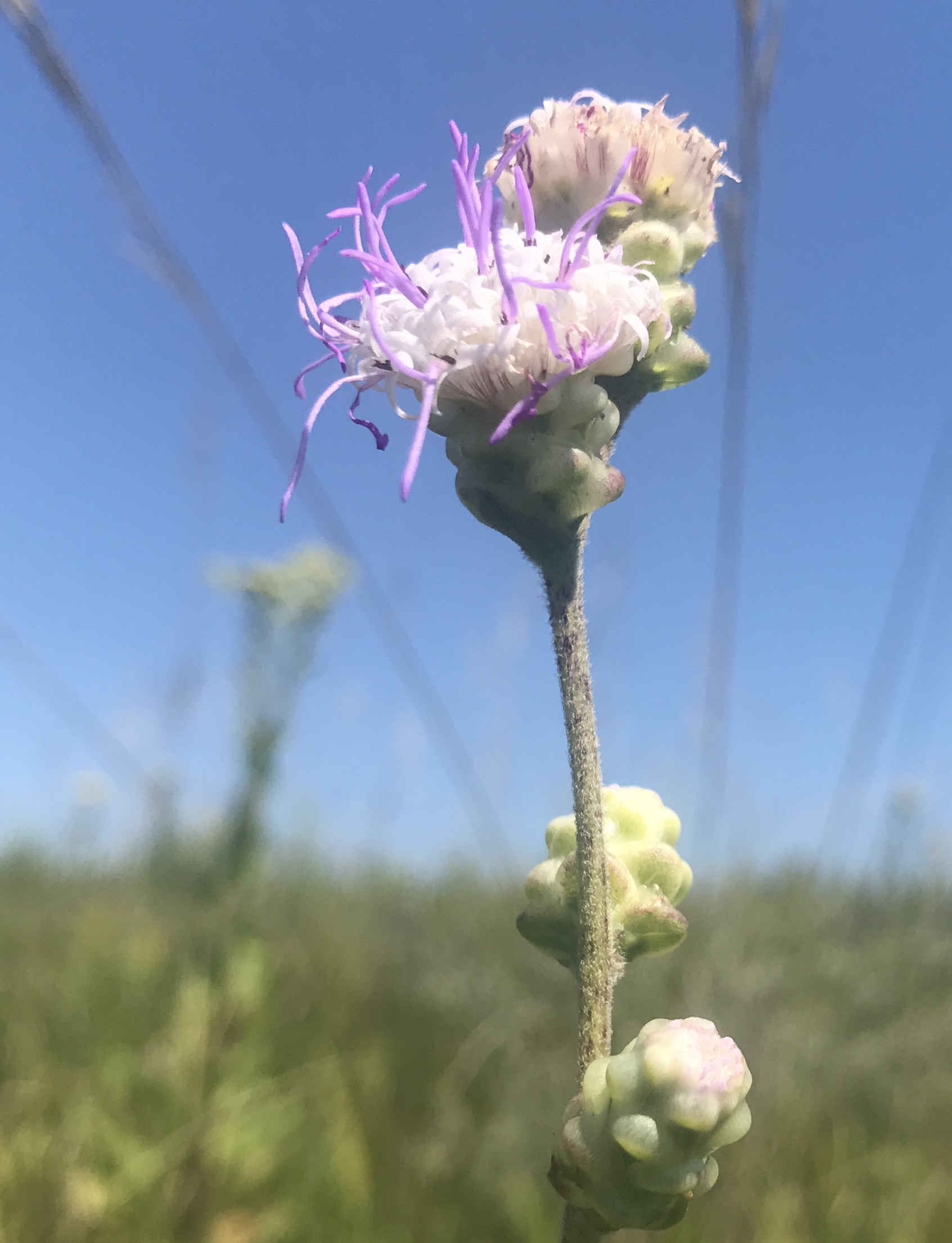
 Recognize this unusual-looking specimen?
As most of you knew, today was the total eclipse that passed across the United States. Being in Minnesota, we were not in the path of totality, but we did have an ok view of the shadow cast by the moon.
Anyway, today started off a little wet and part of the morning was spent on individual projects. When it had dried off a bit, the team headed to P1 to complete rechecks and addition/exclusion of aphids. There is also only one plant left for phenology! Wes had the honor to go out and check it today, but other than that phenology is done!
At lunch, we caught a glimpse of the eclipse. However, it was a little risky since none of us had eclipse glasses….
Then in the afternoon, the team worked on demo at Riley and harvesting.
Can’t wait to see what tomorrow brings!
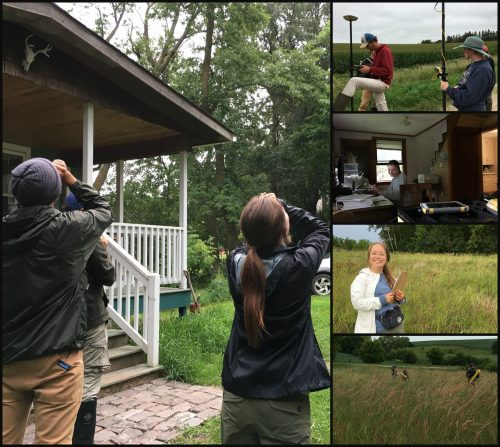
 Viewing the eclipse, demo at Riley, Tracie working on R, Kristen doing aphids, rechecks
This was a great first week, and great introduction to all the work going on this summer with Team Echinacea. Despite everyone else’s familiarity with the procedures, everyone has served as great mentors and teachers this week as I do my best to catch up.
Each day I spent a bit of time doing something different. Monday was spent looking at Lea’s project on Solidago and Liatris, some time on rechecks, and also demo! On Tuesday Stuart introduced me to Hegg lake and the number of interesting projects going on out at that location. I also pinned insects some this week with Alex (yay bees!) and did vegetation with Lea and Tracie.

I’ve set a few goals for myself this summer: these include becoming comfortable with naming the local vegetation and pollinators, developing my skills in R, and staying up on current literature. I’m really enjoying learning about everyone’s projects, developing my skills, and getting to know everyone better.
Today was mostly relaxed, but I decided to get out of the house for a bit this afternoon and check out Runestone County Park. The story goes that a group of Vikings were commissioned by the then current King of Norway to travel to the west. After traveling through the Arctic Ocean, this small group of Vikings ended up in the Hudson Bay and then trekked south into Minnesota. Near Kensington these Vikings were ambushed (likely by Native Americans) and left behind the “Runestone” or an inscription which detailed their encounter. A man and his son discovered the tablet in the late 1800s, prompting investigations into the first recorded history of Europeans in North America.
People remain skeptical of the Runestone, however, after numerous Wikipedia searches it seems that there is some evidence suggesting the story to be true. While we may never know which group of Europeans reached North America first, the park is pretty and serene, and serves as a unique part of an interesting local legend.
|
|