|
|
Over the next several weeks we are going to post updates on all the projects we worked on during summer 2017. Whew we did a lot–it might take a couple of months!
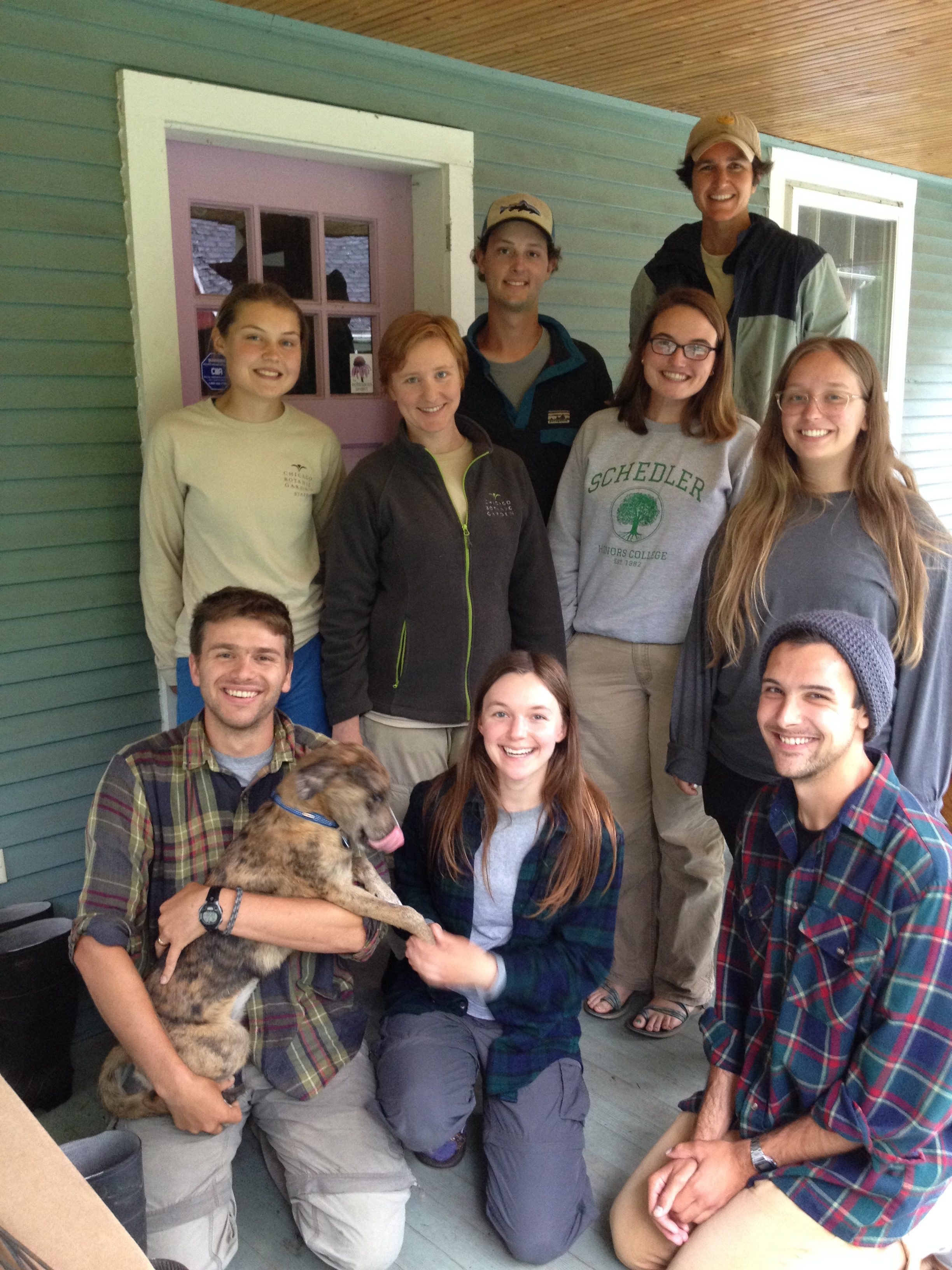
 Team Echinacea summer 2017 Put a bookmark on our update page to stay caught up. We’ll post all updates on that page.
Two new projects to look out for are Richardson’s “Liatris and Solidago phenology” and “Pollinators on roadsides.” Also, we’ll recap Barto’s & Braker’s REU projects. Stay tuned!
We didn’t work on the project Fire & flowering at Staffanson Prairie Preserve
or on Mating compatibility in remnants this summer. We didn’t do the first one because no burns were conducted at the preserve before this growing season. We contemplated assessing compatibility for another year, but there seemed to be more things that we wanted to do than there were people and time to do them.
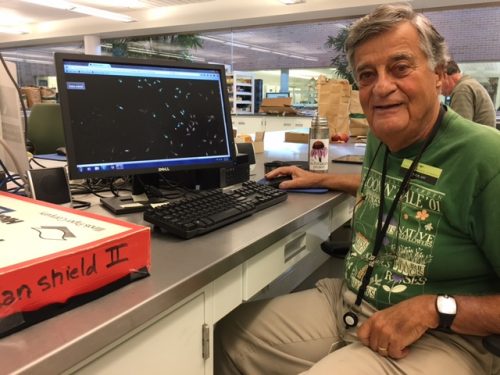
Art is spending the morning today counting achenes at the computer. One great thing about counting achenes is you can still tell stories while you’re doing it, and Art has quite a lot of funny and interesting stories about his earlier days volunteering at the garden.
 Art counting Echinacea achenes in the lab
Today Char and Susie have been cleaning Echinacea heads from 2016. Char is interested in Art’s idea of using the seed counter to count out achenes once they have been cleaned. She wants to know if the seed counter will be able to count achenes that come from small heads that have tons of tiny achenes. An experiment is in the works!
Hi flog!
Today Team Echinacea met at the garden for a day full of exciting meetings and orientation. I got in around 8 to start learning my way around the Plant Science Center, and then Gretel, Stuart, Lea, Kristen, and I met to recap the summer and talk about goals for the fall. We started planning our trips back to Minnesota to finish up field work and burn a few of the experimental plots. Before lunch, we got demonstrations by a few of the volunteers of the ACE protocol, including how to clean Echinacea heads, count achenes, and randomize achenes.
After lunch we continued meeting to discuss project ideas and talk about our weekly schedules. We’re all pretty ambitious with our ideas and goals for the fall, but Stuart believes it’s possible. Can’t wait to get started!
Tracie
Today was a busy day for the three of us: Kristen, Alex and I. But we got a lot done! I spent the morning at Staffanson working on Lea’s Liatris and Solidago phenology/harvest while Kristen and Alex did total demo at East of Town Hall. Later they shot a few extra plants at On 27 while I started remnant harvest. I only got through about half of the sites before heading back to the Hjelm House to meet up for lunch. We took a quick lunch and then got back at it. I finished up remnant harvest and then we started a few sling sites. Even with some GPS trouble, we got through seedling searches at KJ’s, NWLF, and ETH.
 Looking for seedlings at KJs.
Today was another chilly day at the Echinacea Project with highs reaching up into the low 60ºs. Tracie and I spent the morning working on harvesting Lea’s Aster Phenology at SPP. Many of the Liatris are finished flowering and ready for harvest, but some of the Solidago plants still have at least another month or two before they will be ready.
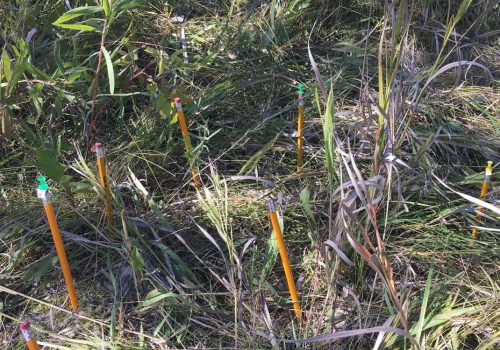
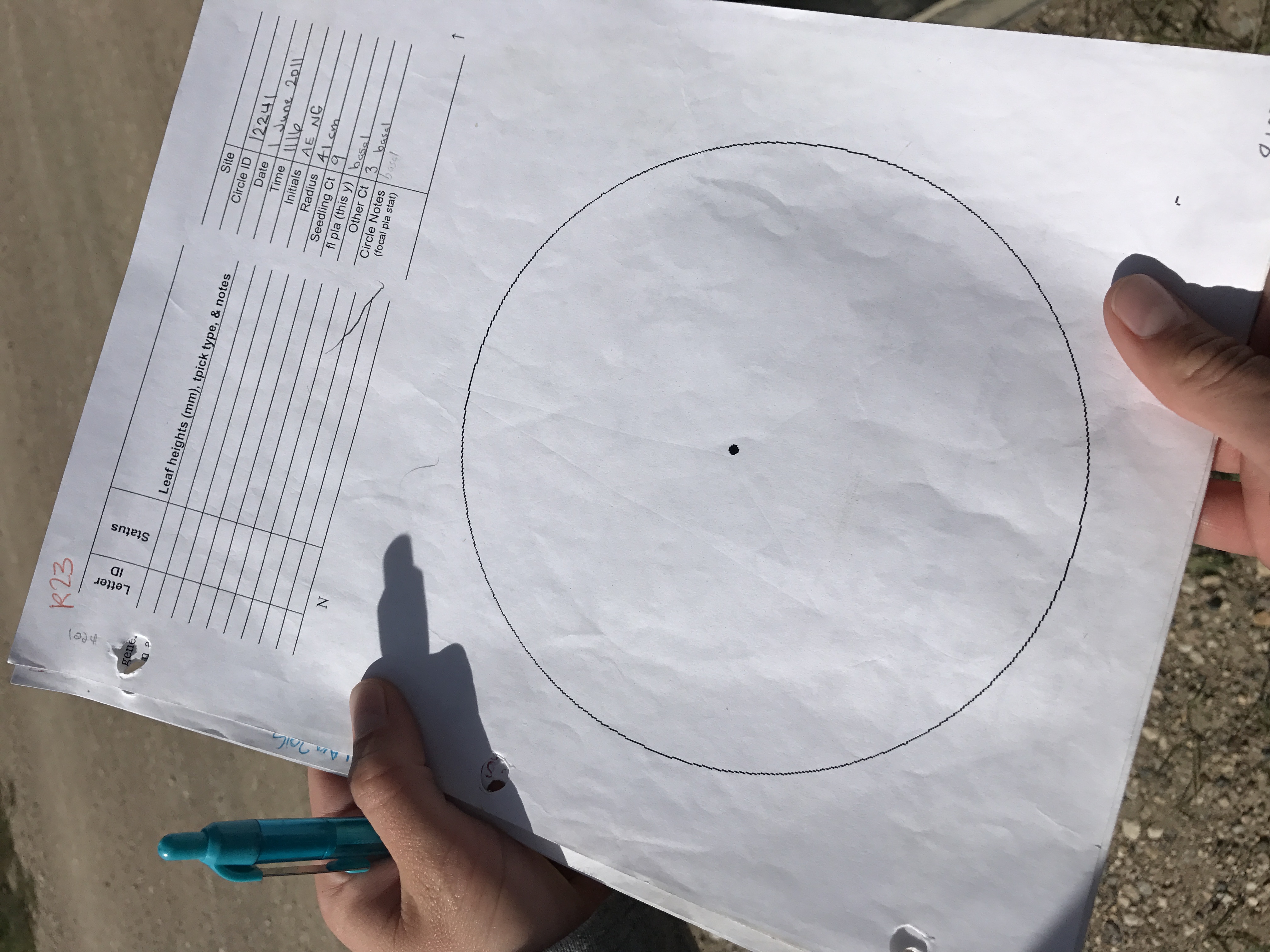
 Prenanthes racemosa In the afternoon we spent our time out at Stephen’s Approach working on more seedling refinds. Between Tracie and I, and later also Stuart and Alex it took us about 3 hours to complete 13 focal plants. This is one of the more challenging activities that we do at the Echinacea Project, however, the glory of finding one of last year’s plastic swords or toothpicks is immeasurable.
Actual seedling refinds map found today. Luckily another map was found for the same site with the correct seedling locations.
Today Lea and the doggies left early in the morning to head back to Chicago. Kristen and I got up a bit later and decided to head for the cities. This was only my second time there, and Kristen’s first! We drove to Grand Ave in St. Paul and walked around looking at all the restaurants and shops there. We ate at a place called Colossal Cafe where we got some fancy grilled cheeses and portobello sandwiches. Once we finished up there, we went to the U to look around.
On our drive back to Andes we talked about how everything we were seeing used to be prairie. Kristen painted a nice picture of how it would have looked without all the trees and roads. After a day saying “uffdah!” so we could feel like we fit in, this was a circumstance for the ultimate uffdah. Would have been cool to see prairie for miles and miles.
Minneapolis, MN
Today was another relaxed Saturday. Each of us at Andes had a number of errands to run including the very important task of getting the doggies groomed and cleaned before heading back to Evanston! Lea took the doggies in to Bark n Bubble in town for an all over spa treatment.

Later in the evening Lea, Tracie, and I celebrated Lea’s last day by enjoying some wine and having a ladies night in.
Today was maybe the best weather day of the summer in my opinion, a nice breeze all day and just below 70 degrees. We took full advantage of the great weather and went to our Landfill remnant to finish doing total demo. We only did total demo on part of the site but, we still visited 687 previously flowering Echinacea and even found some never before seen individuals!
It didn’t take long to finish demo at the Landfill, so we did some miscellaneous jobs for the rest of the morning. In the afternoon we went to Hegg Lake WMA to find any remaining individuals of the treasonous Echinacea pallida. We found three pallida and quickly relieved them of their heads. One of the individuals we found appeared to have aster yellows, a disease that affects many species in the Aster family including E. angustifolia and E. pallida. It is possible that pallida, a non-native, could outcompete the native variety (hence the decapitation to prevent the spreading of achenes). So it is good to know that like our much loved Echinacea angustifolia, Echinacea pallida can get sick too!
An E. pallida with what appears to be a case of aster yellows.
Counting the total number of achenes provides important information regarding seed set to access the female fitness.
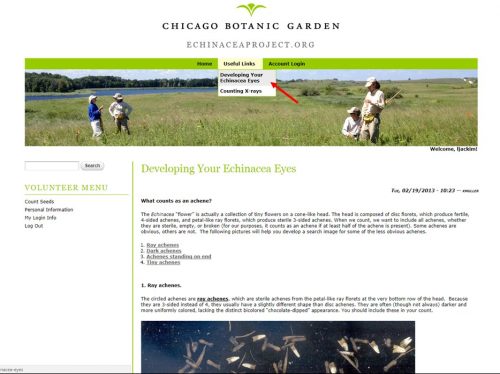
Before you start to count achenes you may want to get adjusted to looking at them. Under the tab “Useful Links” on the echinaceaproject.org/lab page you will find “Developing Your Echinacea Eyes” click on it to get familiar with the different types of achenes you may see. Achenes range from rays to tiny achenes so it’s important to make sure you know what to count( Figure 1).
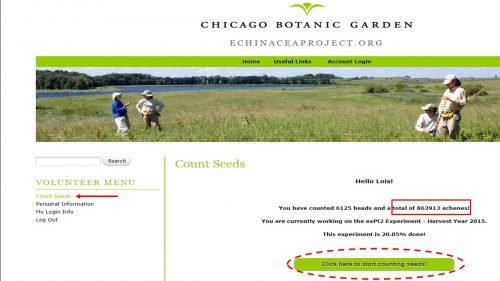
 Figure 1. Familiarize yourself with what different achenes look like The “counters” (people who count achenes) use the scanned image of the achenes to count how many achenes come from a single head. This is done by logging on to the echinaceaproject.org/lab website to access the page to count seeds; a detailed protocol is available in lab. All volunteers and staff will need a username and password for this website to be set up in advance. Once logged on to the website, click the link under the side Menu entitled “Count Seeds” (Figure 2).
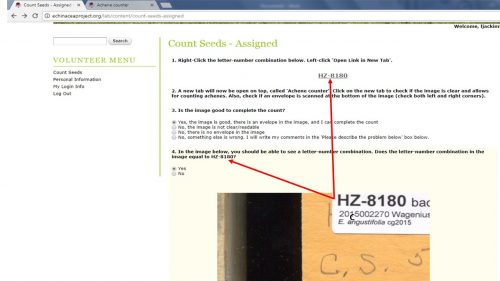
 Figure 2. Lois (the Achene Queen) has counted 862,912 achenes and counting… This will then lead you to another screen where you will have information on the progress of the project you are working on as well as the number of seeds you have counted. The example shows our Achene Queen Lois’ stats, she has counted well over 800,000 achenes! Start counting seeds by clicking on the green button aptly titled “Click here to start counting seeds!” (Figure 2). The next page will provide you with a set of questions to answer regarding the head from which you will count seeds. The letno (Letter/Number combination) of the head will be provided and you should open the image in a separate tab. Once you see the image is of good quality you will be shown the envelope that should have the same letno combination (Figure 3).
Figure 3. Make sure you are counting achenes from the correct Echinacea head! At times there is nothing in the image in question four but if the envelope in the scan you opened matches the letno the question asks about then you should mark “yes” they do match (Figure 4).
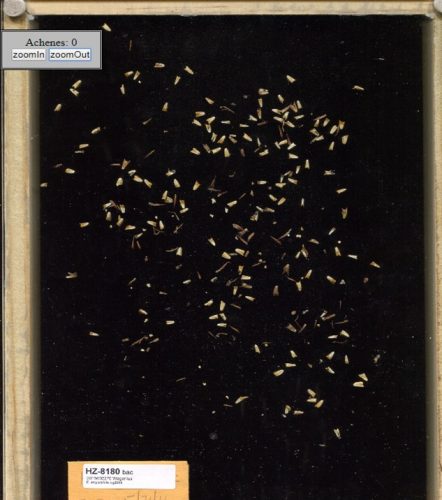
 Figure 4. Full image of achenes with the envelope and LetNo in lower left corner
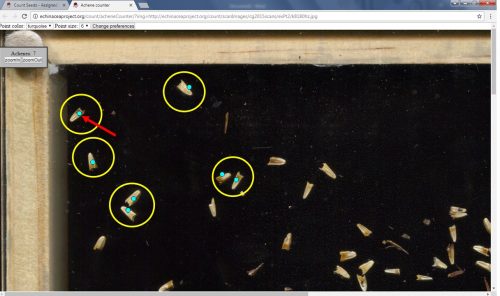
In the tab with the scanned image you will see a floating counter. When you click on an achene you will see a cyan dot appear and the number of dots, i.e. achenes, will be recorded (Figure 5). You can get rid of dots by double clicking on them and the counter will adjust to a new total.
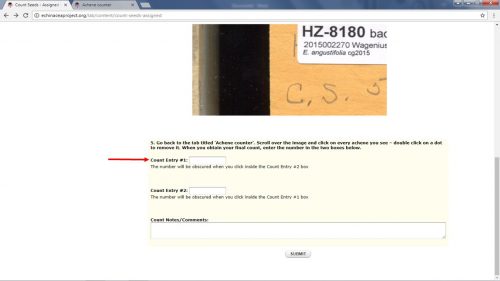
 Figure 5. Circled achenes that have been counted. Red arrow points to a cyan dot that the floating counter in upper left corner tracks. Once you have counted all the achenes the total should be recorded in question five (Figure 6). Once you are done with that head you can submit the information and you will be asked if you want to count another head.
Figure 6. Return to the other tab and fill in the count information Now you can start counting like the Achene Queen Lois!
|
|