|
|
With Lea leaving this morning, the remaining crew members Amy, James, Will and I, took the day off. There was no work to do, and thus no work was done. Kensington was cool and cloudy today, but it should be back to 80 degrees this week, when we plan to finish demo at Staffanson, continue harvesting, recheck p7, and check Lea’s Liatris and goldenrod transects.
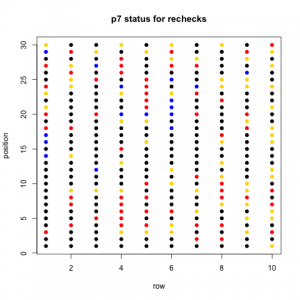
 Map I made of recheck status for all positions searched in p7 this year. Black dots represent plants found, red dots represent positions where plants were not found that will be rechecked, gold represents positions where plants haven’t been seen in three years, and blue represents plants that should be remeasured. We’ll hopefully recheck p7 this upcoming week.
Today was probably the coldest day of fieldwork we have had all summer, a cold front passed through on Wednesday and left us with a cloudy 60 degree day. For those team members who are more accustomed to hotter summers today was a little bit of a shock.
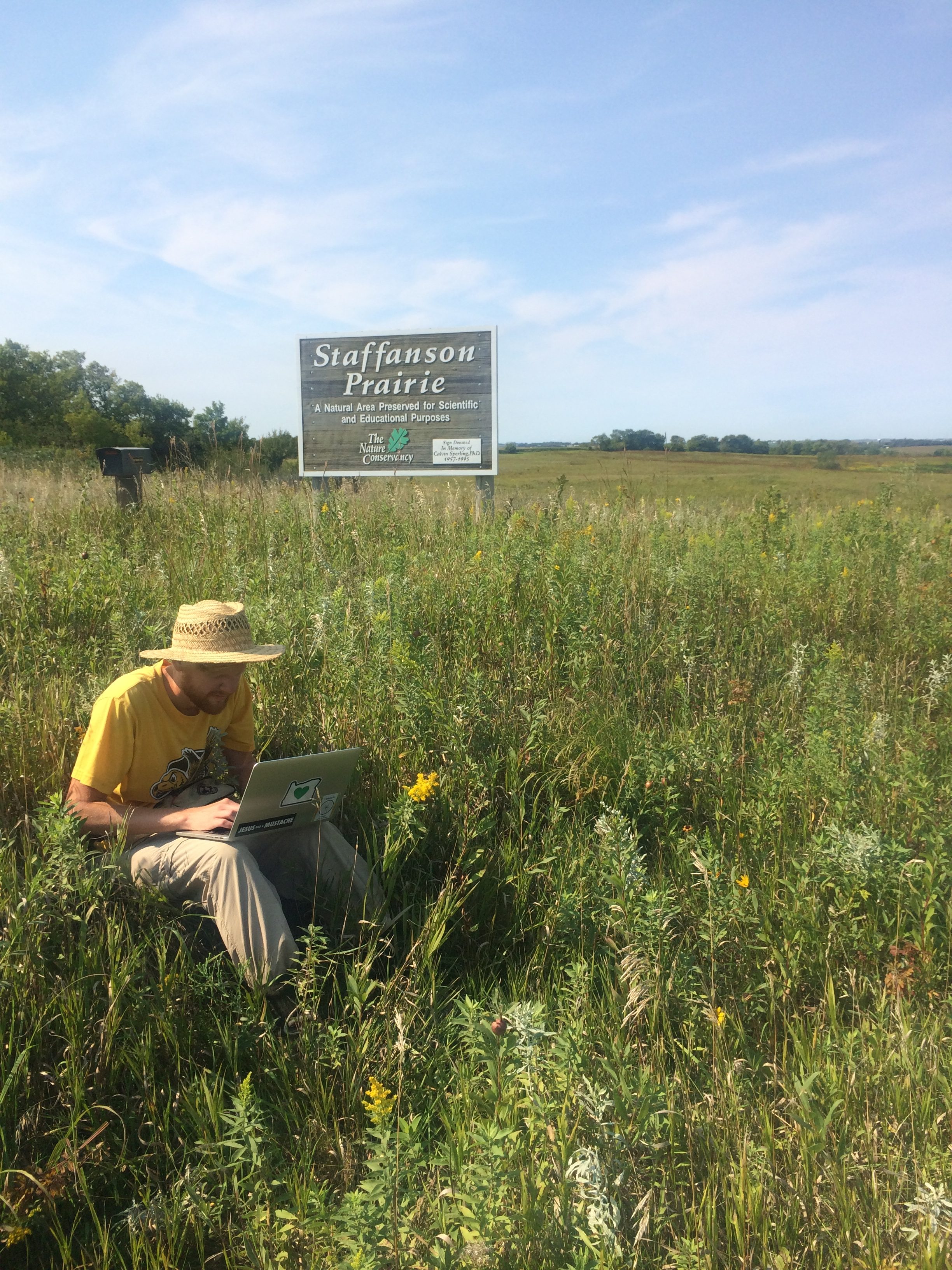
We went out to do total demography at Staffanson Praire Preserve, our goal while doing total demo is to census all of the plants that have flowered sometime in the last 20 years. It’s a big project, at Staffanson alone there are just over one thousand locations to visit. While not all of these locations still have a plant it is awesome to see a tag around a plant that was put there in 1996 or 1997.
 Even the flowers are cold! We made a huge dent in the number of locations at Staffanson, of the 1054 locations we visited 435, nearly half done!
 Scott stakes locations while Amy does demography on the plants at each location
Good evening floglanders,
 Computers in the prairie!! No parents no rules!! Stuart took the train back to Chicago this morning, leaving us kids in charge of fieldwork for the rest of the week. In the absence of responsible adults, we did all kinds of wild and crazy things. Lea and Scott assessed phenology for Lea’s experiment at Staffanson while Will, Jame, and I did demo at RRX and NRRX. Will and I left James to set up seedling refinds at Staffanson and went on to harvest a few remaining heads from the remnant harvest sample that we started yesterday. After lunch we did total demo on the south side of the road at Aanenson and after that we did seedling refinds at Staffanson. It was totally OC (outta control). We wrapped up the day by getting the ice cream out of the freezer and having root beer floats for the second day in a row. Woohoo!!! Don’t tell Stuart or Gretel.
Til next time,
Amy
Today was a continuation of harvesting. Instead of harvesting heads in experimental plots, we harvested Echinacea heads from many of the remnant sites. At every site we visited, we collected five randomly selected heads as well as the most and least isolated heads and the first and last to end flowering. We were surprised at the number of heads that were ready for harvesting yesterday, but today we had an even higher percentage of heads with ripe achenes. Our rough estimate was around 50% of heads harvested. We spent the afternoon rechecking P9 for any missed plants, and Scott proved himself the musty champion of searching with around 15 Echinacea found.
After work we had some great rootbeer floats, while discussing the rest of the week. Stuart is headed to Chicago, so it will just be us younger folks for the rest of the week. Thankfully, he left us with some sage advice to help us survive the week, “Work hard, but don’t forget the ice cream.” I believe this is advice by which to live.
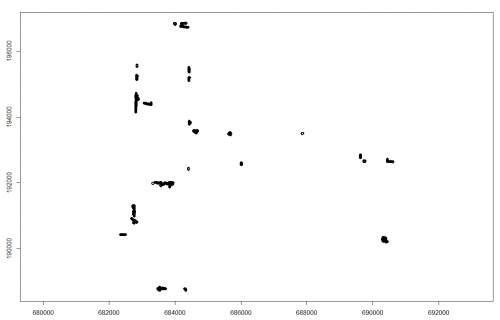
Since I can’t think of much else to write, I’ll leave you with an image generated through my independent research. I want to know if there is a relationship between the distance of a plant to the nearest habitat edge and reproductive fitness. I recently completed the first step of assigning distance to the nearest edge to each flowering plant. Below is a visual depicting the edges of all remnant sites (also included because I didn’t remember to catalogue any of today’s events with photographic evidence).
Harvest
Today, we began the harvest season — cultivating the heads of Echinacea that are soon to drop their achenes. These heads are harvested so their achenes (which may house seeds) can be counted, a way to quantify the reproductive output of individual plants. These can be used in an aster analysis to estimate fitness of individuals, but there are plenty of other ecological and morphologically interesting questions that the seeds can help answer, such as how effectively flowers have been pollinated. We harvested this morning in P1 and the 99 south garden, clipping and storing a modest total of 48 heads. But first — we spent a little bit of time herding the goats between paddocks in the backyard. For what it’s worth, we lost zero goats and endured zero shocks.
 Jame is a miner for a heart of gold… Everybody Knows This is Nowhere
We came dancing across the highway, with our clippers and our boards… This brought us to P2, where we spent most of the afternoon, and maybe a little bit of the evening. Here, like in P1, we checked the status of every single head in the plot for the signs (dead cauline leaves, brown involucral bracts) or for loose achenes. However, P2 had over four times as many heads to check as P1, making for a long afternoon. It seems like P2 was on a slightly earlier flowering schedule than P1, for we think that we had to harvest nearly half of the heads we came across. Amy and I worked for about four hours and only managed to move through 13 rows of plants, some of which we enlisted Lea to help with. I don’t remember what exactly we said, but I remember laughter — perhaps at this macabre reminder of our own mortality, or perhaps because we were carrying around a shopping bag with more than 100 crisp flower heads in it.
Old man, take a look at my life, I’m a lot like you After the Gold Rush
Lea made excellent pesto tonight with some of our leftover fennel and sunflower seeds, while Amy and I went to Morris to pick up the CSA. At dinner we went on a journey through the past, talking about Team Echinaceas from past and present, then finished off our evening with ice cream. Our aching bones and weary fingertips required rest, so we retired early and will sleep ’til the morning comes.
Regards,
Scott “Southern Man” Nordstrom
While much of Team Echinacea 2016 has returned to school (with Gretel, Hattie, and Roxy being our most recent members to say goodbye) the few of us remaining have decided it’s still time for some summer fun. So, today we started the day by sleeping in, eating various homemade breakfasts, and relaxing a bit more. As the morning chill burned off and the sun came out, we decided on a plan. The main activity of the day? Visiting the Douglas County Fair! We headed out in the early afternoon. Take a look at a few of the things we saw!
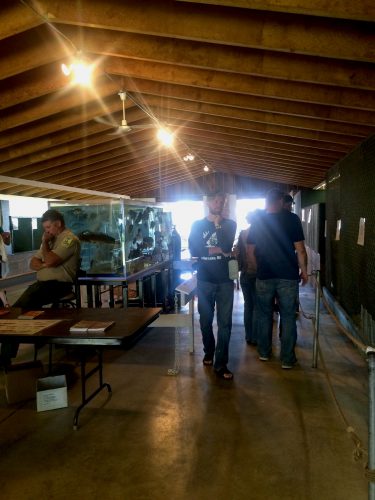
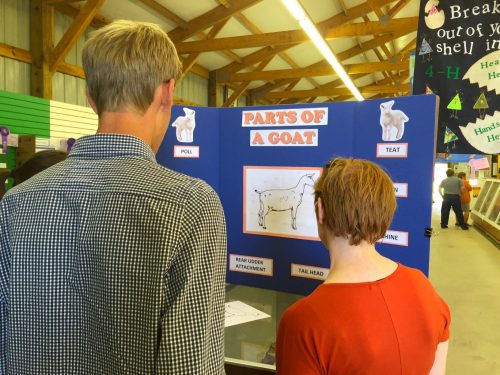
 Each building had many interesting art pieces and exhibits. But what does this one mean?  The kids whose work is shown above may be talented photographers, but what is all this Echinacea purpurea doing in a Douglas County Fair photo contest? Echinacea angustifolia is actually native to Douglas County, unlike Echinacea purpurea! Scott takes time to enjoy the Minnesota DNR building that is filled with exhibits on wildlife of the region. After the four of us explored this exhibit, we all spun the pollinator wheel and won posters after answering questions about native pollinators!  Here you see James and Amy depicted in this modern piece, “Sweet Corn is Summer” James and Lea think real hard about what part of the goat the “poll” might be- they struggle less with “teat”.  Amy and Lea shown here as part of a performance art piece. “Just keep swimming with 4H” explores the roles of two young women accidentally caught in the current of the local big bass, 4H.
After our fun day at the fair, we shopped for our weekly groceries and drove back to Kensington. The weather today was truly fair, and the fair was truly wonderful- the perfect end to a great week!
Efficiency and good data are two of our major goals at the Echinacea Project. Today we achieved the efficiency part, and hopefully while we were efficient we collected some good data. We started off the day with seedling refinds in big batch. After our work today, there are only fifteen more segments, and we’ll have hopefully found all the surviving plants in P1. Scott calculated we have somewhere around a 0.675 % chance of no rain, however we realized our luck was quickly running out. We decided to head away from the rain to the east and attempt to do total demography at East of Town Hall, however as soon as we put the GPS together it began raining. After eight plants, we called it quits and headed back for some computer work. I was able to finish my code for easily calculating how far a plant is away from a habitat edge.
Lunch was eaten in cold silence with a few sparse comments on how 68 degrees shouldn’t and usually doesn’t feel so cold. Roxy lighted the mood by taking out her squirrel jerky, which she had been saving for her last full day in Minnesota. This prompted comments as to why someone would eat something that has been dead that long. Stuart didn’t know why, but he in turn wondered why people would drink kombucha. This elicited discontented mumblings from our resident kombucha lovers. I’m still in the dark as to what exactly kombucha is, but I know it’s alive and I generally don’t like to drink live things.
In the afternoon we completed demography of East of Town Hall, Nessman, Bill Tom’s Gate, Landfill and Around Landfill. Sadly we learned that today was Gretel’s last day. We had so little warning of this that Will compared it to ripping of a bandaid: painful and quick. We eventually had to say goodbye to Gretel, Hattie and Roxy. I’m still unsure of how we’ll sync the visors without Gretel, but we’ll have to manage. I hate to leave you on that sad note, but I must.
The refs are reviewing the stake files. Looks like they’ll be delaying the demo due to rain.
Good afternoon floggers! As far as progress goes, we are moving along steadily on cleaning and counting. I have randomized about 180 samples of achenes and I have finished rechecking the three trays of randomized achenes. We are on the 9th bag of Echinacea heads that need to be cleaned. In other news from the lab, the REU students have completed their research and are presenting their scientific posters today. We have had lots of interesting information and studies to read about over the past few days! Today will be my last day volunteering in the lab. I am off to University of Michigan to complete my undergraduate degree in Environmental Sciences. The opportunity to volunteer in the lab this summer has been truly unbelievable. I have learned so much, not only from staff members, but also from the incredible volunteers who kept me company. I am so grateful to have been given this job and I would like to thank everyone who made this summer internship unforgettable. This is Ivy Klee signing off! Goodbye and good luck with the rest of project Echinacea!
Hi Flog,
It’s great to be back in Minnesota after a muggy and fun week at ESA in Ft. Lauderdale. On Thursday, I presented my poster, “Two temporal scales of reproduction affect mating opportunity in long-lived perennials.” The poster was displaying work that I did this past year looking at the 11-year phenology dataset we have from the individuals in p1. The question I tried to answer, basically, was whether it flowering on a high-flowering day or in a a high-flowering year was more important for an individual’s number of opportunities to mate. For example, this year is a low-flowering year in p1, whereas last year was a high-flowering year. Would it be better to flower on the population’s peak date of flowering this year or to have flowered off peak last year? It turns out that in this system, the year is more important relative to the day. I think this is because all flowering within a season is synchronous enough that most individuals don’t totally miss out on opportunities to mate, even if they are early or late flowering. I still have some work left to do on my analysis, but it was super helpful to hear what questions people had and get some useful insights as well!
 Here’s me with my poster
Here’s a link to my poster if you want to take a closer look!
I’ll get to the topic presented in the title, but first I’ll give you a quick recap of our day in The Birthplace of America. Laura left this morning (the unearthly hours of the morning), and we will miss her and her stick shift driving skillz. We spent the morning relaxing. I cheered on USA in the Olympics, specifically in sailing. I promise it’s more interesting than it sounds.
As you can tell, there wasn’t going to be much of note to write about today. Until we experienced an enlightening dinner conversation, I was going to tell you about fridge phenology. Yes, with only four Echinacea still flowering we are missing it. But that was before our local expert on fiber, Lea, began what was to be a life changing conversation.
Lea suggested that eating the recommended daily fiber intake was nigh impossible, so I looked up my daily suggested fiber intake. You too can do this on the USDA website. It recommended I eat 38 grams of fiber a day. It was not until later I realized how much this was. Helpfully, the USDA also suggested that I have over 50 grams of protein a day and very surpr
isingly suggested I have 0 grams of arsenic in my diet. Being the curious budding scientists we are, we played a game called guess the amount of fiber a vegetable contains. We were having braised leeks for dinner, so we quickly found out that your average 89 gram leek contains only 1.6 grams of fiber. If you do the math, I would have to eat over 23 leeks a day to satiate my fiber needs. You must be thinking, “Wait, there must be a better way to get my fiber.” I’m sorry to say after searching the fiber content for over 5 vegetables (a massive sample size if you would like my opinion), nothing had a great amount of fiber. An average medium size potato (213 grams to be precise), contains 4.7 grams of fiber while a large potato (369 grams) contains 8 grams of fiber. That is, as Scott would say, some basic math. This seemed like a lot to me until I realized I would have to eat over eight potatoes a day to satisfy my needs. That’s 1722 grams of potatoes or, for those of you who like the imperial system of measurement, 3.7 lbs of potatoes a day. We now arrive at the conundrum of our discussion of nutrition. How does one eat 23 leeks in a day and still manage to eat enough protein? We tried to discover this secret of nutrition, but then realized we would be better off just eating some ice cream and ending our day on a high note.
A local sunflower patch
|
|