Hello! My name is Keaton Holsinger and I am honored to be a member of the 2014 Team Echinacea. If you would like to find out more about me, check out my background at website. Also, just for fun, here is a picture of a fish I caught!

|
||||
|
Hello! My name is Keaton Holsinger and I am honored to be a member of the 2014 Team Echinacea. If you would like to find out more about me, check out my background at website. Also, just for fun, here is a picture of a fish I caught!
Hello Floggers! My name is Claire Ellwanger and I’m excited to be a part of Team Echinacea this summer. Since graduating from Bowdoin College in 2012 I’ve spent the past two years gaining experience in the field of plant biology and conservation in Maine, California, and Puerto Rico. I’m already enjoying time in the mid-west getting to know prairie plants and how their reproductive success is impacted by habitat fragmentation. More about me and my research this summer can be found on the Echinacea Project website.
These are the methods for the hawkweed removal experiment performed by Allison Grecco, Cam Shorb, Jared Beck and Elizabeth Mays in experimental plot 1. The percent basal cover of hawkweed in each quadrant is to be determined by Team Echinacea in Summer 2015.
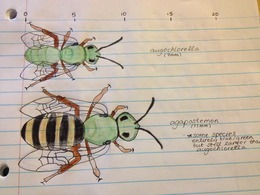
This afternoon Claire and I struck out for Staffanson Prairie to check on the flowering status of Echinacea. Over the course of the summer, we will be monitoring the phenology of mapped plants at Staffanson to examine how fire influences mating opportunities and reproductive success in Echinacea populations. We found several plants getting ready to flower (including Echinacea #7553 photographed by Claire) but we are still a week away from floret emergence. Although Echinacea bracts were closed tight, we did find numerous other species in bloom such as Wood Lily (Lilium philadelphicum), Yellow Sundrops (Calylophus serrulatus), Prairie phlox (Phlox pilosa), Prairie Alumroot (Heuchera richardsonii), Silverleaf Scurfpea (Pediomelum argophyllum but always Psoralea to me), and the aptly named Mountain Death Camas (Zigadenus elegans). I graduated from Jefferson High School in June, and I will be attending the University of Minnesota – Twin Cities next fall. This is my first real research experience but last summer I spent some time with the Minnesota Department of Natural Resources and the University of St. Thomas doing some work with stable isotope ecology. This summer I plan to study pollen longevity and determine a method for long term storage of the pollen. I am also very excited to work with other team members and help with their projects. I am incredibly excited to be a member of Team Echinacea 2014, I think it is going to be an amazing experience and I am going to be working with some very awesome people! you can learn more about me at my page on the Echinacea Project website. My Saturday began with some casual sketching as a way to get more familiar with some of the common pollinators found on E. angustifolia. Fun fact: illustrating correct wing venation is very arduous process.
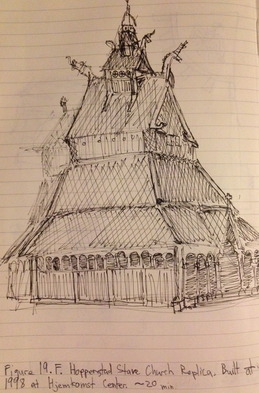
I then joined everyone else for a team brunch at the local diner. Once all members of Team Echinacea were sufficiently stuffed with pancakes, eggs, hash browns and other belly-expanding foods, 62.5% of Team Echinacea set sail for Fargo to attend the 37th Scandinavian Hjemkomst/ Annual Midwest Viking Festival! There were battle demonstrations, informative exhibits, and plenty of Scandinavian crafts, foods, and performers. A team favorite was the Hopperstad Stave Church Replica that Cam sketched with the precision of a seasoned Viking-aficionado (Figure 19.F).
The day ended was some delicious Fettuccini Alfredo prepared by Keaton and we all fell asleep full of both food and new knowledge! Skal! (Cheers in Norwegian from the Old Norse word for cup) -Maureen Page … to pull weeds, that is! Today Jared, Allie, Cam and I designed an experiment to determine the most effective and efficient way to terminate hawkweed from the SW corner of Experimental Plot 1 (P1). We created a 4m x 4m plot with 16, 1m quadrants. We originally wanted to have four treatments of: 1. Hand weeding 2. Hand weeding with tool 3. Painting round-up solution on peduncles after cutting off the flowering heads 4. Painting round-up on one leaf per basal rosette. Due to time restraints we had a fifth treatment: 5. No hawkweed removal (as a control). We learned a lot about experimental design while getting our hands dirty! In the afternoon we removed the rest of the hawkweed that was outside the plot and searched multiple rows in P1 for Stipa, affectionately known as “Porcupine Grass”. At least it’s not as smelly as the porcupines in the Colorado Springs Zoo! (Title of flog post inspiration courtesy of Rebecca Blacks infamous song “Friday”.) Hello everyone! My name is Maureen Page and I am a rising Junior at Scripps College majoring in Biology. If you would like to know more about me and my research project you can check out my bio on the Echinacea Project website.
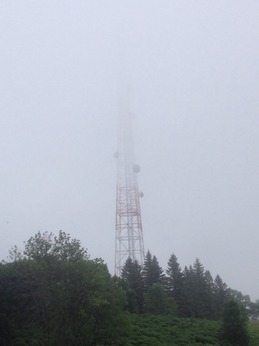
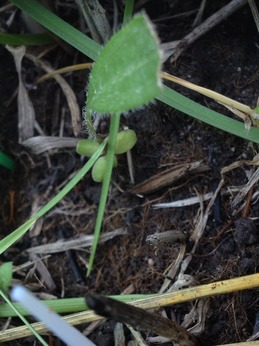
Tuesday’s morning started out similar to the past few mornings. The team worked on finding Echinacea seedlings and measuring them in the Quantitative Genetics plot 2 (a.k.a. Q2). We were a little worried that we would be rained out, but the gloomy, foggy weather quickly passed and the sun emerged to make for a beautiful day. The team split into pairs and measured multiple segments of seedlings. During this time, two members of the team, Jared Beck and Will Reed, discovered a rare Echinacea seedling with 3 cotyledons, also known as a tricot. For the afternoon portion of Tuesday’s workday, we were introduced to Common Garden 1 (a.k.a. Experimental Plot 1), a site that has lead to numerous important findings concerning the biology of Echinacea. Some of these plants were planted as early as 1996! (fun fact: some of these plants may be as old as our youngest team member, Will Reed) The majority of the team spent the afternoon flagging a plethora of Echinacea plants, or points where Echinacea had once thrived but now cease to exist (may those plants now rest in peace). While we worked on flagging, Stuart was hard at work mowing in between the transects, creating an easily visible and safe walkway. Personally, I had the pleasure of working with Stuart and Gretel’s son Per. There was never a dull moment as we discussed funny pranks, the joys of having uncommon names, and the mystery/absurdity that is art. During this time, Per managed to concoct a ninja/airplane/bird out of old, flag-less pins (we couldn’t decide which one it was). All in all, it was a very productive, pleasant day in the field for Team Echinacea. A picture of the electric tower near Q2 which illustrates the gloomy start to our day.
Here you can see the tricot discovered by Will and Jared.
The team hard at work in Experimental Plot 1
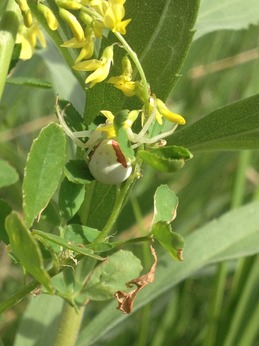
Finally, an interesting spider that Per and I found later identified as a Goldenrod Crab Spider
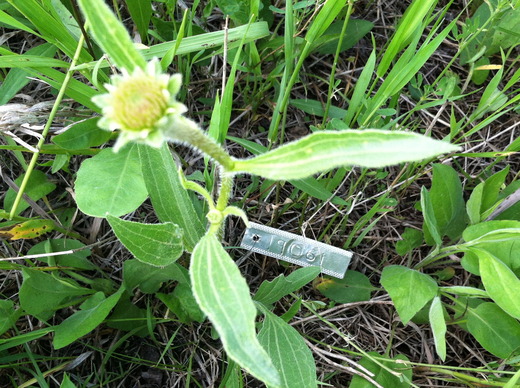
We started out the day doing what we do best: searching for seedlings in Experimental Plot 8 (a.k.a. Q2). Having braved formidable winds to plant them late last October, Stuart, Gretel, and Ruth were visibly relieved to see them pop up this spring. Since last week Team Echinacea has been diligently tracking down each seedling and “naming” them with colored toothpicks and row location coordinates, accurate to one centimeter. In the afternoon we located and counted Echinacea in the recruitment experiment, a continuation of the project described in this paper. The procedure is really fun: we find the boundaries of the plots with metal detectors, triangulate points, then search within an area exactly the size of a regulation 175-gram Disc-craft Ultra Star disc (a.k.a. frisbee). Go CUT! The best part of the day was tagging my first Echinacea. Maybe it just lost its old tag, but I like to think this is the first time this plant has ever born the silver badge. Sometime 10-12 years ago, this seed was planted. Now that it is finally about to flower, it has the honor of going down in history in the databases of the Echinacea Project, living out the rest of its life in the service of science. This 23rd of June, 3.65 m from the southwest corner and 0.79 m from the southeast corner of the northeast plot in Recruit 9, I named a flowerstalk “19061.” Isn’t it beautiful?
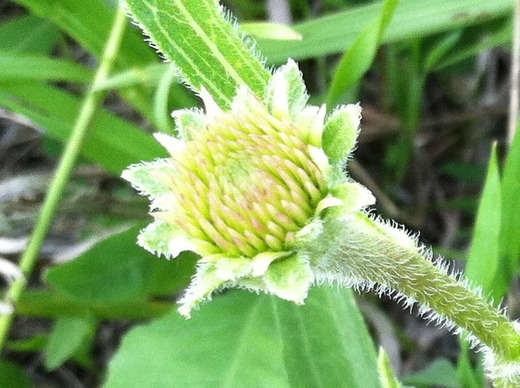
Doesn’t the flower head look ripe? Stuart says we may start to see flowering as early as the end of this week!
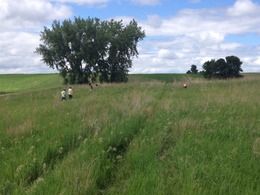
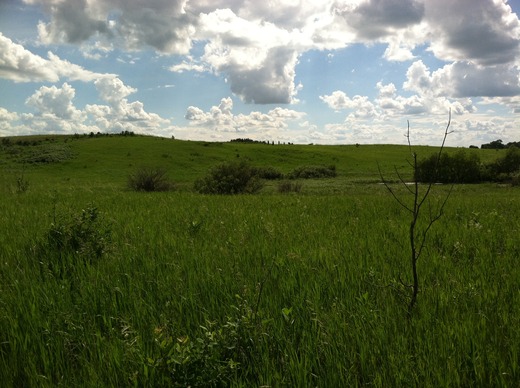
Eventually the time came to leave my new friend and join the rest of the team. This is where they were:
(Can you spot the team?) A nice day is Douglas County is a very nice day. |
||||
|
© 2026 The Echinacea Project - All Rights Reserved - Log in Powered by WordPress & Atahualpa |
||||