|
|
Hey everyone! Sorry it’s been a while since our last post, we’ve just been so busy! A lot has been happening here in Kensington. Last week we finished demography (the first run though) with a visit to Krusemarks. Unfortunately the GPS would not cooperate and we couldn’t actually map out the plants there. The walk there and back however, was quite exciting as we waded through stinging nettle and poison ivy and even decided to take a short cut through the corn. We also have begun collecting sideoats grama grass and little blue stem seeds that we’ll plant in the new common garden. Ilse and I have been hard at work hauling trees from new common garden site (photos to come) and today (after 3 attempts) we got the tractor going and dragged a ton of trees out from the field and into massive burn piles.
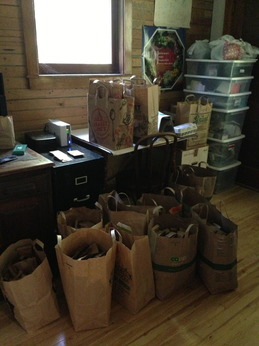
We’ve also been harvesting Echinacea heads like crazy! Nearly all the heads in the qGen2 crossing experiment have been harvested and today we did our first dissections. I would also estimate we’ve harvested roughly half of all the other heads in the common garden. This stack of bags in Hjelm House just keeps growing.

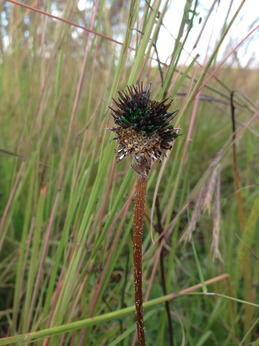
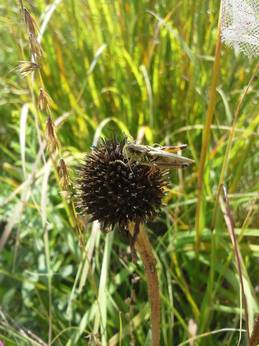
In other news, the last head in the common garden was done flowering today! Unfortunately its flowering period was prematurely cut short due to grasshopper herbivory. Apparently the immature florets and anthers looked pretty tasty. Grasshoppers have also taken a liking to the heads from the crossing experiment. Much to our dismay, we’ve returned to a couple heads that look like this:
This is quite frustrating since many times the grasshoppers have chewed the bracts down so much that it’s impossible to tell what color the head was painted and therefore some of the of crosses are going to lose a fair number of achenes. Alas, we’ve stopped de-bagging the heads in hopes of combating this issue.
Well I think that’s all the news for now. Have a good rest of the week!
This week has been full of demography and clearing a plot to plant seeds from the crossing experiment that took place this summer. We’ve been busy lopping, chain sawing, weed whipping and painting stumps with roundup in order to make way for the incoming prairie. Demography is almost done, just one site left to hit up for our first sweep through.
This afternoon while Stuart was busy trapping gophers Lydia and I spent the afternoon harvesting heads from the crossing experiment, we were on our second to last head when we encountered a curious situation. We were at the correct row and position and just could not find the plant that we had visited so many times this summer. We did however find a small hole in the ground near where an Echinacea plant should be. We pondered what to do, then Lydia finally exclaimed “I’m going to go-for-it”! Then she put her face to the ground, peered in and shouted “I see a mesh bag!!” Then in a flurry she reached down inside the hole and pulled out an already harvested Echinacea head….
…the gophers must have read the protocol because they seemed to know to leave 3 centimeters worth of stem from the base of the head.
We are preparing to plant a new experiment this fall. We are cutting down ash trees (Fraxinus pennsylvanicus) in an abandoned agricultural field that was planted with Brome in the 1980s. We will plant Echinacea angustifolia seeds from our experimental crosses this summer. We will hand broadcast two native warm-season grasses: Bouteloua curtipendula (sideoats grama) and Schizachyrium scoparium (little bluestem). Keep up-to-date on progress on this experiment via twitter.

Dwight, Lydia, & Ilse with tools of the day: chainsaw, loppers, brushcutter. Not shown: paintbrush.
The first of the month started off with Phenology on only 4 plants…but now we are down to the last two! Head harvesting is underway and it looks like we will have plenty to harvest come Thursday. We are staying busy trying to keep up with repainting heads in the crossing experiment before they are ready to be harvested, but the grasshoppers are doing their best to sabotage our efforts, check out this guy caught in the act of eating off painted bracts!
Yesterday Lydia and I mapped out a potential location for a new common garden where the progeny from the crosses from this summer will be planted this fall. This morning we are off to do demography and survey, as well as harvest the heads at Hegg lake. We will harvest all plants in the experimental plot there as well as the pallida plants Dayvis observed pollenators on and the nearest angustifolia plants to determine if any of the progeny from those heads are a product of hybridization…we may see some interesting results!
The end of another week has snuck up on us. Kory left today which means Team Echinacea is down to just Ilse and myself. We’ll be around until early to mid-October or until all the field work is done for the season. Can you believe we’ll still have a couple heads flowering on Labor Day?!
Today we harvested for the second time in CG1. The three of us didn’t expect many heads to be ready, especially since 3 days ago we harvested ~1% of the flowering heads this year (and like I just mentioned, there are still heads flowering!) but holy moly! There was a sharp increase in the heads harvested today. I would estimate we got roughly 110 heads, which would put us around 6% complete. Maybe “holy moly” was a bit dramatic, but it seemed like a lot more than earlier this week. Many of these heads were also in the qGen2 crossing experiment which is great since we’ll want to get those heads drying and dissected as soon as possible in order to plant the achenes this fall (and before it snows).
We also continued surveying and entering demography information this week. Today Ilse, Kory, and I headed to the Landfill site where we flagged all the flowering plants and took information on how many heads they have and their GPS coordinates. We’ll still need Stuart to look over that site to make sure we have found all the flowering plants (try as we might, we seem to always miss a couple) but it’s been great to make some progress with the bigger sites.
This past week we also decided things might be a bit more interesting here in Douglas county if we renamed some of the remnants to be more exciting and/or secretive. Thus far we’ve come up with:
— Treasure Islandfill (and therefore Around Treasure Islandfill, North West of Treasure Islandfill, etc)
— King’s crossing (formerly railroad crossing)
— Loeffler’s Hollow
— Staffanson Prairie Plunder
— Lost Liatris Hill
Let us know if you think of any others. Be creative! We’ll want next year’s Team Echinacea curious and intrigued by the possible mysteries at each of the remnants.
Andddd speaking of Liatris, Ilse and I found a beautiful white Liatris at Hegg Lake while we were harvesting Dayvis’ E. pallida and E. angustifolia plants. Check it out!
Hopefully this week was the last of the heat wave! I’m ready for it to go back to being in the 70s. Have a good weekend!
Lydia
Hey Everyone! Here is my final conglomerated data (mine, Andrew’s and Katie’s). As well as my excel file with all the extra information. I will also be posting it in my dropbox as well.
Kory Kolis Final Data.csv
Poll_Efficiancy_Data Kory Kolis 2013.xlsx
What is a typical radiation dose experienced by an Echinacea seed when we x-ray Echinacea fruits to assess seed set?
We usually put the seeds on the bottom tray and the setting 10 s @ 18 kV. According to the documentation on dosage for our x-ray machine 18 kV outputs 292.6 R/h when the dosimeter probe is 57.2 cm away (that's the shelf with 1:1 magnification). The dose unit quote here R is Roetngen.
A little arithmetic can tell us total Roentgens for a ten second exposure:
( 10 s frac{1 h}{60 min} frac{1 min}{60 s} 292.6 frac{R}{h} )
In R code, that's
10 * 1/60 * 1/60 * 292.6
## [1] 0.8128
0.8128 R (Roentgen)
We may put the seeds on a higher shelf for more magnification, maybe 1:1.5 or the 1:2. We can enter dosages from each shelf from the documenation on exposure levels by shelf to estimate how much higher the dose is.
lvl <- c(1, 1.5, 2, 3, 4, 5)
RPM <- c(7.815, 20.55, 42.55, 115.45, 232, 397)
data.frame(shelf = lvl, dose = RPM)
##   shelf    dose
## 1   1.0   7.815
## 2   1.5  20.550
## 3   2.0  42.550
## 4   3.0 115.450
## 5   4.0 232.000
## 6   5.0 397.000
The dose on the 2x magnification shelf is RPM[3]/RPM[1] = 5.4447 times greater than the dose on the 1:1 shelf. Doubling the magnification generally should increase the dose by a factor of 5.4. Let's check: the dose on the 4x shelf is RPM[5]/RPM[3] = 5.4524 times greater than the dose on the 2x shelf. Also, the dose on the 3x shelf is RPM[4]/RPM[2] = 5.618 times greater than the dose on the 1.5x shelf. Close.
The expected dose at the stadard settings is 0.82 R on the bottom shelf and 0.8128 * 5.5 = 4.4704, or about 4.5 R on the 2x shelf.
Today was a very productive day! In the morning Ilse did phenology, and came back with great news! There are only seven heads left; flowering is almost done! Lydia worked on her aphid experiment and I worked on my poster. Around 10 am Ilse and I went to SPP and worked on the Demography project.
In the afternoon Lydia (one again) worked on her aphid project, and Ilse and I payed a visit to Hegg lake to do Demography on the recruitment sights. Overall a very productive day for Team Echinacea.
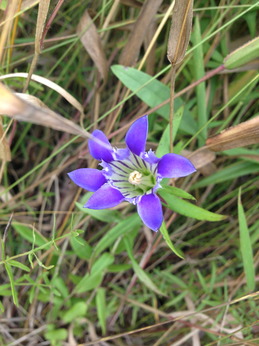
On a side note, this little blue gem just started flowering!
Kelly’s data from 2012 modified for use in RStudio
master_datasheet_MODIFIED.csv
After leaving June first to the Societyy of Wetland Scientists conference at Duluth, MN, I am definitely returning to the coolest city in this country “My sweet home Chicago” today. It has been a very interesting and special summer for me. I have had tons of good experiences. I certainly had the best experiences in the Star of the North (Minnesota). Specifically, with the Echinacea Project. Thanks guys of the Echinacea team 2013, Gretel, Stuart, and family.
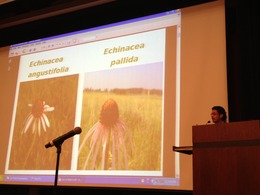
On August 26th, Marie and me had the opportunity of sharing our respective research in the Field Museum of Chicago. We found a very receptive audience for the Echinacea project. I had good amount of very interesting questions. Overall, people liked the fact that several students have been working in research that complement each other. This is the case of Shona in 2012 with Marie and me in 2013.
Now, I am preparing to present this research again in my university symposium on September 20th and as a poster presentation at the SACNAS National conference at San Antonio TX next on October 4th.
Again, Thank you very much to everybody who is or has been part of this fascinating enterprise called the Echinacea project
|
|


-thumb-260x346-136589.jpg)