|
|
Happy 2014 everyone! Here’s the latest news from The Echinacea Project.
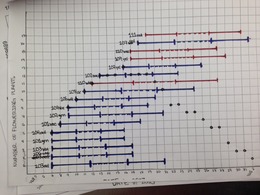
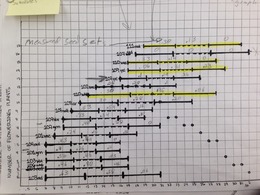
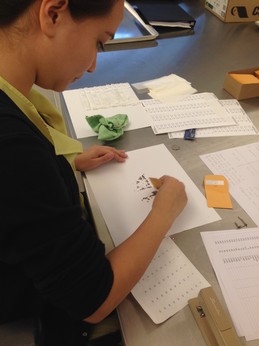
Grace and Aaron, two students from Carleton who spent their winter breaks in the lab, finished up their internship on Friday. They did some great work with the E. angustifolia and E. pallida heads we collected from Hegg Lake. If you recall from the summer, Dayvis looked at the flowering phenology and pollinator assemblages of these plants. In short, Grace and Aaron followed up on Dayvis’ work by examining seed set (via x-ray AND weigh machine!) of the top, middle, and bottoms of each head. They were interested in determining the likelihood of hybrization occuring naturally between pallida and angustifolia and modeled this likelihood with the Dayvis’ phenology data from this summer. They created some beautiful, hand-drawn flowering schedules (shown below) and they’re working on finishing a report that we will post soon.

Above: flowering schedule with pallida heads shown is blue and angustifolia shown in red. Below: flowering schedule with seed set of each section of each head written in pencil.
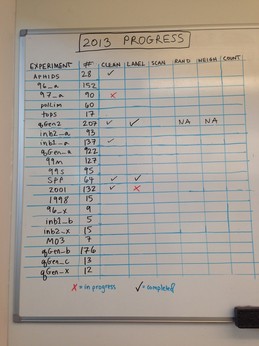
We’re now tracking the progress of our 2013 heads with this handy-dandy white board chart. On the left we have all our experiments in the common garden and the number of heads in each experiment. The chart may look mostly empty, but that doesn’t mean our volunteers aren’t hard at work! We had people come in on Christmas Eve and New Years Eve! What dedication! We will keep you updated as this chart begins to fill up!

Stay warm!
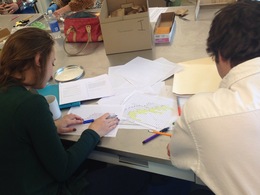
Here’s Melisa’s final powerpoint from her mini-internship last month. You can see our seed set results from the 6 remnants we collected Dalea purpurea from this fall as well as maps of all our plants locations!
CambronMiniInternshipFall2013.pdf
Grace and Aaron have made headway with the E. angustifolia and E. pallida heads we collected this fall from Hegg Lake. They dissected the heads into top, middle, and bottom sections and they’ve already scanned and counted the achenes. They’re currently at work weighing achenes. I’m sure you’ll hear more about they’re progress next week!
Happy Friday the 13th!
We hope everyone had a good Thanksgiving and is embracing the cold weather and snow! A couple big things have happened in the lab over the last few weeks.
We have two interns, Grace and Aaron, from Carleton College who are working in the lab during their winter break.Their main project has been deciding how to proceed with the Echinacea pallida and E. angustifolia heads we harvested from Hegg Lake this fall. Dayvis observed pollinators and took phenology data on these heads during the summer for his REU project and now we’re interested in seeing if these two species have actually hybridized in nature. Grace and Aaron are currently working on making flowering schedules for the heads we collected.
Stuart heard back from the NSF with good news! They’re funding the proposal he submitted this summer! With this grant money he plans to examine constraints on reproductive fitness of Echinacea in remnants by combining data on spatial isolation, flowering phenology, and mating compatibility. Really cool stuff!
Other than that, it’s business as usual here at the Chicago Botanic Garden. Our volunteers have been working hard cleaning heads and counting seeds. We’re definitely making headway on this year’s harvest!
Stay warm!
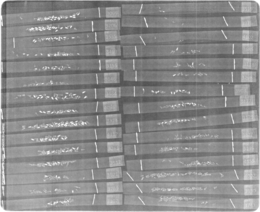
The preliminary results for our Dalea purpurea experiment are in! Melisa, our Lake Forest College student, came for the final installment of her mini-internship yesterday where we analyzed the results of the full pod counts. Just as a reminder, these pods originally came from 120 D. purpurea plants in 6 remnants (Lf, Spp, Sgc, Woodys, Rrx, and On27) and we hypothesized that the sites with the largest populations (Spp and Lf) would also have the highest seed set. After looking at the xray images (see a photo example below), we compared average seed set, as measured by full pod counts, across the 6 remnants and found that On27 and Woody’s had the highest seed set. There was enough variability between sites that our results were significant (meaning that site matters when looking at average seed set of Dalea purpurea populations). Obviously sheer remnant size is not the only factor influencing seed set in these populations since On27 and Woody’s especially, are relatively small. More investigation to come!

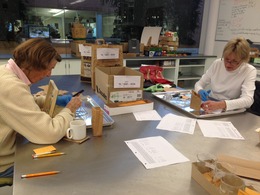
Our volunteers have been hard at work cleaning and counting the past few weeks. After recovering two “missing” boxes of achenes from 2011, Susie finished up all the weighing that needed to get done and we were able to organized the 2011 achenes in hopes of getting them placed in long term storage later this year. Here’s an action shot of Susie and Susan cleaning!
I’m in the midst of searching for background literature on inbreeding and phenology as I’m hoping to asses whether mating system influences flowering time using Team Echinacea phenology data in the INB gardens. I’ll keep you all updated as these results come in.
Stuart’s off to Minnesota and I’m off to Rhode Island today to celebrate Thanksgiving. We hope you all have a wonderful holiday!
Last week the volunteers began cleaning heads from this years harvest. It was a productive week; we cleaned ~60 heads.
This week and last week students from Lake Forest College came to the botanic gardens to begin mini-internships. They will be coming two more times in the next two weeks to assist various labs in projects. For our project, we’re looking at seeds of Dalea purpurea we collected from six different remnants this fall (SPP, Woodys, RRX, On27, SGC, and LF–120 plants total). We’re planning on taking a sub-sample of seeds from every plant and x-raying them to see if seed set varies in different remnants. The past two weeks we’ve had Melissa (our student) randomize the seeds to take our sub-sample. We’ll keep you posted on our findings!
Our hope is eventually to plant these Dalea seeds among our Echinacea in the new common garden (south field). Who knows, this could be the beginning of The Dalea Project.
In other news we’ve already got volunteers underway with counting full achenes in our X-ray images (see flog post below for example) from the qGen2 crossing experiment and soon we’ll be able to analyze these data and see how seed set varies among different crosses.
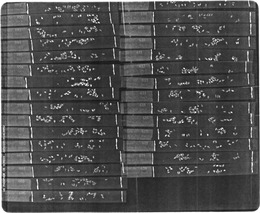
We took some high-quality images of Echinacea achenes for our q2 experiment this fall; an example is below. Notice how easy it is to distinguish empty achenes from those with embryos. By darkening the room and removing the opaque film, we were able to use lower levels of xrays for a shorter duration than we have previously. This plate was exposed to 12kV x-rays for 4s. We used long, thin glassine envelopes to facilitate counting. Notice also that the laser-printed labels reveal the packet IDs.

X-ray image of 30 packets of achenes from
Echinacea angustifolia. Click on thumbnail to enlarge.
Well it has been quite a while since our last update and a lot has happened in the last couple weeks. I don’t think I’ll be able to recall everything that we did to wrap up the field season, but here’s a rough summary of a last few weeks.
We finished harvesting all the heads for this year on October 18 which I think is probably one of the latest harvest dates ever for Team Echinacea! The volunteers at the botanic gardens have now begun inventory on the ~2300 heads from this season.
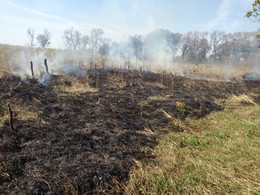
We burned the new common garden site! The weather/wind direction looked good and so on October 9th Stuart, Dwight, Ilse and I went out and set afire the south field. It was both Ilse’s and my first burning experience and I think both of us found it be hotter and smokier than we were expecting. The burn took roughly 3 hours and was a little patchy in places but overall a huge success and made clearing the rest of the plot and planting a whole lot easier.
The next step after the burn for the qGen2 crossing experiment was to clear all the trees, saplings, stumps, etc from this new field site and apply another round of herbicide to ensure our prairie stays prairie in the future. After this was completed, Ilse and I then set out to stake (with the GPS equipment) a planting grid. Unlike other common gardens, planting in the south field did not take place in consecutive rows. Instead, we planted along “random” rows in the field in order to ensure that more plantings can take place in future years and so that we can compare different plantings across the field site without worrying about any small scale effects of location.
Prior to planting, however, we x-rayed the achenes down at the Chicago Botanic Gardens. We spent roughly two full days scanning and packaging achenes into glassine envelopes which we were able to subject to very low doses of x-ray and still decipher how many full/empty achenes there were. Unfortunately, some crosses did not yield any full achenes (perhaps these were incompatible?) but the silver lining was that we were able to look at the x-rays, pick out the crosses with only empty achenes, and exclude them from the planting portion of the experiment.
Planting got delayed a bit because of wet and cold weather, but we finally put the seeds on the ground this past Thursday and Friday (Oct 24-25). Ruth Shaw and Katherine Muller came to help out on Friday. We planted achenes from each cross along one meter segments. Planting went smoothly (it was 50 degrees on Friday!) except it was very windy. Even though Echinacea is not normally considered to be wind dispersed, we had be to extremely cautious when planting since large gusts of wind were frequent and could easily blow away the achenes.
And with the gQen2 crossing experiments seeds on the ground, the field season has finally come to a close. Ilse and I departed from Kensington, our home for nearly 5 months, this past weekend and went our separate ways. I came down to Chicago and started working at the botanic gardens this past Monday where I’ll be managing Stuart’s lab until June.
Final consolidated file of ech. ang. flowering phenology data from 2011
Edit: now with sppe and sppw differentiated
2011DataFINAL.csv
Hello again faithful flog followers! I’m here to update on another week for Team Echinacea.
We’ve finished dissecting the qGen2 heads! This was a big job and thanks to a lot of help from Gretel and many dissection full days, we were able to power through and get all the achenes out and ready for their next step: x-raying. Ilse and I will be driving down to Chicago in the next week or so to x-ray all the achenes before they are planted. The x-ray will be useful in determining whether achenes are empty or full and will (hopefully) be faster and more reliable than weighing achenes.
Harvesting is nearly complete (~15 more heads in CG1) and we’ve collected many more bags of bouteloua and little blue stem. The new common garden is still in the progress of being fully lopped and cleared of small trees and we’re all really hoping for some good burn-friendly weather in the next few weeks as it would make planting a lot smoother. This week we also went out to six remnant sites and collected seeds from Dalea purpurpea plants. We GPSed these plants with the hope that we can plant their seeds in the new common garden and begin what may become “The Dalea Project.”
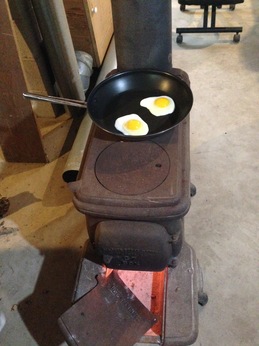
It’s also gotten a bit colder in Kensington and we’ve had a few days of thunderstorms and rain showers. A tree got struck by lightning out on Tower Road (around 100m from Hjelm House) and the shock/sound frightened all of us to pieces. That’s the closest I’ve ever been to lightning striking! The cooler weather also means we’ve started using the wood burning stove in the basement of Hjelm House on a more regular basis. On Friday Ilse and I decided it might be fun to try and cook some eggs on top of the stove and it worked out deliciously!
Here’s to another pleasant and productive week as we wrap up the field season!
Lydia
We are over the peak harvest bump! Looking through the harvest data sheets its clear that we have harvested well over half of the heads that were in cg1 this year. Lydia and I are dissecting the heads that were used in the quantitative genetics experiment this year. Out of just over 200 we are more than halfway finished extracting the achenes, each head takes approximately half an hour. Prepping the new experimental plot is still in progress though most of the trees have been cleared out at this point. We’ve begun collecting little bluestem and Bouteloua seeds which we will broadcast in the new plot this fall. We’ve also discovered windy days are NOT the best days to do this, even a slight wind will carry away the little bluestem. We also completed the first demography recheck of the fall and there are many more to come.
|
|