|
|
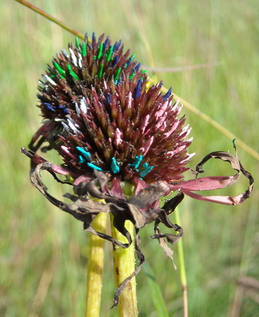
Saturday was a quiet day for those of us living at the town hall. Katherine biked in to the Hjelm house to work on her aphid addition and exclusion project and I spent a few hours at Hegg Lake repainting the last of the bracts from my crosses and harvesting the first pallida head. Kelly and Andrew were both away for the day, and everyone else took a needed break and spent the day relaxing.
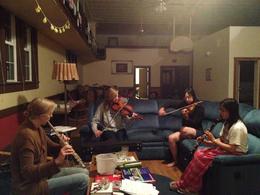
In the evening we took out our instruments and all played together for the first time of the summer. I’m not sure how it worked out that we didn’t get around to playing together until Lydia’s last night, but somehow that’s just how it worked out. I’m glad we did get the chance to all play together.

Some of my painted bracts

playing music, photo courtesy of Jill
A bittersweet day for the Echinacea Project crew, we returned to the Hjelm house feeling both proud that our poster presentations went so well, and sad that the summer is coming soon to a close for some of us. We spent the morning tying up loose ends on our projects, working on project status forms, and doing a little cleaning and organizing. I made an exciting discovery while following up on a comment I received on Thursday. It turns out that i missed a few pollinators when going through the many hours of video, so now I have data for for three more pollinator visits, bringing my sample size to 29 bees! Yay! After lunch We all worked together to complete an ant/aphid survey for Katherine’s experiment, harvest heads in CG1 and CG2, and collect a pail full of Bouteloua seeds from CG1. We finished the week off right with rootbeer floats as a farewell celebration for Lydia on her last day working on the project.
At 6:30 this morning we piled into the car, headed to the University of Minnesota in Minneapolis, and presented our posters. Although the symposium was dominated by pre-meds, it was a good experience for us to explain our research to undergraduates with different focuses. Next week Andrew and I are off to Chicago to present again at the Chicago Botanic Garden.
Here’s a picture of all of us at the conference:
It was a dark and stormy morning. With the exception of Jill, Maria, and I, the members of team Echinacea bided their time at the old town hall waiting for the rain to diminish. The three of us had indoor tasks to work on–specifically, sorting ants and entering data. After the sky had exhausted itself, a group of us went to a large site at East Elk Lake Road to search for flowering plants for the annual Echinacea demography census. We had searched the site before, but the cloud cover made prime conditions for finding Echinacea among the shrubs and trees. Stuart, Maria, and Andrew went to another large and difficult-to-search site (Aanenson) to take GPS points on plants.
After that, several of us began censusing Riley, a roadside remnant. The site is full of flowering plants, many of which are growing in the road. Because of this, many of the plants have lost their heads due to mowing. The team finished Riley in the afternoon, leaving enough time to census a nearby site we call Woody’s.
I spent the afternoon excluding aphids from plants in my aphid addition/exclusion experiment. Aphid infestation is clearly on the decline for the season. Each time I perform aphid exclusion, I record the number of aphids present on the plant before I remove them. This time yielded the lowest aphid counts in my exclusion group this summer. I haven’t crunched the numbers yet, but based on my exclusion data I estimate that the peak of aphid season was probably between July 25th and August 1st. That is much earlier than last year, when the peak was between August 12th and 26th.
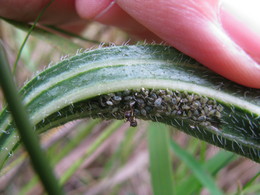
Last Saturday when I was performing aphid additions, I noticed that a lot of the plants in my addition group had colonies of dead aphids. For example, one plant that hosted nearly 2000 aphids on July 21st was down to 7 last Saturday. For an idea of what this transformation looks like, here’s a picture of a dense, thriving aphid colony:
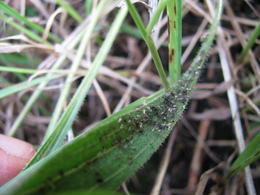
And here’s a picture of a colony that has died off:
It is unclear why this happens so suddenly, considering the plant is still green. My guess is a surge of defensive chemicals in the plant.
On Thursday, all the undergraduates are going to the University of Minnesota for a poster session. They all did a great job on their research projects and put a lot of time and effort into their posters. I wish them all good luck in their presentations and look forward to hearing about their experience.
Here’s all of my data from my crossing experiment and the R script that I used to analyze it! I’ll put up a metadata sheet soon.
angustifolia_pallidaCrossData.csv
final crossing script.txt
Hallo once again from K-town! It was yet another wonderfully nice day out in the prairie of Minnesota. This morning, Maria and Katherine headed out to the Landfill site to GPS all of the flowering plants we found earlier (about 80 of them this year). Kelly, Jill, and I headed over to Around Landfill to do demography on the plants Kelly used for her phenology project. And Shona and Andrew won (at long last) a battle with our second GPS unit (which arrived yesterday), Chekov. Chekov has come to join Sulu in our endeavors to gain coordinates. But it’s best if both work properly. Oh, and Kelly’s last plant at all her remnants finished flowering today! It’s bittersweet.
We came back to the Hjelm House later in the morning and had time to work on getting things ready and wrapped up for our poster presentations on Thursday. Yoiks! It’s coming up quick! Ruth came up with Lisa, and undergrad, and Dave, a potential post-doc for the Echinacea Project. After lunch, Dave gave us his presentation on his work with Solidago velutina (goldenrod). We then headed over to Aanenson to do demography. There were not very many flowering plants there this year, though Jill and I found a monster of one on the side of the road. We had both GPS units out with us, but we had a ton of trouble with them and were only able to GPS a few plants. We’ll just blame it on solar flares again. Once finished, we reconvened at the Hjelm House for some nummy watermelon fresh from the garden! Maria also found something interesting while we were out. We’re thinking these might be egg sacs of some sort, but we’re not quite sure.
I’m really excited to present on Thursday at the U of M! Come check it out.PolEfficiency2012_small.pdf
Title: Examining Pollen Limitation in a native prairie panic grass, Dichanthelium leibergii
MW-UMN-30×40.pdf
It has lots of cool pictures and Dichanthelium as the background! 🙂
See you at the symposium!
Here’s the poster I will be presenting at the University of Minnesota on Thursday.
Shona Sanford-Long_compatibility poster_small.pdf
Here’s a copy of the poster that I submitted for the poster session at the University of Minnesota. It has some preliminary results as well as a list of future data analysis that I want to complete.
kapsar_UofMPoster.pdf
|
|