|
|
The past couple of days have been lovely for outdoor work–sunny, cool, a little breezy. On Monday we said bon voyage to the Wagenius family as they prepared for their trip back to Chicagoland. Stuart will be back next week, but Gretel and the kids are done for the summer. Now there are five of us and no shortage of work to do.
Monday morning we went to the site off of hwy 27 to take demography data on plants that flowered last year and reconcile errors from this year’s demography census. With two teams working with the GRS-1 GPS units, the task went quickly and smoothly.
We spent Monday afternoon re-finding seedlings at KJ’s. This is a particularly challenging site because there is a high density of plants in a small area. We continued the endeavor this morning, and I’m happy to say are nearly finished. We should be able to defeat the beast tomorrow morning.
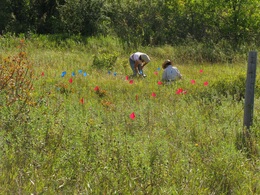
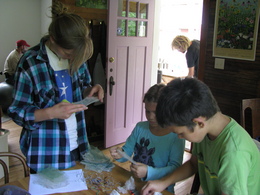
Here are Jill and Maria looking for seedlings at KJ’s. Red flags mark completed focal plants.

This afternoon we performed some routine maintenance of the main experimental plot, pulling out flags that marked plant we could not find. Then we spent the rest of the afternoon on individual projects.
Karen Taira, who came up last week, has been spending her days working on her pollination experiment involving several species of Helianthus. Her field story of the day was that she found a pile of entrails next to one of her experimental plants. Apparently they were bigger than a prairie dog’s and smaller than a human’s. Perhaps it’s a new form of sacrificial sun worship–Praise Helianthus!
After lunch on Wednesday, Andrew and I left for Chicago to present our posters and give 5 minutes talks at the Chicago Botanic Garden. Thursday we navigated the city, got caught in a downpour, and missed our train. Friday we had better luck– we made it to the garden on time, stayed dry, and both gave strong presentations. In our downtime we visited the gift shop and toured the gardens.
Here are pictures from Friday:
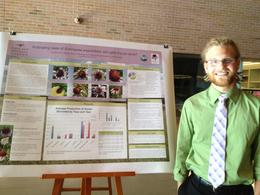
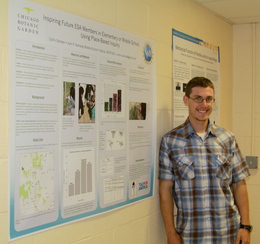
Andrew’s Poster
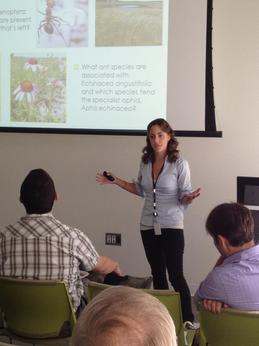
My talk

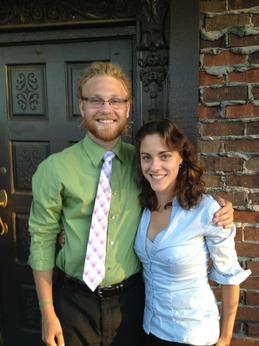
Andrew and I after our presentations and pizza dinner
Like their hosts, Echinacea aphids exhibit a strong seasonality. There’s a sharp rise in the frequency and abundance of aphid infestation followed by a rapid decline in early fall. That decline has occurred much earlier this year than last year. Fortunately, that has given me a chance to make some observations about what happens to aphids at the end of the summer. Here are a few things I’ve noticed:
1. Throughout my surveys in CG1 and several prairie remnants, I’ve noticed that the frequency of winged morphs has declined since July. Last week, I did not see any winged aphids, with the exception of a couple at East Elk Lake Road. This implies that dispersal declines as aphid numbers drop.
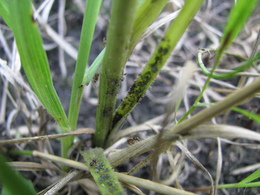
2. I and several others have noticed that aphids are starting to congregate at the base of the plant both at the petioles and at the base of the stem. I’ve also seen aphids crawling down beneath the soil surface and a few latched onto the tops of roots. One possibility is that as plants withdraw resources from their leaves, aphids move down the plant to follow their food source. I’ve also seen ants moving aphids at the base of the plant and placing them in dirt structures. These observations support the notion that aphids overwinter on Echinacea roots.
Many aphid species in temperate regions spend the winter and summer on different plants. Their winter host is where they lay eggs and their summer host is where they feed and reproduce asexually. My guess is that Aphis echinaceae does not have a separate winter host.
This plant at Nessman’s had a bunch of aphids congregated at the base. Notice the little green guys on the stem:
This is one of the plants from my aphid addition/exclusion experiment in CG1. There are still aphids on the leaves, but most of them have moved to the petioles:
After a fairly cool start, we enjoyed a sunny and mild day that was perfect for field work.
Katherine was finishing up with the ants and aphids at Staffanson today. Karen continued pollination treatments on Helianthus species at Hegg Lake and Riley. The team worked on demography at various sites, pulling flags and taking GPS points.
We can’t wait to hear how about the REU symposium at the Chicago Botanic Garden that Jill and Andrew are attending today!
Today, we say farewell to yet another Team Echinacea 2012 member as Shona heads off to Vermont. The end of field season seems to be near…….
Thursday was a cool, beautiful day in Kensington. Our main task this week has been to finish up the first round of demography at all of the remnant prairies. Today Stuart, Gretel, Shona, and I went out to work on some of the smaller remnants (usually <10 flowering plants). Demography is a great way to allow us to keep track of plants over time and monitor the flowering patterns of both individuals and populations.
Katherine and Maria started on Katherine’s last round of ant and aphid surveys in the remnants today. It seems like the peak of aphid season has come and gone, but this last survey should help her determine the rate of decline of aphid populations (and maybe provide hints as to where they all go in the winter!).
After a few mishaps with regard to seedling re-finds (the process of re-finding the seedlings, or “slings”, that have been discovered during Amy’s seedling search experiment), I decided to write a haiku to best express our emotions:
Seedling re-finding
Basals, slings, all on visor?
No one really knows.
Thankfully, Amy and Stuart came through to save the day and we now have a much more firm grasp of our mission. In short:
Slings are important
Basals only if they’re near
Gotta find the slings.
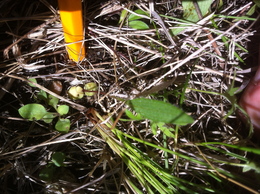
Here’s a picture of a seedling that we found earlier this summer. Take a look at the two green cotyledons at the base of the plant. Cotyledons only appear in a plants first year of growing and are the only way to be sure that a plant is a seedling instead of just a small basal.

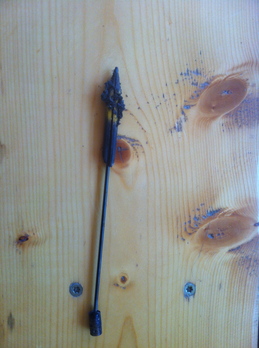
Today dawned slightly warmer than the past few days, and we spent a beautiful morning doing demography out at Staffanson. The west side of Staffanson was burned late this spring setting things back a little later than the east side and the remnants, and the big blue stem and indian grass are now in full bloom and about five feet tall. Dichanthelium is flowering, and I even saw a phlox, which I haven’t seen for weeks at any other site. The echinacea there have all finished flowering, but many still boast pink ray florets. The recent burn also removed all of the duff that we often have to dig through to find tags and check for nearby echinacea, and left everything greener and softer. One other result of the burn was this pencil that I found next to the last plant I demo’d. It looks like someone forgot to remove it from seedling searches…you can see the part that was sticking in the ground survived the flames.

It was Andrew’s last day today, he and Jill left after lunch to present their posters at the Chicago Botanical Gardens, and only Jill will return. To send him off we had rootbeer floats after a lunch which was also enhanced with bowls of delicious cucumbers, cantaloupe and grapes from the Wagenius gardens.
This afternoon we all had some time to work on our independent projects. Although we presented posters last Thursday I think all of us have plenty more that we could do. In some ways I feel like I have more work to do than when I started this summer, although much of it is still just ideas of new projects or parts of my project that I could build on if had more time. I did take the opportunity to get in a little more fieldwork, and Gretel drove out to Hegg Lake with me to help gather more data. We GPSed all of the plants for my crossing experiment again (the first time around the files got a little mixed up) as well as all flowering plants in my population of E. angustifolia. We also began developing a protocol to measure leaf pubescence for my characteristics study. From each plant we cut off the end of a leaf to be pressed and viewed under a scope, and then I painted a small patch of “new skin” (liquid band-aid) on the top of the leaf, waited for it to dry, peeled it off and mounted it on a slide also to look at under a microscope. While we were out there I completely lost track of time, and when Kelly called to see if we were done yet I was shocked to realize that it was already 5:30!
Title: Inspiring future ESA members in elementary or middle school, using place-based inquiry
Abstract:
Many obstacles hold back students’ learning in science in K12 education. Some obstacles, such as school culture and persuasive paradigms that “school is not cool” are a few, long-term hindrances. Only about 1 in 3 middle school students currently achieve proficient scores on state tests. With great burdens and distressing statistics, what can teachers do? They can make short-term changes in pedagogy to increase motivation and responsibility in their students.
This project explored place-based inquiry, which allows students to use the natural environment in which they live as an inquiry-based learning environment. Students gained knowledge and learned skills that could apply across the curriculum. In a low-income middle school, in northwestern New Mexico, 160 students engaged in a mini-unit, broadly exploring the nature of life science. Students designed an observational study – they formulated questions, wrote procedures, collected data, and drew conclusions.
This type of pedagogy was successful for several reasons. First, students were motivated to answer questions that they typically could not answer with a textbook. Second, students gained knowledge and skills that could be used across the curriculum.
Here’s a pdf of the poster: ESA Poster cswitzer 12.pdf
The conference didn’t allow photos in the poster hall, so I took one later! Here’s me with my poster!
Tuesday was a cool, windy day with scattered rain showers. In the morning we descended on KJ’s, a small site chocked full of Echinacea, to check on seedlings in Amy’s recruitment study. We made some progress, but we have a long way to go at that site.
In the afternoon, we all crammed into the pickup truck and rode over to Krusmark’s, an isolated site near the Wagenius property. Maria was especially excited to ride in the truck bed. We collected demography data on flowering plants and gathered seed from sideoats gramma grass (Bouteloua curtipendula) to scatter in the main experimental plot.
Since there were not many flowering plants, we finished up in time to catch up on chores around the field station. Here’s the Wagenius kids helping Shona clean up after her pollination crossing experiment. She and several others developed a wire contraption to keep the pollinator exclusion bags away from the anthers.
It is bittersweet to see a good summer coming to a close. Lydia left on Sunday, Andrew’s leaving on Wednesday, and Shona will head out on Friday. Although we are sad to see them go, we have plenty of work to distract us from our sorrow.
Today was a cool day! High temp of mid 70s.
Ruth and Amy came up from the Twin Cities, to give us a jumpstart to Seedling Refinds.
We overcame some technical hurdles with DroppedBoxx on Sulu and Chekov (our two lovely GPS units), and started seedling refinds at Steven’s Approach in the morning, worked way past lunch hour before Stuart called timeout.
We had lunch supplemented generously with bounty from the Wagenius family garden – juicy chestnut crabapples, ripe sweet cantaloupe, and cool yellow watermelon!
After lunch we stopped by the road outside CG2/Jennifer’s Plot at Hegg Lake, and harvested Bouteloua. We will broadcast the Bouteloua seeds in CG2 after the burn if DNR decides to burn the plot; otherwise we will broadcast half the seeds in the fall and half in spring.
Then we resumed seedling refinds at Steven’s Approach. We solved some tricky mysteries with the seedling maps, and completed Steven’s Approach! We also found a couple of flowering plants that had been missed during demo.
While we were doing all that, Karen was working hard at her independent project. The searching and keying paid off as she found a third species of Helianthus, H. tuberosus, at Hegg Lake.
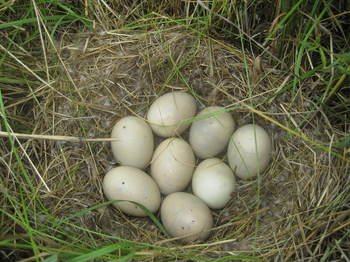
Here’s an unrelated picture of a pheasant’s nest near my Dichanthelium plot. The pheasant mum and I often startled each other during those mornings when I did fieldwork.

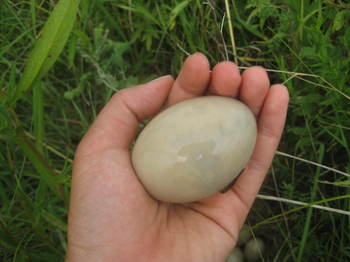
Look, a pheasant egg!
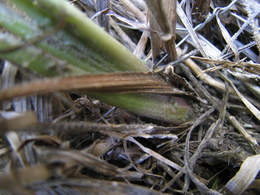
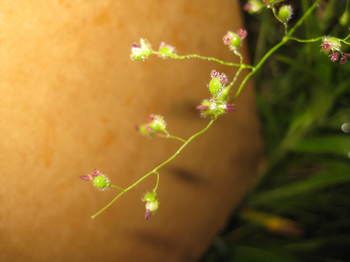
And I know you’ll forgive me for posting yet another picture of Dichanthelium 😀
Hi all, Maria at K-town.
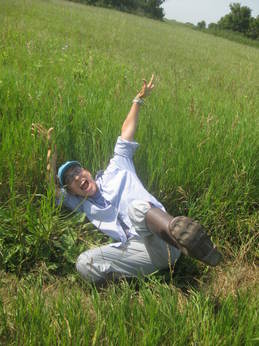
It was raining this morning as we bade goodbye to Lydia. All the best to Lydia as she prepares to go to Ireland for study abroad! Here’s a great picture to remember the fun times in the prairie 😀
Karen arrived at the town hall yesterday evening! This morning, she braved the rain and went out to many prairie remnants to look for Helianthus. She reports that Riley, Staffanson and Hegg Lake seem to hold the best promise for her pollen limitation experiments with H. maximiliani and H. pauciflorus, and maybe another H. species, if she can find it.
Andrew arrived back from his weekend trip announcing that he had all the food that’s bad for you all in one day. He, Shona, and Jill went to watch Alladin, the play by the Prairie Fire Children’s Theatre that Per and Hattie were in. They enjoyed it very much!
The skies gradually cleared up though temps were still in 60s-70s. It was quite chilly in the town hall.
With the squash, zucchini, and cucumber explosion 😀 😀 :D, Shona made zucchini bread. We also welcomed Kelly’s return from Northbrook about an hour ago.
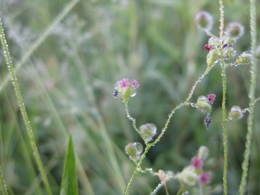
Lastly, here’s a beautiful photo of Dichanthelium with morning dew:
|
|