|
|
What a day! The kitchen at Town Hall was busier at 7:20 this morning than I’ve ever seen. It seems like everyone had the same idea to get up early and give their poster one last look before submitting it for printing. Thankfully we all got our posters in on time and we are enjoying a nice reprieve from poster-work this evening.
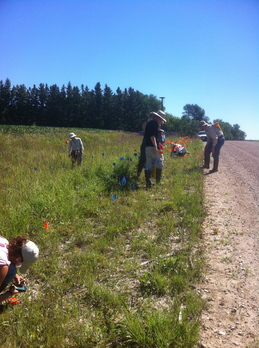
At work today, we completed demography on East Riley. There were lots and lots of flowering plants within a meter or so of the road that had been mowed and did not get chance to flower this year. In the afternoon, we worked on more demography at East Elk Lake Road and Around Landfill.

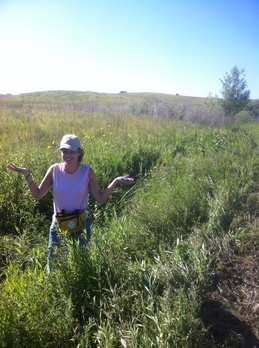
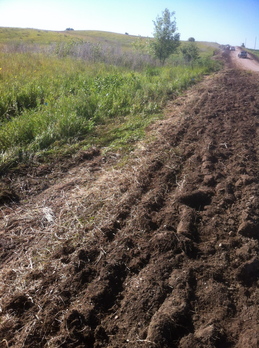
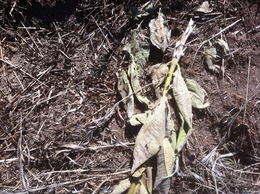
In the morning, Stuart told us about some roadwork that was happening along the Douglas-Grant County line by our Landfill sites. Katherine, Jill, and I stopped by to check it out. It looks like the road workers have dug up about 3 meters of roadside along the North-northwest of Landfill site. On the positive side, it’s lucky that this is happening after the plants had finished flowering, but on the negative side, one row of Jill’s pitfall traps have been buried. We met some of the construction workers who told us that they were working to improve the drainage of the road by evening out the roadside ditches. He also showed us the seed they were replanting: a mixture of brome, timothy, alfalfa, and clover among other things.

I guess this is a prime example of the habitat fragmentation and altered disturbance patterns that we’re here to study. It’s hard to watch the plants go, but in the long run these disturbances and our ability to monitor if/how the plants recover will teach us how to better manage prairie remnants in order to maintain stable plant populations.
Here is my poster for the University of Minnesota symposium. I may make some changes for the Chicago Botanic Garden symposium, but that depends on how much more data I get through by the 17th. Jillian Gall_REU Poster_Small.pdf
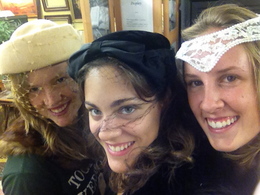
Posters, posters, posters. That’s what Saturday was all about for Team Echinacea (mostly). Saturday morning Shona, Kelly, and I broke away from poster monotony and headed to Alexandria to check out the farmers market, later ending up in an antique store trying on hats from the 30s.

Here’s what the rest of the gang was up to on Saturday:
-Maria biked to Hjelm house to clean up her data for R
-Katherine did her aphid experiment
-Andrew headed out of town for the day
-Lydia spent time with her Aunt
By the evening, however, everyone was back at town hall glued to our computer screens until the wee hours of the morning. Midnight banana and zucchini bread made by Kelly and Shona kept our spirits up.
Here is a link to my poster!
Lydia_Kan_poster_2012.pdf
So, a while back when GPS-ing the recruitment plots, there were a number of places where no nail was found in our initial survey. Here’s the list of those point numbers in the GPS:
250
257
276
278
302
319
395
406
These were supposed to have nails, but we were unable to find them.
407
422
428
434
435
Wow! Last year my last day of field research was a harvest day in September and I took heads from plants in the common garden and the last one from Hegg Lake plots,. This year we have started harvesting already and there are roughly one-fourth the heads to keep as there were a year ago. I tried but failed to get a good picture of harvesting but Shona clicked a nice one on Wednesday. While the wheat fields get harvested with big machines – some John Deere or Internationals, Echinacea harvesters are more “hands-on”
Today was full of re-checks for Team Echinacea. In the morning we finished re-checking all of the locations in the CG-1 experimental plot where we could not find a plant when we were measuring. If plants are not found for three years in a row, then they are considered to be dead. This means that an empty location gets checked five times before it gets a staple! This procedure allows us to be sure that we aren’t just overlooking a small plant that needs to be measured (small plants have important data too!).
For the remainder of the morning, all of the undergraduates worked hard on preparing for the University of Minnesota Undergraduate Research Poster Session next Thursday. Many of us are working hard to learn R before Monday when our posters have to be submitted. I believe that opinions are still divided with regard to R (although I personally converted back from the dark side after I finally figured out how to make my graphs work!). We’ll report back later with a final opinion.
Since we have been perfecting our re-checking skills in the CG1 experimental plot, Stuart decided we were finally ready to start tackling the CG2 plot at Hegg Lake. Unlike CG1, the Hegg Lake garden does not have nicely mowed rows or staples, which makes it more challenging to measure. However, we did find a fair number of previously overlooked plants this afternoon.
To cool off after work, Stuart bought ice cream and root beer for everyone. We all had ginormous root beer floats while trying to find GRE vocab words that could stump Stuart. I think we failed pretty badly. In the end, 2 liters of soda and 5 quarts of ice cream were consumed and good times were had by all!
Here’s an improved version of my poster on my pilot study of Dichanthelium germination, which I presented at the Undergraduate Research & Arts Expo at Northwestern. It’s pretty much the same content, but less text and neater.
MWangURGExpo2012poster_44_x_36.ppt
Might I ask how it already got to be August? Time sure seems to fly out on the prairie. To start out with, we continued doing rechecks in the Common Garden. We’ve found about 80 positions that were previously listed as Can’t Find. Yay!! The rest of the morning was spent on individual projects. Katherine worked on her aphid survey in the Common Garden, Jill continued to ID ants from her pitfall traps, and Stuart talked to Andrew, Shona, and I about doing glm’s (generalized linear models) on our data. Hooray for stats! The battle with R continues, though Kelly beat it by producing a pretty snazzy graph.
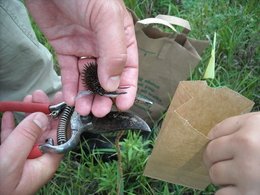
Now for the good part (not that other things weren’t good, but you’ll see what I mean). This afternoon, we started harvesting echinacea heads. If the head looked ready (as in pretty much everything on the plant by the head is brown), we chopped it off in an organized fashion and placed each head in a labeled bag.
Here’s a picture of us harvesting!
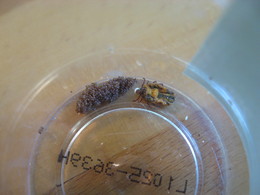
On a more displeasing note, that tick of ours is STILL alive and kicking. Or waving. Or whatever.
In the evening, the Wagenii made an appearance at Town Hall to watch the Bee Movie. It was enjoyed by all!
Oops!! I had an entry written for Tuesday, just waiting for the obligatory photograph, but somehow my title was published and nothing else was saved. So here is the delayed version of Tuesday’s events, maybe the extra hindsight will shed a different light on our activities…
We started off the morning with an hour of rechecks (Stuart and Gretel have limited the amount of time we are allowed to spend on them to limit the frustrating and demoralizing experience of looking for plant after plant and rarely finding any trace). It’s not all bad though, because among the strings of can’t finds, there is, on rare occasion, a tiny, fuzzy, triple lined leaf of echinacea peaking through the grasses (or sometimes a large and blatantly obvious one), and finding one of those is always worth a shout of joy.
Later, Maria, Gretel and I returned to the common garden to remeasure a few other plants whose measurements didn’t quite seem normal. We searched in vain for a black head someone recorded a no twist tie as being on the same head as, removed a few staples where there had been no records of staples ever being placed, and remeasured a head whose height had been recorded as 95cm (normal for pallida maybe, but not angustifolia).
In the afternoon Katherine, Jill, and Stuart took the GPS out to finish demography at On 27.
The rest of the day we spent working on independent projects. We’ve found out that our posters need to be finished by 10am next Monday so I think we all appreciated a little extra time. I spent most of my time on R again, it would probably take me less time if Stuart just told me exactly what to do, but figuring out what I can on my own is more rewarding, and this way I actually understand what I’m doing and will be able to figure out R again next time I need it. Kelly and I did spend about two or three hours trying to figure out how to show the number of flowers that had started flowering by each day, and after a few premature high fives, and one or two nudges in the right direction from Stuart we eventually produced a beautiful graph. At least it will be once Kelly changes the axis labels from accumprop and sDints and makes it so those of us who don’t know what those mean can make sense of what it means.
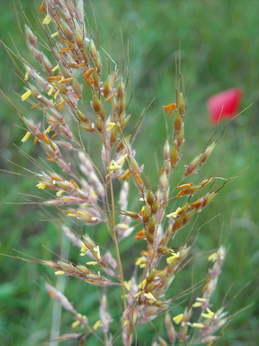
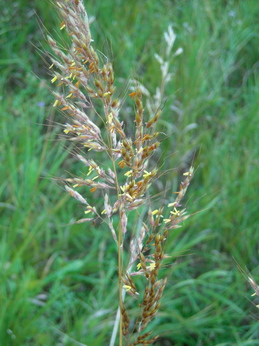
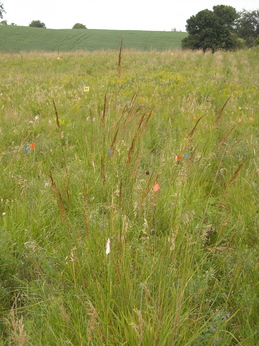
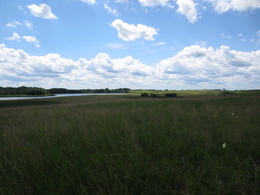
Working out in the common garden recently the views have been changing. Goldenrod is in full bloom along the edges and Big Blue Stem and Indian Grass have sent up tall stems (culms) and begun flowering. Some of the culms reach up above my head and I makes me wonder what it would have been like to walk through a prairie full of them.
Indian Grass- Sorghastrum nutans

|
|

-thumb-260x195-129959.jpg)