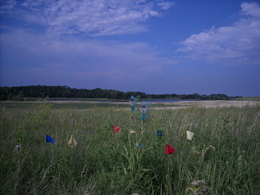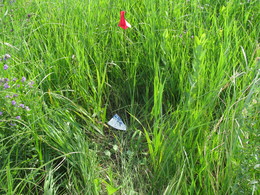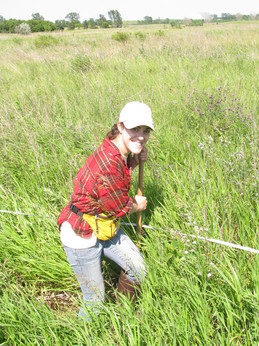
Who needs a sauna when you have the great outdoors? Yes, it was another hot and sticky day in Kensington, and we took it on and beat it. This morning, Katherine, Jill, and Lydia went to several remnants while Katherine used Sulu, the GPS, to find last year’s and this year’s flowering plants to use for ant and aphid surveys, and Lydia performed crosses on several plants at East Elk Lake Road and Around Landfill. Bug Catcher Kelly and Bug Catcher Andrew used Sweepnet in the Common Garden to collect pollinators. It was super effective! Shona and Maria were found over at Hegg Lake performing/analyzing crosses on echinacea and dicanthelium. This afternoon (or rather, last afternoon), a number of us continued measuring all the plants in the Common Garden. We’re 1/4 done!!!
|
||||
|
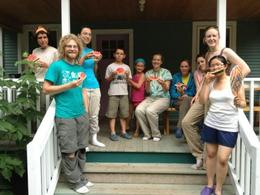
Monday was incredibly hot in Kensington, but the heat could not keep Team Echinacea from their work! Everyone is very busy working on their individual projects. Some members are beginning to get results in the form of shriveled styles, aphid counts, video footage of pollinators, and the end dates for Echinacea that have already finished flowering! The first flower to finish up in my phenology experiment was done flowering on Sunday, July 1st! Isn’t that crazy? It seems like it’ll be an early season for Echinacea this year. Other than individual projects, a few members of the Team went out and continued with phenology in C1 Monday morning. We also had a crew go out in the afternoon. They finished measuring in the inbred 1 garden. At the end of the day, everyone cooled off on the porch of Hjelm house with some refreshing watermelon slices.
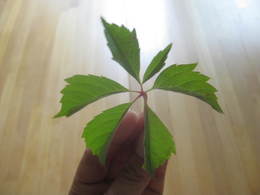
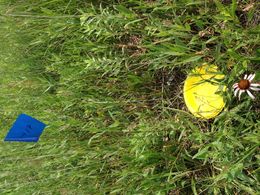
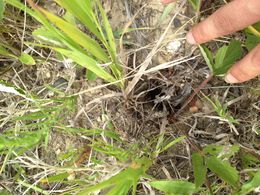
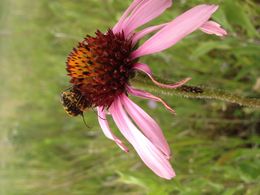
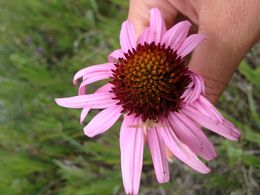
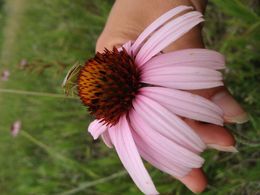
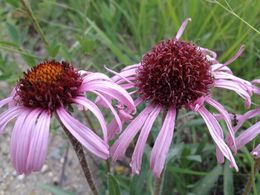
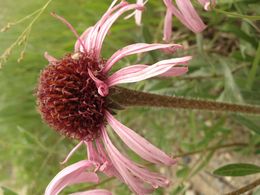
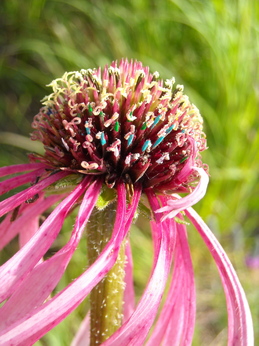
(Aghh I just finished writing and then when i tried to publish the site told me that my session had expired and of course I lost the whole blog post T___T ) Anyways… Some of us accomplished field work. To end off the week, here’s a special 6-leaved Virginia Creeper (they are usually 5-leaved) I found in the 99 south garden. Hope it brings everyone good luck! We, well, most of us, headed out to the Hjelm House to assess phenology in the Common Garden. Those that were not there were out in the remnants/preserves working on individual projects. Shona went out at Hegg Lake to perform some angustifolia and pallida crosses. Maria also went out to Hegg where she looked at dicanthelium. Once Common Garden phenology was finished, Andrew worked on his pollinator efficiency experiment. Kelly and Lydia headed out to a few remnants to do phenology and assess within-remnant crosses, respectively. Lydia had a few crosses that were entirely successful as well as some ambiguous results. The afternoon was fairly relaxing and comprised of a trip into Alexandria, laundry, frisbee, and playing with Felix, the new kitten. Despite the heat and humidity, Friday was yet another productive field day for Team Echinacea. This morning everyone worked on their individual projects. Since my pitfall traps are ready to go, Greg and I placed pollinator traps on different prairie remnants. Pollinator traps are these nifty –and apparently hard to come by– yellow bowls that you fill with soapy water. Traveling from remnant to remnant, we also discovered that there’s a giant hole where the landfill prairie remnant used to be… Later this morning, equipped with buckets as chairs, Greg and I headed up to one of the hills around Hegg Lake to observe some large soil-nesting bees. After an hour of watching, we saw two bees land in different holes, but no bees emerge. We’re not sure whether these bees are solitary or eusocial. I also scored some pictures of the arthropod life on Echinacea heads.
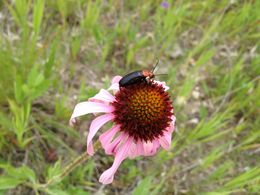
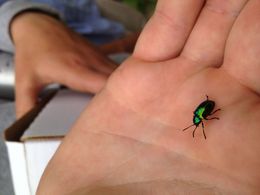
Greg and I took off a bit early from measuring to go collect the pollinators from the traps we set out earlier in the morning. Also, Shona made a beetle friend! We’re still trying to figure out what exactly this little guy is and I’ll post it once we figure it out. I realize that most of these pictures are sideways and I don’t know how to fix it at the moment. All of them were rotated the right way when I uploaded them…go figure.
This summer I’m building off of Nicholas’ work with E. angustifolia and E. pallida hybridization. I uploaded my proposal last week, but I’ve already learned a lot since then. angustifolia_pallidaCrossingProtocol.doc It worked wonderfully for a few days, when most of the heads were flowering and I didn’t have to keep track of which plant had been sufficiently crossed and which needed more, and then it started getting a little complicated, especially when Gretel found another pallida head to add in….
Here are two of my Echinacea heads at Hegg Lake, bagged to exclude pollinators and thoroughly flagged to help protect them from being mowed. This morning we split our time between work on individual projects and observing phenology in the common garden and at Hegg Lake. I spent my morning at Hegg Lake again crossing the E angustifolia and E paliida that I painted yesterday. And when Gretel arrived to do phenology at Hegg Lake and pick me up she found a new E pallida in its first day of flowering! After a long lunch Gretel and Stewart explained the procedure for measuring plants in the common garden, and we completed the first few hours of what is going to be a lot of searching for and measuring plants. Of course, we also got to stand outside and enjoy the day, which thankfully wasn’t quite as hot or humid as yesterday. With the help of Andrew and Kelly, I finished setting up all of my pitfall traps for my ant survey today–a grand total of 12 5x30m plots and 144 pitfall traps! I started on Monday with Katherine, setting up Nessman, the smallest of my sites. We quickly learned that digging holes with the soil core sampler is much more efficient when we have some sort of sharp object to dislodge soil from the sampler & that having a dibbler to pre-form holes speeds up the process.
On Tuesday Katherine, Lydia, Kelly, and I set up the plots on East Elk Lake Road, Northwest Landfill, and North Northwest Landfill. Today Andrew, Kelly, and I braved the ticks out in Staffanson prairie preserve, knocking out the final 4 plots, 2 on the east unburned side and 2 on the west burned side.
To give the disturbed areas some time to settle, I’m leaving my traps capped until next week, after which I’ll collect specimens weekly and get cracking on ID-ing. For more details about why I’m doing what I’m doing, see my proposal. Also, a brief protocol for setting up and collecting from my pitfall traps is below: Here’s my summer project proposal explaining my work with the ants in the prairie. I still need to tighten up the methods a bit, so keep an eye out for updated versions! This summer I’m going to continue with Amber Z’s phenology research from last year. I’ve added on two new sites: North Northwest of Landfill and Around Landfill. I started taking data on June 18th when there were only a couple of plants beginning to flower, but now, many more plants have started flowering and a couple are even close to finishing! |
||||
|
© 2026 The Echinacea Project - All Rights Reserved - Log in Powered by WordPress & Atahualpa |
||||