|
|
I only need 680 positions/site, because the seeds will be in between the plug points. So attached is a .doc and an R file w/ the script to create 3 sites with ~680 positions in each. I have also attached the resulting .csv file, 3 columns “site”, “row”, and “pos”.
KG_row&pos_03 July.doc
KG_row&pos_03 July.R
KG_positions_03July.csv
Here’s the breakdown:
site breakdown.xls
Next steps:
- Assign each new.env ids to a row and position. See file: sane3blocks.csv
- Create labels.
- Put labels on envelopes.
- Assign each plug to a row and position (keeping in mind that they’re already randomized in the trays.)
- Develop planting protocol.
- Organize materials for planting.
- Mow sites.
- Plant.
Today Josh and I searched the last two circles at Staffanson Prairie (SPP). Our last search centered on this focal plant:

We found 23 seedlings in the circles at SPP, bringing our grand total for this year to 74. In comparison, we found 29 seedlings in 2006, 135 in 2007, 239 in 2008, and 93 in 2009. That’s quite a lot of year-to-year variation!
So this past week I was able to work on my project because the Echinacea has started flowering in the common garden! So far so good, but it is going slow…
The painting is going really well. I am able to distinguish one and two day old styles wonderfully based on how I am painting the brachts. However, the pollinators take their sweet time to visit my flowering Echinacea head when I want to do the single insect visit. I was under the silly impression that I would remove the pollinator exclusion bag and a bee would come flying to the flower, do its pollinating thing, and let me move on to the next plant. Wrong! Sometimes it takes a bee 30min to and hour to land on the flowering head, which means I am sitting there patiently watching a single Echinacea head for a long time. UffDa!
I do video tape the bees in case one lands that I cannot identify in the field. Plus, it’s nice to have video for my presentation later. BUT the video camera’s battery dies after a couple hours. So we may have to purchase a back up battery…
I have had 8 insect visits this week so far, and have noticed that they have all been after 10am. Maybe 10 – noon is the peek time for bees to collect pollen? Not sure yet.
The visits I have had are pretty exciting! I have had 3 Augochlorella visits, 2 Agopostemon visits, 1 Melissodes visit, 1 Lasioglossum visit, and 1 Ceratina visit. Quite a diversity!
The interesting thing is: when observing the shriveling or lack of the day after, Melissodes shriveled 1 style and only had a 3 second long visit! Both Augochlorella’s shriveled 1-2 styles each and they spent 5-7 min each on the Echinacea head! Looks like they are not very efficient pollinators, most likely do to thier small size and they barely touch the styles when collecting pollen from the anthers. Same with the Lasioglossum, which is around the same size as Augochlorella and it didn’t shrivel any styles. The Agopostemon spent a few minutes gathering pollen and shriveled 5 styles! I am curious to assess the shriveling of the other Agopostemon and the Ceratina (another small sized bee) tomorrow because those were the visits I had today.
A concern of mine is all the bags that are on the flowering heads in the common garden. Several people, including myself, are using pollinator exclusion bags. So maybe if the bees know that they wont be able to collect pollen as readily from the common garden, maybe they do not bother visiting as much as they would if the bags were not on the heads. Any thoughts?
The bags may also contribute to a lower pollinator efficiency if the bees are not able to transfer pollen as they would be if the bags were not on :/ …However, there will be more flowering plants as the season progresses and hopefully there will be a good number of them that do not have bags on them. So I am guessing I will see an increase in pollinator efficiency as the season progresses.
Also Gretel- would you be able to provide me with the peak flowering data from within the common garden when the time is right so that I can compare that to a peak in pollinator efficiency (if I see one)?
I believe thats all for now! I look forward to giving another update on pollinators next week! 🙂
Later,
Katie
After the fourth
The 55th Annual Waterama is July 19th-25th, 2010 in Glenwood .
Grant County Fair: July 22, 2010 – July 25, 2010 in Herman.
Hoffman’s Harvest Festival will be held August 13,14th, and 15th.
Douglas County Fair: Thursday, August 19 – Sunday, August 22, 2010.
Fourth of July fireworks on Lake Darling, just NW of Alexandria.
View Larger Map.
Well, it’s been almost 2 weeks since my last post. How time flies.
Accomplishments:
- Friday the 25th my seed envelopes (of remnant and restoration plants) arrived all sorted from IL. Thanks to my father and all the volunteers for working so hard to get that all done! Great job!
- We finished measuring the first 9 trays of my seed plugs. I think almost eveyone in the team has been helping with this, so my thanks are profuse to you all.
- Laura and I have been working hard to sort all of the purchased seeds into coin envelopes. (30 envelops for each species and source (3 species/3 sources) = 270 envelopes; 20 seeds per envelope = 5,400 seeds).
- Laura and I have also been working on her project together. It’s a lot of fun to visit her remnant sites and see how the floral neighborhoods change over time. Her data’s going to be very exciting!
- Early this week I was given verbal permission to plant my 10×10 meter plots of seeds and plugs at Hegg Lake, Runestone Park, and Bob Mahoney’s. I will hopefully have all the paperwork done soon for that!
- I’ve spent some time working on FNC and pollinator data, but not nearly enough. Hopefully, I’ll be able to devote more time to it soon, especially because I have less than 3 weeks to finish putting together my poster! Eeep!
To Do:
The big goal is to get my plants in the ground ASAP! To that end:
- Today, Laura and I will be marking out my plots.
- We need to finish measuring the 2nd group of 9 flats. It’s particularly important to get the Alive/Dead status for each plug, so I can plan for next week. I hope I can wrangle up more volunteers here, although I know everyone is working hard on their own projects. (Btw, special shout out to Lauren and Hillery who’ve been helping a lot with this!)
- I need to assemble my data to create new envelope labels with the location information for the plots, I’m hoping to get that done and and envelopes labeled by the end of the weekend.
News:
Parents are arriving today for a 4th of July visit! Hopefully they’ll get here in time to enjoy burger night at the K-town bar and grill, but if not they can meet everyone Friday morning.
We will be exploring Starbuck Heritage Days on Saturday (people are free to join us). There will be fireworks at 10 pm.
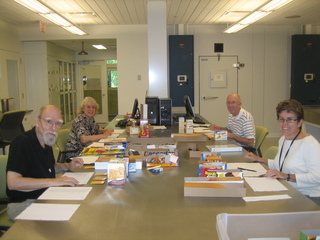
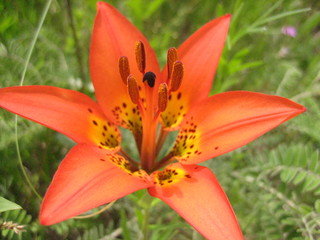
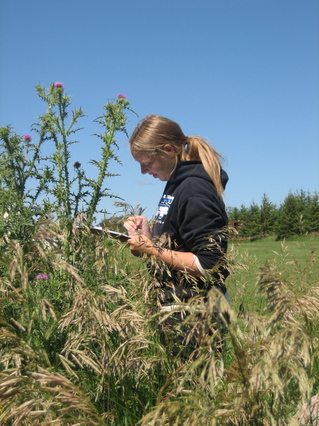
Some pictures from the weeks news:

Here’s a document that outlines a proposed visor form for the census of Caroline’s Next Generation Rescue experiment.
Proposed protocol for Next Gen Rescue census 2010.docx

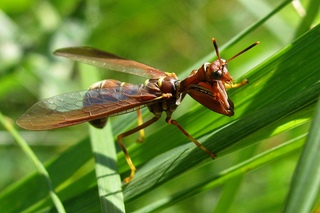
Ok, you have to enlarge this photo.
Climaciella brunnea: the Wasp Mantidfly is really neither of those things (well, it’s a mantidfly, but you know what I mean). It’s not a wasp (order Hymenoptera, includes bees and ants, too) nor is it a mantis (order Mantodea, pretty much just mantids). It’s actually more related to lacewings and antlions (order Neuroptera).
Doesn’t it just look strange?

June 21, 2010 marked the start of Echinacea flowering in the common garden this year. As of June 28, 2010 113 plants had started producing pollen. Approximately 775 plants will flower this season with a total of 1062 heads. We will be busy keeping track of the first and last day of pollen production per plant. As you can see from the pictures above, the pollinators are back at work, too!
|
|