
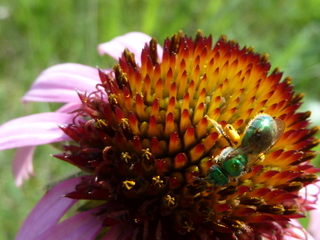
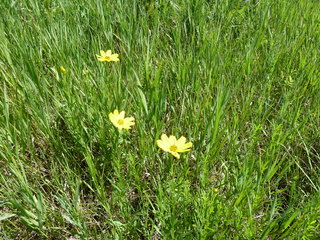
My project seems to be going well, I now have all of the sites picked out and data recorded for them. I have now seen all four of my plants in bloom at least at one of the sites. Here are a few pics I was able to capture of some of them.
|
||||
|
My project seems to be going well, I now have all of the sites picked out and data recorded for them. I have now seen all four of my plants in bloom at least at one of the sites. Here are a few pics I was able to capture of some of them.
So the weekend is upon us, summer is already beginning to slip away, and aphid abundance is on the rise. Mine and Lauren’s aphid specialization experiment is still being tweaked to perfection. We set up 5 preliminary aphid transfers on B genotype plants (the offspring of between site echinacea crosses) in order to practice appropriate aphid transfer methods and make sure that we can get aphid establishment on plants that we know aphids are found on (aka to ensure that our transfer methods do not result in aphid squashing and death). This proved perhaps more difficult than expected. I single-handedly destroyed the greater part of several aphid colonies before determining that trying to remove aphids from their leafy homes with a tooth pick was just not going to work. Eventually I settled on disturbing the leaf/gently poking at one aphid (which, it turns out, causes some species of aphid to release an alarm pheromone so all the other aphids on the leaf stop sucking phloem, withdraw their stylets and start moving around). Apparently many Aphis species do not have this alarm pheromone, but when I starting messing with the aphids/the aphids’ leaf they started running around in frantic disarray, so whether or not they release a pheromone, poking them seems to work. After instigating a mass aphid exodus, I attempted to herd several confused individuals onto the flat side of a twist tie. This was also more difficult than you might expect it to be, and was rather time consuming. When we set up our actual experiment we will knock the disturbed aphids into a petri dish, which will be a much more efficient method and will probably result in a significantly less aphid mortality. We had initially planned on using a single alate (winged) aphid as our population founder, because these are the individuals that would colonize new plants. However, this particular aphid morphology is not nearly as common as the apterous aphids (lacking wings). After conferring with Dave Andow, an entomologist from the U of M, we determined that using apterous aphids is fine, as we are testing plant suitability rather than aphid preference (ie CAN aphids colonize a certain plant, not which plant would a aphid PREFER. And anyway, preference will probably manifest itself somewhat in the form of population success and growth rate). We also discussed the important question of one founder aphid or two. If we can have lots of replicates we could have only one founder. If we are worried about aphid success rate and have fewer replicates, Dave suggested that we have two founders and just record whether one or both birth their aphid babies within the first one or two days of the experiment. Dear readers: Comments or suggestions about aphid founders are encouraged! One problem: whatever sort of aphid we use, we need to introduce gravid ones to our plants or there will be no population growth whatsoever and our experiment will fail epically. Thus it is now necessary for Lauren and I to be able to identify gravid aphids. Hmm. Apparently this is possible, and this is something we are going to have to figure out before our actual experiment can start. Again: comments or suggestion are encouraged! I think that covers most of the updates in the glorious and exciting world of me, Lauren, and aphids. Over and out! So these are the Stipa that have been collected so far. I’ve labeled a couple of the places on the map. I was having trouble projecting the data exported from GPS Pathfinder Office (trimble) and noticed that no coordinate system was defined (same issue with the DOQ maps Stuart gave me; the GeoTIFFs didn’t have a spatial definition). The GPS data should be North American 1983 in the Geographic Coordinate System folder (right click on the data in ArcCatalog, hit the XY Coordinate System tab and hit the Select button). The DOQ maps ought to be using the NAD_1983_UTM_Zone_15N from the Projected Coordinate System folder. Dumping all of these files into ArcMap (and a little fiddling) gave me this nice map. Next plan of attack is to make it work in GPS Pathfinder Office, as it’s much less complicated than ArcGIS. Here’s the schedule of events for Barrett’s Old Settlers’ Reunion. Here’s a list of plant species that flowered within 2m of a flowering Echinacea plant that we observed last year. The list is sorted by the count of inflorescences we counted. Species in the Asteraceae are highlighted.
Here are the locations of E. strigosus plants in the common garden: Here’s a picture of a Stipa seedling in the Common Garden. I’m about to create a form for entering data on our seedlings. We are debating if we should count and measure each leaf or count leaves and measure the length of just the longest leaf. Most of our time will be spent finding the plants and/or the toothpicks that we put in to mark them. So, taking the measurements of each leaf shouldn’t add that much time. Any thoughts? Stuart and I did an initial investigation of about 30 locations where Stipa was planted. We found plants at 40-50% of the locations! Caroline, what was your estimate for germination of these seeds? Josh, Gretel, Hillary, and Ian are also trained on the TopScan to collect the GPS data. The ideal is that the radio signal is at 100% and the designation of the location is described as Fixed – (Float will do and Auto works if you are unable to connect to a radio signal) We’re off to a great start this season. We’ve made good progress on our ongoing projects and folks are well on their way with their independent projects. We had better keep moving because the earliest plant in the Common Garden started flowering on the 21st! Here’s a list of independent projects for Summer 2010:
I attached a pdf file of our ongoing projects. Exciting news! Amy and Hillary found some seedlings at a Hegg Lake plot, the one thats on a hill (the hill with all the phlox on the side) near that blind corner. Anyway, there were nearby flowering plants so its great their reproducing! There were also a couple seedlings found outside the frisbee sized circle area. here are the pics:
This one is a close up of the shriveled cots (with an achene next to it), can you see it!?! The seedling finders, working hard! This was in the morning, getting ready for work: This is just a prairie lilly (Lilium philadelphicum) that I spotted at Staffenson. First time ever seeing one and I think their beautiful!
Lastly, this is a reminder for me to show Stuart my preliminary data collection sheet: -Katie |
||||
|
© 2026 The Echinacea Project - All Rights Reserved - Log in Powered by WordPress & Atahualpa |
||||

-thumb-320x240-45985.jpg)
-thumb-320x405-45988.jpg)
-thumb-320x240-45993.jpg)
-thumb-320x240-45997.jpg)
-thumb-320x240-46001.jpg)