|
|
So, for another update from the luxurious Hjelm house, which is THE place to be this summer. We recently had the wireless router in the basement stop allowing people to log on to the network wirelessly, so Stuart ordered a new wireless router, along with an 8 port switch so that we can have more than 3 computers connected at the same time. They got here yesterday, and I took them downstairs to set up.
The entire process of setting up took about 20 minutes, and everything worked like a charm. I hooked the cable modem up to the router, set up the router DHCP (Dynamic Host Configuration Protocol, used to assign IP addresses to computers on the network), and hooked the router up to the switch, after mounting them on the wall. However, I wanted to see if we could get wireless access in the Wagenius house, about 60 metres away.
Setting the router up near the window in the basement did not work, so I moved the router upstairs. After a couple hours trying various spots, it was placed in Stuart’s office, which offered easy access to an Ethernet jack, as well as a convenient window.
In order to enable both the wireless router and the wall jacks, while preserving the network, I had to disable DHCP on the new wireless router, and place the old one downstairs to act as a DHCP distributing thingy for the house. It took me a couple hours to figure this out as well, since I thought the wireless router could perform the same function through the switch.
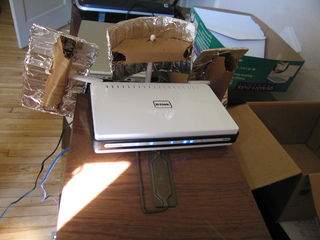
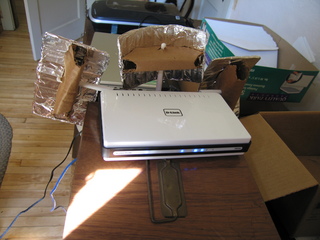
Anyway, to cut a long boring story short, the new router upstairs fell just short of the Wagenius house computer’s range, so using the excellent resources of (Lifehack.com, I made three parabolic reflectors out of cardboard and tin foil to boost the signal. They worked like a charm! They are originally the idea of this site: http://www.freeantennas.com/projects/template/, and I got the template to build the antennas from here: http://www.freeantennas.com/projects/template2/index.html.
Some pictures of the new wireless router:

So sadly, it looks like I won’t be able to come back to Minnesota again this summer. It’s taking much longer than I anticipated to score slides and time is really running out (is anyone else wishing they had a few more days this summer? I sure do..).
I was hoping someone could remove my bags from the ground sometime this week. I’ve posted a file with all the individuals who should have a bag located just south of the plant. I hope this isn’t a very busy week for you guys! The bags can definitely wait if that’s the case.
dataSheetMycorrhizae_8_12_2009.xls
I think Amanda should still have a file on her computer with labels for each individual plant. Coin envelopes were the perfect size for the baggies so hopefully there are still some of those left in storage.
Also, some of the bags may rip when you pull them out of the ground. To retrieve the membranes you may have to dig so you should have a trowel ready. You won’t have to dig more than 5 cm to find the brightly colored mesh with the membranes. Thank you so much for your help!
-Andrea
So, I know I have been missing from the flog lately, but that is only because I was saving up all my flog posts to make one huge, wonderful one! But this is not that post. First of all,
AphidSearch09FinalVersion.mdb
Here is the aphid search data for the past 6 weeks. Each plant has a unique RecordID that identifies it though all three tables. The UnitID field, while it might seem repetitive, is just from the format used on the Hjelm house computer. We have found 263 plants so far, but about 20 of them were can’t finds in following weeks.
This still lacks the transect searches that we will do next week, at which time I shal post an updated version. Note that even though this says Final version, this is just where I save all the final versions of my tables, as opposed to the working versions I use to sort out the tables.
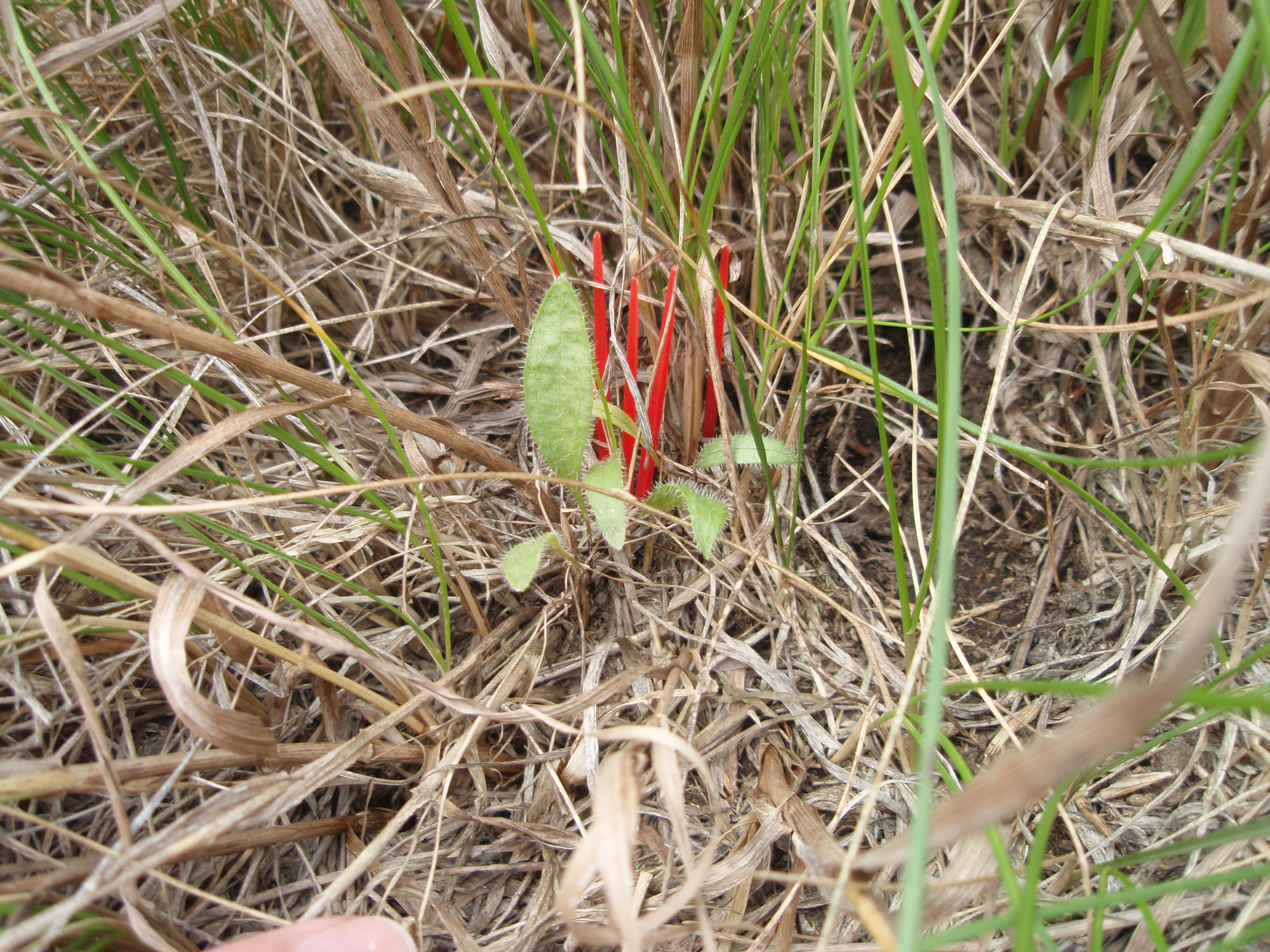
Today I found some healthy-looking Echinacea seedlings at my experimental plot in Perch Lake WPA near Leola, SD.
View image
The DNR sprayed this area (including my plot) last week, in an effort to eradicate yellow toadflax. It seems that my seedlings were shielded by the tall grass. It’s also likely that the seedlings are not in a rapidly growing stage, so they may have been less vulnerable than other broad-leaf plants.
Here’s another picture:
Come to the farm for a picnic celebrating the near end of the Echinacea season. I’ll be making pesto and roasted zucchini and yellow squash. Jean is making brownies. We’ll provide drinks and s’more necessities-including a monster burn pile. Hope to see you 6:30ish.
Until I get the website done, this list of measurements is all I can offer you. The measurements are in pixels. The measurements were made from multiple pollen on a single slide.Slide list.xls
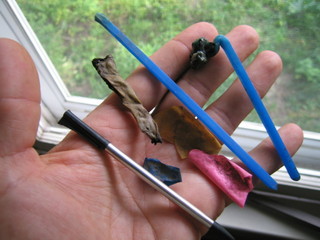
I found a few things besides Echinacea plants, while searching for plants that may have died in the common garden. I found a fossil shell. I gave it to Per and he held on to it for a while but dropped it. Someone else will find it! I found a stylus (for a handspring visor). It’s probably Gretel’s; she lost hers earlier this year. I found a snake skin with an intact top of head–the eyes were transparent-cool! Per gave to Hattie, I think. I found a mouse in a mouse nest (right on top of dead Echinacea leaves from last year). The mouse bounded away. Also, Ruth called while I was searching to say that she had just found the serial cord for the survey station data collector that we couldn’t find–we had been looking for that for a few days. Wahoo! Finally, I emptied my pockets of litter that I had picked up: three pieces of flagging, one melted plastic plug label, and 2 blue plastic cocktail stirrers.
Stuff from Stuart’s pocket: stylus (1), flagging bits (3),
melted plastic plug label (1), blue plastic cocktail stirrers (2)
We are making great progress on annual measurements of plant in the common garden. On Monday we finished measuring all plants (~10000). On Tuesday we finished placing staples at all locations where plants died overwinter in 2007-2008 (>700). Today we made a huge dent in “rechecks.”
Rechecking is when we revisit all the locations where we recorded a “can’t find” and left a flag while measuring. We placed about 1500 flags. About 700 of those “can’t finds” were stapled this year. So, we just verified that staples were in the correct locations and pulled flags. Some locations had staples from previous years that a measurer didn’t find. We pulled flags there too. Then there were the plants that were alive last year. We rechecked those and found quite a few plants. Each time someone found one, they yelled “wahoo” and the rest of us responded with a whoop and a holler.
Shucks, it was fun!! Actually I was burned out by the end. Next year we should plan two 2h sessions instead of one 4h session.
Perplexed by Stuart’s question – a trip to the hilltop here in Watertown, and Mimi’s poster, I checked again on the amorpha pollen – it is NOT bean shaped. But I do have reliable pictures – (Amanda don’t bother getting its pollen tomorrow)
What keeps amorpha and medicago sativa from occupying the same locations? Legume wars underground? Does Andrea have insight?
Here’s a snippet of R code showing how to extract info from the shrivel character data (a file is below…
df <- data.frame(shrivel.txt =c("x", "xoxx", "xxxx", "oooo", "xoooo"))
df      # start off with this data frame
str(df)

df$shrivel.count <- nchar(as.character(df$shrivel.txt)) #add column

vx <- gsub("o", "", df$shrivel.txt)  # replace o with ""
vx
df$shrivel.xs <- nchar(vx)           # make a new column in df

vo <- gsub("x", "", df$shrivel.txt)  # replace x with ""
vo
df$shrivel.os <- nchar(vo)           # make a new column in df

str(df)
df      # final data frame
codeForAllegra.r
|
|