I wanted to share Diedre and Jake’s REU posters with everyone…they both did a great job!
Poster-DRfinal.pdf
JJF Poster-final.pdf
|
||||
|
Here’s what needs to be done tomorrow, around 10am, for pollinating Cirsium altissimum at Hegg Lake. I will provide a clipboard with a data sheet, map, and pollinating tools. Plant numbers are on flags to the south of the plants. Plant 9-7 has a yellow twist-tied head that is flowering right now. It will need to be selfed. Yellow tt heads on plants 9-16,-6, and -8 may be flowering tomorrow. If so, they also need to be selfed. Plant 9-19 had two bagged yellow heads. One is done flowering, the other may be flowering tomorrow. If the second one is flowering, it should be selfed. 9-26 with a red tt may be flowering. If so, it needs to be crossed. Cross pollen can be obtained from 9-14, which has a white tt and is blooming now, or 9-21, which may be flowering tomorrow. To pollinate the heads, use a q-tip provided. For selfing, just rub the q-tip over the anthers to collect the pollen, then brush the q-tip on the stigmas. The pollen is very sticky and will easily stick to the q-tip. For crossing, rub a q-tip on the anthers of a pollen donor (white tt). Place in a labeled glass vial, transport to the head to be crossed, and rub the stigmas with the q-tip. Be sure to write down which plant was used as a pollen donor. Here’s a histogram of pollen sizes (~30 grains per species) from 3 individual plants of Coreopsis palmata, Echinacea angustifolia, and Heliopsis helianthoides.
Greg outlined the methods taking the measurements here. Greg, what software program did you use?
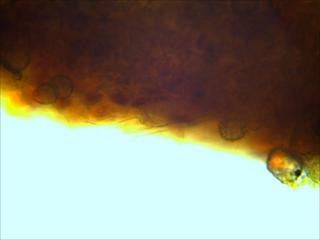
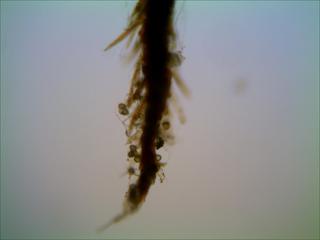
You WISH you were eating these cakes!!!!!! We miss you, Mimi! You too, Greg! Here is a file with the pollen storage data (excluding Stuart’s data on the 48 hour style persistence). We pollinated 3 plants in the common garden that were still flowering. Each plant had 3 treatments of stored Echinacea pollen; ambient temperature, frozen, and refrigerated. The frozen and refrigerated pollen caused shriveling, the ambient temperature treatment did not. Hey All, Now, onto the next step, taking pictures of these slides. I took my very first pictures today, just a couple to get the hang of things, they are attached to this post. From my fiddling around today, I can see that this is going to be a lot more work than I thought. First off, the pollen is hard to find, it’s not all at the same level of view, some of them are on top of the stigma and then they’re really hard to see. Also, it’s challenging to focus in enough to where I can ID pollen grains. Stuart suggested working on a random sample of my slides for the rest of the summer, and completing them this fall at the CBG. The only issue there is the change of machinery, but hopefully we can figure something out. As for the rest, I think I’ll be taking 1-2 shots of the entire style, and labeling them thus: stylevialID_site_date/time_A# – so A1, A2, etc. Then I’ll zoom in and proceed to take pictures at sites B through F on the style, and for each change in focus will be another number. The question is whether I should attempt to get a good sense of the exact number of pollen grains on the stigmas or try to ID the pollen types. I’d like to be able to do both, but I think for this summer at least, I’ll try to get a handle on the former rather than deal with the later. On that note, Caroline suggested using a clicker to count the number of pollen in a picture, and that seems like an excellent suggestion. Does anyone know if we’ve got one? Anyway, enjoy the pictures that I took so far:
-Kate Monster Here is my dataset that I am working on analyzing in R as a .csv file. Stuart, here is my R script so far: I made new columns in the .csv spreadsheet for the factors and levels we discussed. I will work on a list of hypotheses to test. I think I changed the definition of “y” when I did my 24 hour analysis. Can I give “y” a different name for each analysis? Or does the code need to read a defined “y” each time? Thanks for the help and check out the graph of 24 hours and the summary m2. Allegra Here are the data on the three pollen types and the protocol for measuring. Bad news – the Ech. ang. and Heli. heli. are very close. Good news – maybe the pollinators and plants can’t tell them apart either. PS – I am in SE Minn and the Monarda Sunflower and Miss. Goldenrod are in full bloom all over. |
||||
|
© 2026 The Echinacea Project - All Rights Reserved - Log in Powered by WordPress & Atahualpa |
||||