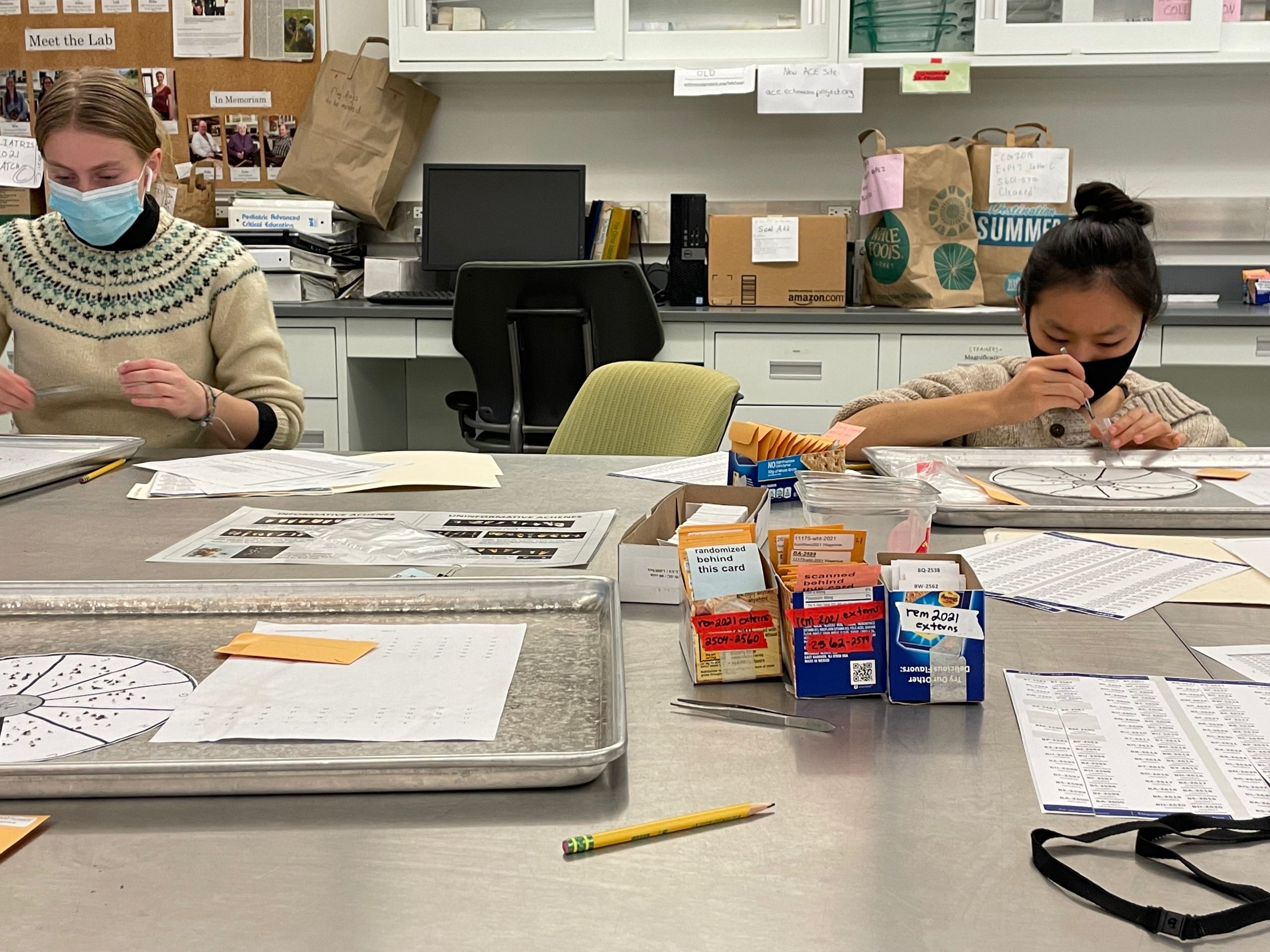
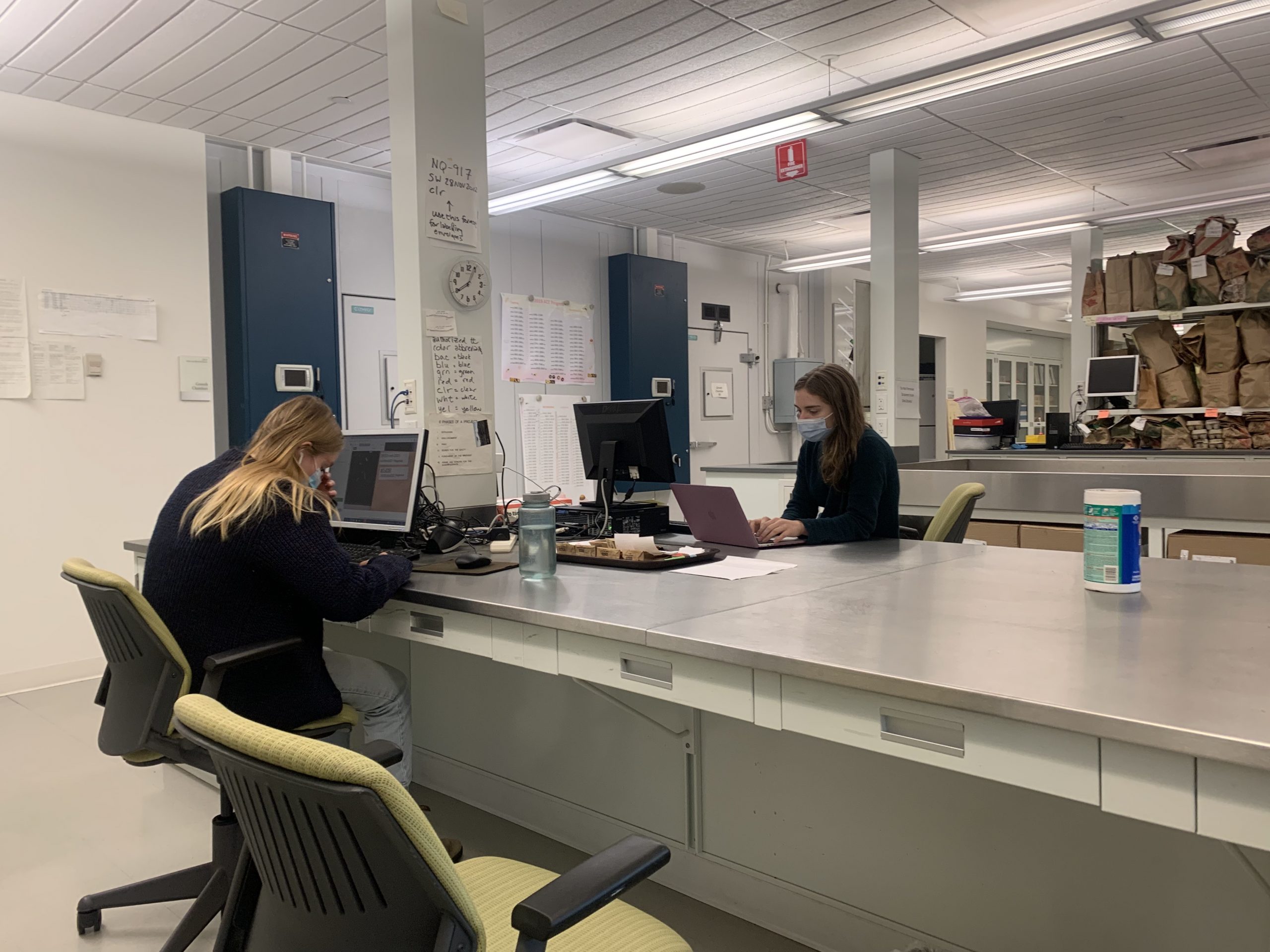
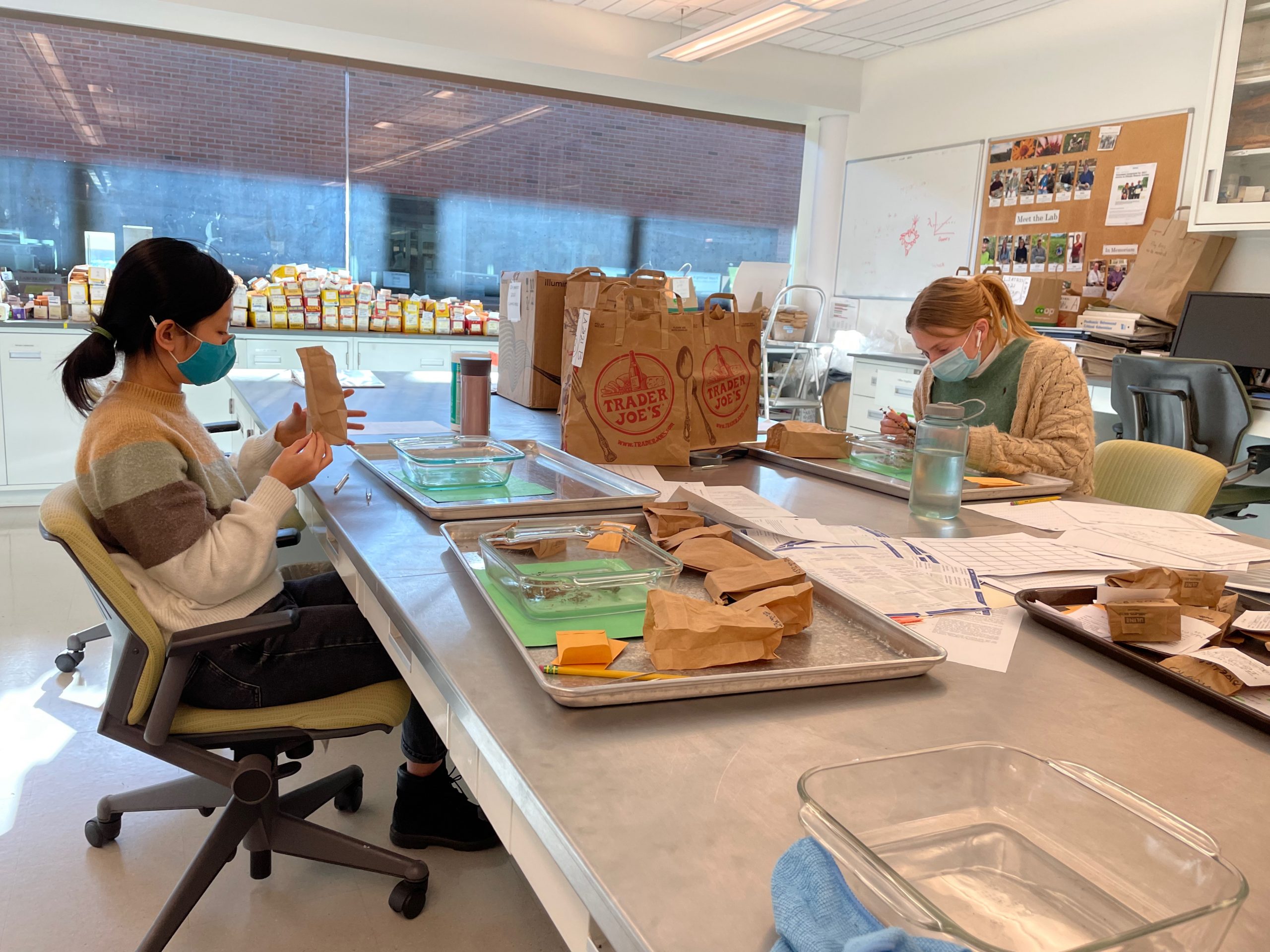
I can’t believe our externship is almost over! Just yesterday we finished randomizing Liatris, so today we started randomizing Echinacea. The procedures were similar, except we used a circle (which looks like a carnival spin-the-wheel) instead of a grid when scattering achenes. The total achene numbers were also unusually small in 2020 and 2021 compared to the previous Echinacea collection years, so we actually had to alter the randomization protocol in order to get a minimum of 25 achenes that can be classified for pollination.
Here’s me, Cassie, and Wanying randomizing Echinacea by scattering the achenes on the circle (lower left) and using the letter randomizer on the project website to select achenes to be put onto the counting sheet (right of the circle)
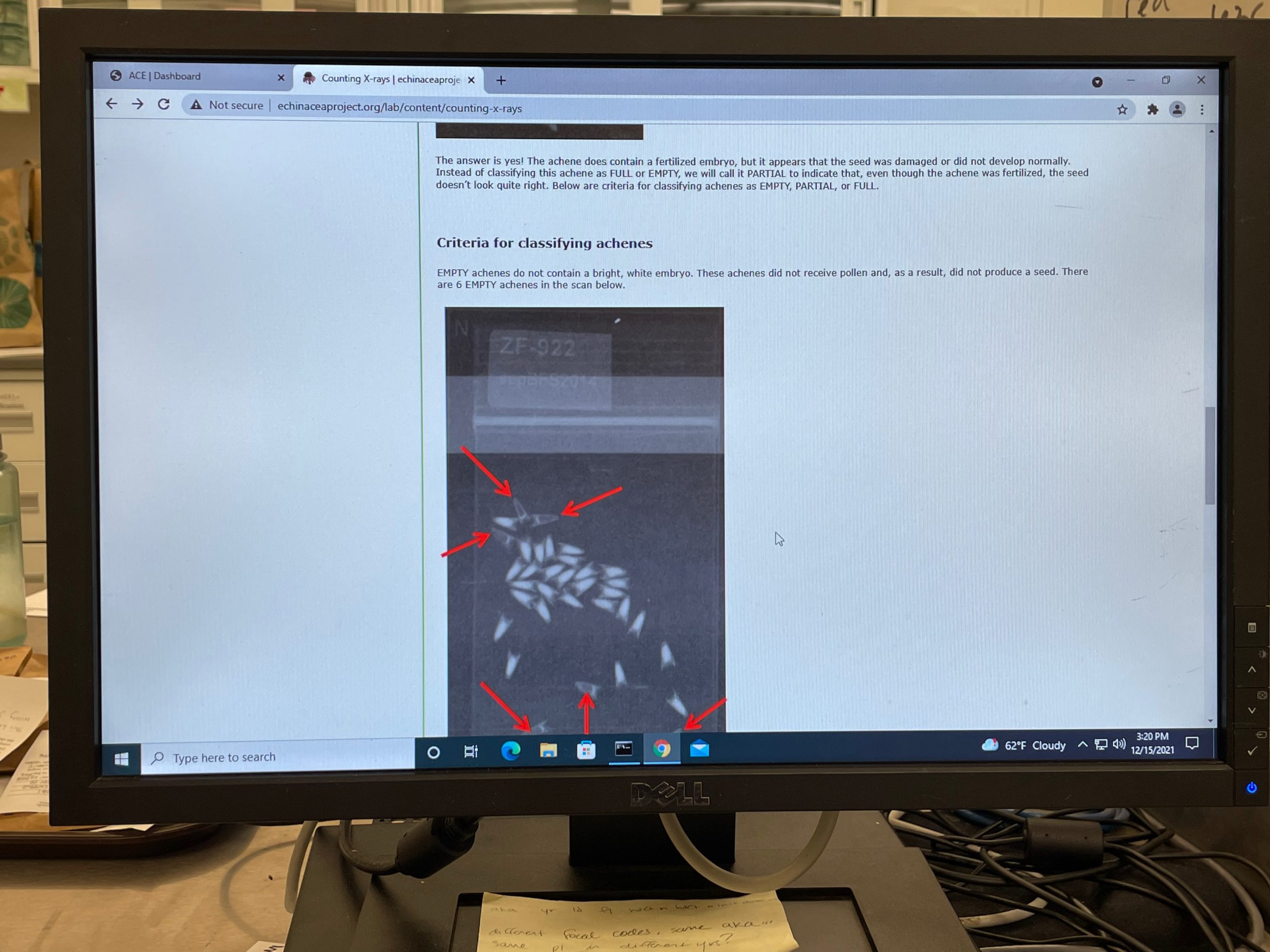
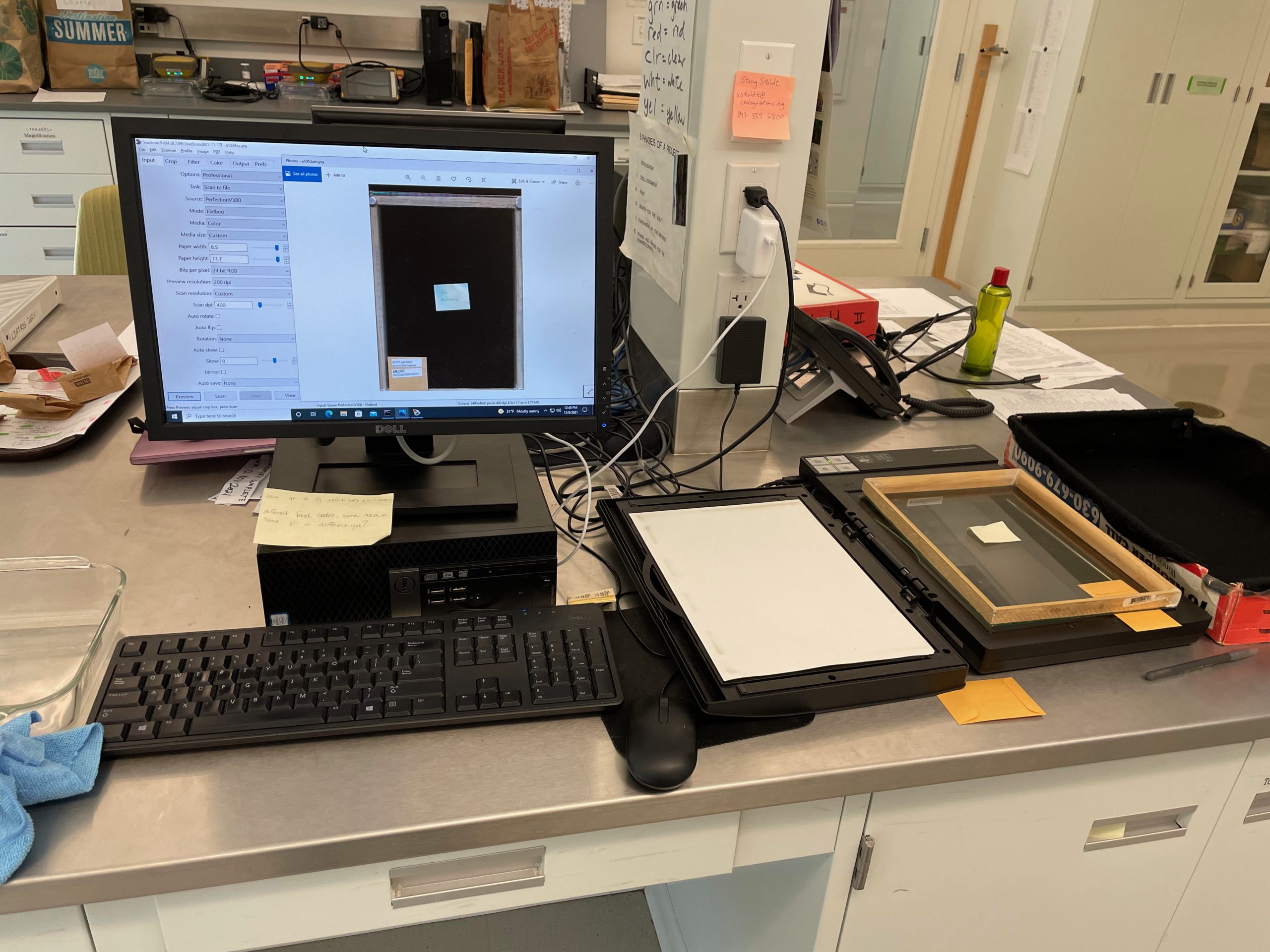
We also x-rayed the rest of the Liatris today and learned how to classify achenes that have been x-rayed. These x-rays are meant to look at the seed status of the achenes in order to determine which achenes were pollinated. We used the Echinacea classification training module on the Echinacea Project website and created specific criteria for Liatris in order to mark the achenes as empty, partial, and full. We should be able to finish x-raying and classifying the Echinacea we randomized tomorrow morning!
The achene classification training module, which includes an interactive practice classifying session
However, the best part of my day was meeting with one of the Ph.D. students doing research in the lab, Drake, and learning about their current work with parasitic plants. Drake and Lea, who is another Ph.D. student that we met earlier in the week, gave valuable insight about preparing for grad school and Ph.D. programs. They especially gave great advice about not being afraid to cold email people we want to connect with as well as how to take advantage of our unscheduled time for research, especially in the latter Ph.D. program years.
I’m also excited for tomorrow, which is when we will finally get all of our data processed! With this data, we’ll be able to answer our research questions and input the results into our presentation for Friday’s lab meeting. I can’t wait to not just get the results, but also to discuss them and their implications with the project team!
Alondra, Connor, Maeve, and Marina finished their mini-internships with us. It was a great experience for them and us. We appreciate their contributions to science and conservation and they gained valuable experience. As part of their plant biology class, Alondra, Connor, Maeve, and Marina, who are juniors and seniors at Lake Forest College, worked on two projects to assess effects of prescribed fires on reproduction in Echinacea. In the lab, they gained hands-on experience in seed biology over three Wednesday afternoons, including cleaning, scanning, counting, developing hypotheses, and data management. To test their hypotheses, they developed a dataset and summarized their results. In class they presented posters and they are attached here. It was a wonderful mini-internship–thanks to Alondra, Connor, Maeve, and Marina, as well as Prof. Westley!
The second week of the externship is coming to an end. We started the day by finishing off all the counting we needed for our final project. We counted achenes of echinacea heads harvested in 2020 and 2021 from several burnt and unburnt places. The echinacea plants these heads came from also had variation in density and number of heads produced so that the data we generated from counting would be helpful for all of our projects.
Caitlin and Cassie counting echinacea achenes
We had our weekly lab meeting at 9 and talked about a paper Jared had been working on. I learned more about the process of scientific writing and it was inspiring to learn that studies of one particular plants could provide insight into methodology used in ecological research in general.
Later in the afternoon, we had a brainstorming session on preparing for our presentation next Friday. We all discussed our hypotheses, potential graphs, diagrams and pictures to include in a slideshow. We all felt more confident about it and were excited to see what we could find out next week!
This week we’ve been making good progress on gathering the necessary data for our projects! An important part of this, especially for mine and Wanying’s projects, has been outlining our randomization protocol for liatris. After brainstorming a liatris randomization protocol yesterday to ensure we would be getting unbiased samples for our data, today we finalized some of the details of our protocol and started randomizing!
We spent the majority of the day creating random samples of liatris achenes to use for our projects, and we were able to get 60 samples done. It was exciting to put a protocol that we had drafted into practice, and continue working towards our data sets and the final product of our projects. The variation of achenes from each plant was also very apparent during the randomization process.
We finished off the day with some echinacea achene counting, which will be important for Caitlin’s data analysis. It’s fun to get a variety of different tasks throughout the day while contributing to different projects. I’m looking forward to more randomizing tomorrow and doing more work on our projects!
We’re now past the midpoint of our externship! This week we are focusing more on gathering the data for our own projects, so yesterday Alex and Mia gave us a list of Echinacea purpurea samples that would be helpful to use in my project. Cassie, Wanying, and I separated these samples and moved them through the entire process we had learned so far, including cleaning, rechecking, random letter-number label assigning, reordering, and scanning. Thanks to this work, we only had a few scans to do today and redid the scans that did not have any achenes so that they now include a note to any potential counters.
Here I am adding notes to the achene-less scans, which are done on the right and entered into the computer program
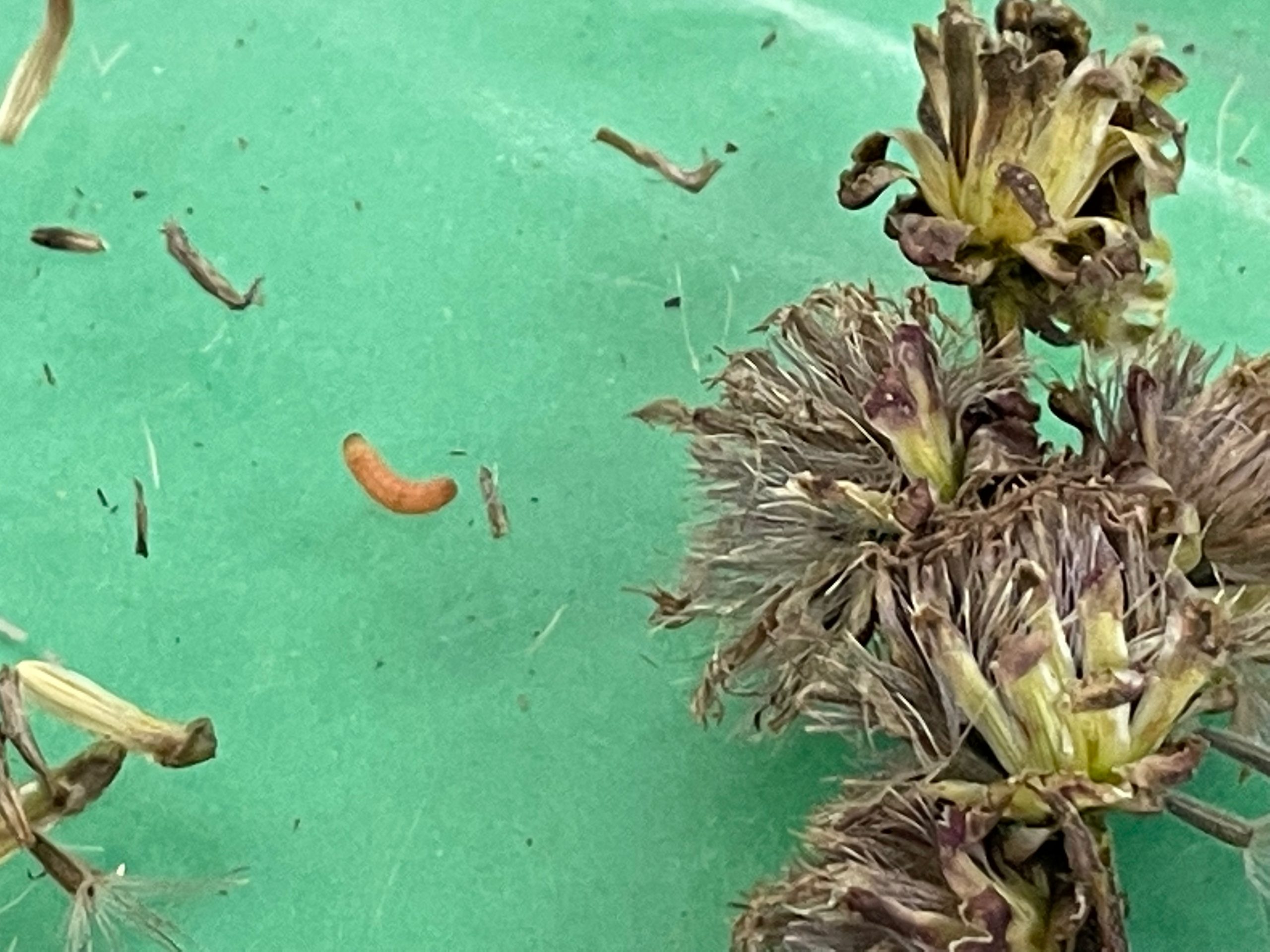
Then we started thinking about Liatris aspera, which is used in Cassie and Wanying’s projects, and how to randomize each plant’s achenes in order to get smaller samples that can be realistically checked for seed predation and x-rayed. We learned the Echinacea randomization protocol today, but there is no protocol for Liatris, so we brainstormed one together based on the challenges of Liatris and our goals. We started to draft this protocol into a document listing our objectives, materials, troubleshooting tips, and methods. Then we cleaned Liatris until the end of the day, and I made endless more grub friends.
Wanying and Cassie cleaning Liatris headsA grub just chilling and pretending it didn’t eat through the achenes I needed
I’m excited for tomorrow, which is when we’ll hopefully be able to start randomizing and maybe even putting our protocol to the test!
We know that burning has a positive effect on flowering in Echinacea. However, fire effects on insects are highly variable. There is very little known about how fire affects insect abundance, particularly how fire affects beneficial insects and their predators. Insect predators such as robber flies, ambush bugs, and crab spiders tend to hunt on Echinacea heads or other inflorescences. The increase in flowering heads may increase the prevalence of bee predators. In addition, the 2021 field crew had a high interest in insects. Therefore, we decided to investigate the abundance of beneficial and insect predators on Echinacea heads.
We were able to take advantage of the burned and unburned remnants to investigate this. Starting on July 7th, during phenology we recorded if any insects were present on each head. If any insects were present, we filled out a multi-selection list preloaded with common insects seen on Echinacea heads. Since we were utilizing the phenology data set, we have data on insects from approximately 2,292 heads every three days from July 7th until the end of the season. We ended up having a MASSIVE data set: 11,941 observations of whether insects were present on Echinacea heads or not.
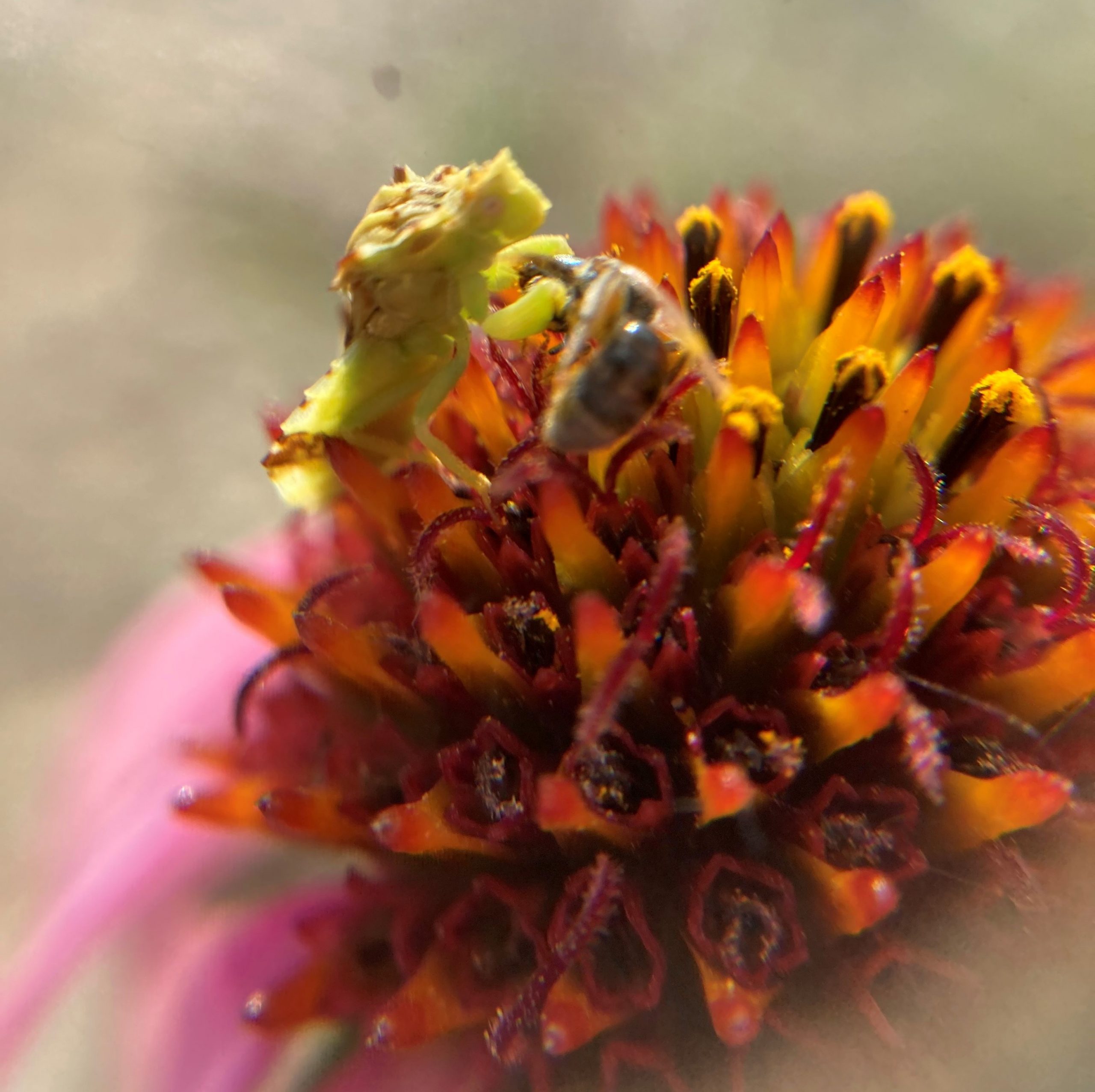
An ambush bug devouring a bee on an Echinacea head
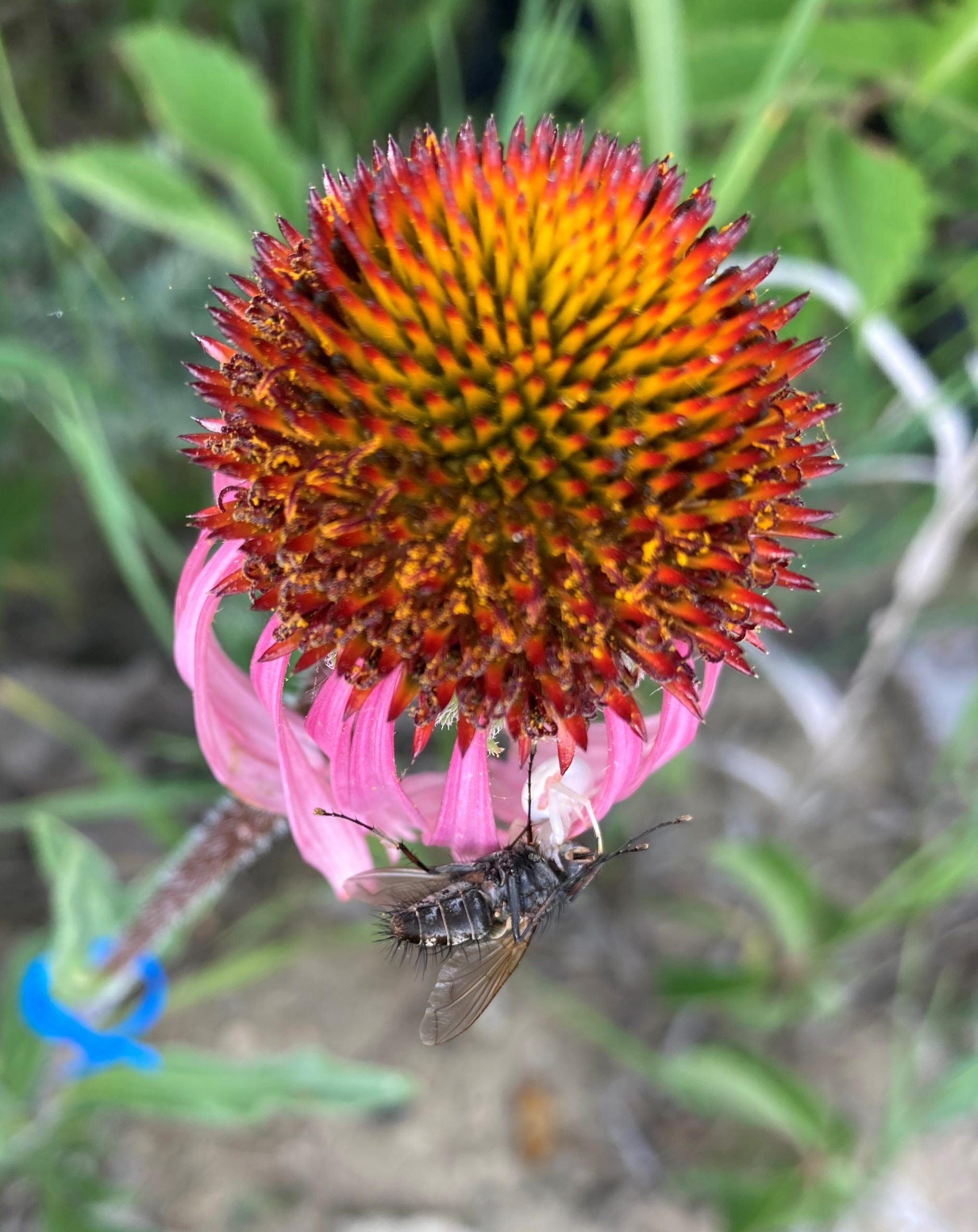
A crab spider with a horsefly snack; note the numerous styles on this head
Insect predators have been seen using Echinacea heads as hunting grounds
Start year: 2021
Location: All remnant prairie sites (n=32) where phenology was taken
Data collected: Presence/absence data of insects on Echinacea heads. This data has not been cleaned yet, but all the data are in the aiisummer2021/phen folder
Samples or specimens collected: no samples were collected
In summer 2020, Team Echinacea established two plots south of experimental plot 8 for a pilot experiment examining fire effects on Big bluestem (Andropogon gerardii) reproduction. Neither plot was burned during 2020. During spring 2021, we randomly selected the western plot to be burned.
Within each rectangular plot, we selected 30 random points. We then counted the number of flowering Andropogon culms within circular 1m2 subplot centered on each random point (within 56.4 cm). After excluding random points that overlapped with the plot boundary or other random points, we were left with 24 usable random points in the eastern plot and 23 usable random points in the western plot.
Stakefile for random plot locations: ~Dropbox/geospatialDataBackup2021/stakeFiles2021/stakeAndroPilot2021.csv
Scanned data sheets: ~Dropbox/burnRems/pilotAndro/androPilot2021
Samples or specimens collected: Seed heads collected from 2020 and 2021 are currently stored in Jared’s office. These have been dried and will be cleaned / x-rayed to quantify seed set.
Products: Stay tuned!
You can read more about the Andropogon fire and flowering in exPt08 experiment, as well as links to prior flog entries about this experiment, on the background page for this experiment.
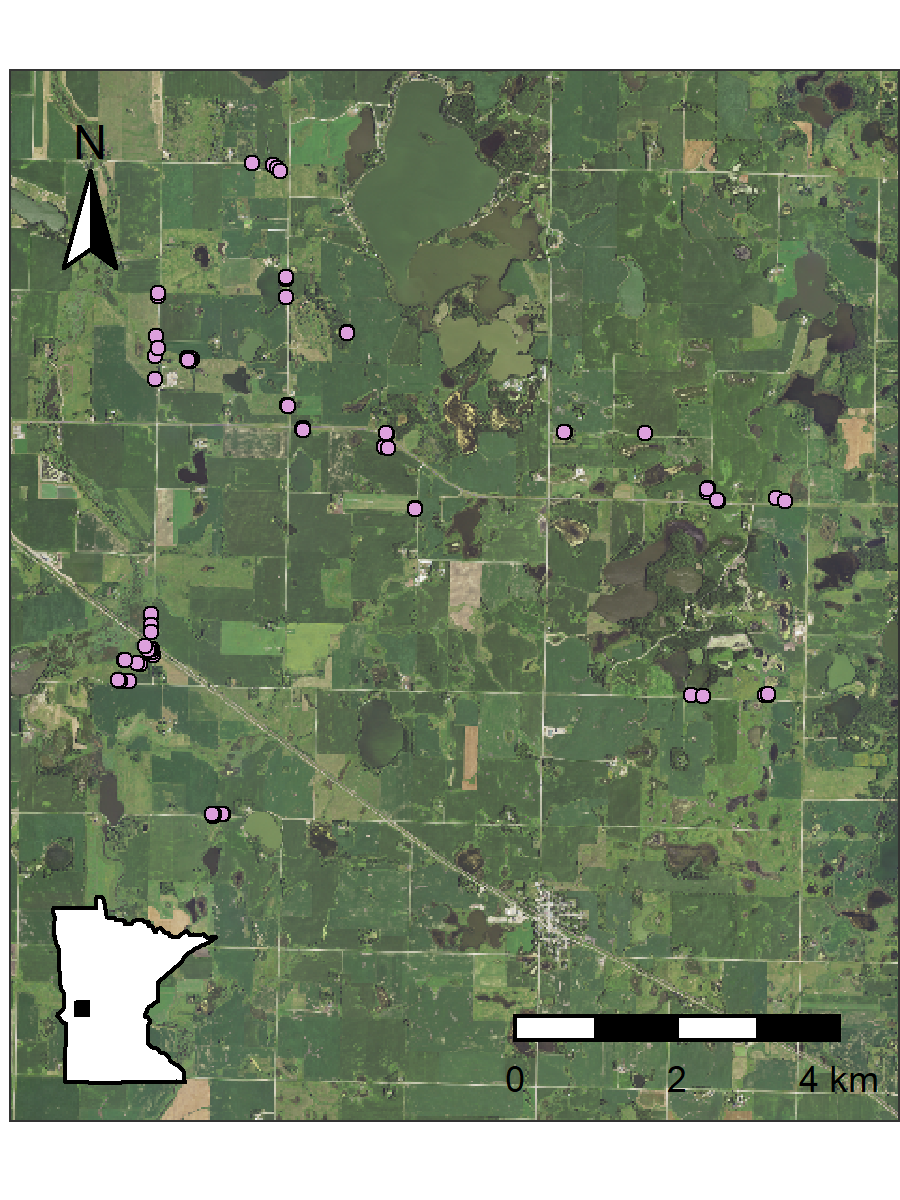
In 2021, Team Echinacea established 76 transects (each 4 m long) across 32 patches of remnant prairie in the study area. Transect locations were determined by generating an ordered list of random points (random integers corresponding with MN state plane coordinate system) within each remnant and selecting the first 2-4 random points that were located within ~5m of an adult Echinacea but avoided dense patches of flowering plants where we may have difficulty distinguishing experimental seedlings from natural recruits. Each transect originating at a random point is 4-m long and contains four 1-m segments. Most transects extend North from the random point but some extend East (in sites where North-South transects may span an entire ditch). One segment per transect was chosen at random to be planted in fall 2021 and one transect chosen at random to be planted during fall 2022.
Map of 76 transects
Start year: 2021
Location: 32 patches of remnant prairie in and around Solem Township, MN
Data collected: locations for seed addition transects: ~echinaceagis/remSeedAdditionExpt/remSeedExptTransectLocations.csv
Samples or specimens collected: NA
Products: Stay tuned!
You can read more about the seed addition transects in remnants, as well as links to prior flog entries about this experiment, on the background page for this experiment.
As part of the 2020 NSF grant to study fire effects on plant reproduction and population dynamics, we are implementing a seed addition experiment in numerous remnants. From previous studies, we know that fire can improve recruitment, which is important for population growth. However, our previous observations of recruitment in remnants conflate the amount of seed entering the seed bank and the seedlings emerging from the seed bank. The goal of this seed addition experiment is to help us directly quantify the effects of fire on seedling emergence and early seedling fitness. We will use these data to parameterize demographic models for Echinacea.
For the seed addition experiment, we established 76 transects distributed across 32 prairie remnants with Echinacea. One segment per transect was chosen at random to be planted in fall 2021 and one transect chosen at random to be planted during fall 2022. The study includes 9 sites burned during spring 2021 as well as 7 sites slated to burn during spring 2022. Seeds were sowed in groups of 50 (either one or two packets of 50 per segment planted). All seeds were derived from the 2016 heads harvested in p2.
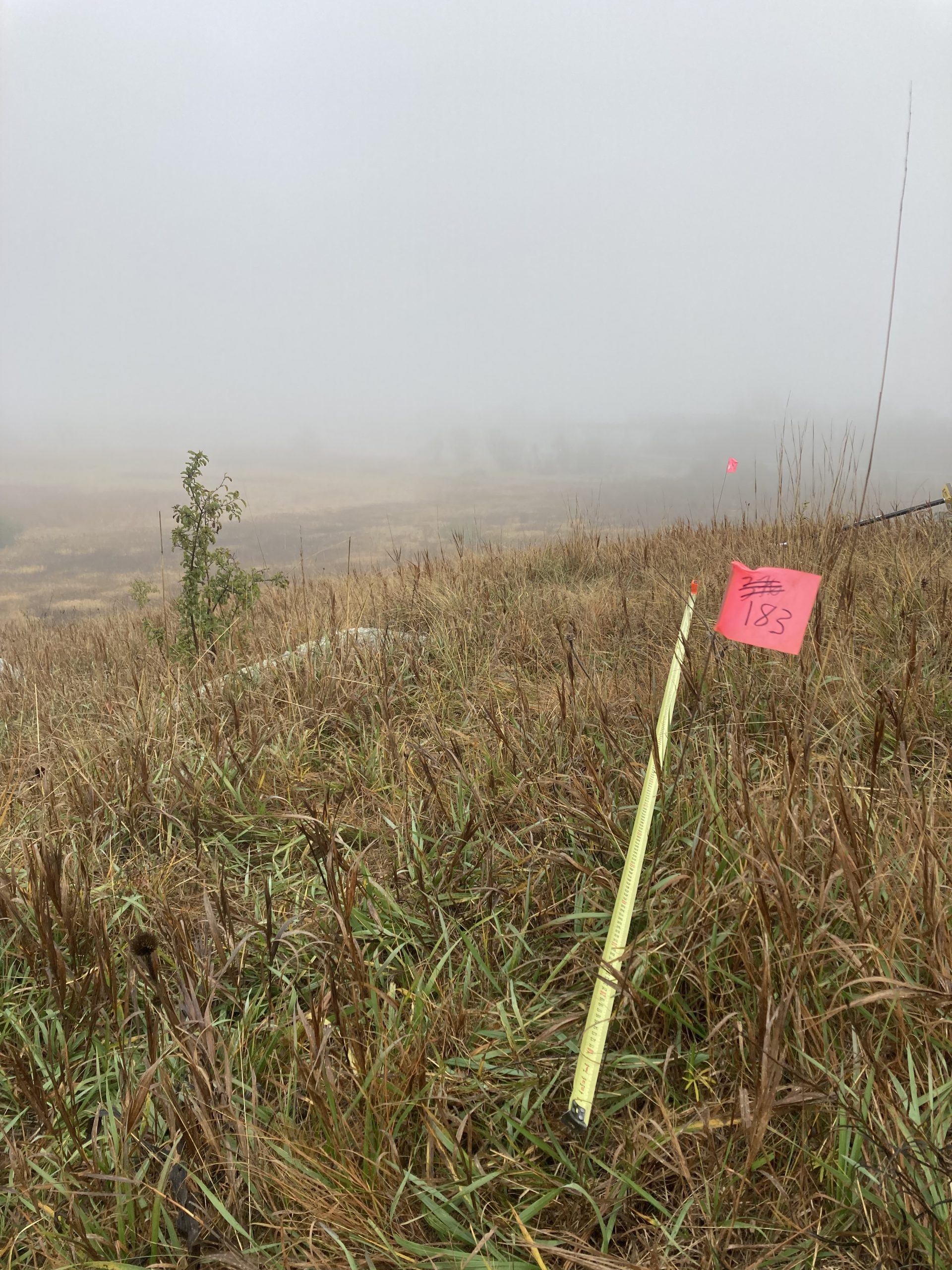
Foggy transect at the hulz hills
Start year: 2021
Location: 32 patches of remnant prairie in and around Solem Township, MN
Data collected: All data related to planting can be found here: ~Dropbox/burnRems/seedExp
Samples or specimens collected: Seed packets to be planted in fall 2022 are stored in see-through glass cabinets in the population biology lab at CBG.
Products: Stay tuned!
You can read more about the fire and seedling fitness in remnants experiment, as well as links to prior flog entries about this experiment, on the background page for this experiment.
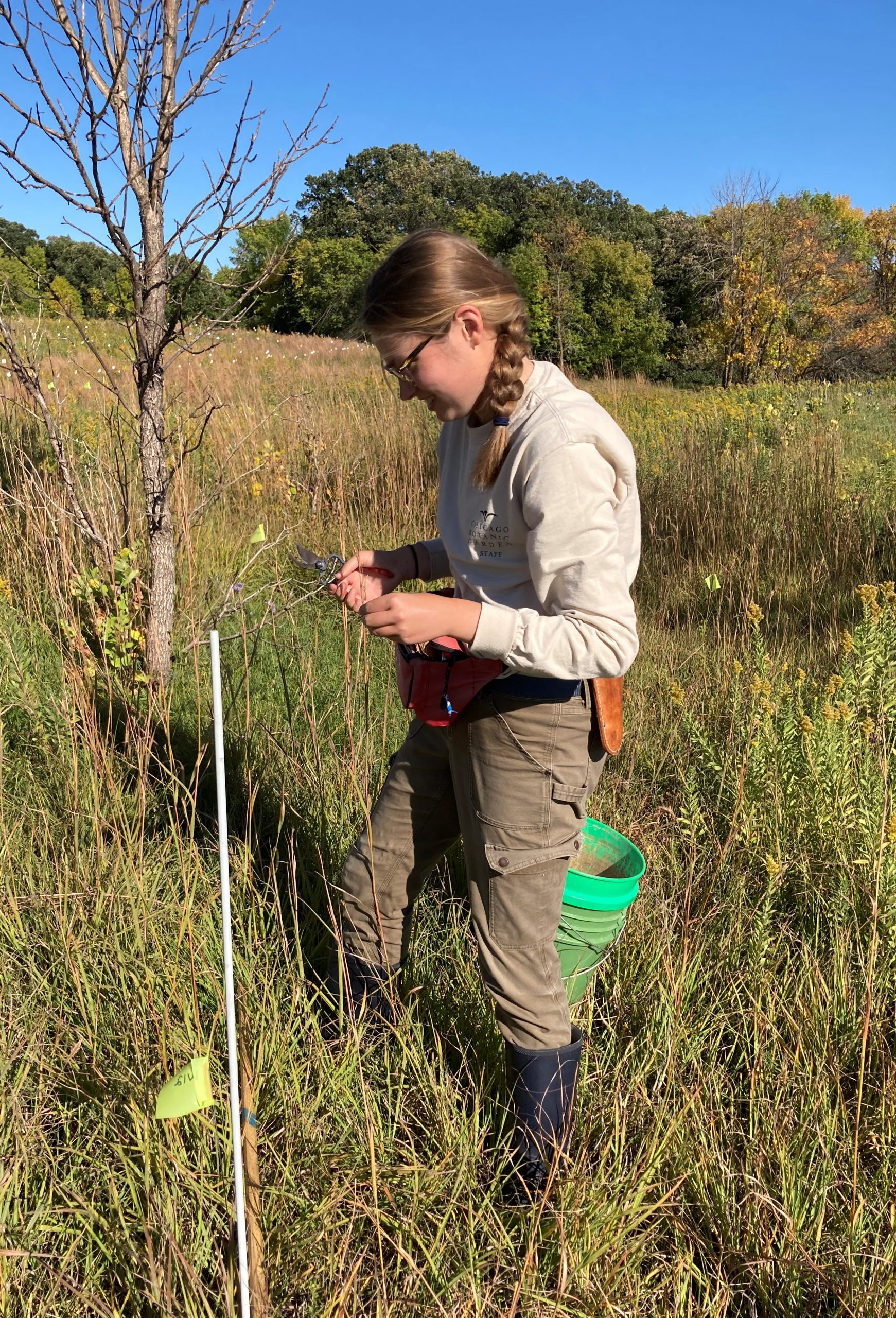
As part of the Echinacea Project’s long-term efforts to monitor reproductive fitness in the remnant populations, Team Echinacea harvested 383 seeds heads from 29 remnants during summer 2021. We randomly selected 15 heads from each population to harvest. If a population had less than 15 flowering plants, we harvested a randomly selected head from all flowering plants. In the fragmented populations we study, flowering plants often fail to produce viable seed due to limited mating opportunities. By harvesting seed heads and quantifying seed set, we can better understand how the spatial location and flowering phenology of Echinacea contribute to reproductive fitness. We are keenly interested in understanding how fire influences reproductive outcomes in fragmented prairies. To this end, we harvested seed heads from 8 populations experimentally burned during spring 2021. We will examine how fire influences mating opportunities and seed set across different populations ranging in size.
These heads we harvested are currently in the CBG lab being cleaned by volunteers and interns. We have even started scanning and counting achenes! Soon the new x-ray will be up and running, and we will begin to answer the burning questions we have about Echinacea reproduction in fragmented prairie remnants.
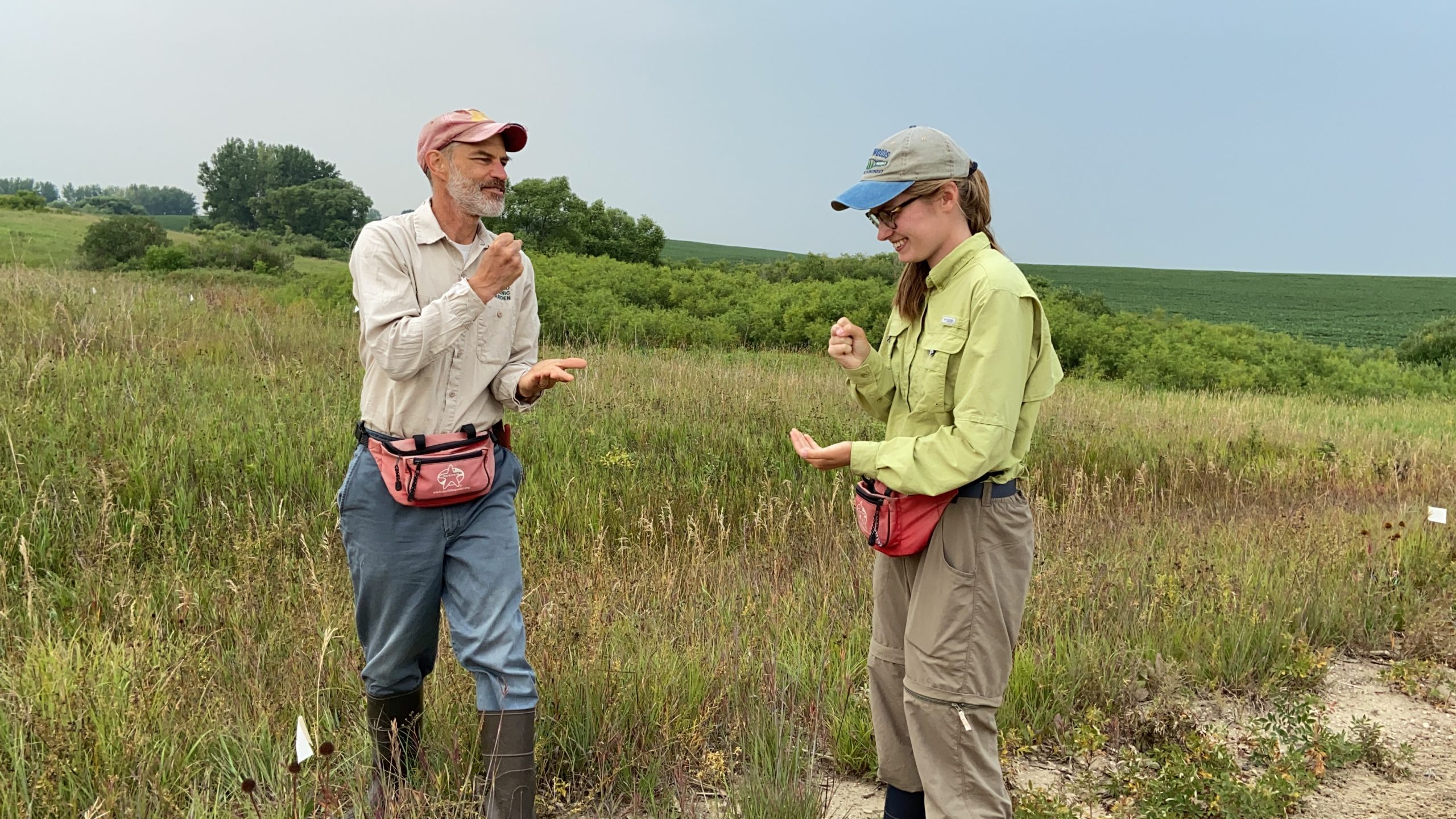
Stuart and Mia playing a game “harvest now?” to get independent assessments of whether Echinacea heads are ready to harvest
Start year: 1996
Location: Roadsides, railroad rights of way, and nature preserves in and around Solem Township, MN
Data/Materials collected: 383 seed heads were collected; these are currently at the Chicago Botanic Garden. Data sheets and other materials can be found here: ~Dropbox/remData
Products: We will compile seed set data from 2021 into a dataset with seed set data from previous years.
You can read more about reproductive fitness in remnants, as well as links to previous flog entries mentioning the experiment, on the background page for this experiment.