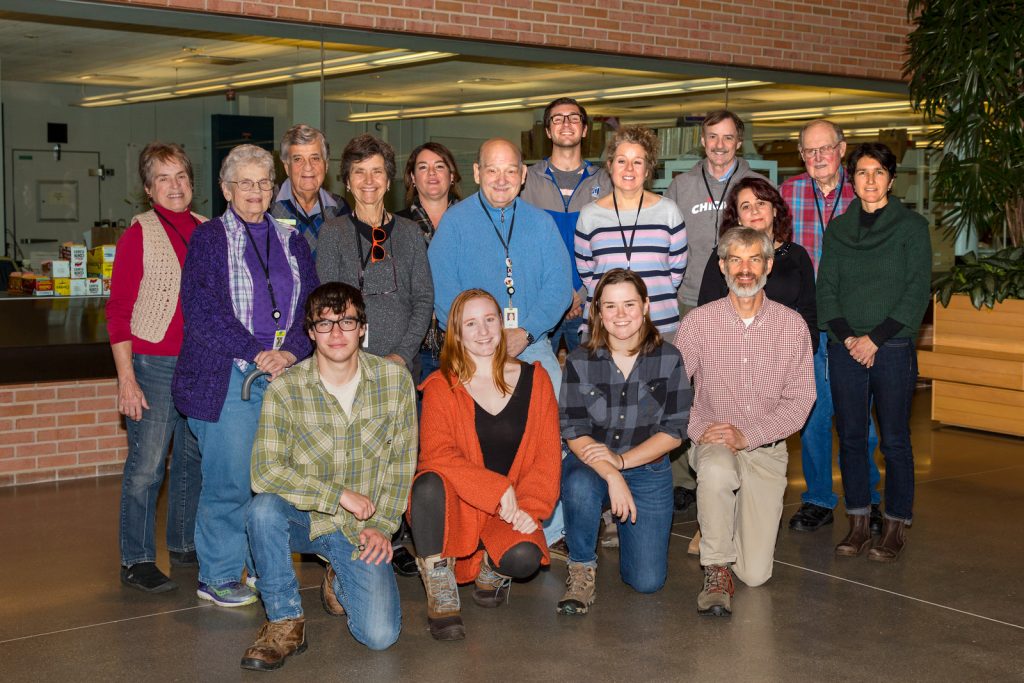
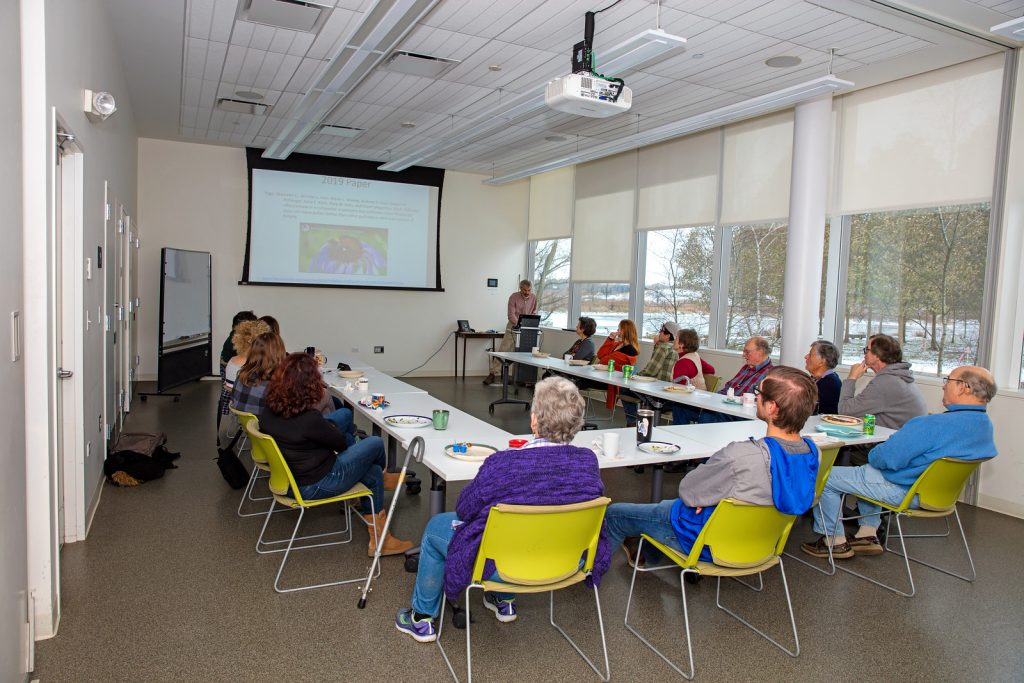
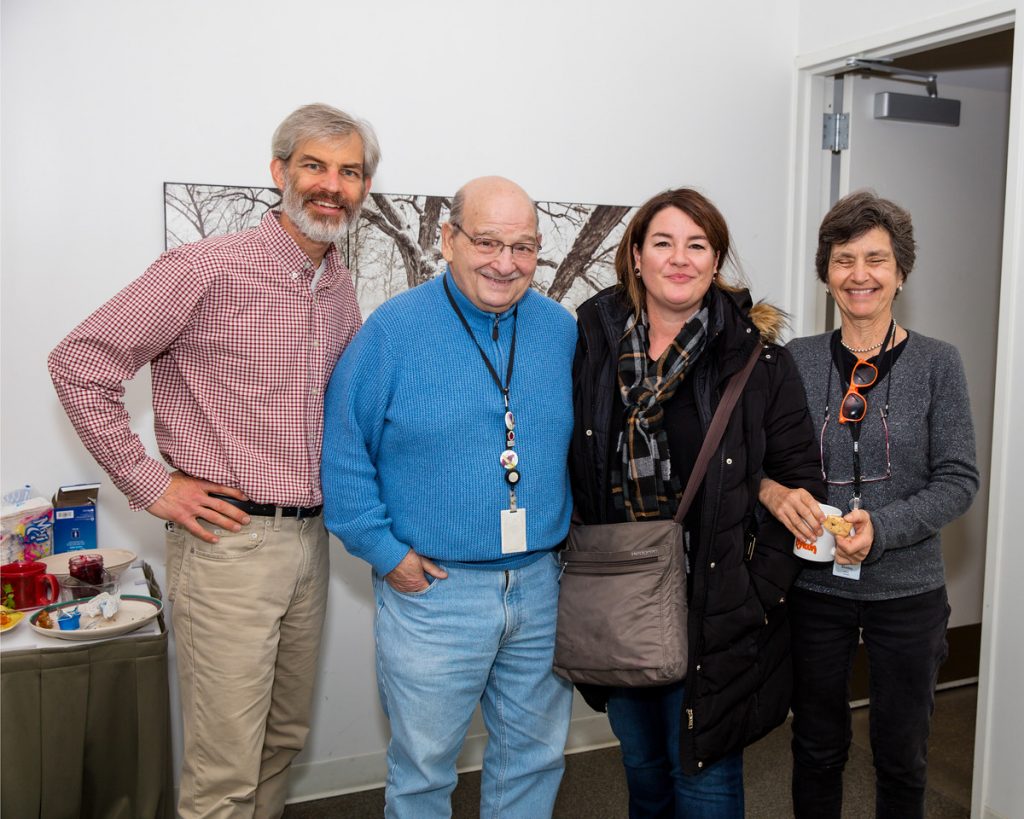
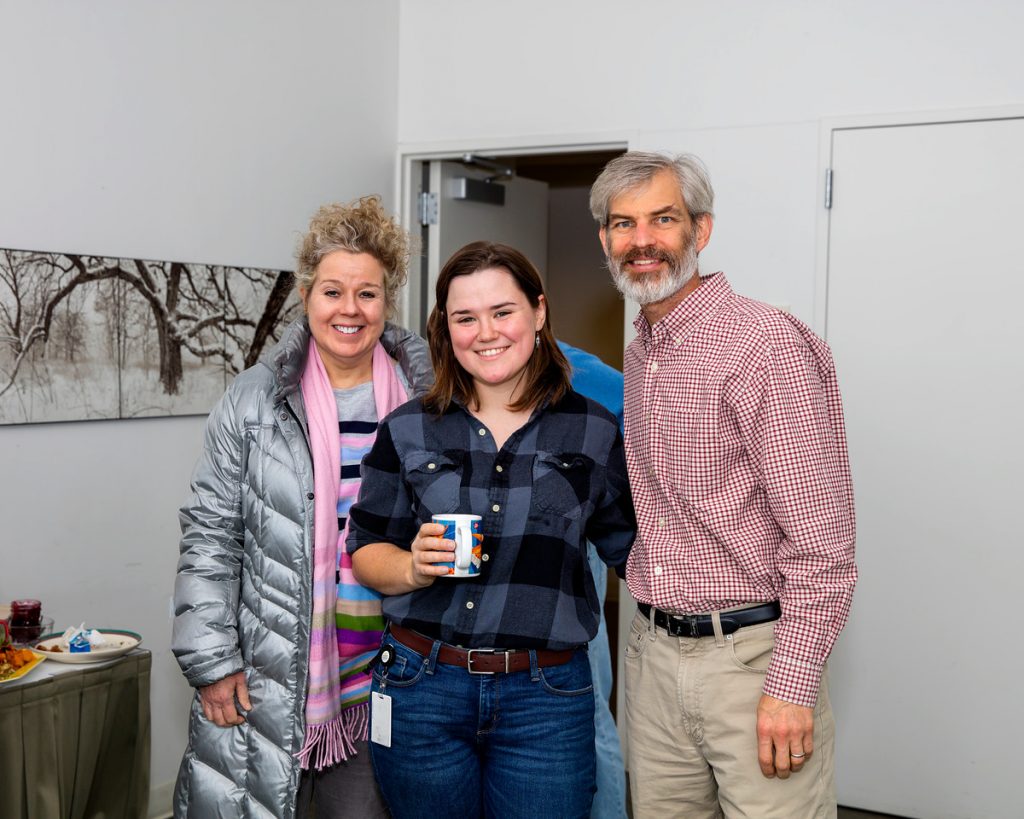
Last Thursday, we had our annual Team Echinacea potluck to honor the work of lab volunteers over the past year. Stuart discussed why what we do is so important and how the work of volunteers helps us to answer important scientific questions. Some great recent milestones accomplished by volunteers include:
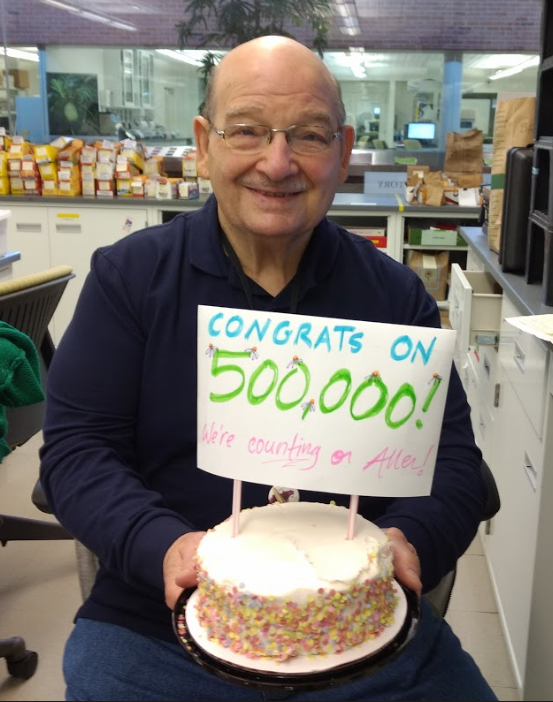
Allen, Sam, and Anne reaching 500,000 achenes counted
All 2017 heads have been cleaned, rechecked, and scanned
670,000 achenes were counted and 113,000 achenes were classified in 2019 (so far)
In addition to a general overview of the Echinacea Project’s goals, members of the lab who have individual projects talked about what they are working on. These projects are: Erin’s remnant flowering intervals, Drake’s prairie parasites, Lea’s floral neighborhood, Elif’s congener ploidy project, and Riley’s prairie fragment crosses. It was really great to talk about research and hear about a number of projects.
Most importantly, though, I want to thank all people who volunteer their time to the lab. Without you, the cutting-edge science we do is impossible. Truly, you are making huge contributions to science and our understanding of plant reproductive fitness in anthropogenically fragmented landscapes. Your work is so appreciated, and we are so lucky to have you all around!
Oh, by the way, the food was absolutely wonderful. 11/10.
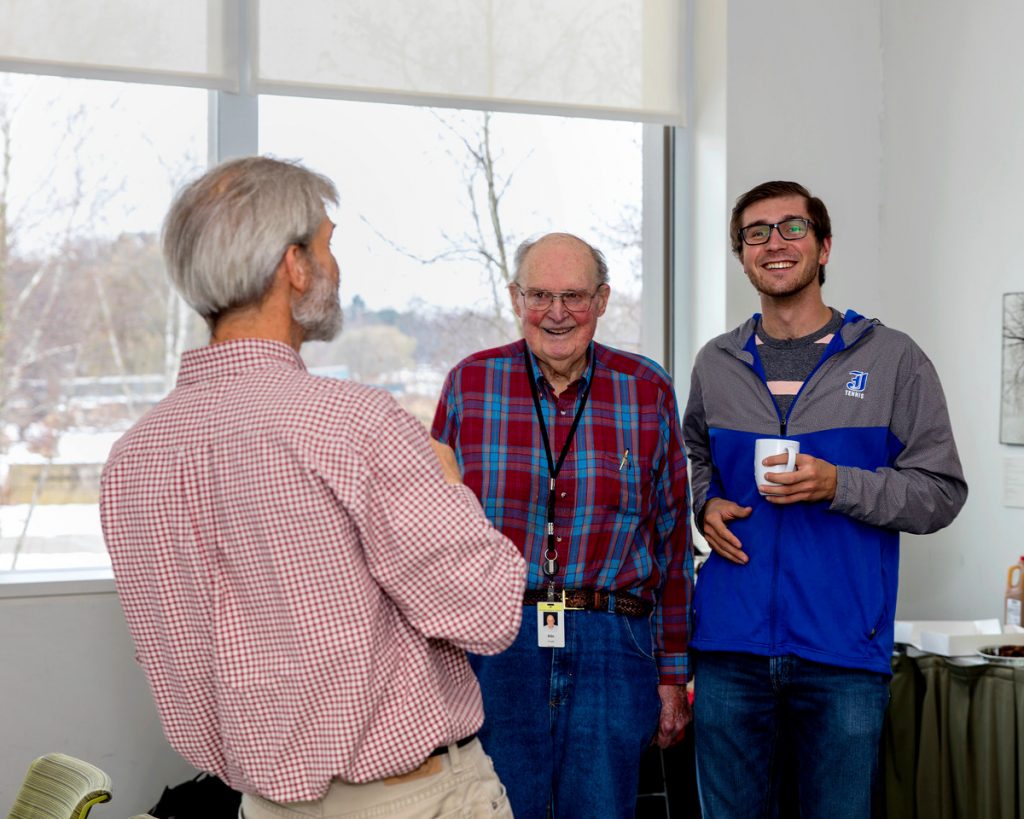
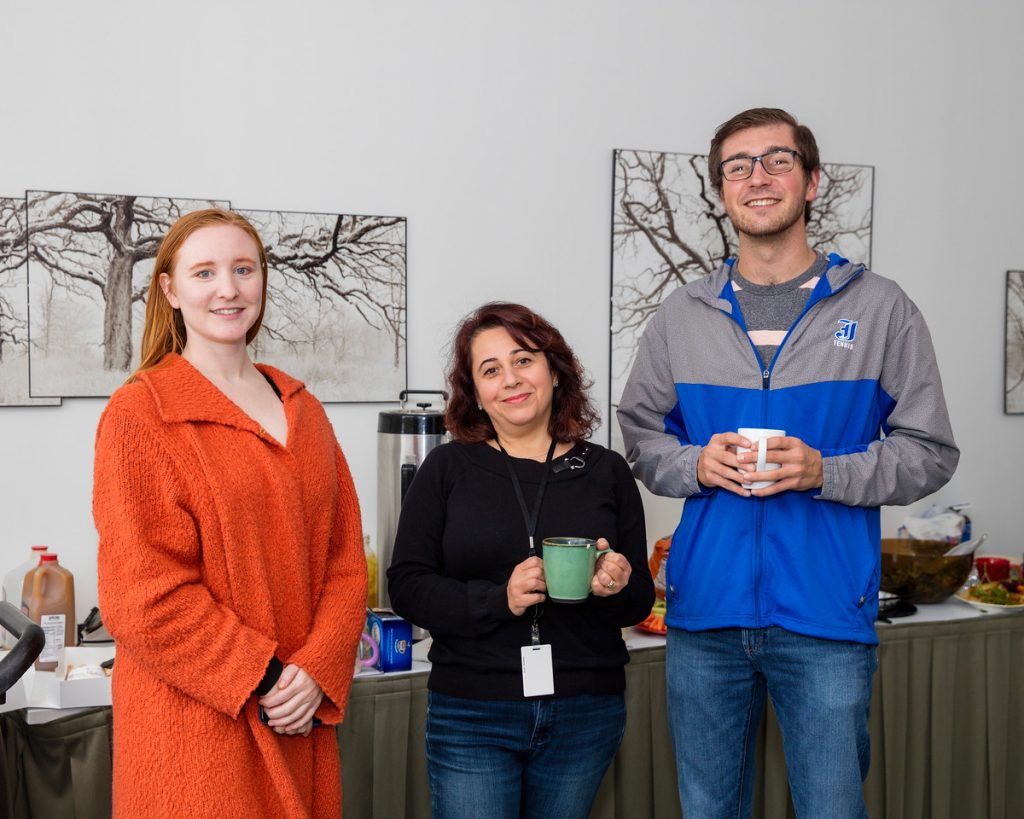
Team Echinacea IL! Front (L to R): Drake, Lea, Erin, Stuart Middle (L to R): Char, Shelley, Allen, Laura, Elif, Gretel Back (L to R): Marty, Art, Tessa, Riley, Mike, AldoFolks eat and Stuart talks about an Echinacea Project paper.Stuart tries to get a good angle on a photo of Riley and Aldo – photoception.Lea, Elif, and Riley. Stuart, Allen, Tessa, and Shelley. Shelley did not see that someone was taking a photo. Laura, Erin, and Stuart.
All of these photos are courtesy of Ray, a volunteer in the photography group. Thank you very much, Ray!!
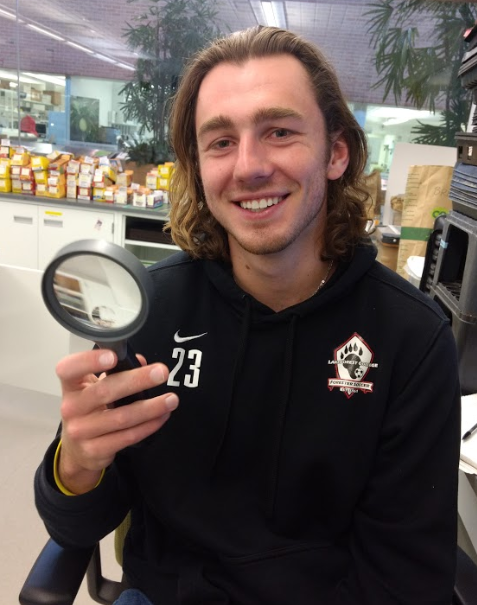
Tate is interning with us in November with his classmates from Lake Forest College. We’re excited to have his help around lab!
Tate, happy to see a scan with barely any chaff! Nice work, cleaners!
Hi FLOG!
I’m Tate Rosenhagen, a junior biology major at Lake Forest College doing a four week mini internship at the Chicago Botanical Garden for a Plant Biology course. It’s my second week in the Echinacea lab, coming in once a week for four hours, and this week I’m learning how to count achenes and randomize samples! Last week I learned a lot of the background of the Echinacea project; what an achene is, how to remove the achenes from the flower head, and a little bit about Echinacea and their pollinators. One of the questions I hope to answer while I’m here is if there is a relationship between seed number and average seed weight in Echinacea. I hypothesized that in heads with fewer seeds, the average seed weight should be higher as all of the plants are in the same experimental plot and thus are subject to the same conditions and nutrients. If the plants have roughly the same amount of nutrients and conditions, theoretically plants should use the same amount of energy as their neighbors. Therefore, I hypothesized that if one plant has created fewer achenes than another plant, their achenes may have more nutrients in their endosperm thus leading to a higher weight. However, a number of factors could cause plants to use their energy in places other than their seeds, such as damage repair on the plant itself or stem growth. I hope that some of the data I find while I’m here will begin to answer this question, however, only being here once a week for four weeks limits how much data I am able to collect.
Recently, Team Echinacea welcomed a new member, Elif Taskiran. Elif has a PhD in economics, but has recently expressed interest in biological sciences. The Echinacea Project is happy to have her on board! Elif volunteers her time on Fridays, where she engages in data entry and cleans heads. Elif also attends weekly lab meetings, where she engages in paper discussion and gives feedback on various works of the team (like presentations and proposals).
Elif is also very interested in using Chicago Botanic Garden’s flow cytometer to understand ploidy differences between Echinacea angustifolia, E. pallida, E. purpurea, and Echinacea hybrids. We hope this project will be fruitful! Thank you, Elif, for all of your work so far with the Echinacea Project. We look forward to your work in the future!
Last Friday, I was dispatched by Stuart to find the number of plants/ achenes planted in each experimental plot, along with the number alive as of a recent year (2017-2019, based on the plot). Although records of some plots were a bit harder to come across that others, I was able to compile data from each plot (besides p10 – planted 2019 – data coming soon). This would not have been possible without the help of Gretel, so thanks GK! I have attached a small datasheet with the survival data.
In the history of the Echinacea Project, the team has sown 31,888 Echinacea viable achenes in experimental plots. There were many more sown that likely did not have a seed. Team members found 3634 seedlings from these seeds, not including Amy D’s experimental plot 3 and remnant seedling refinds. The team has planted 18,869 Echinacea seedlings in experimental plots, not including p10 – planted at West Central Area HS in 2019. Finally, 7090 Echinacea are currently alive in the experimental plots!
Jay Fordham gave a presentation on his research about Fraxinus pennsylvanica (green ash) management that he conducted for his summer 2019 REU project. He presented at the 2019 Midstates Undergraduate Research Symposium in St. Louis on November 1-2.
Friday was a fun day in the lab! After the morning lab
meeting, where Erin presented her study proposal on quantifying the correlation
between Echinacea spatial isolation and flowering intervals, I continued weighing
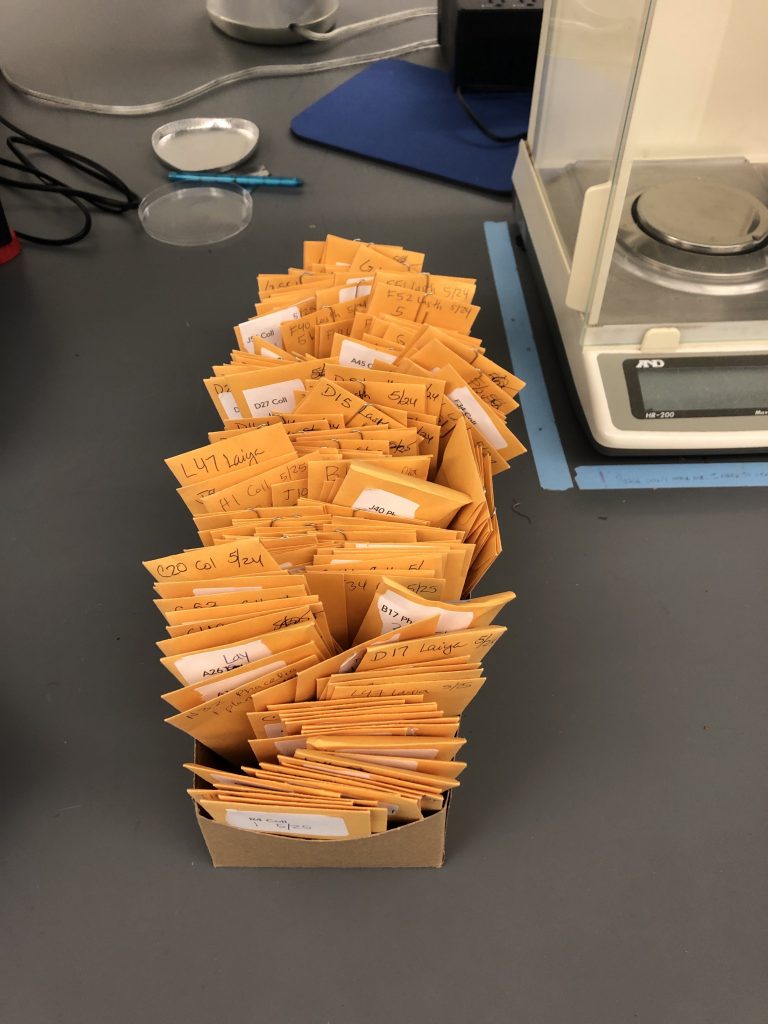
biomass samples. I was able to get through about half the Day 3 samples and I
am hopeful I will be able to finish the rest by November 14th.
Half of the Day 3 samples
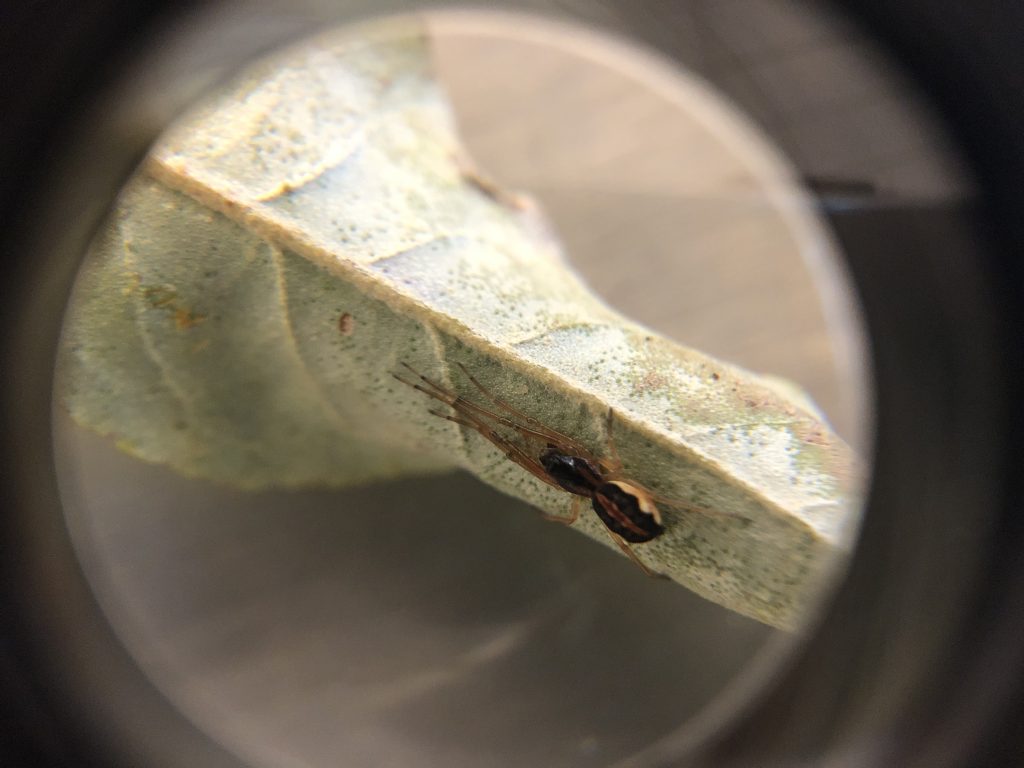
I brought a few friends along to the lab today from Goose Lake Prairie down in Morris, IL. A small spider I found nuzzled in a Grey Dogwood branch and a rather sizable praying mantis who was picking fights with cars in the parking lot. The mantis was a bit slow in the morning which made her easy to handle. The spider was also very cooperative even allowing itself to be put under a microscope. At this level of detail, one can see the spider’s heart beat in its abdomen. Fun fact spiders do not have a classical circulatory system but rather a heart that pumps haemolymph into sinus surrounding its internal organs. After thoroughly examining both specimen I released them back into the wild so each could go back to living their lives having learned a valuable lesson about hairless apes and glass jars.
Prairie SpiderSpider heartbeatReleased to hunt birds and mug garden patrons
It’s been a long summer field season. Plants started flowering late (and they persisted), we aimed to accomplish a lot (and we did), and the weather stymied our fieldwork efforts (we avoided lightning). Nonetheless, it is time to say good-bye to MN and fieldwork and hello to Illinois and labwork. Riley, Erin, and Drake finished up the last of the big projects, backed up the computers, cleaned up the Hjelm house, packed up their cars, and drove to Illinois for the upcoming adventures in our lab at the Chicago Botanic Garden.
Riley, Erin, and Drake wrap up field activities in Minnesota (for now). …and just in time to avoid the snow in the forecast.
The seasons have finally
begun to shift here at the Garden with the last heat waves of summer breaking
onto crisp October shores. Friday morning, I continued my working weighing
biomass, adding 88 new samples to the data set. There are still many samples to
be weighed but I believe I have now passed the halfway point.
Friday morning’s samples weighed and entered
In the afternoon I returned to counting seeds. Stuart explained that the seeds I was counting were no ordinary seeds, but in fact ones that were very rare and difficult to collect, and that my counts would play a pivotal role in determining whether they were to be preserved or propagated. I felt proud that I was contributing to prairie conservation in such a direct and meaningful way. It was also fascinating to see firsthand the multitude of designs and strategies plants have for seed dispersal!
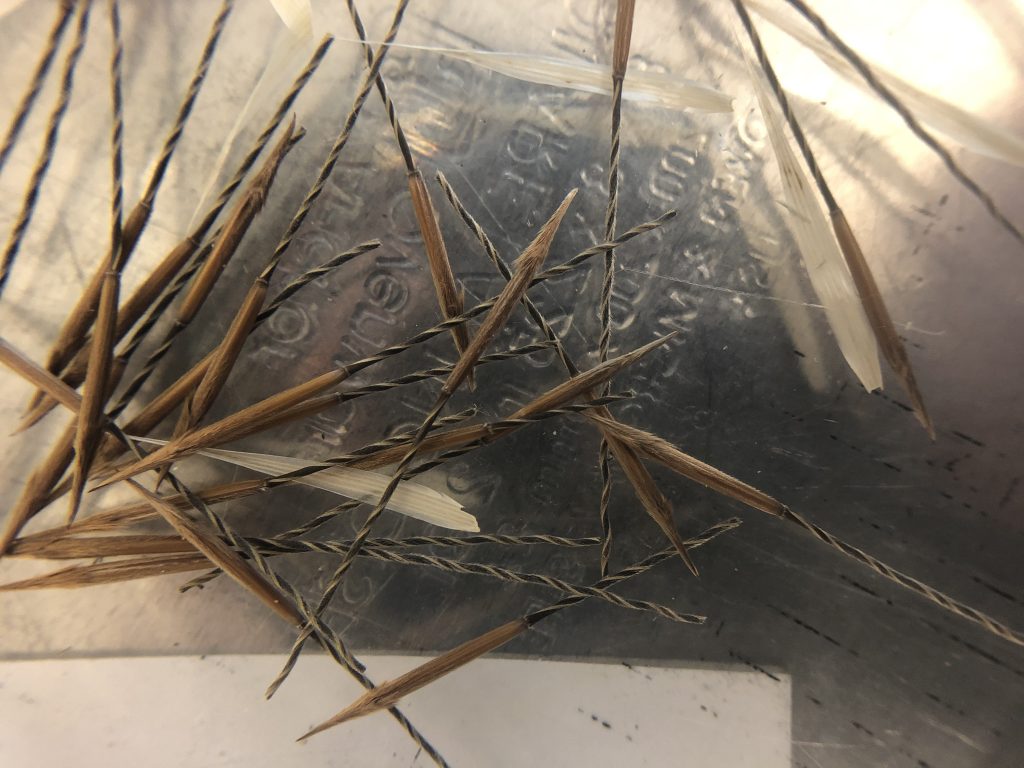
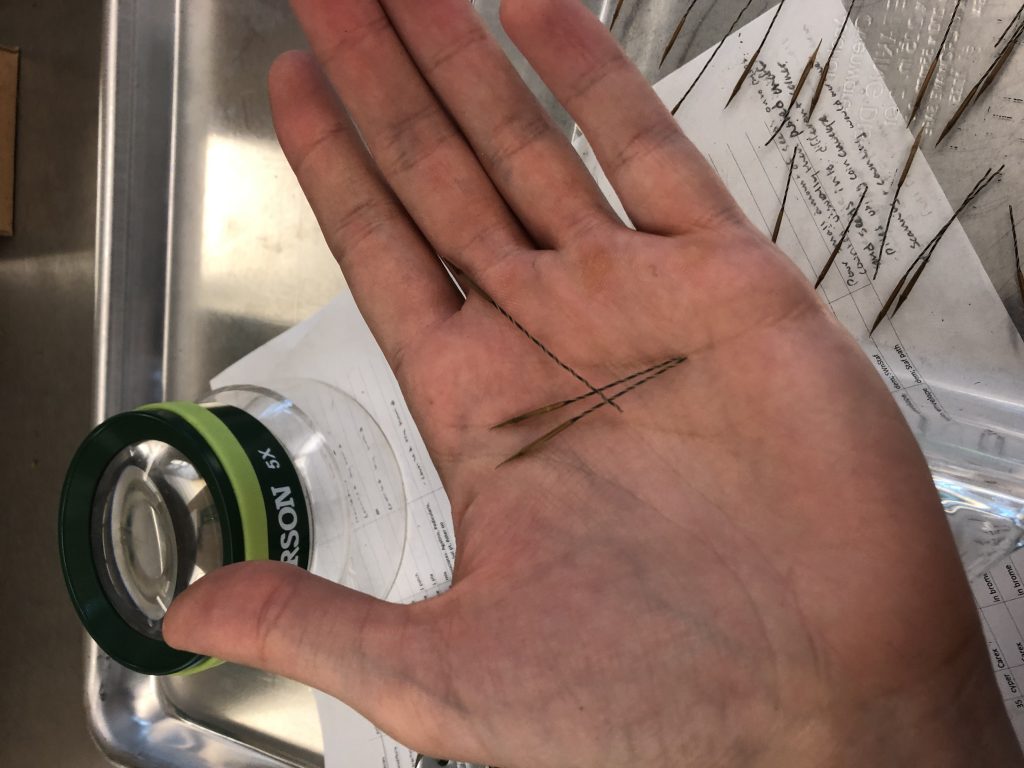
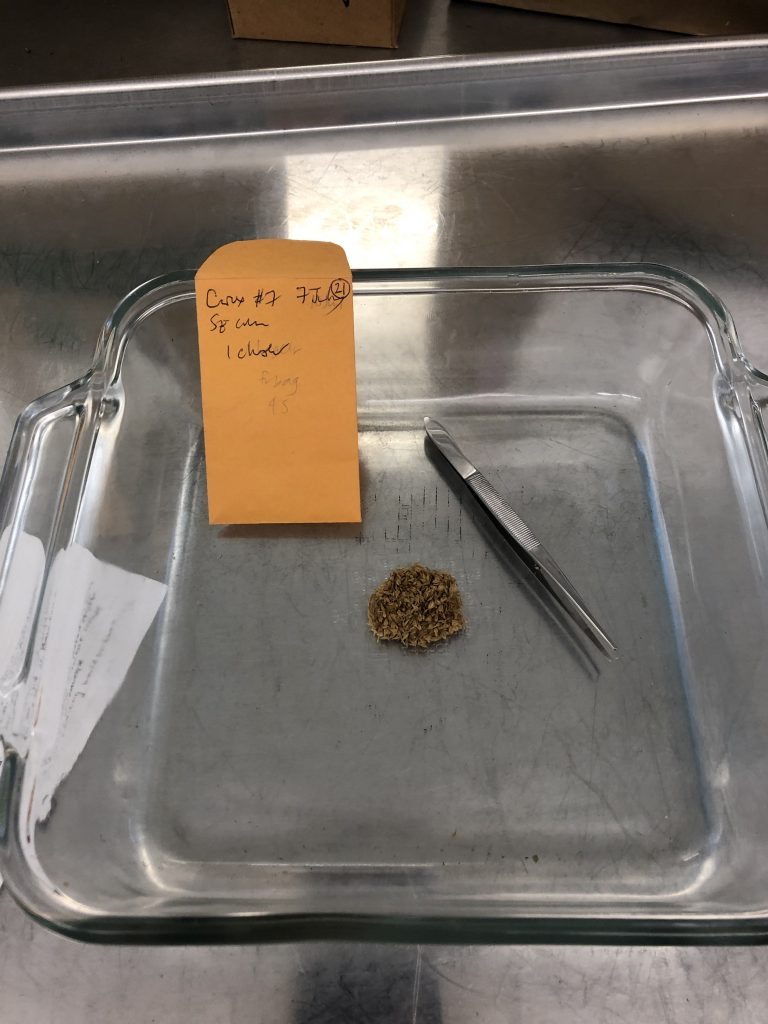
Hesperostipa spartea seeds (the spiral ends twist at different rates depending on humidity)Hesperostipa spartea seeds + hand for scaleLooks can be deceiving, there are close to 880 Carex seeds in this small pile!
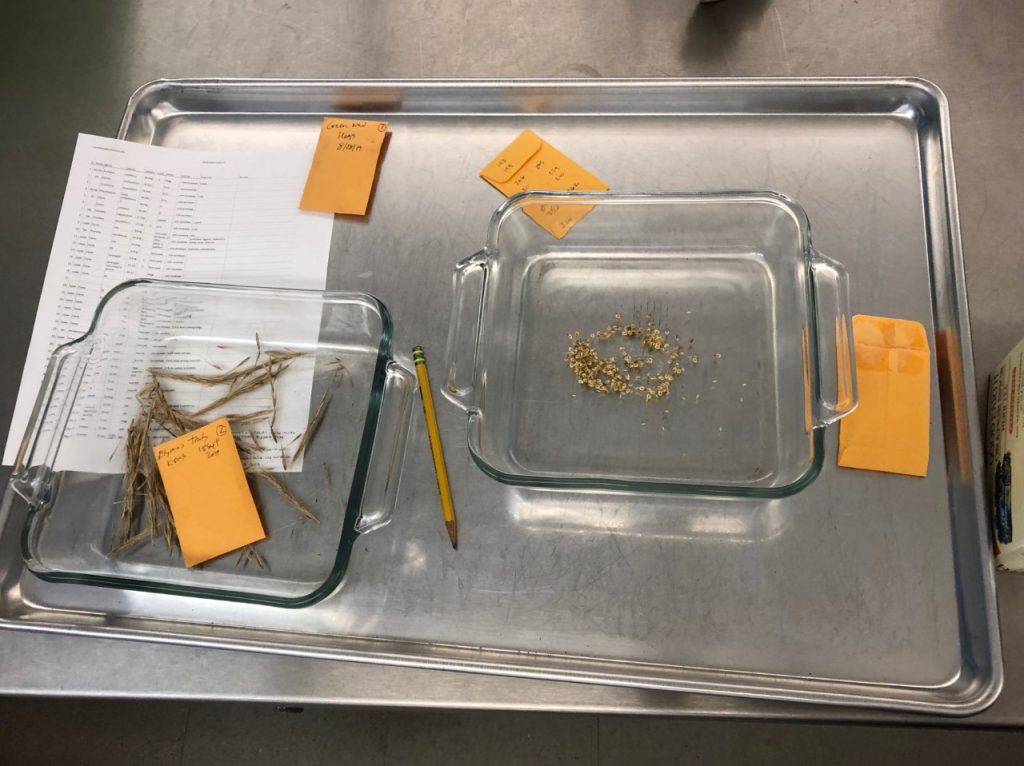
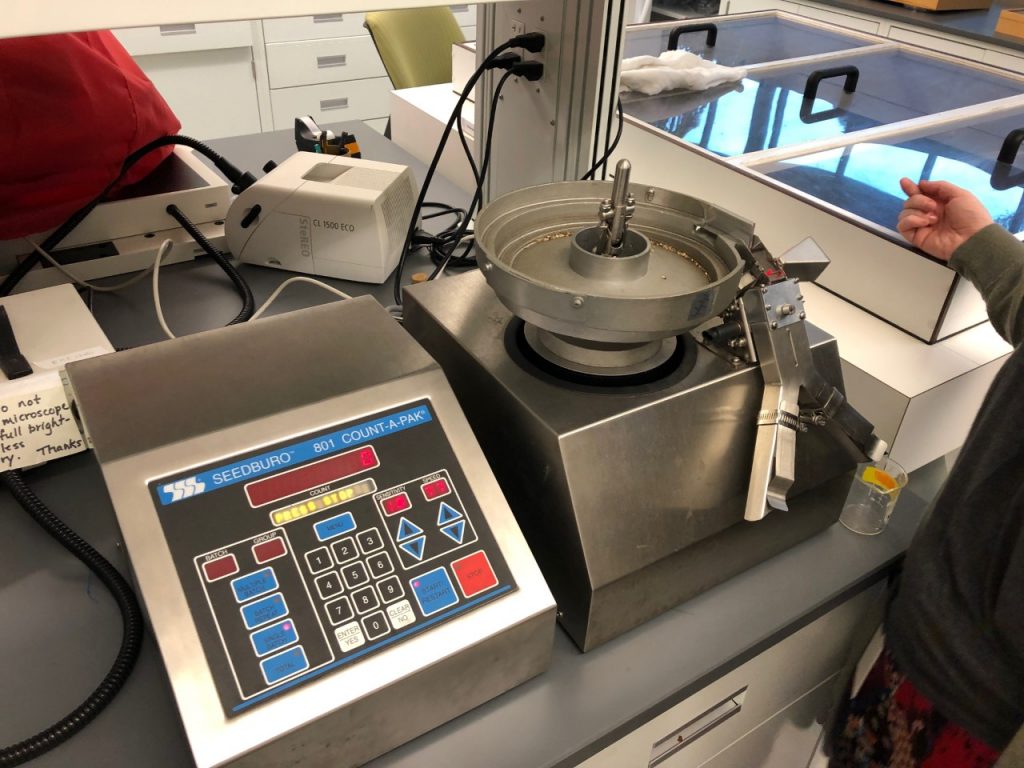
Today I was challenged to count seeds from a few different species of plants. The intention behind this assignment I believe was to teach me how to utilize the Lab’s SeedBuro™ 801 Count-A-Pak® using a variety of seed types. However, the seed-counter had other plans, absolutely refusing to count in spite of our sweet pleads and gentle coaxing. Without the mechanized aid of the SeedBuro™ I was forced to improvise. First, in classic American fashion, I tried brute force, emptying each pack into a Pyrex dish and counting every seed by hand. This worked well for the first few packs of 50-60 seeds but I soon found myself overwhelmed as the seeds began to number into the hundreds. For the large seed packets, I decided to deduce a count by dividing the total mass by that of a single seed mass (SSM). I found the SSM by taking 5 random samples of 10 seeds from the packet in question, weighing them, and averaging those masses. I then divided that average by ten which gave me my SSM. Finally, I took the total seed mass and divided it by the SSM which gave me a seed count. This procedure allowed to me to count a 2,390 Carex seed sample in just a few minutes.
Seeds from two different plant families (Poaeceae on the left and Cyperaceae on the right) to be countedThe seed counter adamant that there are no seeds in the tray
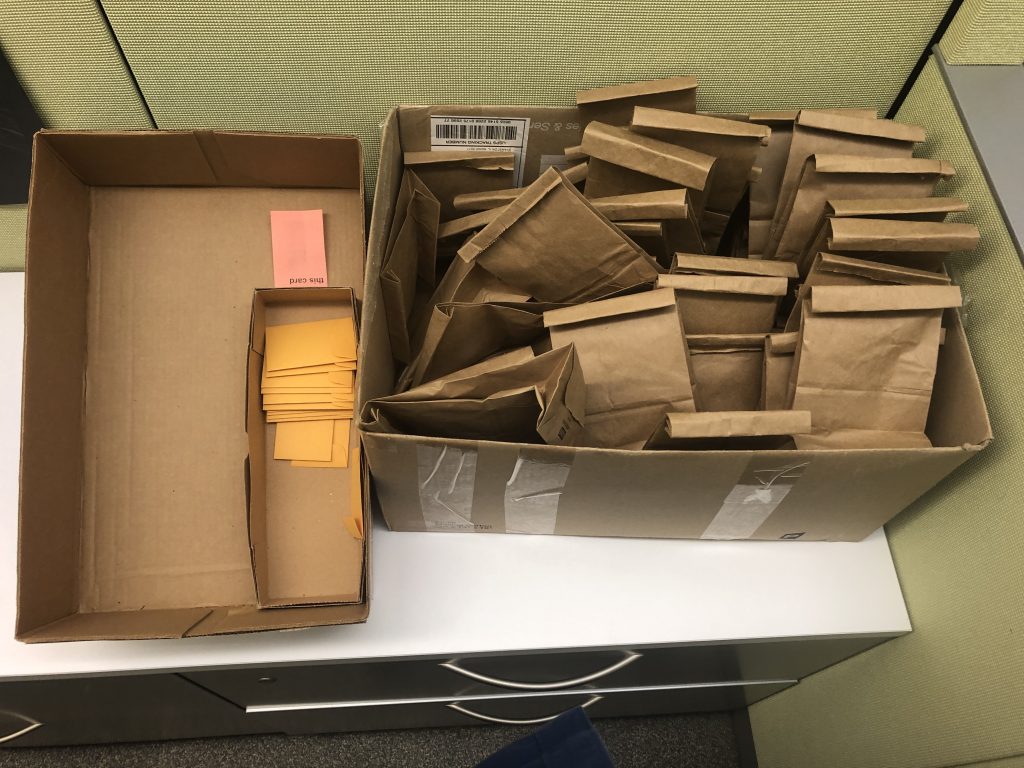
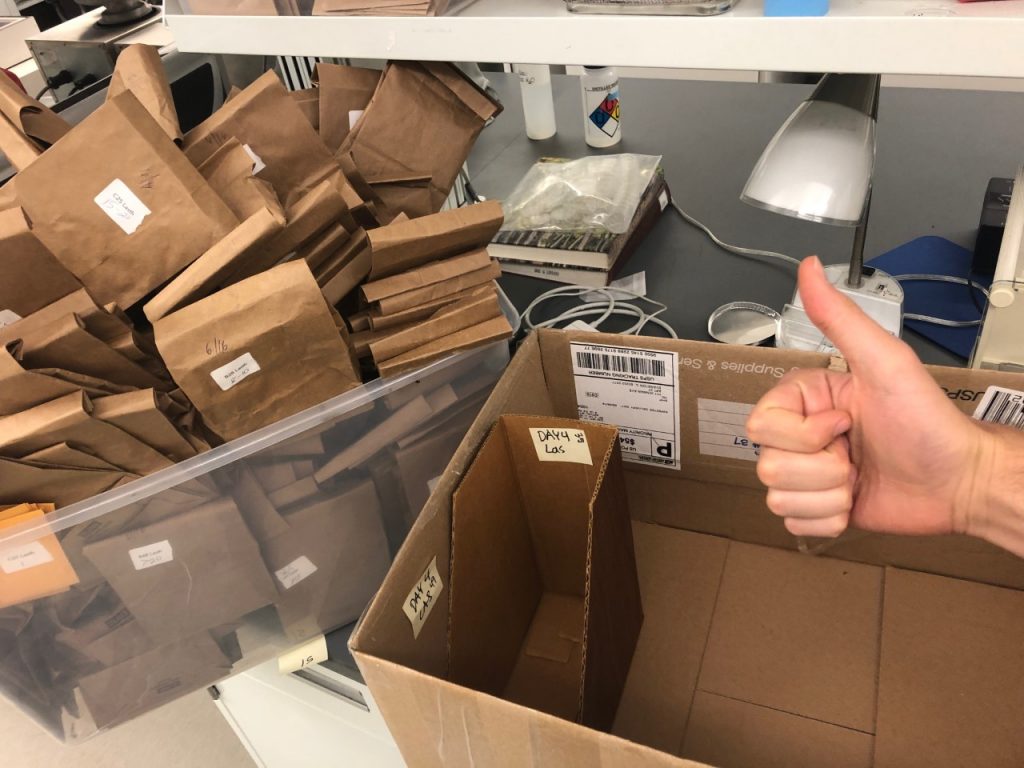
After an afternoon of seed counting I returned to work weighing biomass and finally completed weighing the contents of the second Day 4 cardboard box. I have now collected the biomass data from over 420 plants. I am very excited to begin learning how best to process and analyze all this data!
The clear tub is filled with all the newly weighed samples from the box on the right.