Wow! This month has just flown by! It’s hard to believe that September is almost over, and so many things have happened.
Let me explain. No. It’s too much. Let me sum up:
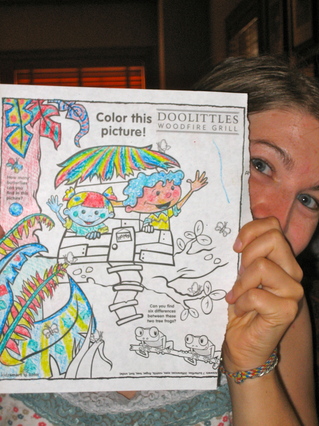
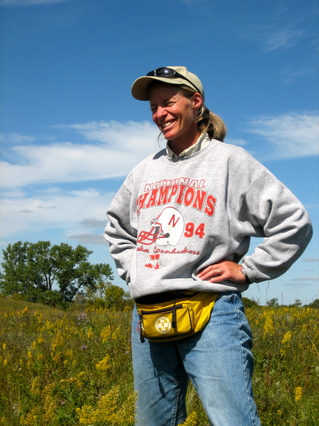
Josh and Hillary had their last day on the 3rd. But before they left we: visited the county fair and saw lot’s of farm animals, visited Morris, and went out to a restaurant for dinner where Hillary created some beautiful art (see picture below). I think she has a great future in the creative arts.

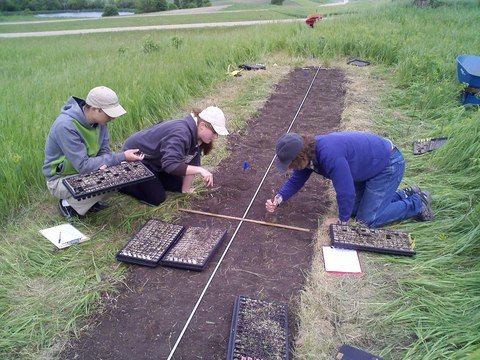
After they left, Amy and I worked very hard on seedling rechecks. Unfortunately, the weather was not always in our favor, but we persevered:

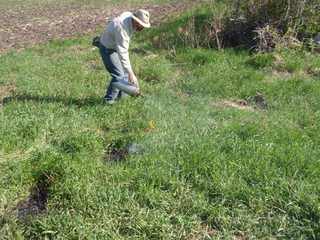
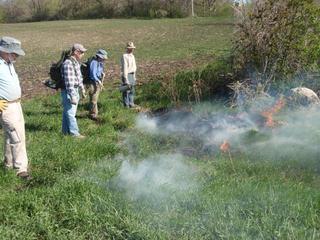
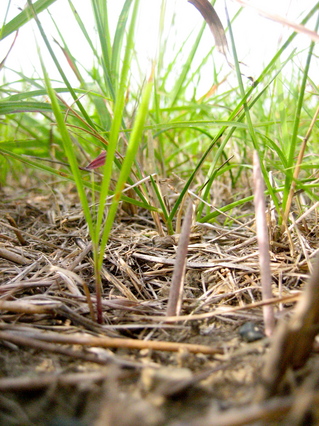
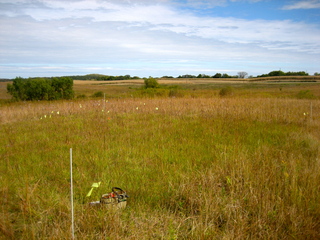
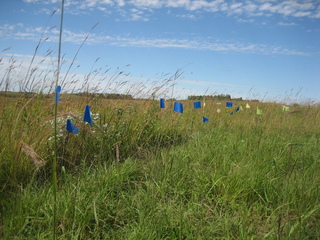
I also spent a significant amount of time gathering my final data for both my seedlings and plugs:
I finished my last bit of measuring on the 14th.
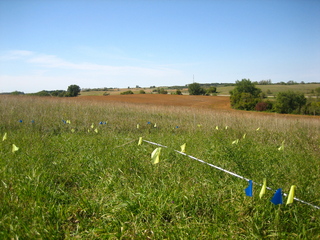
Runestone:
Hegg Lake:
Bob Mahoney’s:
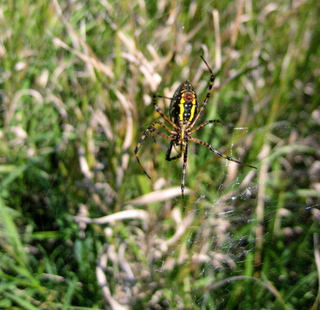
Bob Mahoney’s site has a ton of spiders. I’m not usually very squeamish, but these guys are huge!

So as you all know (I hope), I planted both plugs and seeds at three locations in Kensington: Hegg Lake, Runestone, and Bob Mahoney’s. One of the goals that I had for the summer was to find out what I could about these three locations. The site history; what they were planted with and how they were managed. After I finished my final data collection, I was finally able to take some time away to focus on these questions. I visited the Wildlife Management Office (Runestone) in Fergus Falls and the Department of Natural Resources (Hegg Lake) office in Glenwood.
In Fergus, I met with Kevin Brennan and Chad Raitz, who were both very knowledgeable and helpful. I learned that the Runestone site is old farmland that was purchased in 1988. It was planted with corn in 1989, and with soy in 1990 and 1991, before being seeded with natives. The warm season grass seeds were harvested from a number of sites within a 50mi radius of Runestone, but the cool season grasses were purchased.
Apparently, the gov’t offices can usually harvest their own warm season grasses, but have a harder time with cool season grasses because 1) their harder to find and 2) they don’t have the manpower off-season to go collect the seed. I also learned that in general, they don’t usually plant forbs, or rather they don’t go out and harvest forbs specifically. They do bulk harvests at prairie remnants and previous restorations and if they get forb seed that’s great, but they don’t go out specifically to gather forb seed. This makes me wonder about how successful a prairie restoration can be if the entire community assemblage isn’t present. How often do they go to harvest, what species are they missing? etc. Chad also told me that some of their harvesting sites are now being invaded with Tansy and parsnip, and so they can’t use those sites anymore. But he didn’t think they were working to fend off the invasion, again he sited lack of manpower.
Kevin Kotts at the DNR was also very helpful. He pulled out all of the files on the Hegg Lake site and let me wade through them. I learned a lot about the DNR, their management practices, and a bit about the politics involved in creating a wildlife refuge like Hegg.
It turns out that the DNR’s purchase of the Hegg Lake site was quite controversial. The land was purchased in two parts, but the bulk of it was sold by Mel Hagen for $12,500 back in 1961. Another smaller section was purchased in 1962 from a Mrs. Viola Brown. However, before the land could be purchased, the sale had to be approved by the Douglas County Commissioners, and it wasn’t. Much of the land at Hegg was in crop production, and thus was on the tax lists, and the commissioners didn’t want to loose productive land to wetland restoration. One commissioner claimed that Douglas County already had “enough ducks”! John Scharf, the Area Game Manager for the DNR, had to work for a solid year to get the purchase approved. He wrote in one of his many letters that, “their narrow-minded approach left [him] in a foul mood.” (Pun intended?)
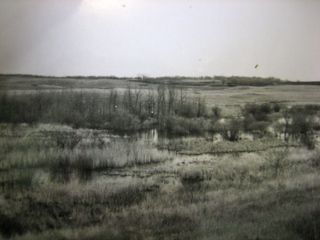
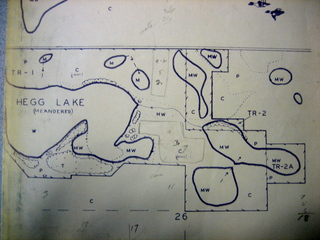
Once they had the land, the DNR focused more on restoring the wetlands than the upland prairie areas at Hegg. Much of the site actually remained cropland for years after the initial purchase. The area where my site was located was finally restored in 1998 and planted with native seed harvested in the Fergus Falls area, at least that’s what Kevin thinks. Despite all their files on the subject, there wasn’t any firm paperwork on the actual restoration of that portion of Hegg.
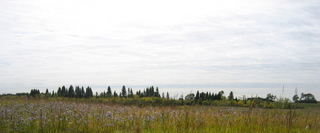
Nevertheless, I got took some interesting pictures and found out some interesting information about the site.
Hegg in 1970’s
Hegg Today:

Hegg Map:
On September 17th, I was able to drive into Minneapolis-St.Paul to visit the University of Minnesota one last time. I met with a number of really interesting professors there. University of MN definitely has a great faculty and some very interesting programs! After my meetings, I met Amanda (from 2009 crew) for dinner. It was great to catch up with her and also to discuss the pollinator study we’ve both been working on for over a year now. We will get this project published by hook or by crook! That night Amy let me crash at her place before driving back to Kensington. I finally met Brad! I felt like I knew the man, but I’d never actually met him. I also met Mr. Bird, and let me tell you, that was an honor! Mr. Bird is quite the personality. So, THANK YOU AMY AND BRAD for letting me spend the night!
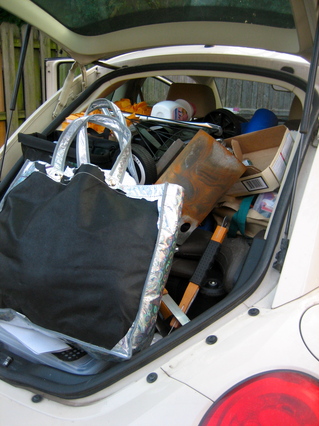
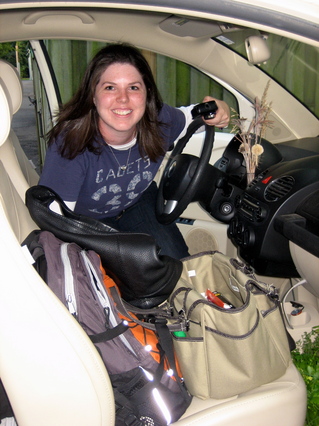
On September 20th I drove back to Chicago! I was surprised to find temperatures in the 80s here in Chicago, when I had been, slowly, getting used to temperatures in the 50’s and 60’s up in MN. Here’s my car all packed for the way home:
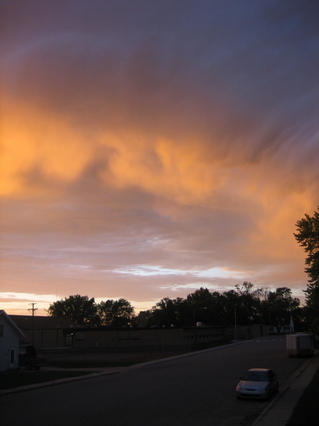
Two last pictures of a beautiful MN sunset:
Thus ends a very successful field season!