|
|
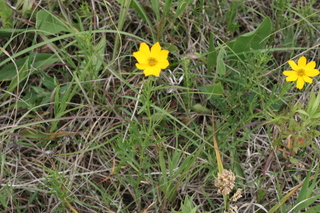
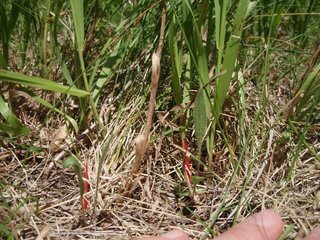
Here is a picture of 2 of the 3 surviving plants in my experimental plot at Perch Lake Waterfowl Production Area, southwest of Leola, SD.
 Each of the 2 Echinacea seedlings is marked with a red party toothpick. We (Shelby, Janelle and I) found them in May when we censused my 2 SoDak plots. We found a total of 10 new seedlings at the Perch Lake site, all of which had 2 cotyledons but no true leaves. I returned to Perch Lake last Thursday, July 8. Sadly, 7 of the seedlings were gone, but I was able to verify that the 3 survivors are, indeed, Echinacea angustifolia. Each of the 2 Echinacea seedlings is marked with a red party toothpick. We (Shelby, Janelle and I) found them in May when we censused my 2 SoDak plots. We found a total of 10 new seedlings at the Perch Lake site, all of which had 2 cotyledons but no true leaves. I returned to Perch Lake last Thursday, July 8. Sadly, 7 of the seedlings were gone, but I was able to verify that the 3 survivors are, indeed, Echinacea angustifolia.
The Perch Lake site is 1 of 3 experimental plots I (and my assistants) sowed in November 2008, to ask whether Echinacea from western South Dakota, central South Dakota and Minnesota exhibit local adaptation in seedling recruitment. More background and results from the 1st 2009 census are displayed in a poster that you can find in the September 2009 archives of the FLOG.
Unfortunately, the Perch Lake site was sprayed with a combination of herbicides (Tordon and Telar) in August 2009. The treatment was lethal to ALL the Echinacea seedlings that emerged in 2009. Thus, the 3 surviving seedlings from this year are the only living Echinacea in this plot! Fortunately, I was able to census the plot shortly after it was sprayed, and I am confident that I found the survivors up to that point.
I plan to present a talk about my local adaptation experiment at the North American Prairie conference in August.
Today we will start measuring Echinacea in the Common Garden. Here is the link to the protocol: CGmeasureprotocol2010.htm
Parent’s Visit and the 4th:
On July 1st, my parents came to visit us up in MN. They joined the group for burgers at the K-town bar on Thursday night. On Friday, we explored (Mom, Dad and I) Fergus Falls, which has a surprising amount going on for such a small town. We found a great Art gallery, with some really cool pictures of MN from the air, and visited Phelps Mill, an historic site. We ate dinner a yummy Italian restaurant, recommended by Ian (thanks Ian!) and found a wonderful little cafe for dessert, Cafe 116. Sunday, the 4th was spend with the Wagenius’ at Elk Lake, which was a delight. All in all, the parents had a great visit. Below are some of the pictures Mom took:


Orchid Trip:
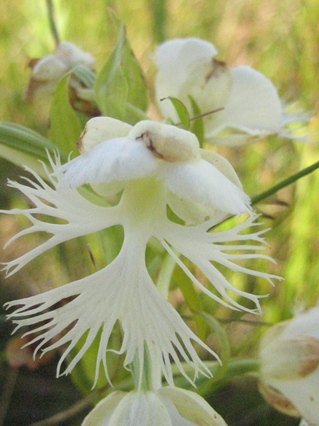
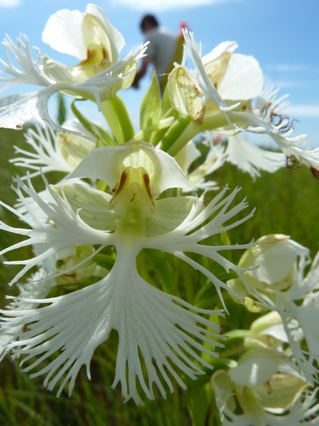
On Monday, July 5th Team Echinacea (or some of us at least), helped Gretel find and count the endangered Great Plains White Fringed Orchid. I did a mini-report on this plant for my Plant Evolution and Diversity class, so to find out more about the plant see Gallagher_PoW_16April2010.pdf .
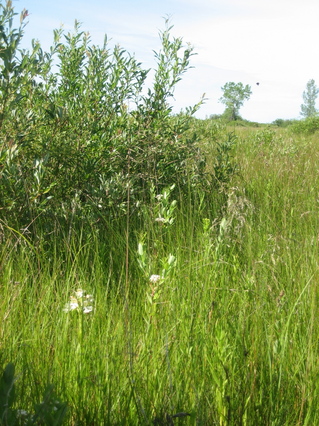
It was really fun to visit to a very different type of prairie (wet vs. mesic), and spend a day doing something totally different. Unfortunately, this year the mosquitoes were especially bad, which kind of put a damper on the day. Fortunately, the team ended up have a lovely dinner at Cafe 116, and I think I can safely say that I had some of the best pulled pork in MN.
Some pictures of the orchid trip:

Planting My MS Project Sites:
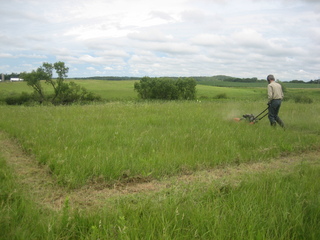
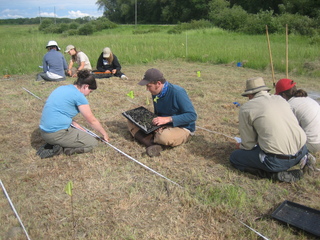
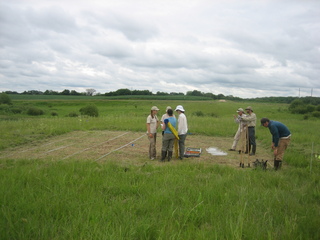
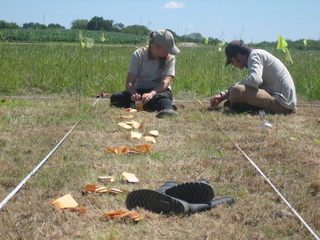
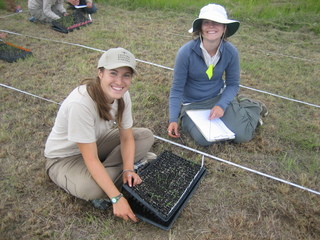
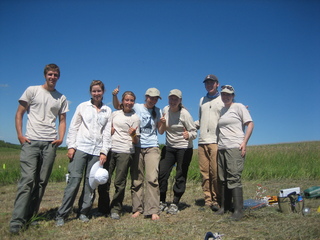
On Wednesday, we finally began planting the three sites for my Masters Project. It was a huge group effort, and I can’t thank everyone enough for helping out. Here are some pictures of the effort:
All Finished! WOOT!
Bowling:
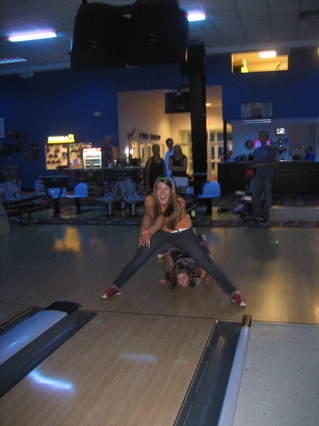
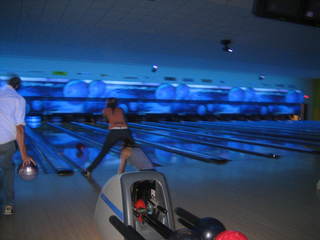
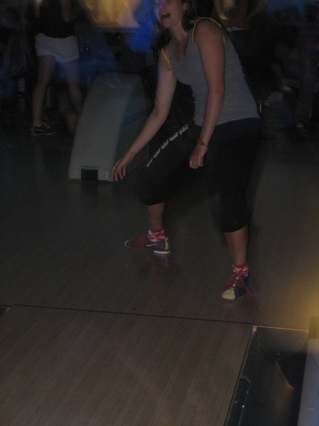
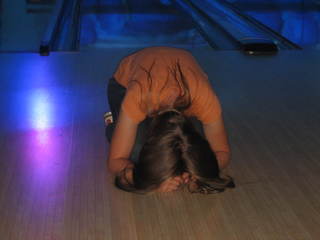
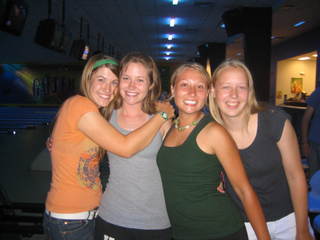
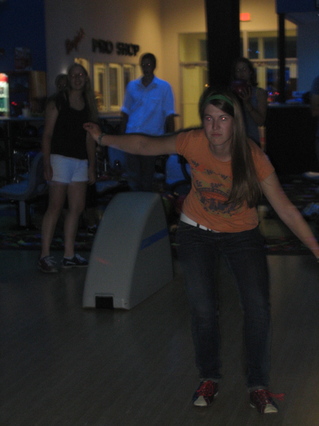
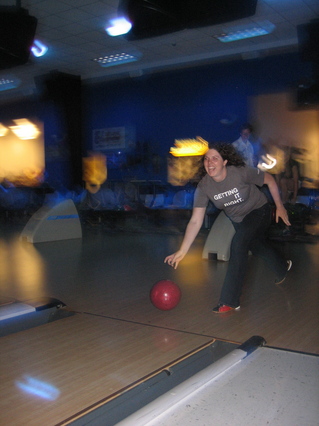
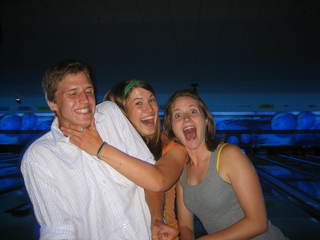
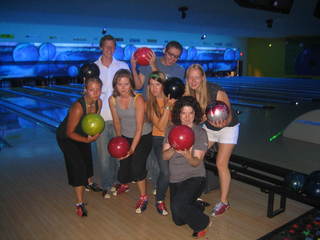
Friday night Team Echinacea went bowling. While I wouldn’t say we were horrible, I also wouldn’t recommend that any of us, except maybe Laura, join a bowling league. The rest of us were inconsistent to say the least, although I think everyone got a least one strike, so there is hope. That said, I think any bowling league would be a bit… surprised by some of the techniques Lauren employed. Bowling left handed, and pushing the ball under Hillary’s legs both seemed particularly successful strategies for her. Personally, I found left-handed bowling to be a complete disaster. Pictures of the fun:
Teamwork gets the job done:
The Under-the-Leg Technique… not so successful, but kinda fun to watch:
Sometimes the fates were against us… for looong stretches of time:
But we had fun anyway:
Et Voila! We’re back up to date. ‘Till next time!
-Kate
Four plants are flowering in Andrea’s garden this year. Andrea Southgate planted this experiment (aka inb2) in 2006 as part of her Master’s research project. Andrea and Jennifer made a photo essay about their plantings that year. These are the first plants to flower in this experiment–about 4/1500 in their fifth growing season!
I dumped the topcon’s gps data into a csv. this data hasn’t been cleaned and contains a couple errors that have yet to be fixed, but it should be enough to flesh out some R magic to help parse the output. The point number, lat, long, and {all the entered data for the points} are comma seperated, the least being one big glob of stuff.
The first couple values are proper points but the wrong dictionary, so those will have to be done seperately.
stipa.csv
Not sure how many are needed, between the common garden and next to Hjelm house, could someone bag coreopsis palmata tops for me? My goal is to get 20 plants with two heads covered. That way I can self-pollinate one head and cross-pollinate another head.
Additionally, if Laura and Katie could check nice island across hwy 27 to see how far along the bagged psoralea is to flowering, that would be great also.
Attached is a picture of each plant.

yesterday a group of us had fun searching for orchids in the wet land prairie, that is until the mosquitoes found us. However we quickly recovered from the attack with an excellent meal and delicious chocolate bread pudding for desert. Here are a few pics from the day.
Today Josh and I searched the last two circles at Staffanson Prairie (SPP). Our last search centered on this focal plant:
We found 23 seedlings in the circles at SPP, bringing our grand total for this year to 74. In comparison, we found 29 seedlings in 2006, 135 in 2007, 239 in 2008, and 93 in 2009. That’s quite a lot of year-to-year variation!
So this past week I was able to work on my project because the Echinacea has started flowering in the common garden! So far so good, but it is going slow…
The painting is going really well. I am able to distinguish one and two day old styles wonderfully based on how I am painting the brachts. However, the pollinators take their sweet time to visit my flowering Echinacea head when I want to do the single insect visit. I was under the silly impression that I would remove the pollinator exclusion bag and a bee would come flying to the flower, do its pollinating thing, and let me move on to the next plant. Wrong! Sometimes it takes a bee 30min to and hour to land on the flowering head, which means I am sitting there patiently watching a single Echinacea head for a long time. UffDa!
I do video tape the bees in case one lands that I cannot identify in the field. Plus, it’s nice to have video for my presentation later. BUT the video camera’s battery dies after a couple hours. So we may have to purchase a back up battery…
I have had 8 insect visits this week so far, and have noticed that they have all been after 10am. Maybe 10 – noon is the peek time for bees to collect pollen? Not sure yet.
The visits I have had are pretty exciting! I have had 3 Augochlorella visits, 2 Agopostemon visits, 1 Melissodes visit, 1 Lasioglossum visit, and 1 Ceratina visit. Quite a diversity!
The interesting thing is: when observing the shriveling or lack of the day after, Melissodes shriveled 1 style and only had a 3 second long visit! Both Augochlorella’s shriveled 1-2 styles each and they spent 5-7 min each on the Echinacea head! Looks like they are not very efficient pollinators, most likely do to thier small size and they barely touch the styles when collecting pollen from the anthers. Same with the Lasioglossum, which is around the same size as Augochlorella and it didn’t shrivel any styles. The Agopostemon spent a few minutes gathering pollen and shriveled 5 styles! I am curious to assess the shriveling of the other Agopostemon and the Ceratina (another small sized bee) tomorrow because those were the visits I had today.
A concern of mine is all the bags that are on the flowering heads in the common garden. Several people, including myself, are using pollinator exclusion bags. So maybe if the bees know that they wont be able to collect pollen as readily from the common garden, maybe they do not bother visiting as much as they would if the bags were not on the heads. Any thoughts?
The bags may also contribute to a lower pollinator efficiency if the bees are not able to transfer pollen as they would be if the bags were not on :/ …However, there will be more flowering plants as the season progresses and hopefully there will be a good number of them that do not have bags on them. So I am guessing I will see an increase in pollinator efficiency as the season progresses.
Also Gretel- would you be able to provide me with the peak flowering data from within the common garden when the time is right so that I can compare that to a peak in pollinator efficiency (if I see one)?
I believe thats all for now! I look forward to giving another update on pollinators next week! 🙂
Later,
Katie
After the fourth
The 55th Annual Waterama is July 19th-25th, 2010 in Glenwood .
Grant County Fair: July 22, 2010 – July 25, 2010 in Herman.
Hoffman’s Harvest Festival will be held August 13,14th, and 15th.
Douglas County Fair: Thursday, August 19 – Sunday, August 22, 2010.
|
|

 Each of the 2 Echinacea seedlings is marked with a red party toothpick. We (Shelby, Janelle and I) found them in May when we censused my 2 SoDak plots. We found a total of 10 new seedlings at the Perch Lake site, all of which had 2 cotyledons but no true leaves. I returned to Perch Lake last Thursday, July 8. Sadly, 7 of the seedlings were gone, but I was able to verify that the 3 survivors are, indeed, Echinacea angustifolia.