|
|
The simplified protocol for crossing these plants (silverleaf scurfpea) is to find an uncrossed, flagged & bagged plant. Remove both bags, leaving the twist tie on the branch to be able to recognize it. Using a toothpick, transfer pollen from the donor flower on a plant to the receiver. (I have been doing a minimum of four and up to as many as possible on the branch) After the pollen is transferred, use a new toothpick to transfer pollen between the next two flowers. (Always a new toothpick)
Once all the flowers on the recipient are “pollinated” use a toothpick to paint the sepals under the flowers purple- then rebag using a white twist.
Record the flag number, the number of purple “self-recipients” and the colors of the painted sepals and twist tie.
Then transfer to the “donors” of pollen on that same plant. For this pollen, use another flowering plant AT LEAST 5 meters away – to avoid them being clones. Individually transfer from donor flower to donor recipient. These sepals get painted pink and the twist tie should be red. Record the number of flowers (it can be more or less than the recipient number) and the color of paint and the twist tie.
Sample data:
Flag #64 Purple – 5 White Twist Pink- 6 Red Twist
It is tedious to get the anthers out of the sheath, but they are loaded with pollen- so touching the toothpick loads it even if you cannot see them. I checked some anthers under the microscope and there is a good deal of pollen – it is clear so it doesn’t show up as well as some asteraceae pollen.
I’ll try to get pictures of the anthers sometime soon as well.
There have been some small details to fix on my data that I posted yesterday so I have attached a new and improved csv file below. I also ran the chi-square again today removing one cross that was not securely an incompatible cross. When removing this point the results for higher incompatibility within remnant crosses became more significant (X2 = 4.33, df = 1, P = 0.038).
My methods for assessing whether there was compatibility between two plants was to collect pollen from a randomly selected paternal plant and then introducing that pollen on five styles of a randomly selected maternal plant. The styles on the maternal plant were marked by painting the bracts behind the styles a unique color and noting the direction the styles were facing on the head. After introducing pollen, styles were given 24 hours to experience shriveling before assessment. A shriveled style was indicative of a compatible cross while a persistent style signaled incompatibility. The plant that I removed for the second chi-square showed 3 persistent styles and 2 shriveled styles when assessed. I was unable to do the cross again given that the plant ended flowering quite early on, and given that it showed only 60% assurance of incompatibility I decided to reject the cross from the statistical analysis.
My original sample size was 30 plants found in the common garden that were progeny from Steven’s Approach, East Riley and Nessman. There were no biparental inbred plants included in the sample. However, towards the end of the crosses one of the plants from Steven’s Approach died before it could receive pollen so I randomly selected a new plant in order to finish the crosses. If I remove the crosses done on the later selected plant the chi-square analysis of the compatibility for between and within remnant crosses becomes slightly less significant (X2 = 3.80, df = 1, P = 0.051).
I have also attached my original data sheets from style assessment as a pdf.
btw.within.crosses.csv
ians.crosses.2010.pdf
I have some pictures of pollinators, but more to choose from would always be helpful for putting together my poster in a couple weeks.
I know Gretel and Josh said they had some, anyone else?
If so.. I would like any good pictures of Melissodes, Agopostemon, Augochlorella, Ceratina, and Lasioglossum. Preferably on Echinacea.
If you could go through them and put them on a USB for me, that would be greatly appreciated. And I would acknowledge you for the picture if I use one of yours.
Thanks,
Katie
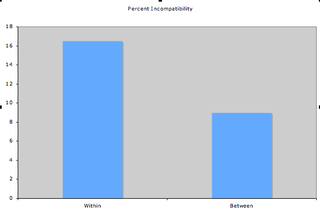
After a couple of weeks of work 278 crosses in the common garden have been completed. Attached is a csv file containing the data collected. I have yet to finish collecting dates of the end of phenology for some of the plants so once all flowering is done I will post the remaining data. I ran a chi-square on the between and within crosses for compatibility and came up with a nearly significant result (X2 = 3.62, df = 1, P = 0.057). Below is a graph representing the difference in compatibility for between and within remnant crosses. As expected, there was higher incompatibility for within remnant crosses than for between remnant crosses. I will continue to post statistical results along with project photos and methods. Please feel free to question or comment.

btw.within.crosses.csv
In case we need help 🙂
Materials:
Visor
Petri dish
paintbrush
mesh bags
twist ties
a partner!
1. Sync visor, get randomized plant (row and position) from Hillary.
2. Collect aphids from several plants in Common Garden. Find leaves with fat, dark aphids (aka mature). Gently disturb aphids with brush tip. When aphids start to scurry (remove stylets), brush them gently into the petri dish. Do not mash them by rubbing paintbrush against the plastic (attempting to dislodge them).
3. When approximately 20 mature aphids have been collected (not including tiny green ones), find assigned plant.
4. Check transfer plant for ants and aphids and record presence in form.
5. Find a suitable leaf (close to ground and small enough to fit in bag) that is free of any ants and aphids (if there are no empty leaves, squish present aphids).
6. Prepare bag over most of the leaf (opening bag and pulling over leaf). Then lift the bag up enough to stick the aphids in.
7. Transfer two random aphids to the top of the leaf (one big aphid and one slightly smaller). It works best if one partner holds the leaf and bag and the other transfers the aphids. Then the bag holder pulls the bag down and the transferrer twists the tie.
8. Pull bag completely over leaf and gently twist tie it closed. Avoid strangling the leaf or squishing or dislodging the aphids.
9. If aphids take a death plunge or fall off make sure they are not in the bag and transfer additional aphids as needed.
So far the phenology is going good, Heliopsis seems to be finishing up flowering, and I was able to pull some flags today! All the echinacea and coreopsis seem to be just at peak or a little past, while the carduss and flags are continuing to be mowed. I am starting to input my data and will probably have some preliminary graphs up next week!
The string segments that came with the wheeled trimmer were 47 cm long. I used 32 cm sections for trimming rows in the CG.
It’s been quite a while so there is lots of good news on the aphid front! First of all, aphid casualties have decreased substantially thanks to improved transfer methods. We have now been using a paint brush to gently disturb and brush the aphids into a petri dish (upon the suggestion of Dr. George E Heimpel). This is far less traumatizing for the aphids and survival has skyrocketed from 20% to around 50%!
Also, fortunately for us, apparently all aphids at this time of the year are gravid, so we only need to select mature individuals for transferring. This was an exciting discovery since we spent a while with a microscope trying to figure out which ones were gravid before this revelation. We also officially decided to use two founders for each transfer to improve chances of survival.
Hillary and I are looking forward to checking out the preliminary data soon!
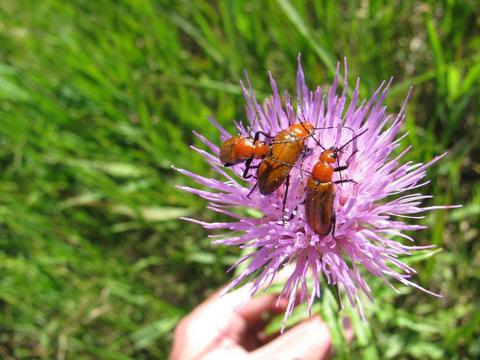
 Beetles getting busy. The male was mounted on the other female shortly before this photo. Beetles getting busy. The male was mounted on the other female shortly before this photo.
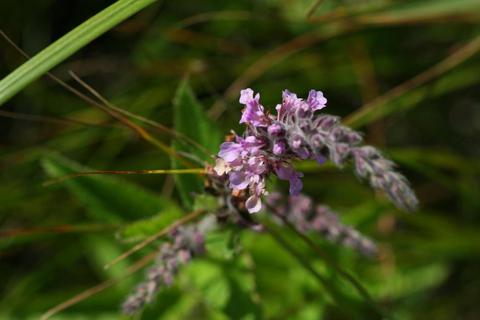
 Looking for orchids, this is in some pretty swampy area. Someone Mentha. Looking for orchids, this is in some pretty swampy area. Someone Mentha.
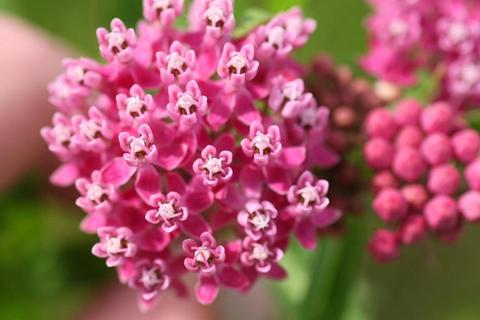
Swamp milkweed, Asclepias incarnata. Also while out looking at orchids.
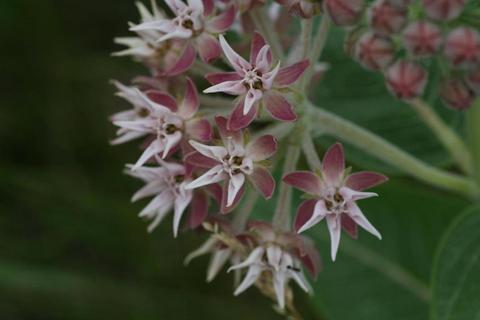
Showy milkweed, Asclepias speciosa.
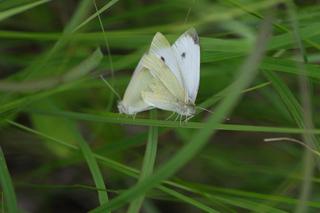
 Lepidopteran love. Lepidopteran love.
This plant appears to not be photosynthetic
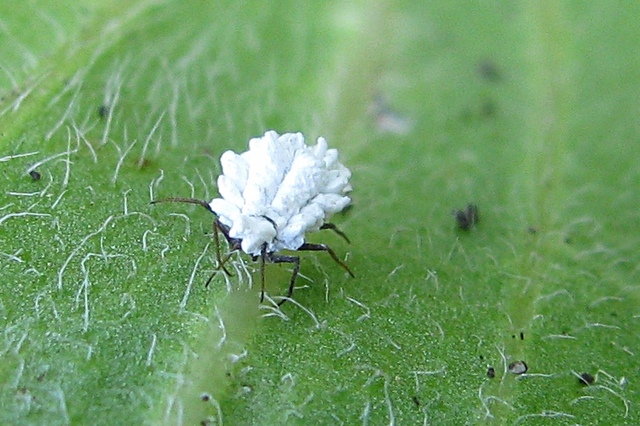
 Click to embiggen. This white fuzzy (yes, an insect!) is hanging out on an echinacea, doing whatever it is they do. Click to embiggen. This white fuzzy (yes, an insect!) is hanging out on an echinacea, doing whatever it is they do.
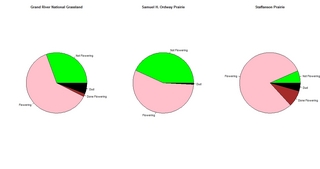
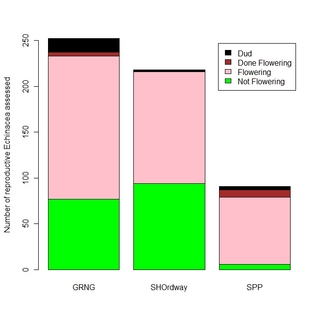
Last week I assessed Echinacea flowering phenology at Grand River National Grassland south of Lemmon, SD, Samuel H. Ordway Prairie west of Leola, SD and Staffanson Prairie near Kensington, MN. Here are a couple of figures I generated to compare phenology at the 3 sites.
First, I made pie charts to show the relative proportions of flowering plants.

Next, to show more quantitative information, I used a stacked bar graph.

These figures illustrate that the flowering phenology is most advanced at Staffanson and least advanced at S. H. Ordway Prairie. Nevertheless, I am encouraged that there are lots of flowering plants at all 3 sites, suggesting that a long-distance cross involving plants from these 3 locations would be possible. I am considering tackling that project next summer, to assess whether there would be lower seedling recruitment from between-population crosses compared to within-population crosses at these 3 sites.
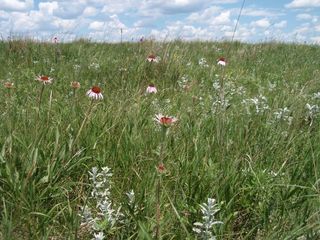
Here’s a picture of some flowering Echinacea at Perch Lake, which is near the S. H. Ordway prairie.

|
|