|
|
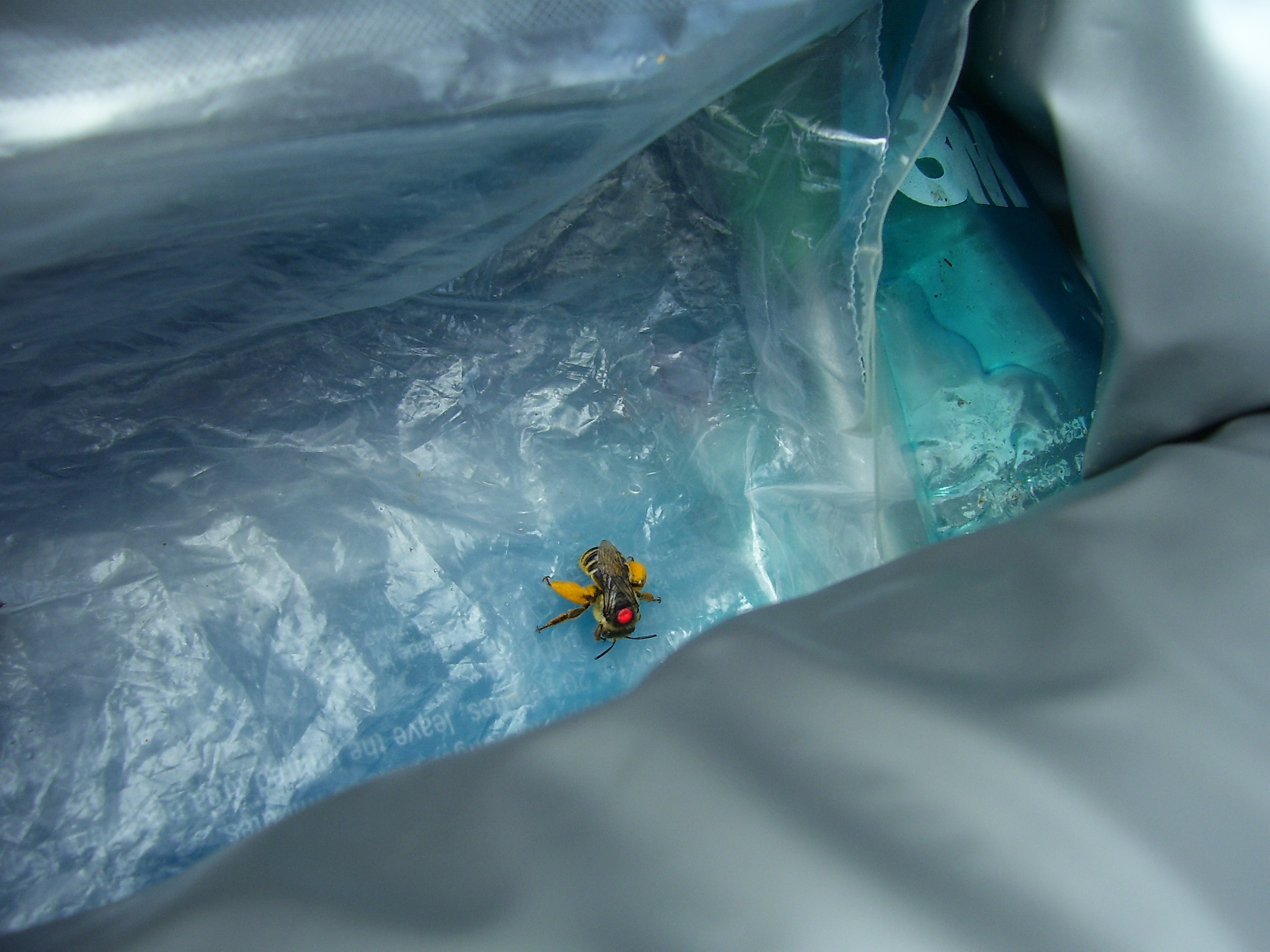
This morning, due to a revolutionary development in our marking protocol, the Bee team members caught and marked 6 Halictus rubicundus in a relatively short amount of time. The secret to our success was capturing the bees and cooling them before any painting was attempted, instead of trying to mark them while they worked the Echinacea heads. Tomorrow we will spend a good portion of the morning marking bees in the common garden, and then hopefully be able to train the rest of the crew in, so that we can begin taking data in earnest later in the week. Read on for new and revised protocols…

Bee Painting Protocol
Needed Equipment:
-lunch box coolers, each with an ice pack and several glass vials
-paint applicator and bandolier
-insect net
-visor, with random number list and bee07 form
1. Walk rows as prescibed by the random number list with a partner, scanning 4rows across for bees on Echinacea heads
2. Catch any bees with the insect net (being careful of flower heads!) and transfer the bees to a chilled vial
3. Keep bees in cooler until sufficiently chilly and slow (approx 3-5 min)
4. Transfer bee from the vial to a flat working surface (plastic bag on top of the ice pack works well) and paint a small dot of the appropriate color on to the middle of the thorax
5. Allow the bee to warm up, and release it in the same vicinity in which it was caught
6. Record all necessary data (including bees species, paint color, plant coordinates etc) in the visor
Tracking Protocol
Needed Equipment:
-binoculars
-color key pallet
-visor, with random number list and bee07 form
We haven’t yet tested this protocol, and there will probably be some revision/elaboration before it gets implemented. But this is the current plan:
1. Working in pairs, walk random rows, searching the 4 adjacent rows for bees.
2. When a bee is located, track it for as many consecutive flights as possible (we anticipate that one person should be visually tracking the bee, while the other partner records data in the visor, and assists with tracking when not data taking)
Here are some preliminary instructions on how to observe and record bee/ant presence or absence while we are doing phenology measurements. I thought that while we are looking so closely at each head, we might as well try to garner some information on the Hymenopteran vistors as well. It will not be continuous data, but rather a simple ‘yes’ or ‘no’ measurement for each plant (bees) or for each head (ants).

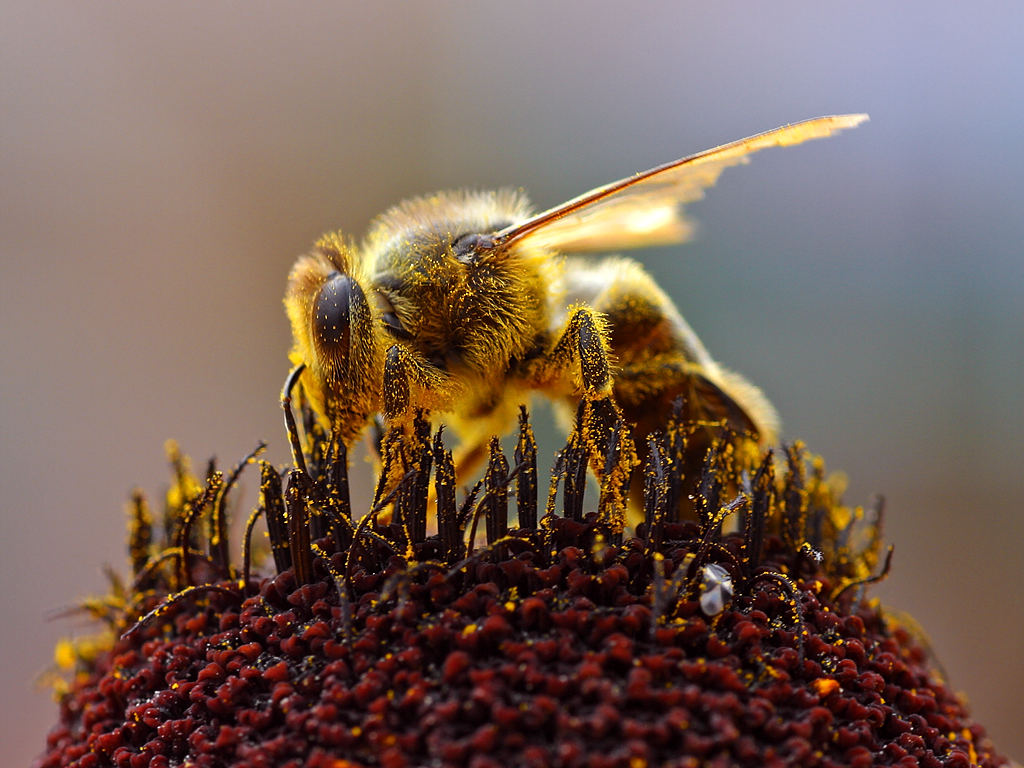
Bee collecting composite pollen, copyright Jon Sullivan
For BEES:
As you begin your phenology measurements only scan for bees once you are within 1m of the plant. If there are any moving, active bees on any head, mark the appropriate box in your phenology form. As soon as you touch a head for phenology measurements, stop recording any bee presence/absence. So, if you are looking at a head and a bee lands on an adjacent head, just ignore it. For bees, we are interested in bee presence for the ENTIRE plant, so as soon as you see one, you are finished entering data.
Remember, wee are only interested in active bees, so don’t count sleeping bees, dead bees, bees caught by crab spiders or assassin bugs, etc.

Ant, copyright Alex Wild
For ANTS:
Ant data are collected on a per-head basis. As you take each head into your hand and begin your anther count, notice if you see any ants on the top of the inflorescence (either ray OR disk florets). Don’t make any special effort at looking underneath the inflorescence. If no ants make an appearance as you are handling the head, mark the head as having no ants, if ANY ants appear whilst you are searching the head, enter the data as such.
Andy

Hello everyone, this is Andy McCall reporting from the farmhouse in Douglas Co. Minnesota.
I’m currently an assistant professor of biology at Denison University, a small liberal arts college (a SLAC!) in Granville, Ohio. I, like many people on the project, graduated from Carleton College , where I first learned to appreciate and love the prairie landscape under the tutelage of Mark Mckone .
Needless to say, I love teaching and learning and have wanted to be a professor since my time at Carleton. After Carleton, I studied alpine flies in New Zealand while earning my Master’s degree at the University of Canterbury, leafcutter ants in Costa Rica, and wild radishes in California.
I received my doctorate in population biology from UC-Davis in 2006 with Rick Karban and spent some time in Ruth Shaw’s lab at the University of Minnesota last summer, thinking about inbreeding, flowers, and insects — a few of my favorite things! I met Ruth when she came to UC-Davis for a week as a workshop speaker in the Center for Population Biology and we immediately hit it off because we both have done work on the lovely annual plant, Nemophila menziesii . She introduced me to Stuart and the Echinacea project, and the rest is history!
Ruth, Stuart, and I were lucky enough to receive funding through the National Science Foundation to support our work on pollination and seed predation this summer, and I have received generous funds from Denison and the Battelle Foundation to support the students I brought from Denison this year: Josh Drizin, Jameson Pfeil, and Colin Venner. I’m psyched to be part of the project as I am certain that we are learning brand-new things about both Echinacea biology and prairie restoration.
Here’s a list of our objectives for the week. Our goal is to gain greater understanding of the ecology and evolution of plants and their associated insects in fragmented prairie habitat. This week will be a peak flowering week for Echinacea this year (1 – 2 weeks earlier that most years). We will spend most of our time observing things related to reproduction. Get down, Echinacea!
Flowering phenology–successfully mating depends on being at the right place at the right time. We can map _where_ all the action occurs later, because our plants don’t move much. Now, we have to figure out _when_ the action is happening and which plants are participating. Some plants are almost done flowering and others are just thinking about flowering.
Style persistence is a signal of which plants are not receiving compatible pollen. We can quantify SP at the same time we observe phenology. We will make phenology and SP observations in the common garden on Monday, Wednesday, & Friday and at Staffanson on Tuesday & Friday.
We will set up ~10 video cameras in the common garden each day. Each camera will be trained on a specific head to watch for pollinator visits. If we can figure out how, we will post a video online for your viewing pleasure.
The Bee Team will mark bees on Monday morning and probably Tuesday too. They will train all of us to make good observations and record high-quality data. We will do that all week. Here’s the link to _the_ online bee identification resource for Eastern North America. This is a great resource!
http://stri.discoverlife.org/mp/20q?search=apoidea#Identification
(It’s certainly good enough for our purposes in western Minnesota.)
The KAP team will take photos of our remnants, if the wind allows. They will be all ready to go when it does. We’ll be keeping track of local weather. Here are some key resources:
Kensington general forecast and 48-hour surface wind forecast (from NWS in Minneapolis).
Hoffman general forecast and 48-hour surface wind forecast (from NWS in Grand Forks).
Current conditions at nearby weather stations.
We will take head photos for symmetry measurements in the afternoons. Colin, now that you made one rig, could you easily & quickly make another one? If so, we could have two pairs of folks taking photos.
One afternoon we will take data on herbivory of ray florets in the common garden.
If weather on Thursday permits, we will take a field trip to visit the Western Prairie Fringed Orchid and help Gretel monitor her long-term experiment.
If it rains this week, we will weed sweet clover & thistle in the CG right after the rain stops–or during if there is no thunder. Bring gloves!
Finally, everyone will post a profile with a photo.
I am looking forward to the coming week! I’d better get some sleep so I can appreciate it.
We have finished two weeks of the summer field season and I feel like we haven’t settled into a routine because we have been doing something new and different each day. It’s exciting.
Here’s a recap of accomplishments this past week…
Last week we finished searching for plants in the recruitment experiment. One plant (of ~1000 still alive) is flowering this year; it’s the first plant in the experiment to flower! The plant germinated in spring 2001.
Our high tech endeavors are underway and we have computer infrastructure to support them. Josh has networked the computers, hard drives, and printer. After some anxiety-inducing modifications to the video camera power supplies, we started taking video of pollinators & other visitors of Echinacea heads. Andy previewed a video this morning and it looks great! We still need to get more reliable power sources, but video cameras sure beat sitting on a bucket.
Colin has developed a camera rig to take shots of Echinacea heads in the common garden. We will be able to quantify many aspects of radial symmetry in the heads with the resulting digital images.
We assessed herbivory of ray florets in the common garden. We also looked at damage to disc florets. Jameson began to classify types of damage, but there weren’t that many heads with damage to the disk florets.
The KAP team (Julie, Rachel, and Josh) has made progress. Wind conditions have kept the kites on the ground most days, but they are making ground markers and have prepared the camera and rig. I flew the Sutton FlowForm 16 today in 12-16 mph surface winds at the park in Hoffman. Wow, it can pull. Yesterday, Gretel & I flew the G-Kites Dopero in somewhat variable winds. It was nervewracking.
The Bee team (Amy, Ian, Jameson, & Gretel) has abandoned my (bad) idea of watching bees through binoculars in favor of their much better idea. They are marking Agapostemon virescens individuals with acrylic paint and watching them when they are on the heads. They marked two bees on Friday and saw one on Saturday. Cool. They also have a slick form for entering observations.
We all have been making systematic observations of flowering phenology and style persistence of all plants in the common garden and along a transect at Staffanson Prairie Preserve.
In case anyone was wondering about the ostensibly narcissistic streak in recent posts, I _asked_ everyone on the team to post a profile with a photo.
Good work team Echinacea! We are making great progress in our quest to gain greater understanding of the ecology and evolution of plants and insects in fragmented prairie habitat.
I’m Josh Drizin, a rising senior at Denison University. I’m majoring in Biology (minor in Chemistry). I’m interested in plants, and possibly more specifically in population ecology. I joined Team Echinacea because I wanted the experience in field work and the project sounded interesting. My tick count to date is 10. I rather enjoy photography and quite like listening to music (I need to get back into playing guitar, though).
Let me reintroduce myself. In rare forgetful moment, I left my self logged into the team computer at the farm house, and a prankster who shall not be named shared with the readers of this blog a couple of facts about my life. All of these facts, with the possible exception of the title of the entry are true. I’m a biology major at Carleton, and will be spending the fall semester studying rain forest ecology in Costa Rica. I like being outside in any and all capacities, love ornithology, and enjoy making and consuming delicious food.

I am Colin Venner, Biology major from Denison University. Orignially of Saline, Michigan (just outside of Ann Arbor), I am in the class of 2009 and I am a Taurus (though I don’t fit the profile for one). I enjoy several different styles of music and have been known to “cut a mean rug”. When I’m not counting anthers of flowering Echinacea heads you can find me enjoying life and smiling frequently.

Hi i’m Amy Alstad. I’m 5′ 113/4″. The saddest part of life is that i’m not 6′ tall. I’m from MN and i’m going to be a junior at Carleton college
|
|