|
|
Today was a day of firsts, realizations and first realizations. It was our first unexpected change in schedule due to weather, and realization that the early flowering of many plants will mess with pollination experiments. It was also our first day in the Common Garden and possibly first experience with chiggers, as we have many unexplainable itchy red bites. I think that we all realized that it’s going to be rough work out there. Mosquitoes swarm all over at all times, the sun/heat is unrelenting and there are thistle plants the size of Christmas trees to deal with. I realized that there is nothing better than a ridiculously long shower after a day in the field. It even seems to make sunburns hurt less, mosquito bites (of which I have many) itch less, and will always be the one place that ticks and chiggers can’t get me.
Day 4 of the Echinacea project and still no blog postings from the ladies of the group. Not to pass judgment on the fairer sex, but they seem to lack general motivation. Hopefully their negative attitudes improve with time.
Hey, it’s 7:47 in the morning in Minnesota. Notice the timestamp on the blog entry. How do we make the timestamp correct?
If y’all like nerdy blogs, check out this one, made by a guy named Johann in Sweden:
http://insect-plant.blogspot.com/
Well, we are off to bed in the men’s condo, or the ‘mando’. I am excited to use the new shower caddy that Colin assembled earlier in the day.
I think Stuart’s idea about measuring anther asymmetry is definitely do-able, especially if we can do some neat batch files to process the pictures automatically. I think this technology exists, as one of Stuart’s volunteers did something similar at the CBG.
The field season is off to a great start. We’ve spent time collecting data on two experiments and we are getting new equipment & gear organized. Not everything is roses though.
We have determined survival of plants in our experimental “recruitment plots.” Seeds were planted during fall 2000, 2001 & 2002 in plots with different prescribed burn treatments. We have kept track of survival every spring. Five plots down, four to go! We will write down our equipment list & the protocol for this experiment later this week.
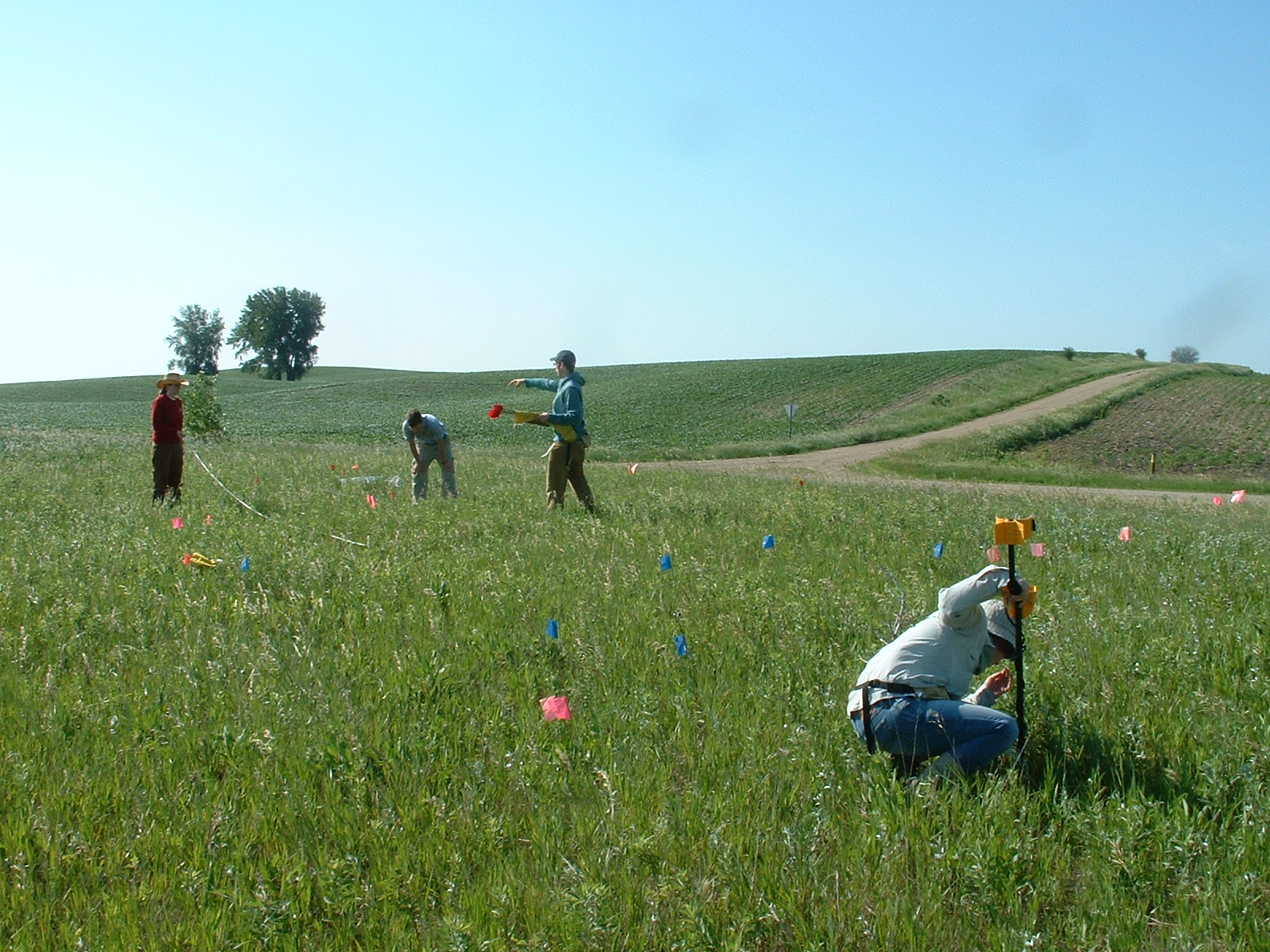
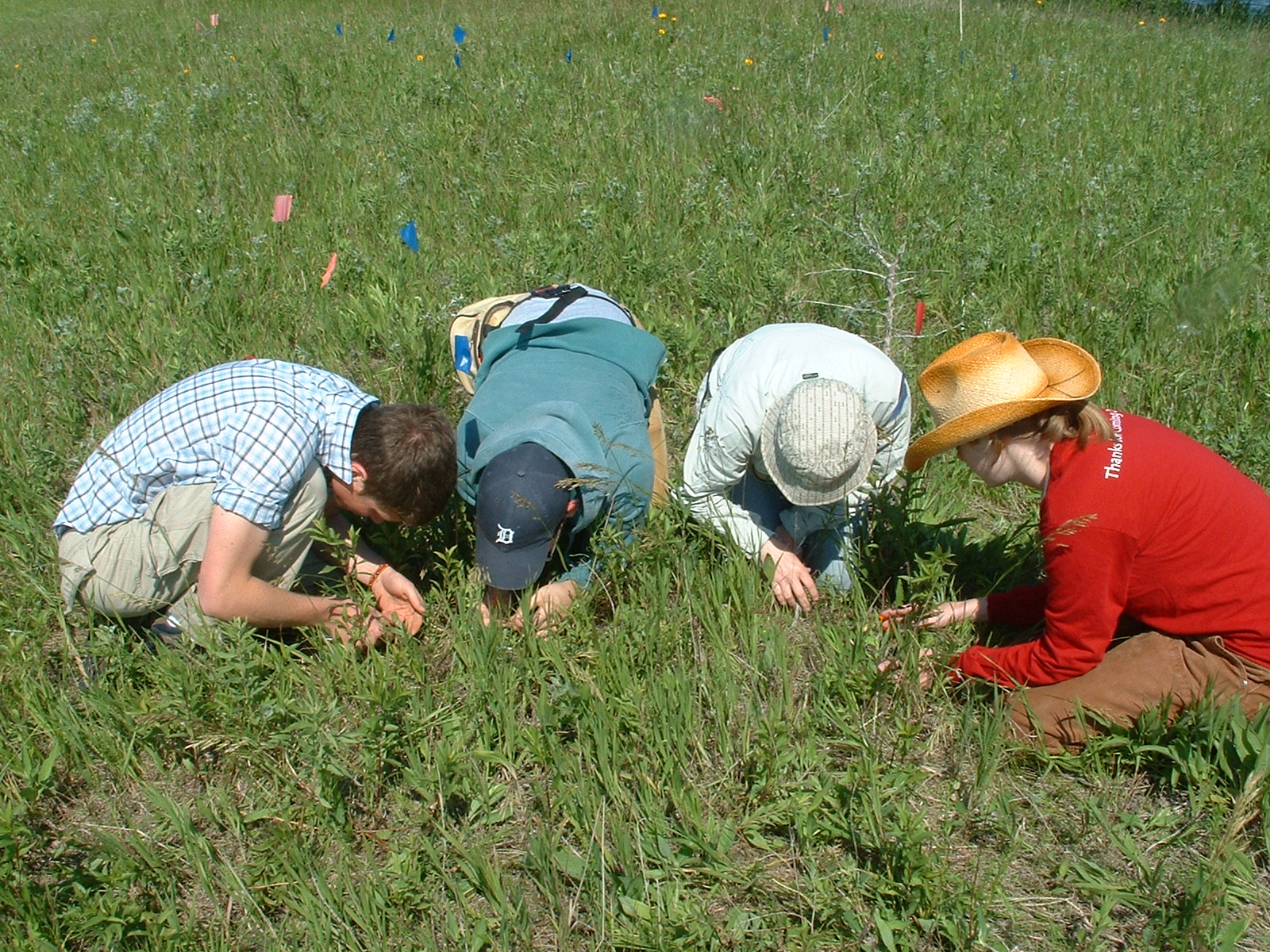
We searched for and found seedlings in three remnants (sap, nwlf & kjs). The goal is to find plants of the 2007 seedling cohort and determine their survival this summer & in future years. We want to compare seedling recruitment & juvenile survival from year to year and among remnants. This project will offer insight into the differences in population dynamics in small & large remnants. We’ll also be able to gauge masting in Echinacea.
Distinguishing between seedlings and small plants is difficult. Some plants were obviously seedlings because we could see green cotyledons or brown shriveled up cotyledons. Other plants were the same size as seedlings, but were obviously not seedlings because we could see remains of a dried up leaf from last year. Then there were some that we just weren’t sure about: small plants with no leaves from last year and no cotyledons.
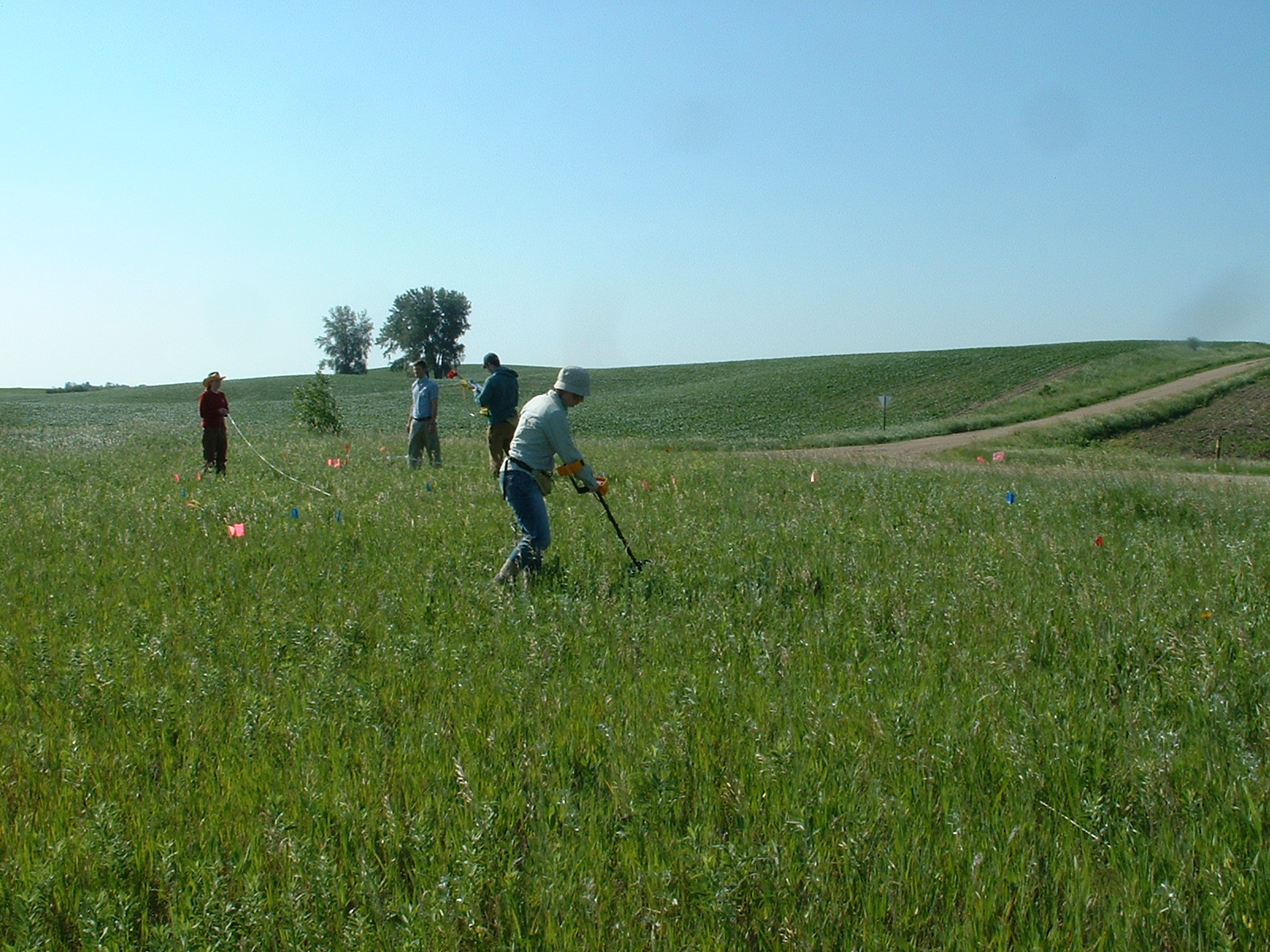
Some problems are impossible to solve right now (distinguishing seedlings). Other problems are solvable–and we have a lot of them. We have many new gadgets to get working this summer: kites, digital cameras, video cameras, high-precision GPS, etc. We will push some of our equipment to the limits (like using binoculars to follow flying bees). We’re feeling a bit overwhelmed and worried that we won’t have everything figured out before flowering starts. And flowering will start soon–one plant at kjs (#1919) looks like it could start flowering tomorrow.
Fortunately, field biologists are a resourceful lot. It is no surprise that Andy & Josh surmounted the problem that we had with downloading large video files.
We will face many challenges in our pursuit of efficient data collection in demanding, harsh field conditions far away from civilization with pressing time constraints. But science must move forward! New discoveries await! We are up to the challenge! Stay tuned to the Echinacea field log to read about new adventures of the Echinacea team…
It was a good day around Andes Tower Hill and the study sites. I think one of the top experiences was when Colin assembled the shower caddy the kind folks from the Andes gave to us and I am guessing that it will vastly improve our showering experience. We also got wireless after some skillful negoitiating by Andy. Working was good today, although it appeared that Echinacea was avoiding our study plots today and we only found two plants on one entire side of the whole plot and also found very few seedlings when doing the seedling counts. There were plenty of seedlings at the other group’s sites however. Once back at Andes, Jameson broke ground on his garden and proceeded to work the dirt into something that would be palatable to his plants. We debated tilling the bunny hill and turning it into a large garden, but then decided it was too much work. I chased butterflies around the condos, and Jameson promptly laughed at me when I took a spill in my quest to capture the flitting, defenseless insects. Six of us went looking for some poor, orphaned furry creatures, namely baby raccoons, that Amy had found, but we were unable to locate them and instead picked up roadkill dragonflies. It wasn’t quite the excitement we were looking for, but it was still good. Jameson’s tick count for today was 5 and currently I do not have the expertise to comment on whether this is above or below his average.
Andy’s problems for the summer:
1. How to transfer large (> 2.0 Gb) of video from the cameras to the hard drives. Right now, it is taking 70 minutes per 2.0 Gb, which is really too long. I am hoping that if I can switch to Josh’s USB 2.0 computer the transfer rate will be much higher. This is probably the biggest problem I need to solve this summer, but there is not much time!
Breaking News!: I just used the USB 2.0 on Josh’s laptop, and the transfer speed is about 30 times faster – yahoooo! Now, I just have to figure out how to keep track of all the videos and how to switch them in the common garden without getting totally confused.
2. Deciding which variables to measure for the path analyses. Some we have thought of so far: population identity, inbreeding status, number of leaves, number of flowering heads, # of pollinators visiting per unit time, style persistence, distance to nearest flowering neighbor, distance from edge in the common garden. The final variables of interest would be # seeds produced and perhaps pollen viability.
3. I need to figure out how to test the viability of Echinacea pollen.
4. How to measure FA in the plants. Leaves and inflorescences should be measured in some manner. The disk itself could be measured for radial symmetry, too. On the inflorescences, the petals themselves can be measured, as well as petals on opposite sides of the head, or across the entire head, as it should be radially symmetric.
Some wild parsnip (Pastinaca sativa) webworm damage. Wild parsnip is an exotic weed found throughout the midwest. It’s chemical ecology has been well studied by May Berenbaum and Art Zangerl at U of Illinois.

Well, until I figure out why putting images in directly won’t work properly for me, I’ll just link them. Click to see the picture. Also, Ian keeps putting stuff in his kill jars. He’s shuffling insects from this mortal coil.
Rosa arkansana – Pasture rose
Lilium philadelphicum – Prairie lily
some kind of Bluet – a damselfly
Whilst strolling around Andes Tower- being eaten alive by mosquitoes- I found myself well beyond familiar territory. The black-diamond slope “Warmgear” had betrayed my trust and led me to a farm field much further south than I had expected. In the treck through the soybeans, I saw 2 white tailed deer in the distance. Distracted by their graceful loping, I was startled by an explosion of feathers from a cluster of brush nearby. The most tremendously obese turkey in the history of people was flapping frantically to remain airborne. As it struggled to move away from me I began to think that I could run faster than it could fly. As I continued back to the condos, I started to wonder if it would have been smarter to have attacked the turkey rather than simply watch it fly to safety in the woods nearby. Had I punched it in the head, as I suggested aloud to Jameson and Andy later, it may have helped me meet my $13 per week food budget. I suppose you live and learn.
Colin
19 June 2007
Andy McCall reporting here. I drove from OH to Minnesota last Friday. It was a trying commute for a number of reasons. After preparing for the summer and trying to rid myself of a strange contagion I may have contracted in Costa Rica last month I took off from Granville, OH to Chicago, where I was to meet Stuart.
All was well until I hit the hellish highway snag that is Chicagoland. I was not expecting the horrors that I encountered. I WAS however, prepared for tolls on US 90, bringing about ten dollars in change. The first toll came to a grand total of 15 cents. I didn’t know that anything, even candy, cost fifteen cents anymore. I used to buy subsidized milk in elementary school for that amount. The next toll was 50 cents – OK, the next toll was 100 meters later and was $2.50. I submit this question to you, dear reader, “What is up with that?��? Why wasn’t it $3.00 in the first place? – I didn’t even see a darn exit in between the tolls.
OK, enough about tolls. I called Stuart telling him of the construction on I-90, suggesting that I was 40 minutes away. Three hours later I arrived in Highland Park, right across the street from the Chicago Botanic Garden. We stayed for about 30 minutes, chatting through the din of the cicadas that had emerged en masse in the Chicago area. Stuart drove my car and we talked of many things, as we had 6hrs in the car.
After arriving in MN, I went down to Northfield for my 10th College Reunion. It was grand, and saw many a familiar face. I also got to visit Carleton’s own prairie restoration, where I had worked years before under the tutelage of Dr. Mark McKone. I took several pictures of prairie plants and their associated insects. From the prairie you can even see Carleton’s giant windmill. St. Olaf has copied us and now has a big one right as you enter Northfield on Hwy 19. I picked up Colin Venner at the MSP airport and then we were on our way!
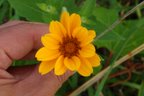
Heliopsis 
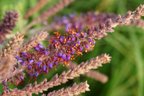
Amorpha canescens
|
|