|
|
In plant populations where reproduction is mate-limited, the potential exists for selection on floral traits through both male and female function (seed production and siring success). Selection could be strong because of high variation in both male and female fitness. Additionally, most plants rely on a number of generalist insect pollinators, each of which is likely imposing selection on plant traits associated with reproduction. In many plant species, these generalist pollinators are native solitary bees. However, pollination research mainly focuses on large social bees—bumblebees and the non-native honeybee.
The main objective of this research project is to quantify how four generalist solitary bee taxa contribute to male and female fitness in the mate-limited prairie perennial, Echinacea angustifolia. To accomplish this objective, 15 researchers worked together to monitor the complete pollinator visitation in a prairie community with over 200 flowering Echinacea individuals during five days in July 2018. Through this effort, we recorded over 700 individual bee visits to a flowering Echinacea plant. To assess seed set, we removed achenes from Echinacea seedheads produced during the five observations day and xrayed the achenes for viable embryos.
Currently, we are germinating the resulting seeds and taking leaf samples. This summer, we will extract DNA from the leaf samples and genotype each sample at 11 previously optimized Echinacea-specific microsatellite loci. We will use a full paternity maximum likelihood analysis to quantify siring success mediated by the different generalist bee taxa. Our results will advance our understanding of relationships between male, female, and total fitness in plant populations. Our results will also reveal how different pollinators may cause variation in fitness. These results can help us predict the effects of changing pollinator communities for fragmented plant populations.
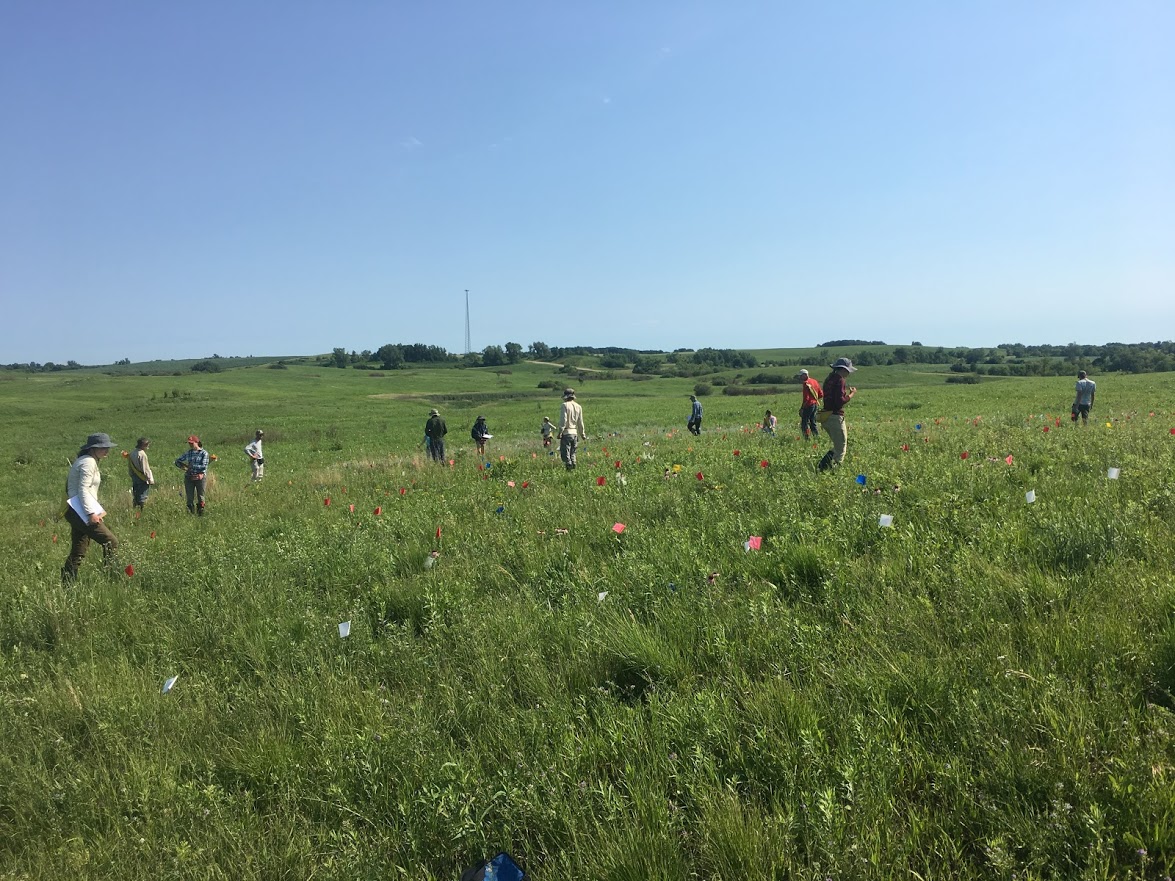
 Everyone in exPt2 looking for bees Start year: 2018
Location: exPt2
Overlaps with: Bees Remove and Deposit Pollen, Pollen to Seed
Physical specimens: 183 Echinacea Heads are currently being processed at CBG
Data collected: Contact Dr. Jennifer Ison for data related to this experiment
Team members who have worked on this project include: Everyone in 2018! The big event was just that- a few very big events
In summer 2018, I harvested 80 seedheads from 12 remnant Echinacea populations (ALF, EELR, KJ, NWLF, GC, NGC, SGC, NNWLF, LC, RRX, NRRX, YOH) to study patterns of reproductive fitness. I sampled heads in two ways – (1) I randomly selected 20% of the individuals at each site (43 individuals) and (2) I randomly sampled up to 5 individuals from full factorial combinations of high, medium, and low spatial isolation and early, peak, and late flowering time (i.e., high spatial isolation/early flowering, high spatial isolation/peak flowering, etc.) across all sites (37 individuals).
In January 2019, I dissected seedheads that I collected from the NW sites (ALF, EELR, KJ, NWLF, GC, SGC, NGC, KJ, NNWLF). I extracted the achenes by row to observe temporal variation in seed set within heads. I x-rayed the achenes and assessed seed set in January.
 Xray images that show whether achenes contain embryos or not Start year: 1996
Location: Remnant prairies in central Minnesota
Overlaps with: Phenology in the Remnants, Gene Flow in Remnants
Products: Check back with the flog for preliminary results and annual reports.
You can read more about reproductive fitness in remnants, as well as links to prior flog entries mentioning the experiment, on the background page for this experiment.
In summer 2018, I began a project to look at pollen movement within and among the remnant populations. To do this, I chose two focal areas, the NW sites in the study area (populations: ALF, EELR, KJ, NWLF, GC, SGC, NGC, KJ, NNWLF) and the SW sites (populations: LC, NRRX, RRX, YOH, and two large populations in between these sites). I mapped and collected leaf tissue from all individuals in the study areas and harvested seedheads from a subset of these individuals (see Reproductive Fitness in Remnants). I am currently extracting the DNA from the leaf tissue samples and a subset of the seeds I collected, and will use the microsatellite markers that Jennifer Ison developed in her dissertation to match up the genotypes of the offspring (i.e., the seeds) with their most likely father (i.e., the pollen source).
 An Echinacea that has had today’s load of pollen fully removed by pollinators Start year: 2018
Location: Remnant prairies in central Minnesota
Overlaps with: Reproductive Fitness in Remnants, Phenology in the Remnants
Products: Check back with the flog for preliminary results and annual reports.
Team members who worked on this project include: Amy Waananen
In 2018, we checked 80* focal plants at 12 remnants for nearby seedlings found in previous years. We found 97 out of the original 955 seedlings (26 fewer than the 123 found last summer). Although challenging to obtain, information about the early stages of E. angustifolia in remnants is critical to understanding the demography of these remnant populations. With still no flowering plants, it is plain to see how long it takes for Echinacea to begin flowering.
Between the summers of 2007 and 2013, team Echinacea observed the recruitment of Echinacea angustifolia seedlings around focal plants at 13 different prairie remnants. The locations of these seedlings were mapped relative to each focal plant and the seedlings (now former seedlings) are revisited each year. For each of these former seedlings, we make a record each year updating its status (e.g., basal, not found), rosette count, and leaf lengths. We also try to update the maps, which are kept on paper and passed down through the years, each person using a different color ink. As you can imagine, they are quite colorful & marked up by now.
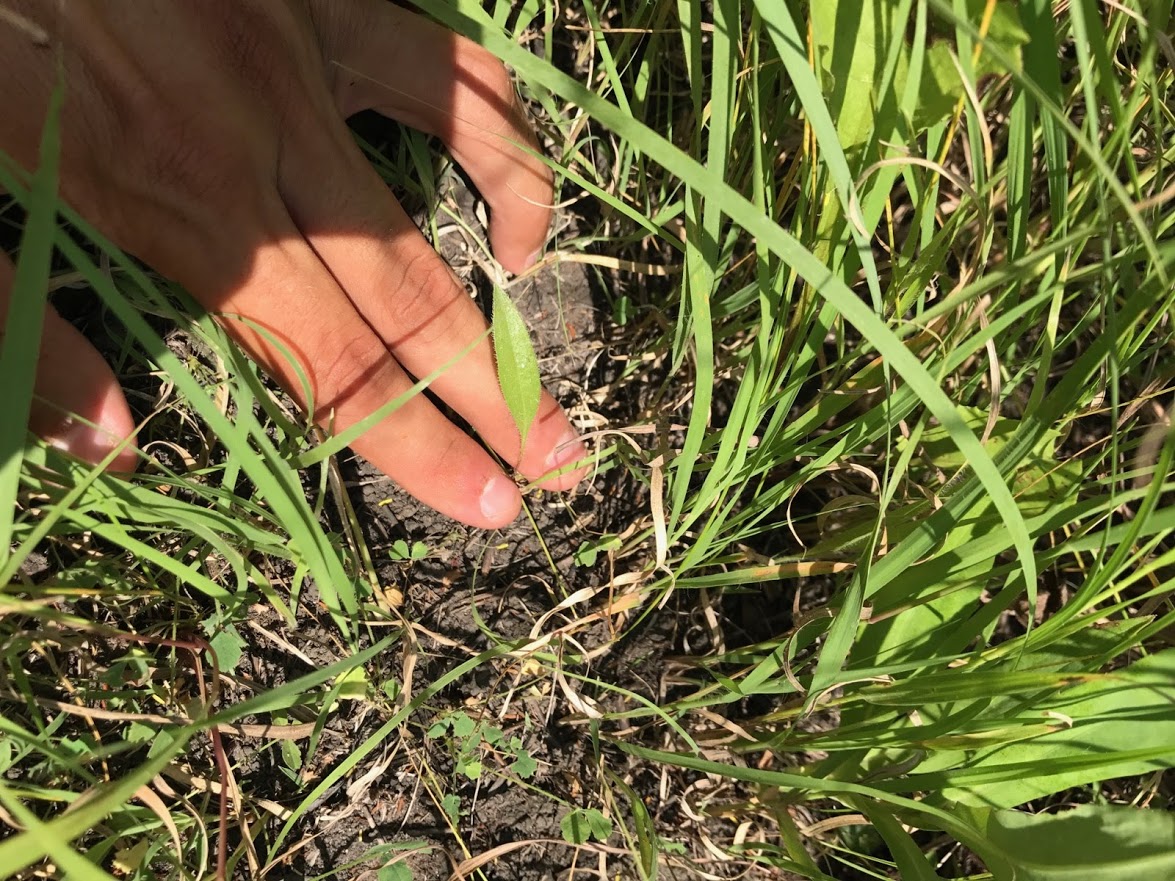
It can be tough to find small plants like this one! Year started: 2007
Location: East Elk Lake Road, East Riley, East of Town Hall, KJ’s, Loeffler’s Corner, Landfill, Nessman, Riley, Steven’s Approach, South of Golf Course remnants and Staffanson Prairie Preserve.
Overlaps with: Demographic census in remnants
Data collected:
- Electronic records of status, leaf measurements, rosette count, and 12-cm neighbors for each seedling. Currently in Pendragon database
- Updated paper maps with status of searched-for plants and helpful landmarks
Products: Amy Dykstra used seedling survival data from 2010 and 2011 to model population growth rates as a part of her dissertation.
You can read more about the seedling establishment experiment and links to previous flog entries about the experiment on the background page for this experiment.
* This number originally read 119, which is incorrect according to the sling master datasheet from 2018. EE edited this on 8 Jan 2020 while writing the PSR for 2019. I encourage someone to correct this number if it is now incorrect but to the best of my knowledge 80 is the number of maternal plants/circles visited.
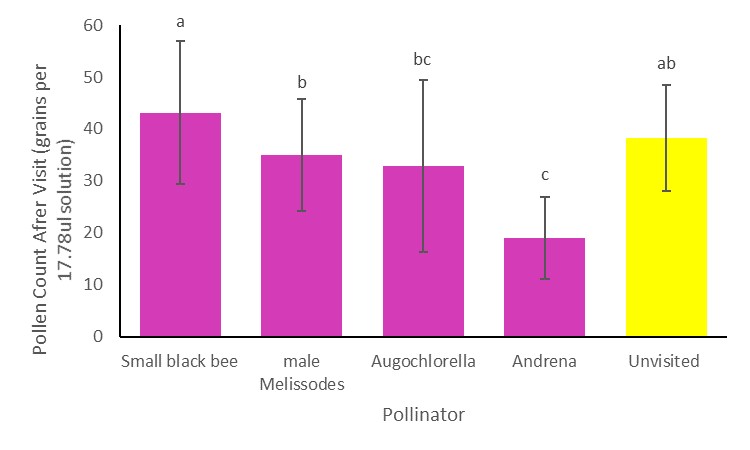
This year in experimental plot 2, we measured pollinator visitation rates, per visit pollen removal, and per visit pollen deposition across common pollinator taxa to provide insight into pollination failure in Echinacea. We collected male and female phase floret samples from 183 Echinacea head observations conducted from July 9th to the July 31st, 2018. The pollinator taxa included in analysis were Andrena (N=18), Augochlorella (N=9), male Melissodes (N=53), small black bees (N=59), and unvisited heads used as environmental controls (N=30). Using light microscopy, we then quantified the number of pollen grains in these samples to determine how much pollen an individual of each taxon removes and deposits per visit. We found that the composite specialist Andrena rudbeckiae removes more grains of pollen per visit than the other common pollinator taxa in the study area; namely, male Melissodes sp., Augochlorella sp., and ‘small black bees,’ a wide taxonomic group comprising a variety of species mostly in the Halictidae. Pollen limitation in the population could be driven by frequent male Melissodes sp. visitation late in the season; based on the per visit removal of male Melissodes sp. and number of visits observed in this study. These results combine to contribute to our understanding of pollination failure and pollen limitation in small fragmented flowering plant populations.
 Mean pollen count of male phase floret samples after visitation compared across pollinator taxa Start year: (Official Experiment) 2018
Location: Experimental plot 2 at Hegg Lake WMA
Overlaps with: ExPt2
Physical specimens: 183 Echinacea heads in egg cartons
Data collected: Contact ZZ, EJ, or JLI for access to their data
Product (to come): Zeke Zelman’s Senior Thesis at Wooster College, 2019
Team members who worked on this project include: Zeke Zelman, Evan Jackson, and Jennifer Ison (2018)
In summer 2018, we searched experimental plot 7 for Echinacea plants that are crosses between and within E. angustifolia and E. pallida. Of the 294 plants originally planted, we found 169. However, for the first time in the history of experimental plot 7, we found a flowering plant (an E. pallida x pallida cross)! The table below shows the counts of Echinacea plant in the summer of 2018. In addition to the lowest survivorship, the native E. angustifolia also has been the smallest (above-ground) over the five experimental years. Uh oh!
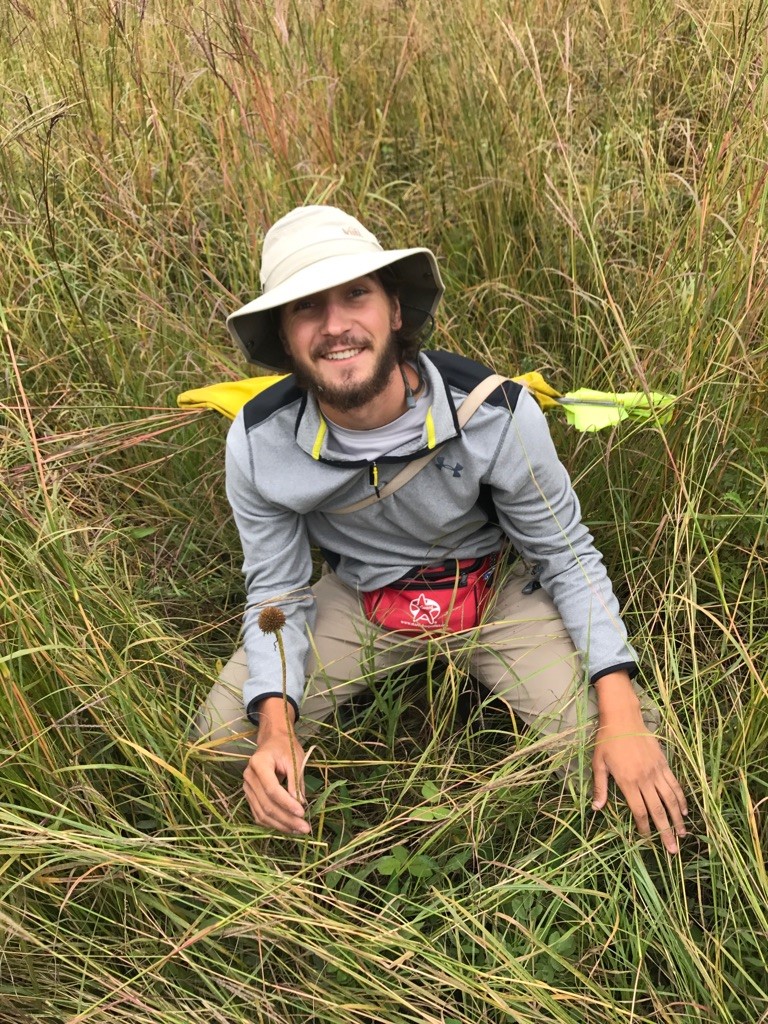
 Riley with the first ever flowering head in exPt7!
| Status 2018 |
ang x ang |
ang x pal |
pal x ang |
pal x pal |
| not found |
52 |
12 |
26 |
35 |
| found |
22 |
16 |
59 |
72 |
Start year: Crossing in 2012, Planting in 2013
Location: Hegg Lake Wildlife Management Area – Experimental Plot 7
Overlaps with: Echinacea hybrids: exPt6; Echinacea hybrids: exPt9
Data collected: Rosette number, leaf number, length of longest leaf, herbivory for each plant collected electronically and exported to CGData. Recheck information for plants not found was also collected electronically and stored in CGData. In 2018, Riley also used a Li-Cor 6400 to analyze ecophysiological traits of Echinacea in expt7. This included photosynthetic rate and water use efficiency. Riley has this data and we’ll make it available after he’s done with his thesis.
Products: Riley’s 2018-19 Biology Honors Project at Gustavus. Riley found that within-species Echinacea angustifolia crosses have lower survivorship, above-ground biomass, and ecophysiological traits than other cross types. Riley made a poster, is writing his thesis, and will defend it in May.
You can read more about rexPt7, as well as links to prior flog entries mentioning the experiment, on the background page for this experiment.
West Central Area School District and grounds are located in west central Minnesota. The high school is located in Barrett, MN which encompasses five small communities (Barrett, Hoffman, Kensington, Elbow Lake, and Wendell) that have united to make one high school. The school was built in 1994 and we are still in the process of restoring our 35 acres of land (Environmental Learning Center – ELC) into native prairie plant species. The ELC has several trails, an observation deck, and a pier that reaches into a small pond. The area has recently begun to be more and more incorporated into several classroom activities. One of the science classes used the ELC in 2018 to sample types of Bombus (bumblebee) species and populations, the agricultural instructor has been using the ELC for soil sampling and classification along with looking at soil profiles. Even the art teacher has had drawing sessions from the observation deck and the English teacher used it for writing exercises. The plan is to utilize the ELC more and more in upcoming years and we have received outstanding support from the school administration, school board, and local businesses in promoting this part of our school. Plans for 2019 are to have 12 plots that 8m x 12m in which four are burned in the spring, 4 are burned in the fall and 4 are not burned at all. As years progress, we plan to have classes engaged in monitoring the progression and health of some native species in these plots, especially Echinacea angustifolia, which will be hand planted in the plots in May of 2019.
Start year: 2019
Location: West Central Area High School
Overlaps with: Nothing… yet!
GPS points shot: 96 points delineating the future plot locations
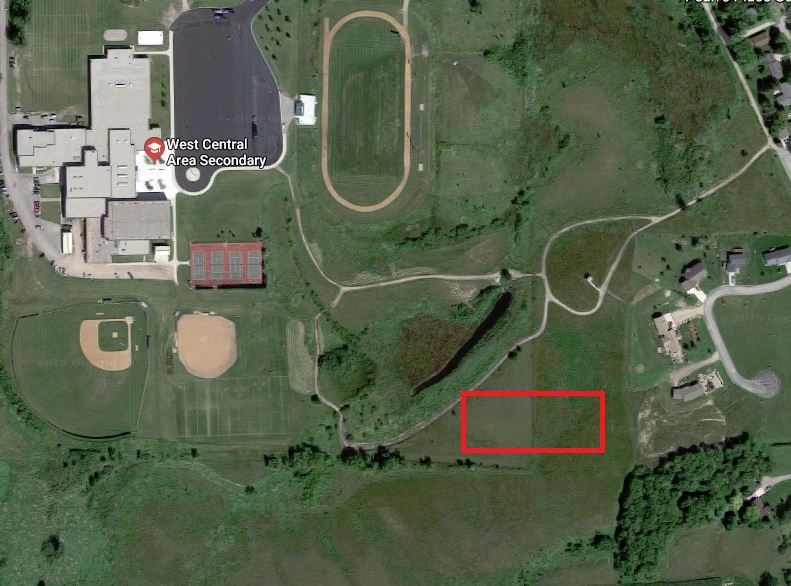
 The location of the field site, near the high school
Hi Flog!
As I’ve said before, here at the Echinacea Project we rely pretty heavily on the work done by our volunteers. That is why I am so excited to introduce you to the newest member of Team Echinacea: Priti!
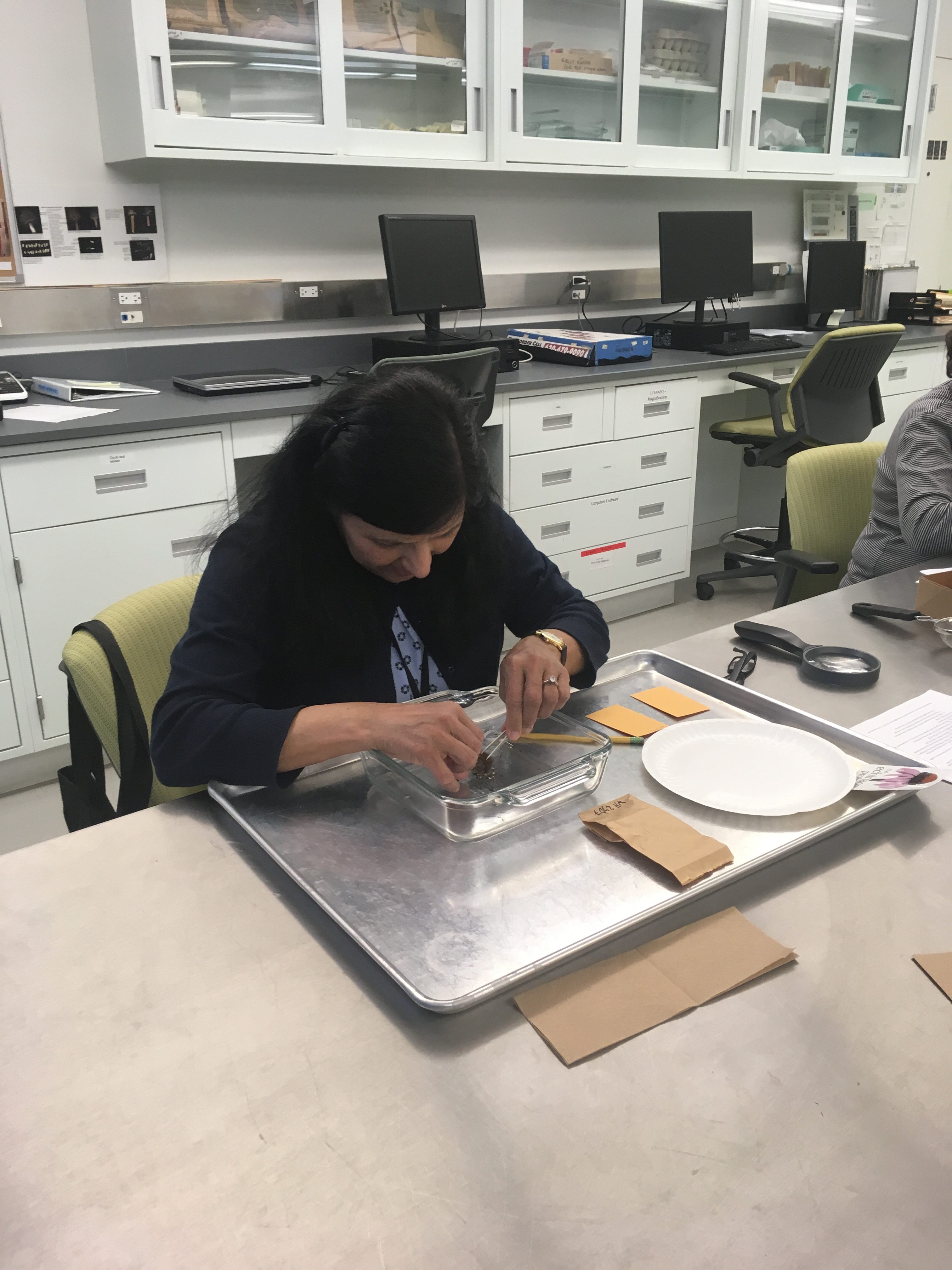
Priti has been working in the seed bank here at the Plant Conservation Science Center, but has just started working our lab today. Priti will be joining us on Fridays to clean heads — the first step to processing echinacea heads, and one of the most important.
Priti cleaning a head We’re thrilled to have Priti as part of the team!
Here on the flog, we like to talk about how much of the important work around the lab is done by our volunteers. Last week Allen, one of our long-term volunteers, hit a huge milestone and showed us just how much he does for the project.
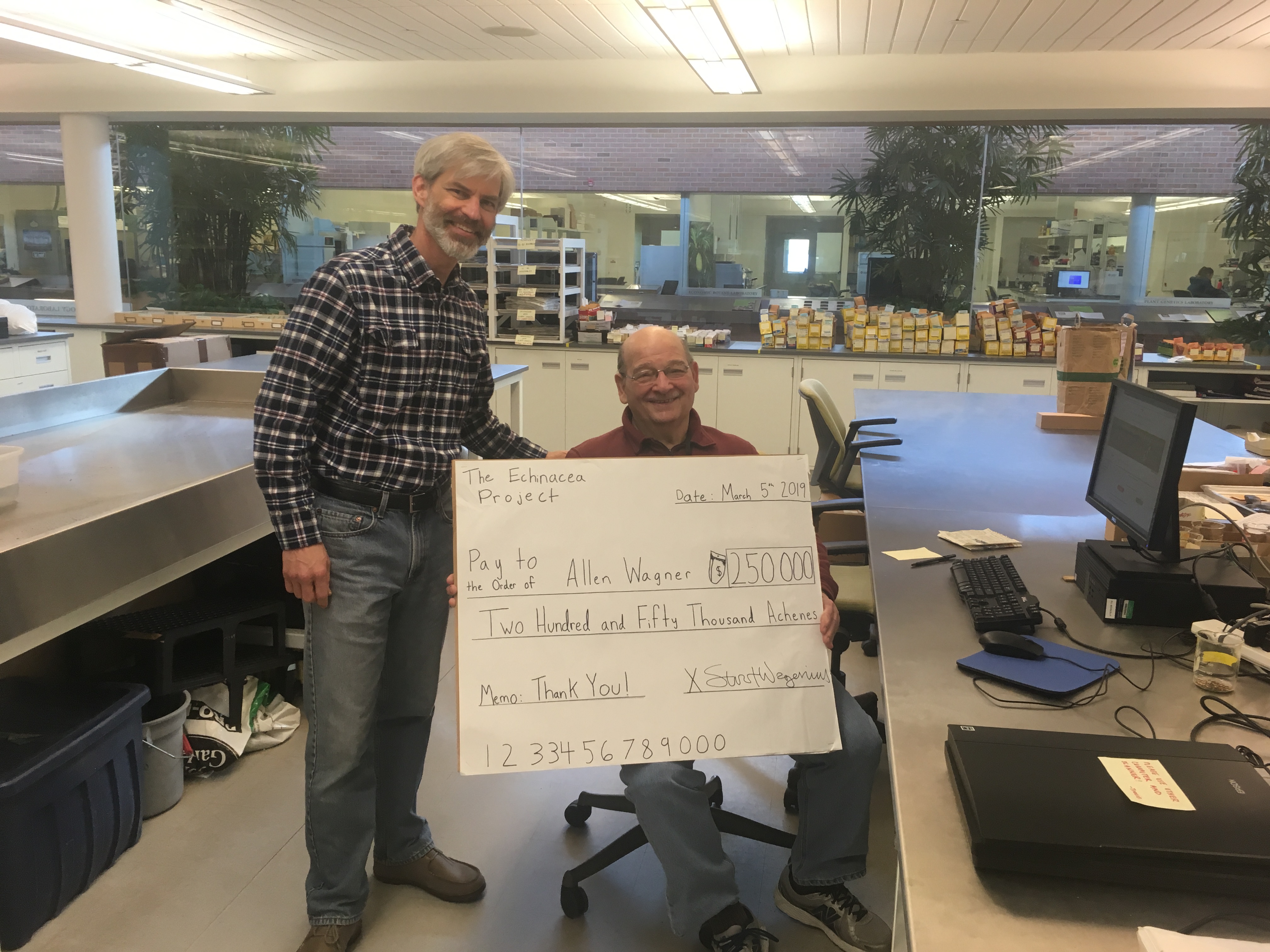
Allen has officially counted a quarter of a million achenes.
Allen reached this number faster than usual, counting up to his quarter million in just a bit over two years. We’re super thankful for all of the work Allen has done for the project. And of course, what better way to show our thanks than a big check?
Allen, Stuart, and a big check In the future, Allen will continue to count achenes and hopefully hit many more large milestones in his counting.
Thank you Allen!
Hello once again flog!
Last weekend I presented a poster (link below) at the Massachusetts Association of Conservation Commissions convention in Worcester, MA.
This was my first poster symposium and I am glad to say it went great! I was able to interact with so many people attending the conference, along with other student researchers. I received some wonderful comments and feedback, and hopefully was able to make more people aware of soil, native bees, and the Echinacea Project!
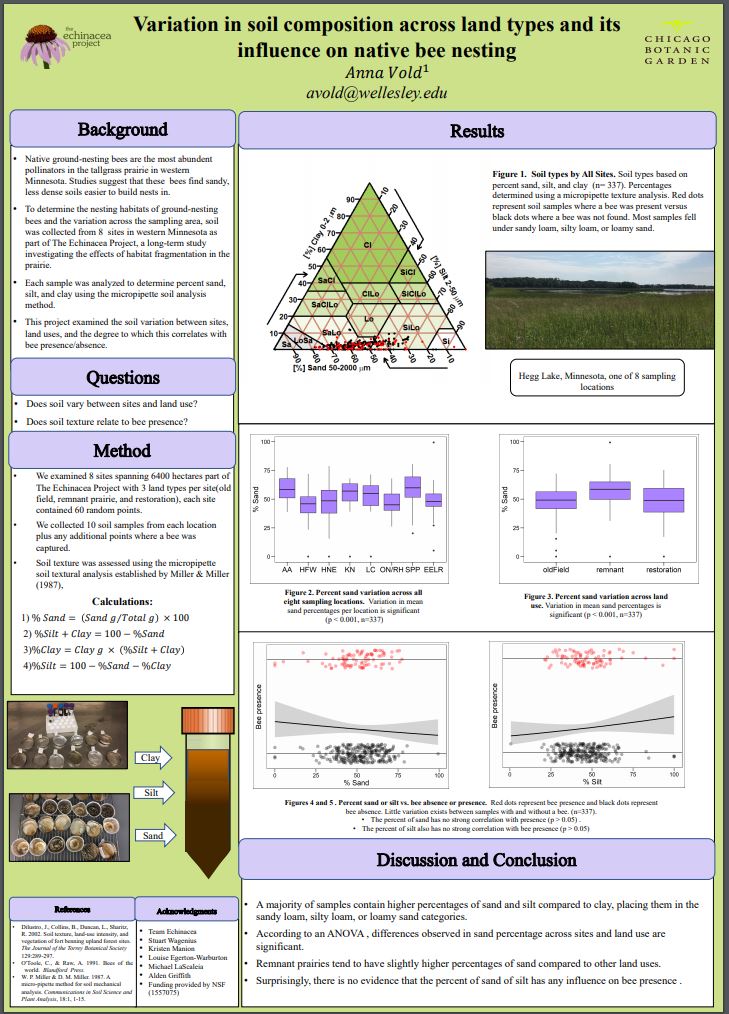
My poster focused on the soil texture data I collected over January and its correlation to native bee nesting. After a little more work in R, I found some surprising results. The percent of sand or silt did not have any influence on bee presence. However, between the eight sites and the three land uses, variation in percent sand was significant. Meaning, soil variation does exist across the Echinacea Project sampling area, it just might not be the strongest factor influencing bee nesting.
The soil is only one component of this project though. We also collected data on the slope, vegetation, percent bare ground, and soil hardness. One of these variables may be the key in understanding native bee nesting, so there’s a lot more analyzing and R to come.
I am so grateful for all the help I have received to make my first poster experience a success!
Until next time!
 Click on the link below to see a high resolution image of the poster annavoldMACCposter19Final
|
|