|
|
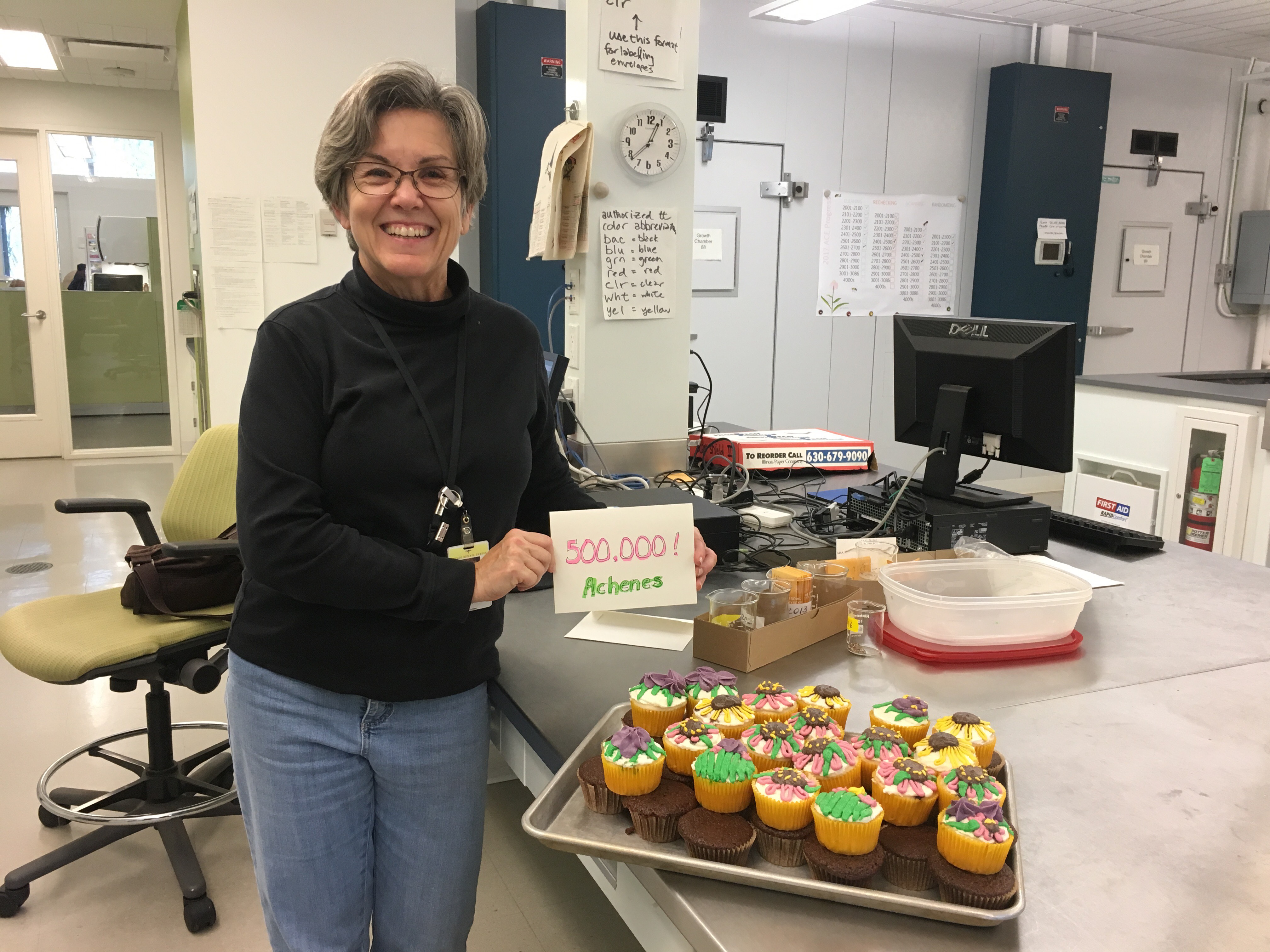
 Anne has counted over half a million achenes! Today we celebrated Anne’s accomplishment of counting over 500,000 achenes with a prairie remnant made out of cupcakes. Anne has been a member of Team Echinacea for over 10 years and she has really put in the hours! We can’t thank her enough; it’s great having her in every Friday.
Notice the cupcake “soil” under the diverse cupcake prairie remnant – complete with Echinacea, Helianthus, bottle gentian, and grass!
Prairie cupcake remnant. Are these bare ground cupcakes good for solitary bees??
Prairie cupcakes detail.
Hello Echinacea folks! After a great summer at the Echinacea Project, I returned to Gustavus to work on the morphological and physiological data I collected at experimental plot 7. In my time at Gustavus so far, I wrote a proposal for my project so I can analyze my data and undertake a senior honors project under familiar Echinacea advisors Pamela Kittelson, Stuart Wagenius, and Sanjive Qazi. I have also worked on a methods section for my final honors paper and made a poster (attached below). In addition to my project, this fall I have been working on a project to implement composting and sustainable practices in Saint Peter restaurants and a project analyzing microRNA-mediated stress response in smooth cordgrass. The next steps for my honors project are to write up an introduction and do statistical analysis over our January-term. I will be performing aster and cluster analyses and am really excited to get back into some R coding! echinaceaPoster1_Thoen
“When life deals us cards
Make everything taste like it is salt
Then you come through like the sweetener you are
To bring the bitter taste to a halt”
Ariana Grande, in the song “Sweetener” off of her latest album Sweetener (2018).
Greetings from the College of Wooster, or Team Echinacea East
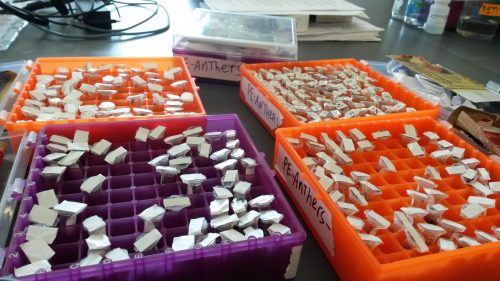
This summer I helped conduct research about the differences in pollen removal and deposition (a measure of pollinator efficiency) across different taxa of solitary bees that visited Echinacea flowers, out at P2 (with Evan, Mia, and Jennifer Ison). In order to quantify pollen removal we collected anthers (the male part of the flower that presents pollen) before a bee visited and again after the visit; we suspended the anthers in water. In order to quantify the number of pollen grains in each sample. But what to do with these samples?
 Here are all the sweet anther samples! In order to quantify the number of pollen grains present in each sample I first break apart and shake up the anthers, to try to get the pollen evenly distributed in the solution; then I count a small amount of this pollen solution on a hemocytometer under a microscope (a hemocytometer is a sort of microscope slide with a grid that is used to count red blood cells in blood; I use it to count pollen particles in water).
Here’s the hemocytometer all loaded up with sweet pollen to count! Now that the summer field season is over I’ve been able to spend quite a bit of time counting pollen. While I’ve been counting pollen I’ve been listening to music on my roommate’s portable speaker. Mostly I’ve been listening to Ariana Grande’s new album Sweetener. The title track which opens this flog post speaks directly to the relationship that I have developed with the act of counting pollen. It is the sweetener to my life. I struggle to leave the lab each night; wanting to get just a little more of that sweet taste of pollen counting. It brings the bitter taste of college life to a halt. I don’t know what it is about pollen counting that I like so much. Is it the repetitiveness of it? The simplicity? The repetition? It’s impossible to say. All that I know for sure is that I really hope that everyone can experience the sweetness that counting pollen brings to my life.
P.S. I really hope I find something to fill the void that will be left in my existence once I run out of pollen to count (I only have 340 samples or so, and I’m more than half way through them).
Thanks
Today is a rainy day at the Hjelm house. Kristen left early in the morning and Michael and I are cleaning and organizing everything from seeds, to g3, to data sheets. We’ve wrapped up most of the field work and plan to leave Andes after some harvest tomorrow morning! Stay tuned for more progress updates in the fall as we bring everything back to the lab and get started processing all of the data from summer 2018!
Your photo-blog-flog fix.
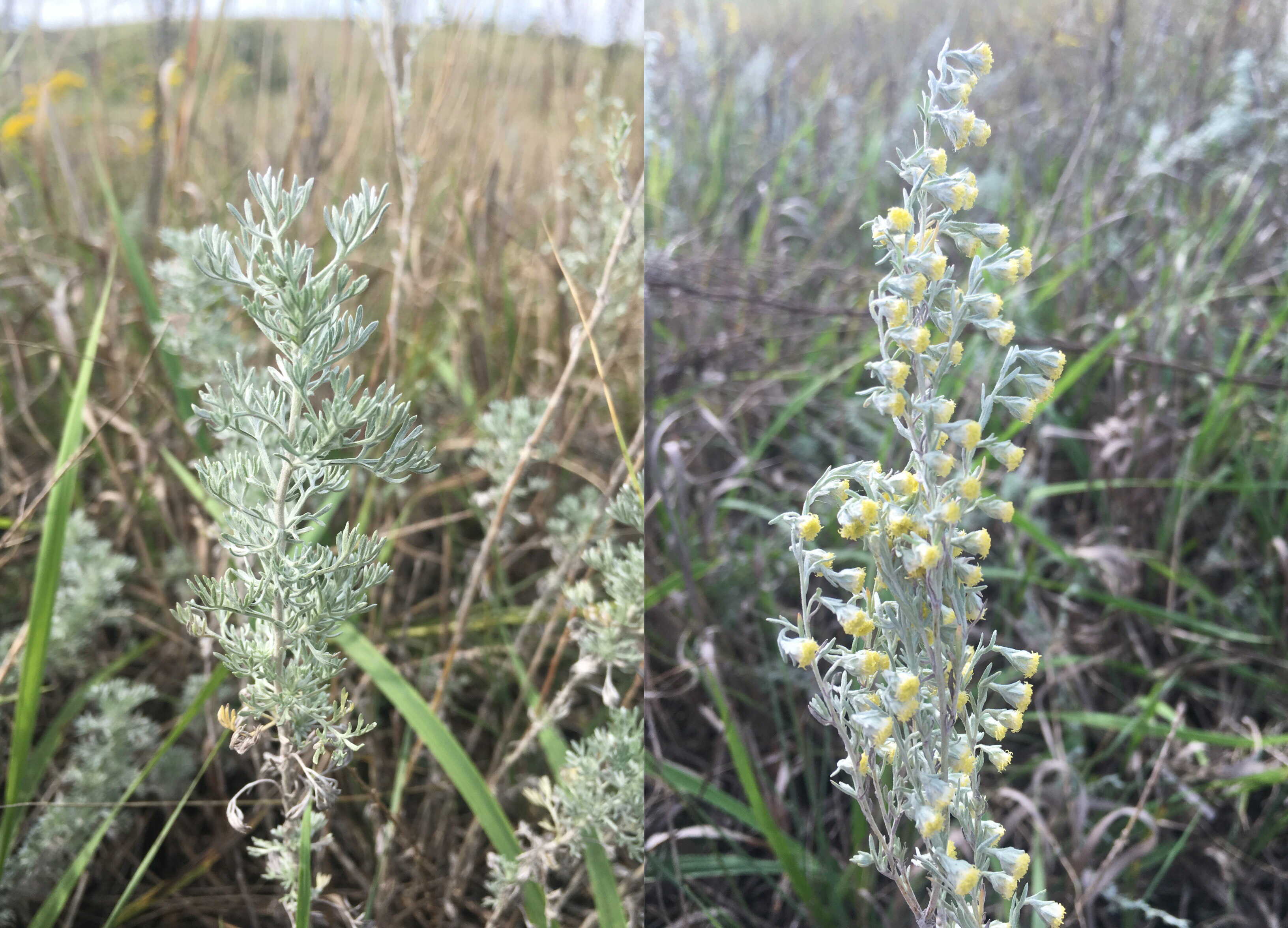
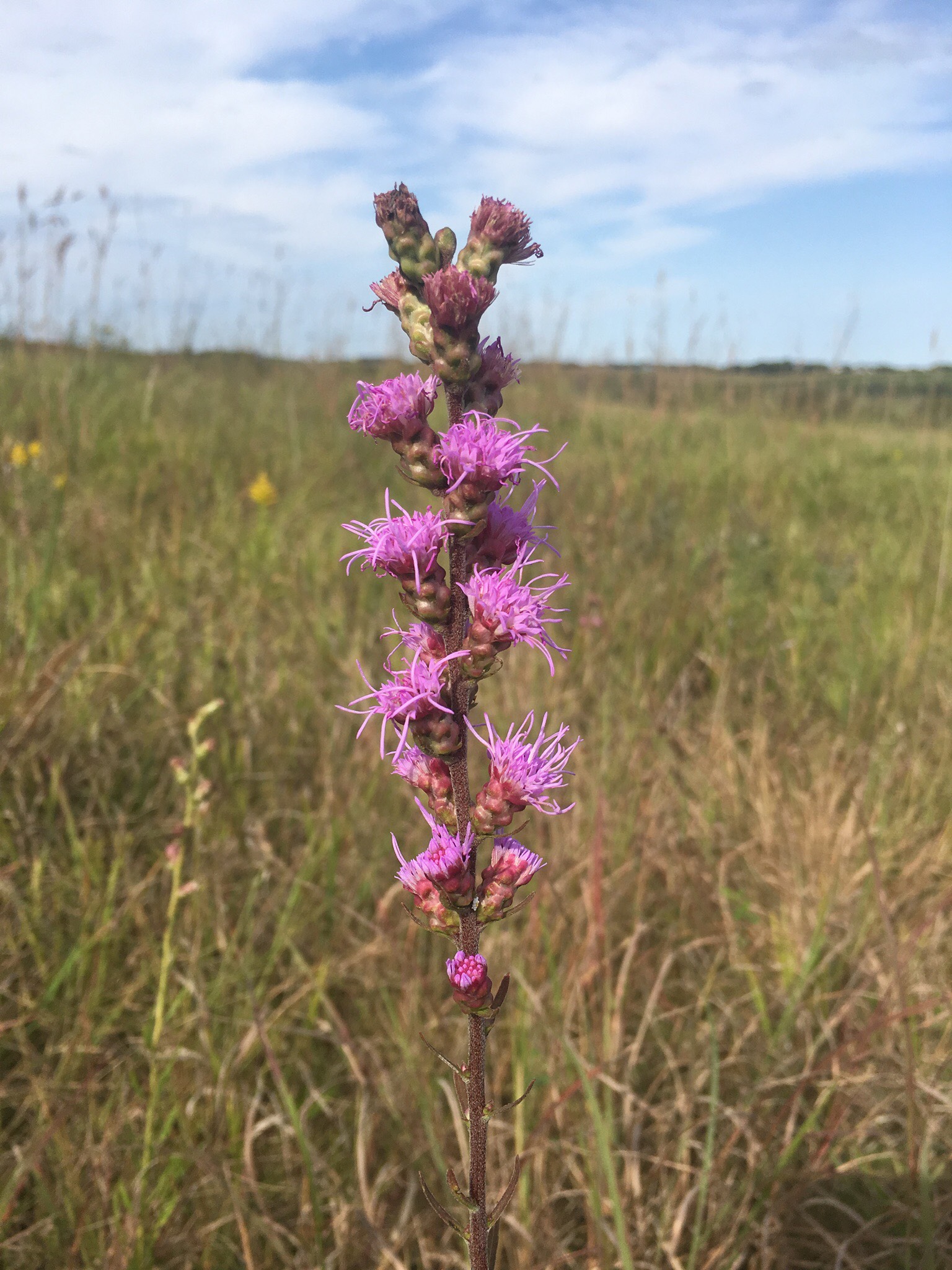
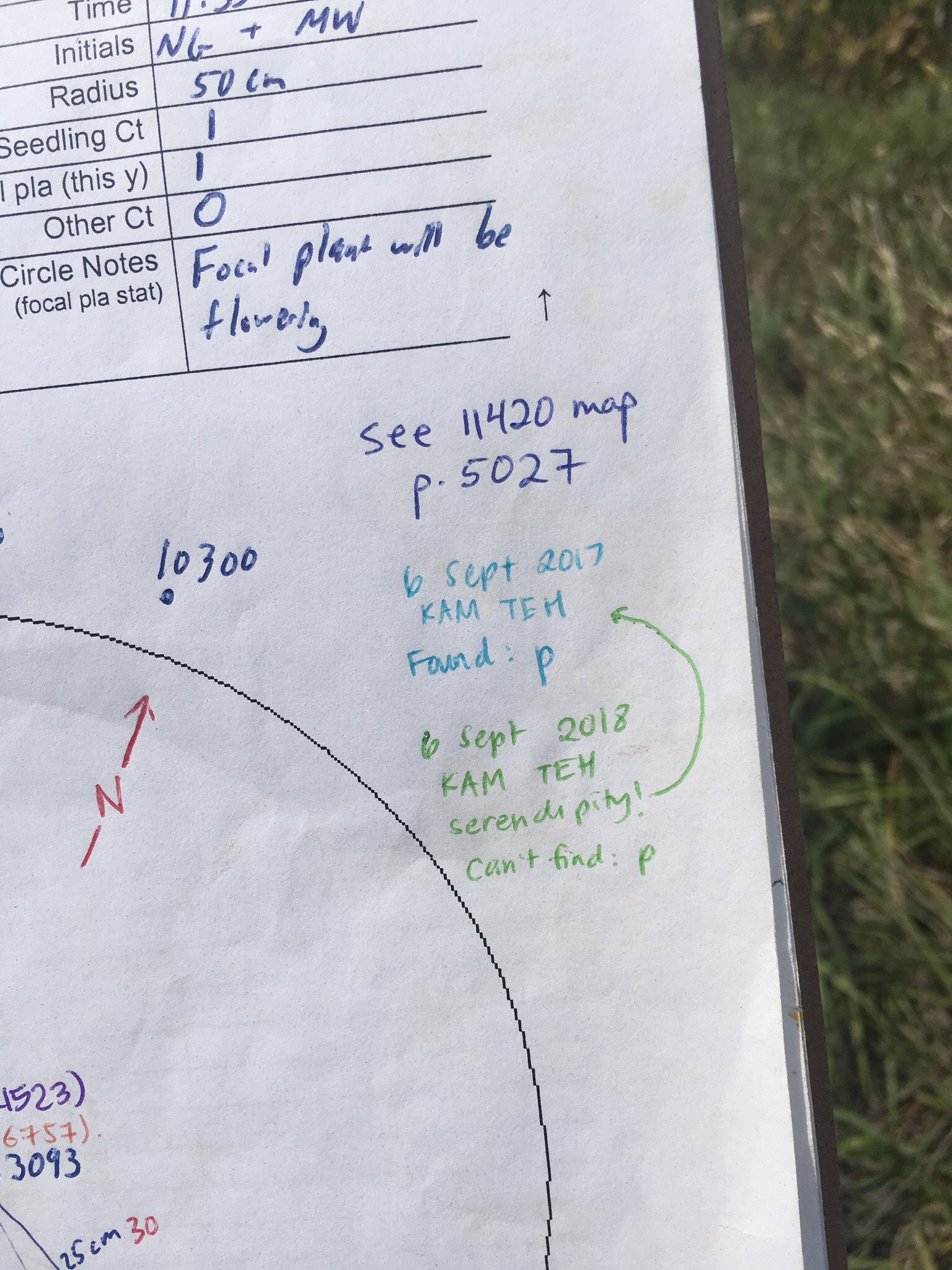
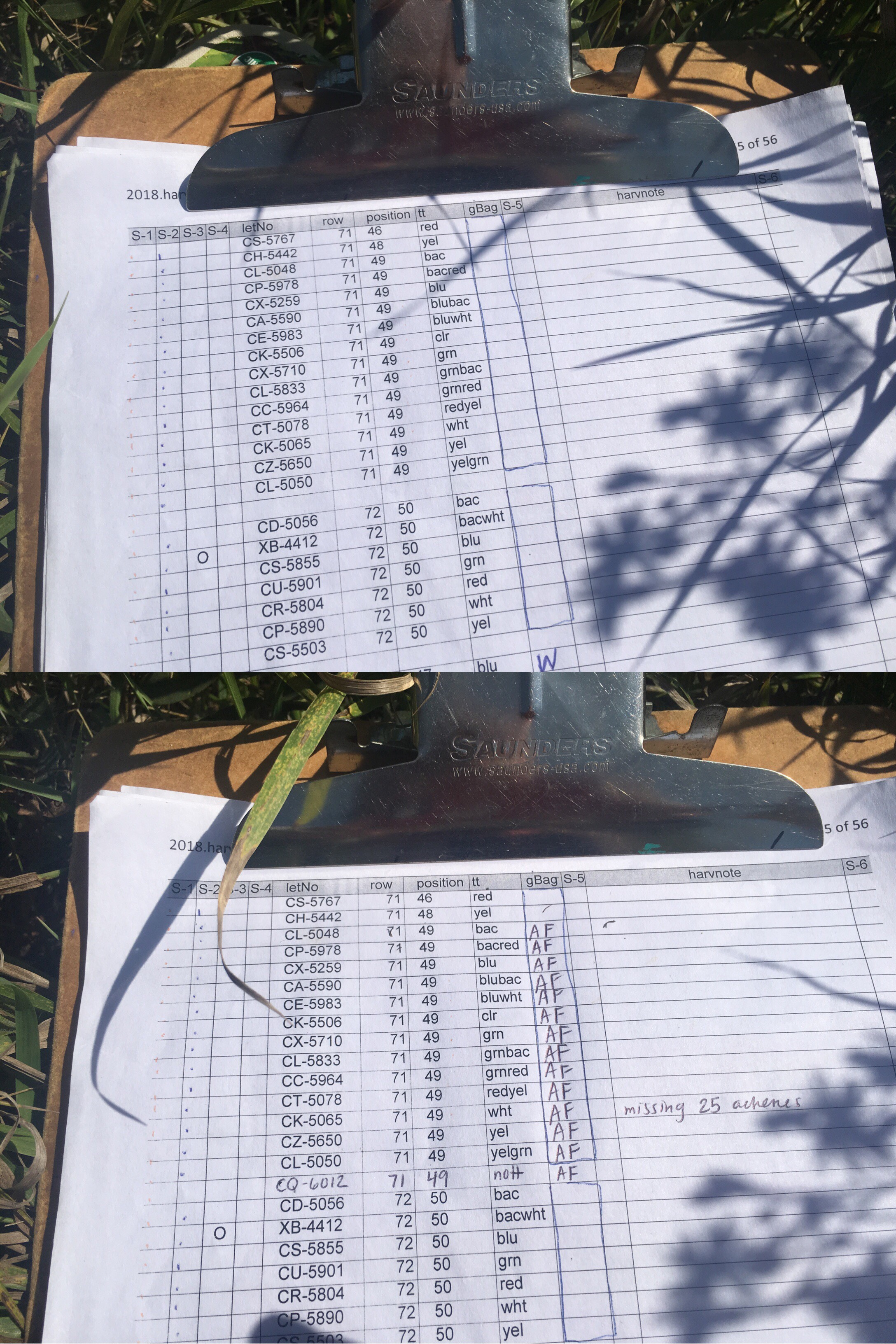
sling attack at eri this morning  Artemisia frigida at Loeffler’s Corner West!  late bloomin’ liatris at lce Serendipity! Nessman sling!  Before and after: I harvested a 13 + 1 headed plant at p2 today! The beautiful late-season walk to p2! Sorry the daily flogging has been irregular these last few days. Since our last entry, we’ve been harvesting Echinacea from p1 and p2, sling-ing, p8 rechecks, and field checks. Lea has been working on demo, phenology, and surveying nearest neighbors along her spp transect, and Kristen has been moving traps and measuring soil and vegetation. We’ve been busy!
I’m so happy to be back in MN as our fieldwork for 2018 finishes up! There has been plenty to do, especially with harvest gearing up. We started out the morning finishing flagging p8 so that it will be easy to avoid Echinacea when we want to spray the Ash trees. Then, after a couple rows of harvesting p1, we had an early lunch so we could go help Kristen take down her emergence tents. We finished the day off with a long session of harvesting p2. A majority of the heads are ready for harvest, and a lot of them have lost achenes/entire heads, likely due to predation or the storm on Monday.
View of P8 from row 19, with Andy harvesting in the distance. I haven’t been here since burning in early spring and I’ve really missed it. Muscle memory has kicked in and I am getting into the rhythm of fieldwork again. Excited to be back and experiencing the late season prairie again!
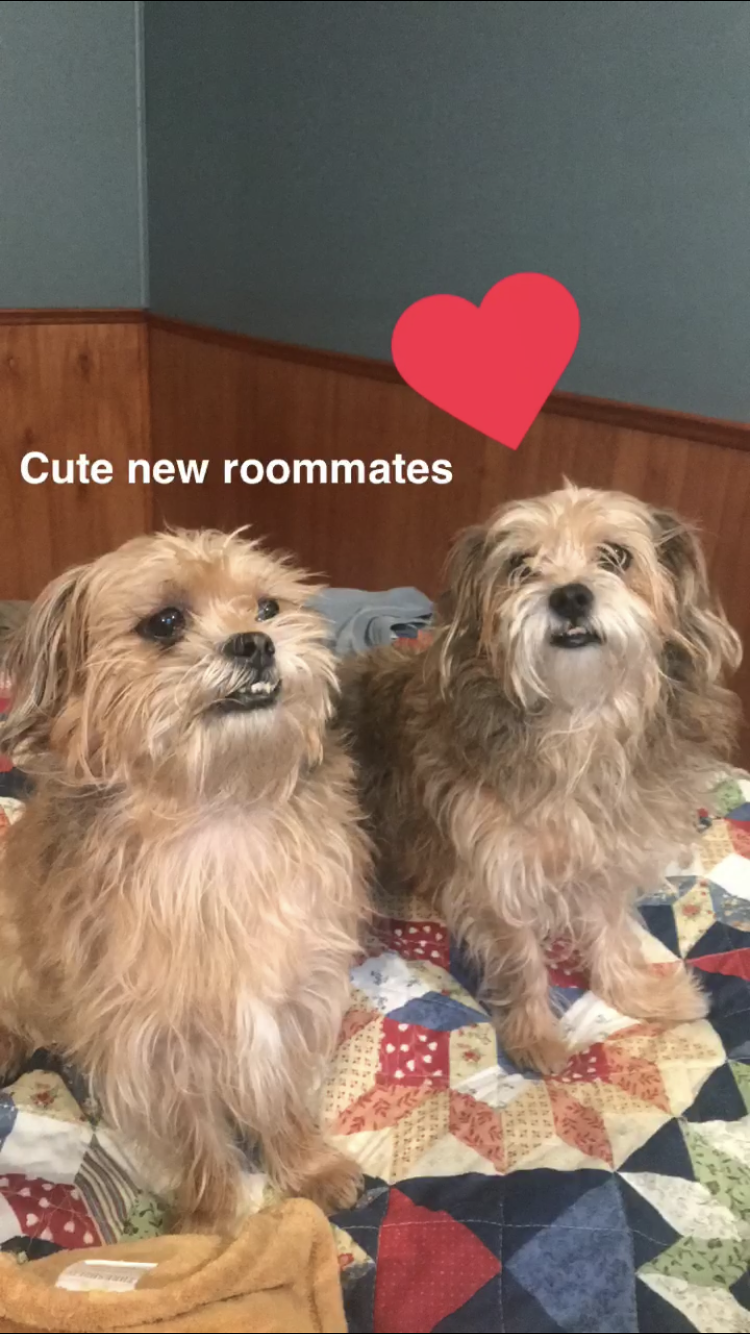
On Friday it was Riley’s last day so we knew going into the weekend that it was going to be rough. Luckily we have a few new roommates around to help us deal with the loss of the majority of the team.
 It’s okay that everyone has left us because we get to enjoy time with the famous Bellamy Salami Odysseus and Huxley Leopold. Furry roommates are the best! On Saturday, the weather was nice. Michael came with me in the afternoon to help move traps at my sites near 55 highway. It was hot and humid, but it went about twice as fast with some assistance.
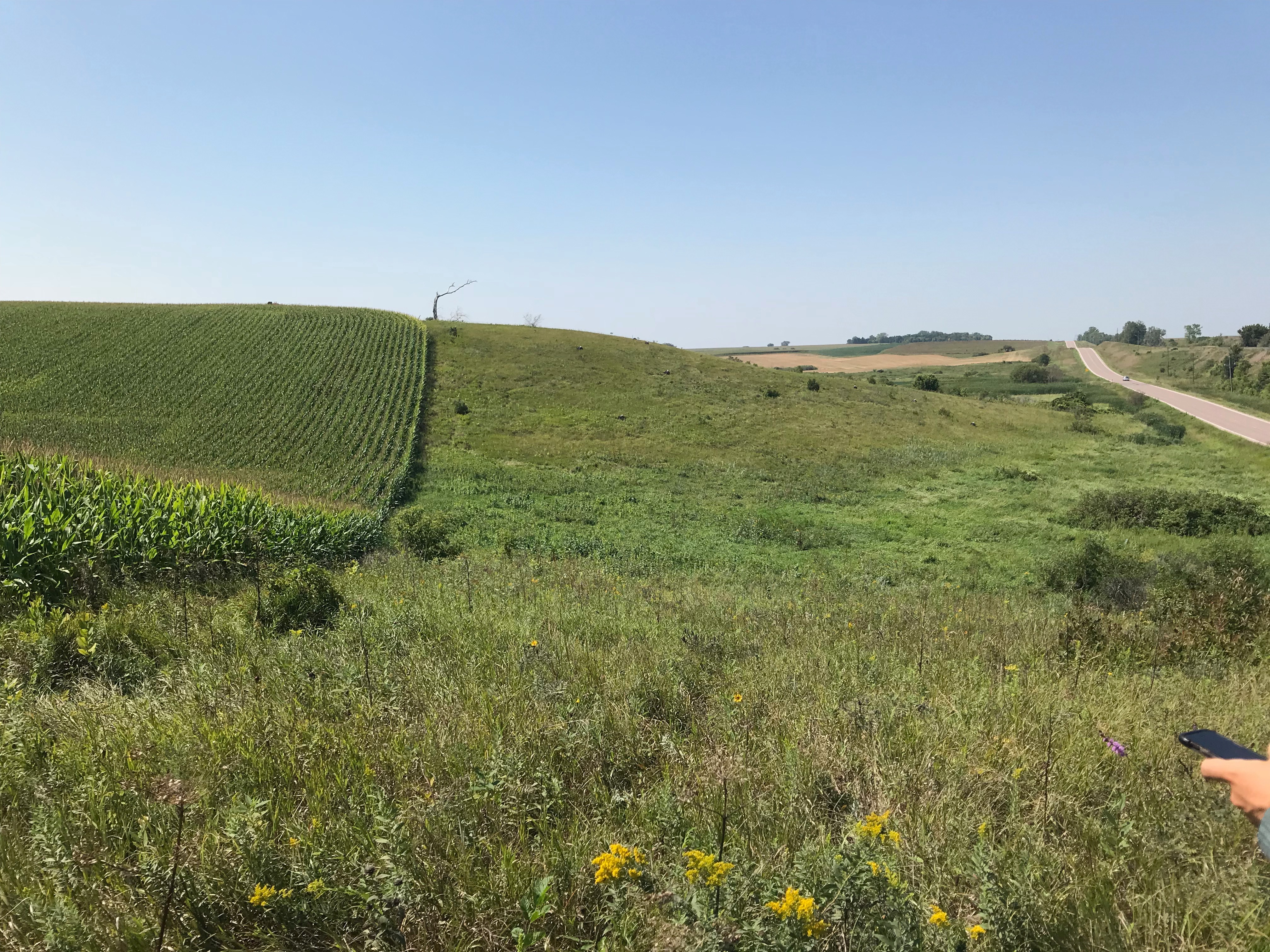
The tents on the hill at a remnant prairie along highway 55. Saturday night we relaxed at Andes and watched a few movies: The Florida Project and Children of Men. Both fantastic films to round out our evening!
On Sunday, the morning was hazy and cloudy so I decided not to move traps. I spent most of the day inputing data in order to compare data frames and realized I have a lot of data entry to catch up on! But with the help of a handy function (written by Will) it’s all much easier on all of us. We also got to talk to a few of our favorite Wooster students (Mia, Zeke, and Evan). Mia virtually showed us around the new lab digs at Wooster. I also got a number of critical updates on their exciting first week back to school – new roommates, sneaking onto roofs, and class schedules. I suggested we Facetime every Sunday for the rest of the year. I am not sure if they felt as willing to commit to this plan as I am. Regardless, it is no surprise that CoWBee was already working hard in the lab on their first weekend back in class.
Sunday evening we relaxed at Andes and watched The Glass Castle, which is the movie depiction of an autobiography of the life of Jeannette Walls. It’s a great book and would highly recommend (although be prepared because it’s a tear jerker!)
We are sad to lose Andy this week but are so excited because Tracie will be here on Wednesday! Stay tuned for more exciting updates this week as things roll on with Team Echinacea 2018.
This morning the much-diminished Team Echinacea (Stuart, Kristen, Lea, Michael, and I) gathered at the Hjelm house to start the day. Lea went to Staffenson Prairie Preserve to measure the flowering phenology of Liatris and Solidago plants. Michael and Kristen began to prepare experimental plot 8 for management in the coming year. The team will treat rogue Ashe trees and collect and broadcast the seeds of several prairie plant species in this plot. This is part of an ongoing effort to ensure that the plant community within the plot is consistent throughout.
Meanwhile, I assessed the leaf damage and senescence of plants in the aphid addition/exclusion experiment in p1. This was the final component of the fieldwork involved in this experiment for the season, and the last step in my independent project before I begin statistical analysis. The next step is to gauge fitness differences between plants in the aphid addition and exclusion treatments by constructing an aster model. While it was exciting to finish this aspect of the project, I will miss spending time with my Aphis echinaceae friends.
Over lunch the team prepared for inclement weather by sharing our experiences of intense weather events. After that, Kristen presented an update on her master’s project. She shared some intriguing preliminary results about the nesting preferences of native ground-nesting bees. We are all looking forward to the results of her study! Due to the rainy weather, the team was ready to call it a day after Kristen’s presentation. We held a short meeting to plan next week’s schedule and then headed home for the weekend.
Today was my last day in Solem Township with Team Echinacea. Three of us (Andy, Michael, and I) went out to Hegg Lake and did demography in the morning while the rest stayed back and worked around Hjelm. Demography at Hegg lake is a mess. The mini-sites are very far from one another and the walks to get to these sites is through swamp-like substrate and tall grass and reeds. There was also loads of showy tick trefoil (the stuff that sticks to clothes) and it got all over me, resulting in a half-hour of me picking those off.
Showy tick trefoil is something to look out for when plodding through prairie! During lunch, I presented the preliminary results of my pt7 hybrids project and Stuart made some super yummy apple crisp! Michael and I went back out to do more demography at Hegg Lake (no stickies this time), and the rest of the team collected seed from pt1. We finished my last day with a discussion on the workings of aster analyses. This really got me excited to work on my project’s analysis!
Me and the first flowering plant at experimental plot 7! I will miss this place! See you soon, Team Echinacea! Thanks for the glorious memories! I will never forget this experience and all of the great people I have met. It’s truly inspiring to be in the presence of such amazing scientists and people!
You’ll be missed, Team Echinacea!
Today was my last day this summer with Team Echinacea. I had an amazing summer and am sad to leave all of the great people I’ve met.
In the morning, we did measuring rechecks in P1, attempting to find missing plants. The plot was quite soggy and everyone ended up pretty soaked, collecting a lot of water in their boots. Andy made the apt suggestion that touching the electric goat fence could help us all get dry. We made the executive decision not to follow this advice. While in P1, I saw a few frogs clinging to Indiangrass stems.
 Ribbeting After rechecks, Anna and I went to Staffanson to monitor Liatris and harvest heads from the Echinacea I used for phenology. These seeds in each head will be examined for embryos in order to determine the relative reproductive success of each individual Echinacea. I hypothesize that there will be more embryos in the seeds from the burned section of the prairie.
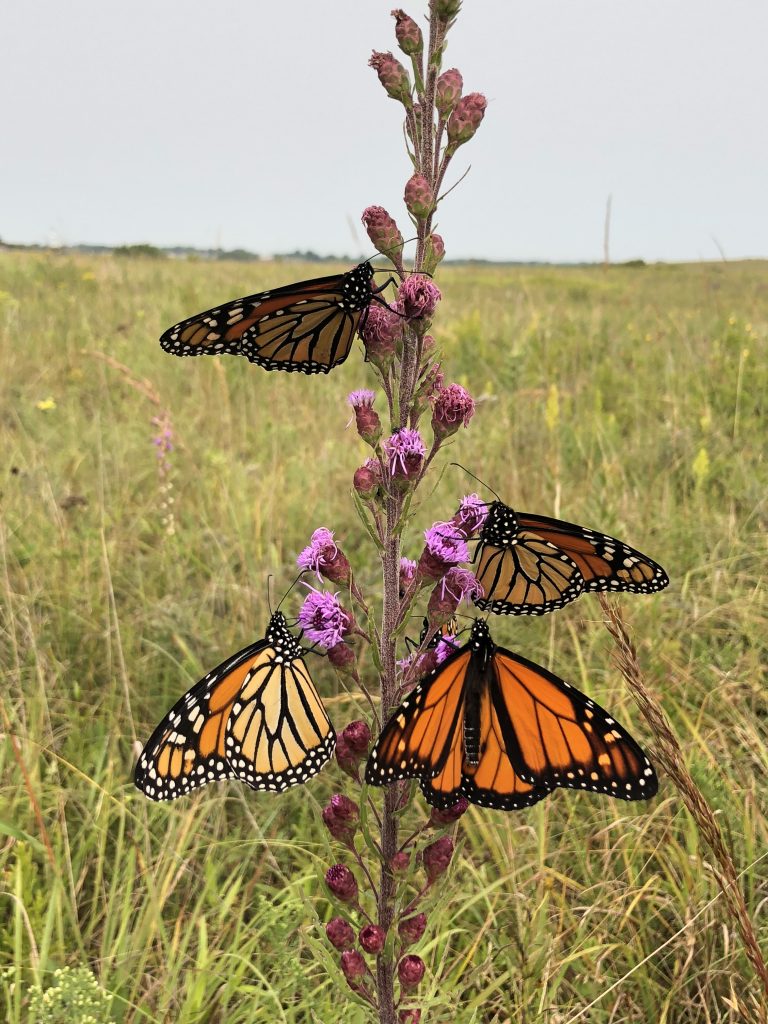
We saw some Phlox which was still flowering (one could say it was a late bloomer, literally). We also saw a preponderance of butterflies. There were butterflies on almost every Liatris in one section and as we walked through, they all flew up in unison. I think it might have been one of the most beautiful things I’ve ever seen.
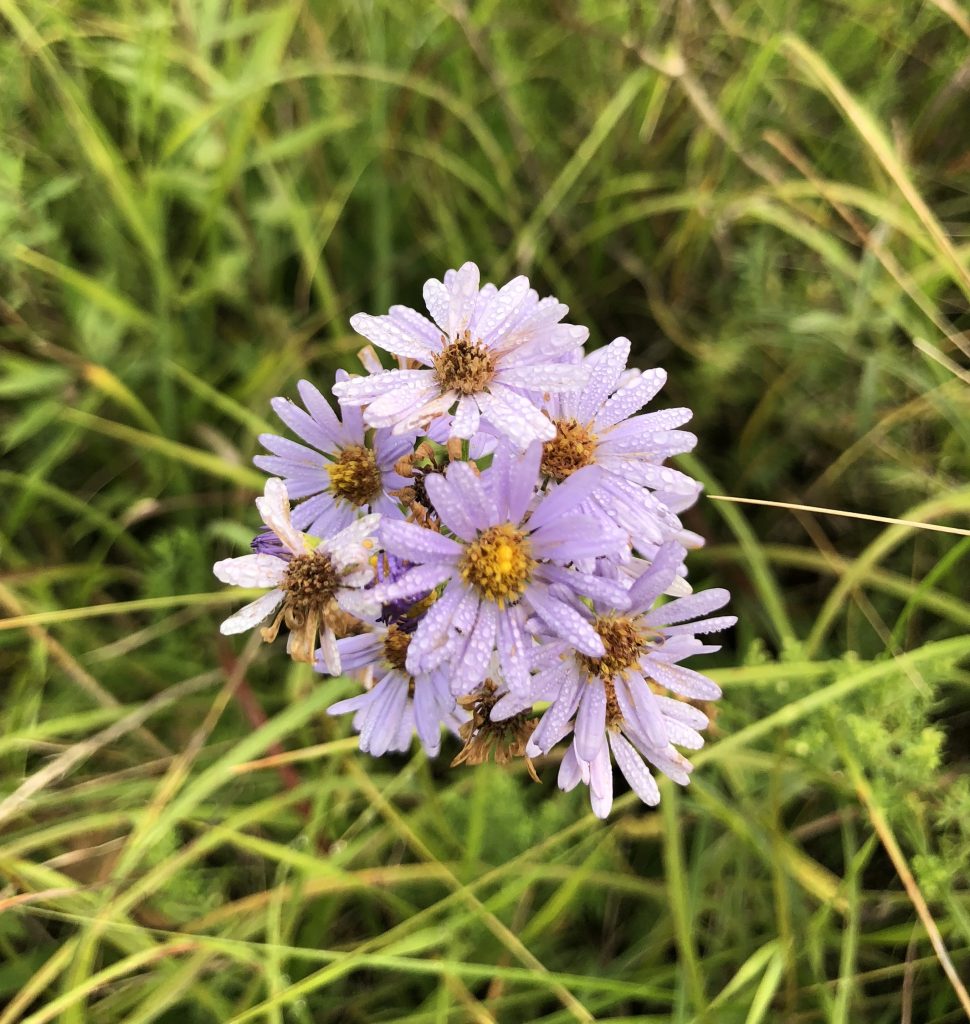
We also saw some sky blue asters which are some of my favorite flowers!

The harvest went well except that many of the heads were missing, due to some rodent or herbivore.
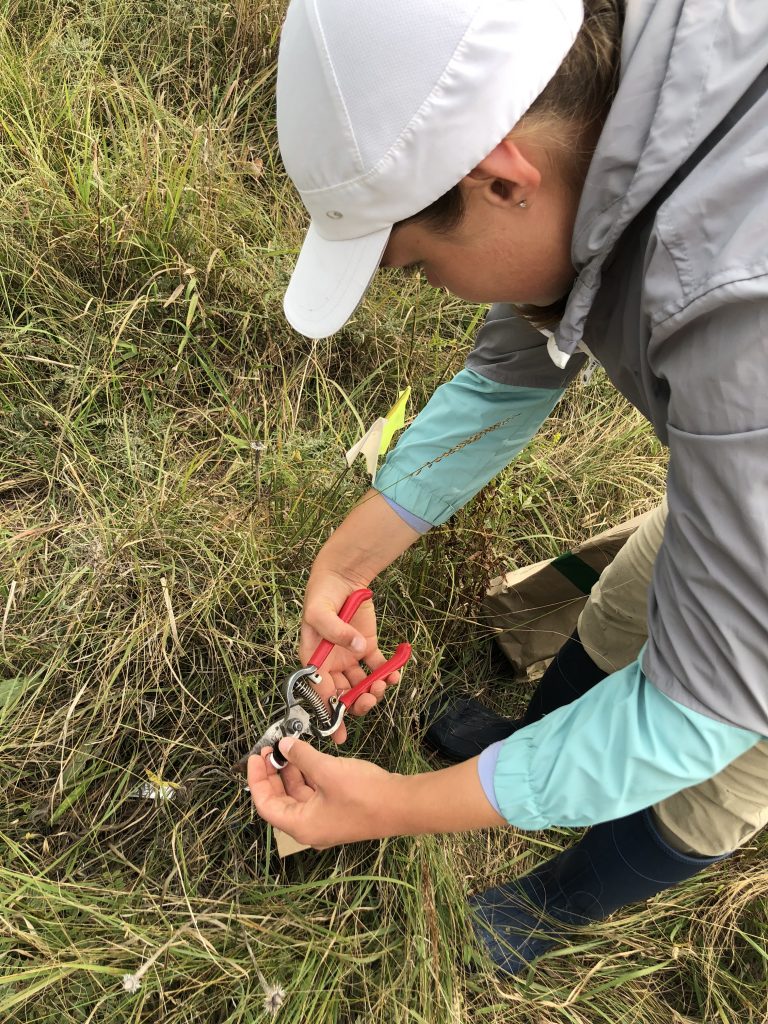
Anna harvesting Echinacea There was a lot to carry and I’m definitely grateful that Anna came to help.
 Is this science? At lunch Anna and I gave research update presentations for our independent projects since it was both of our last days. Anna revealed some preliminary results regarding soil hardness in different types of land treatments (agricultural fields, prairie remnants, restorations). My presentation reported that distances between flowering Echinacea tended to be greater on the unburned section of the prairie, suggesting that fires help decrease the spatial isolation of flowering Echinaceas (the density of flowers is greater on the burned side).
In the afternoon, we harvested Bouteloua in P1.
I will truly miss this project and everyone I have met this summer!
|
|