|
|
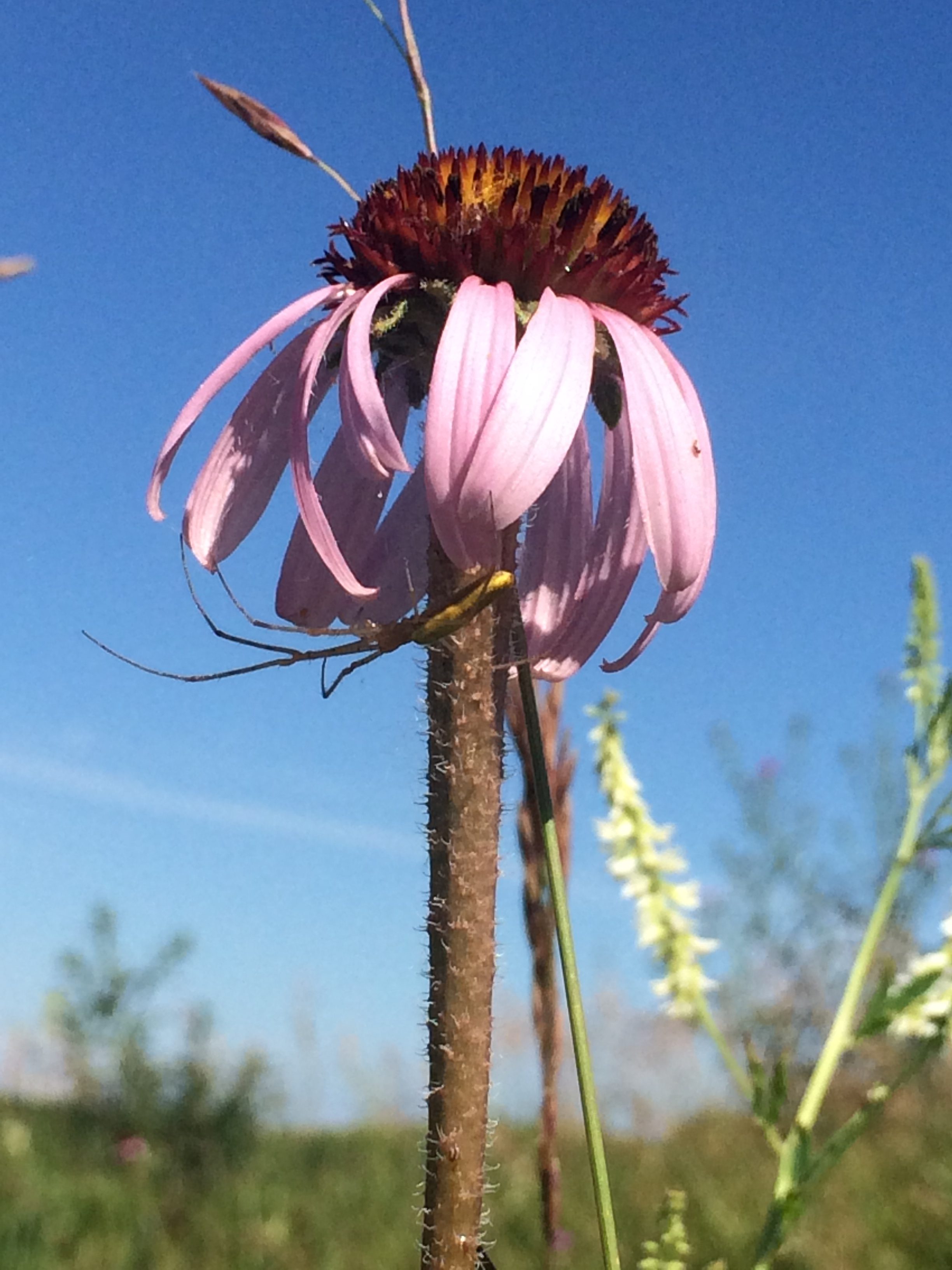
This summer, we measured hybrid Echinacea plants in experimental plot 7 at Hegg Lake. 159 of the original 294 planted seedlings (54%) were found this year. We searched 243 of the 294 positions where plants were originally planted (the other 51 positions were not searched because plants have not been found for at least three years in a row). The table below shows the fate of plants in 2017 summarized by cross-type — the first name in the cross type is the maternal species, and the second name is the paternal species (e.g., ‘ang x pal’ is angustifolia mother and pallida father).
| Status 2017 |
ang x ang |
ang x pal |
pal x ang |
pal x pal |
| not found |
53 |
10 |
33 |
35 |
| found |
21 |
18 |
52 |
72 |
 Flowering Echinacea angustifolia. Start year: Crossing in 2012, Planting in 2013
Location: Hegg Lake Wildlife Management Area – Experimental Plot 7
Overlaps with: Echinacea hybrids: ex Pt 6; Echinacea hybrids: ex Pt 9
Data collected: Rosette number, length of all leaves, herbivory for each plant collected electronically and exported to CGData. Recheck information for plants not found was also collected electronically and stored in CGData.
Products: Taylor Harris’s 2015 poster demonstrating fitness benefits of pallida parenthood.
You can find more information and links to previous flog entries involving experimental plot 7 on the background page for the experiment.
In 2017, we searched for 56 of the original 66 Echinacea hybrid plants. We found 28 Echinacea hybrids, and 2 of the Echinacea hybrids we found just had dead leaves from this year. This means that 42% of the original cohort is still alive, with the survival rate this winter of 78%. Of the surviving plants, the highest leaf count was 5 leaves, the longest basal leaf was 35cm, and only one plant had more than one basal rosette.
 Most plants we measured in exPt6 looked like this. This plot was originally developed for Josh Drizin’s experiment with exotic grasses, but 66 hybrids of Echinacea angustifolia and Echinacea pallida were also planted in 2012. In 2011, Gretel and Nicholas Goldsmith performed reciprocal crosses between 5 non-native pallida plants found at Hegg Lake and 31 angustifolia plants in P1. These plants have been revisited each summer since then.
Year started: Crossing in 2011, planting in 2012
Location: Experimental Plot 6, on Tower Road
Overlaps with: Echinacea hybrids — ex Pt 7, Echinacea hybrids — ex Pt 9
Data collected: Status, rosette count, longest leaf measurement, and number of leaves for each plant. Exported to CGData.
Products: Nicholas Goldsmith wrote a summary of the crosses he conducted in 2011.
You can find more information about experimental plot 6 and previous flog posts about it on the background page for the experiment.
 Alex and Tracie search for juvenile Echinacea plants in experiments qGen2 & qGen3. In 2017, we found 1006 three-year-old plants out of the 2526 original seedlings found in 2014 (we found 1724 plants in 2016) in the qGen2 cohort. In the qGen3 cohort we found 248 of the 644 seedlings.
The main goal of the qGen2 and qGen3 experiments is to quantify the evolutionary potential of two remnant prairie populations of Echinacea angustifolia by estimating the additive genetic variance of fitness. We make estimates for two mating scenarios. The first scenario is an experimental crossing design with all matings among plants from two “core” sites: SPP and LF (core x core). The second design uses sires (pollen donors) from the core and dams from sites peripheral to the core. The crosses performed (core x core, core x periphery) in this experiment will quantify additive genetic variance for fitness in each site and each experimental group. Additionally, we will test for differentiation among families; do progeny from sires differ after accounting for maternal (dam) effects?
Comparing germination and first year survival between the qGen2 & qGen3 cohorts:
| exp |
approxFullAcheneCt |
totalAcheneCt |
seedlingCt |
germination |
firstYrSurvival |
| qGen2 |
6300 |
26144 |
2581 |
41% |
84% |
| qGen3 |
6200 |
19777 |
644 |
10% |
38% |
Start year qGen3: 2015
Start year qGen2: 2013
Location: The sires (pollen donors) are in the remnants Landfill and Staffanson. The dams (seed plants) are in exPt 1 and they originate from remnants. Specifically, the grand-dams (seed plants of dams) are from remnants Landfill (core) & around Landfill (peripheral) and remnants Staffanson (core) & railroad crossing sites (peripheral). All progeny are in exPt 8.
Overlaps with: Heritability of fitness–qGen1
Data collected: We used handheld computers to collect data on juvenile plants.
You can find more information about Heritability of fitness–qGen2 & qGen3 and links to previous flog posts regarding this experiment at the background page for the experiment.
 Team Echinacea measuring plants in big batch In 2017 we assessed survival and fitness measures of the qGen1 plants. 1,991 plants in qGen1 were alive in 2017. Of those, 3% flowered in 2017 and 46% have yet to flower ever. All were planted in 2003.
The qGen1 (quantitative genetics) experiment is designed to quantify the heritability of traits in Echinacea angustifolia. We are especially interested in Darwinian fitness. Could fitness be heritable? During the summer of 2002 we crossed plants from the 1996 & 1997 cohorts of exPt1. We harvested heads, dissected achenes, and germinated seeds over the winter. In the Spring of 2003 we planted the resulting 4468 seedlings (this great number gave rise to this experiment’s nickname “big batch”).
Start year: 2003
Location: Experimental plot 1
Overlaps with: qGen2 & qGen3
Physical specimens: We harvested 46 heads from qGen1 in 2017. These heads will be processed in the lab to determine achene counts and seed set.
Data collected: We collected fitness measures using handheld computers.
Products: We have an awesome dataset that we will share once the paper is published. Ruth Shaw is working on an analysis of the qGen1 dataset.
You can find more information about Heritability of fitness–qGen1 and links to previous flog posts regarding this experiment at the background page for the experiment.
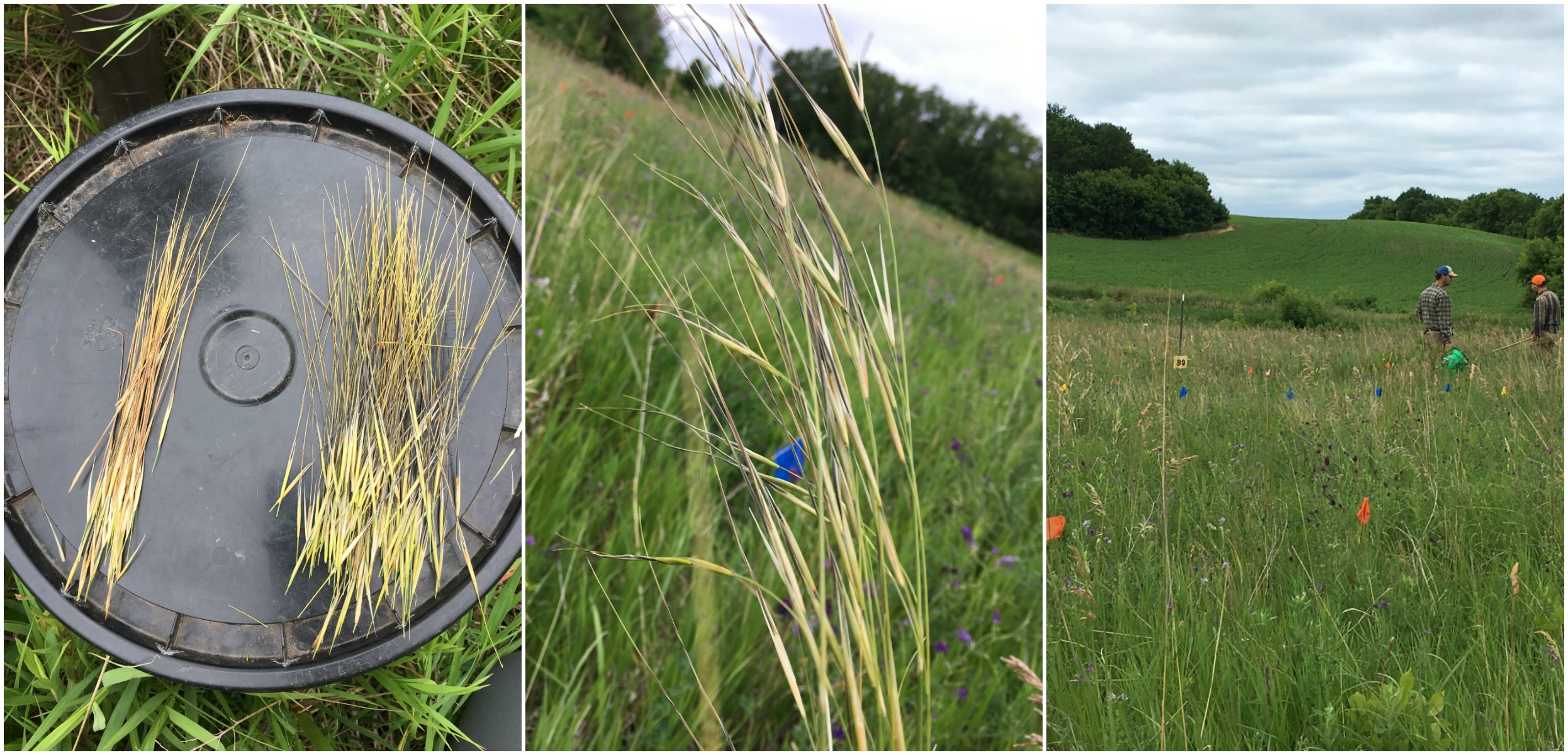
This summer we found 52 basal Stipa plants and 209 flowering plants! The flowering Stipa plants had a median of 15 fruit per plant. Our largest flowering Stipa plant had 301 fruits and 31 culms. We harvested around 5000 fruits from experimental plot 1! These Stipa plants, or porcupine grass (Hesperostipa spartea) were planted as seeds in 2009 and 2010.
 A Stipa collage created by Anna with collected fruits, a flowering plant, and Will and Wes searching for stipa. Start year: 2009
Location: Experimental plot 1
Physical specimens: Fruits from the 209 flowering plants were broadcasted in experimental plot 2.
Data collected: There are currently 3 datasets in the Stipa folder in CGData (~Dropbox/CGData/Stipa/225_measure/measure2017/)
- 20170628StipaSearchData.csv: 50 records from 28 June 2017. We searched for basal and flowering Stipa and recorded row and position, culm count, fruit count, aborted fruit count, missing fruit count, and notes.
- exPt1StipaSearch20170705.csv: 200 records from 28-29 June 2017. This csv includes rows with position 859 and status “Other (Note)”, indicating the row was searched but no stipa was found. When Stipa was found, status, row, position, culm count, fruit count, aborted fruit count, missing fruit count, and notes were recorded.
- 20171109StipaSearchData.csv: 69 records from 2 August 2017 and 9 August 2017. In this csv, predetermined rows and positions (where Stipa were found in previous years) were searched and the same information was collected as the other csvs. Since this was later in the season, all fruits had already dropped–but they could still be counted.
Products:
- Josh Drizin’s MS thesis included a section on the hygroscopicity (reaction to humidity) of Stipa awns. View his presentation or watch his short video.
- Joseph Campagna and Jamie Sauer (Lake Forest College) did a report on variation in Stipa’s physical traits within and among families in 2009
You can find out more about Stipa in the common garden and links to previous flog posts about this project on the background page for this experiment.
We had a big year for censusing plants in natural remnant populations. In 2017 we did both total demo, visiting all plants, and flowering demo, visiting just plants that flowered this year. Check out the chart below to see what we focused on at each site:
| Total Demo |
Aanenson, Around LF (partial), Common Garden, East of Town Hall, East Riley, Hegg Lake, Landfill West, Loeffler Corner East, NRRX, recruit he, recruit hp, recruit hs, Riley, RRX, South of Golf Course, Steven’s Approach, transplant plot |
| Flowering Demo |
Around LF, BTG, DOG, Elk Lake Road East, Golf Course, KJs, Krusemark, Landfill East, Liatris Hill, Loeffler Corner West, Near Town Hall, Nessman, NNWLF, North of Golf Course, NWLF, On 27, recruit el, recruit hw, recruit ke, recruit kw, RRXDC, Staffanson East Unit, Staffanson West Unit, Tower, Town Hall, West of Aanenson, Woody’s, Yellow Orchid Hill East, Yellow Orchid Hill West |
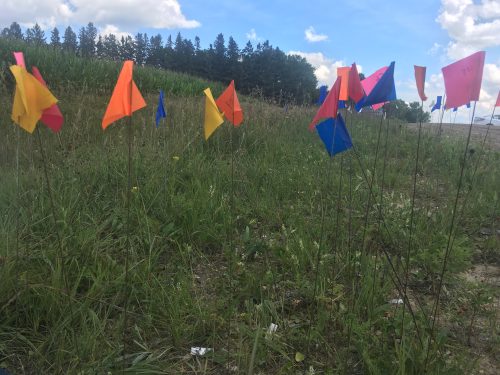
 We stake to locations where flowering plants have been found in the past and place a flag there. This is the East Riley roadside remnant, an area with a lot of Echinacea close together and a high chance of getting mowed. When we find a new flowering Echinacea plant, we give it a tag and get its location with a survey-grade GPS (better than 6 cm precision). Then, we can revisit this plant for years to come and monitor its survival and reproduction.
This season we added 5945 demo records and about 1375 survey records to our database. After over 20 years of this method, we now have a very rich longitudinal dataset of life histories including thousands of plants. REU Will Reed was a huge help organizing demo tasks for Team Echinacea over the summer and helping out with demap (the demographic census database) during the year.
Year started: 1996
Location: Roadsides, railroad rights of way, and nature preserves in and near Solem Township, Minnesota.
Overlaps with: Flowering phenology in remnants, fire and flowering at SPP
Data collected: demo records include Flowering status, number of rosettes, number of heads, neighbors within a 12 cm radius of plants found. These are all taken with PDAs that sync with an MS Access database. They are all transferred to the demap R repository in bitbucket with git version control.
GPS points shot: Points for each flowering plant this year shot mostly in SURV records, stored in surv.csv. Each location should be either associated with a loc from prior years or a point shot this year.
Products:
- Amy Dykstra’s dissertation included matrix projection modeling using demographic data
- Project “demap” merges phenological, spatial and demographic data for remnant plants
You can find out more about the demographic census in the remnants and links to previous posts regarding it on the background page for this experiment.
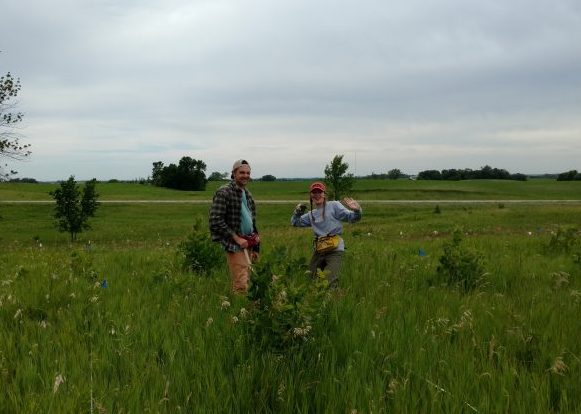
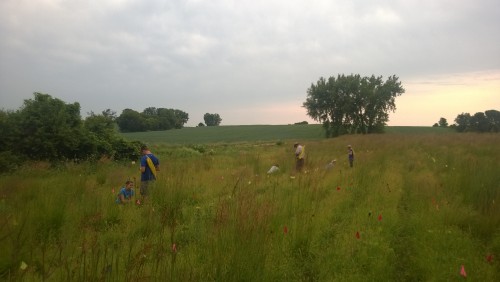
Wes Braker, an REU student in summer 2017, characterized the vegetation in remnant prairie, restored prairie, and old agricultural fields at Hegg Lake State Wildlife Management Area. Prairie communities with a large variety of native plant species are considered generally healthy communities. Wes wanted to characterize the plant communities at these sites and provide information to land managers.
Each area at Hegg Lake WMA was classified as remnant prairie, restored prairie, or abandoned agricultural field. Using Google Earth, areas were mapped out and labeled and three areas were chosen based on their availability for sampling, for a total of 27 study areas. Wes sampled vegetation each week for a total of 8 weeks across the growing season.
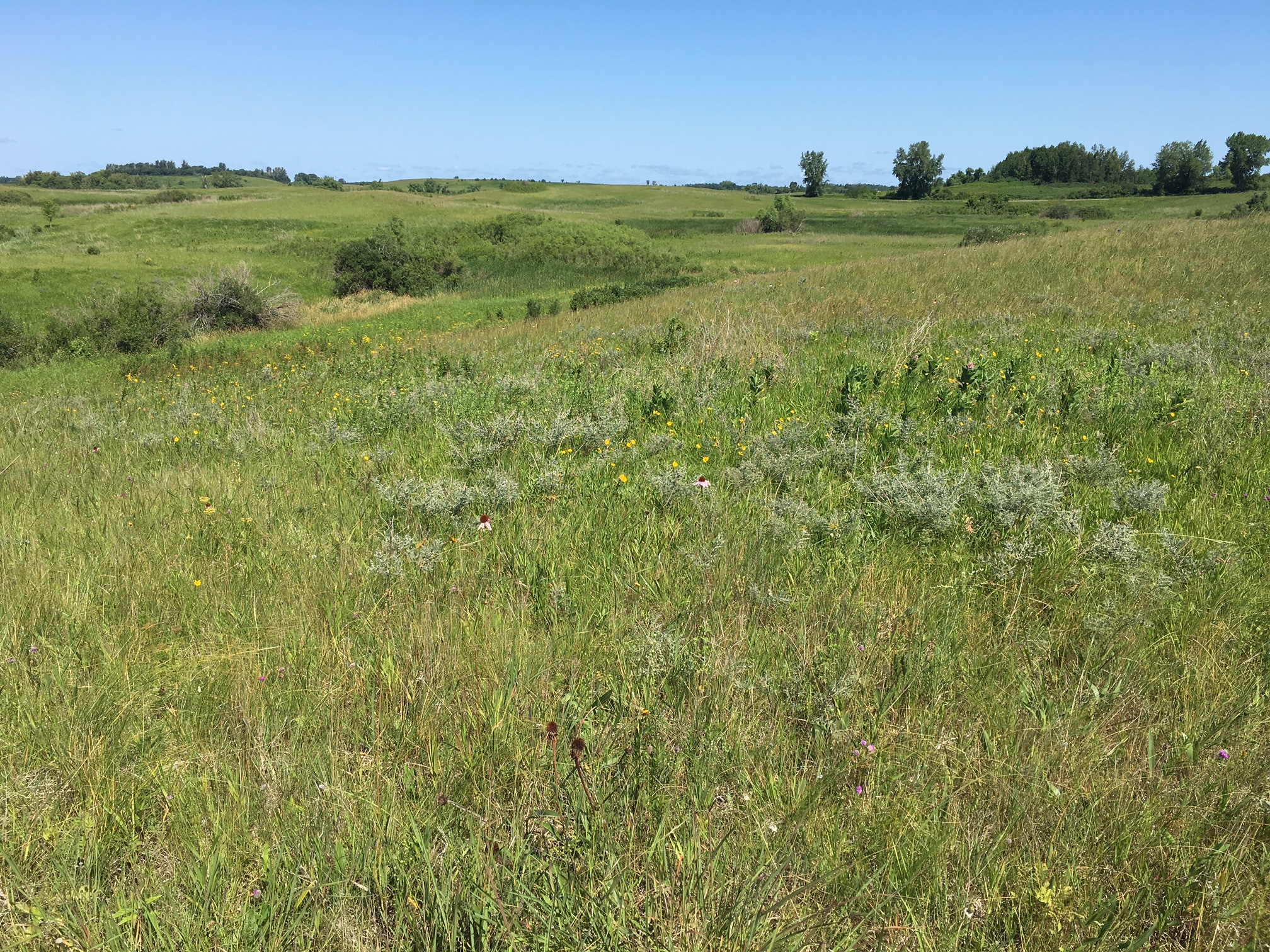
A snapshot of the landscape at Hegg Lake State Wildlife Management Area. The purpose of this project was to characterize the vegetation at this site, building a species list for use by the Minnesota Department of Natural Resources for potential use in local seed sourcing for future restorations. From this project, Wes identified 25 native prairie species for use in future Hegg Lake seed collections. In addition, he identified 80 unique plant species at this site.
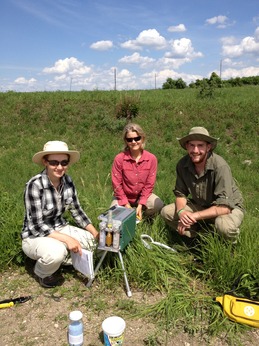
 Reina, Pamela, and Mike with the photosynthesis machine used in Kittelson et al. (2015) In 2017, of the original 1,470 plants in INB2, 473 were still alive. Of the plants that were alive this year, only 4 were flowering (0.8%) and 71% have never flowered. Interestingly, there are differences in survival for each cross level. 31% of the most inbred plants were living in 2017, compared to 39% of the plants in the between-remnant cross level. All individuals were planted in 2006.
The INB2 experiment investigates the relationship between inbreeding level and fitness in Echinacea angustifolia. Each plant in experiment INB2 originates from one of three cross types, depending on the relatedness of the parents: between maternal half siblings; between plants from the same remnant, but not sharing a maternal or paternal parent; and between individuals from different remnants. We continued to measure fitness and flowering phenology in these plants.
Read previous posts about this experiment.
Start year: 2006
Location: Experimental plot 1
Overlaps with: Phenology and fitness in P1, Inbreeding experiment–INB1
Physical specimens: We harvested 2 heads from INB2 that will be processed in the lab with other heads harvested from P1.
Data collected: We used handheld computers to collect fitness data on all plants in INB2.
Products: The below papers were published in summer 2015:
Kittelson, P., S. Wagenius, R. Nielsen, S. Qazi, M. Howe, G. Kiefer, and R. G. Shaw. 2015. Leaf functional traits, herbivory, and genetic diversity in Echinacea: Implications for fragmented populations. Ecology 96:1877–1886. PDF
Shaw, R. G., S. Wagenius and C. J. Geyer. 2015. The susceptibility of Echinacea angustifolia to a specialist aphid: eco-evolutionary perspective on genotypic variation and demographic consequences. Journal of Ecology 103:809-818. PDF
You can find more information about the Inbreeding experiment–INB2 and links to previous flog posts regarding this experiment at the background page for the experiment.
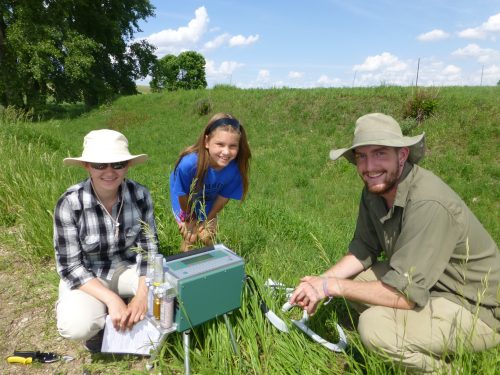
 Reina, Hattie, and Mike with the instrument used to measure photosynthesis in 2013. In 2017, of the original 557 plants in INB1, 180 were still alive. Of the plants that were alive this year, 7 (4%) were flowering and 23% have never flowered. Interestingly, there are differences in survival for each cross level. 21% of the most inbred plants were living in 2017, compared to 39% of the plants in the between remnant cross level. All individuals were planted in 2001.
The INB1 experiment investigates the relationship between inbreeding level and fitness in Echinacea angustifolia. Each plant in experiment INB1 originates from one of three cross types, depending on the relatedness of the parents: between maternal half siblings; between plants from the same remnant, but not sharing a maternal or paternal parent; and between individuals from different remnants. We continued to measure fitness and flowering phenology in these plants.
Read previous posts about this experiment.
Start year: 2001
Location: Experimental plot 1
Overlaps with: Phenology and fitness in P1
Physical specimens: We harvested 6 heads from INB1 that will be processed in the lab with other heads harvested from P1.
Data collected: We used handheld computers to collect fitness data on all plants in INB1.
Products: The below papers were published in summer 2015:
Kittelson, P., S. Wagenius, R. Nielsen, S. Qazi, M. Howe, G. Kiefer, and R. G. Shaw. 2015. Leaf functional traits, herbivory, and genetic diversity in Echinacea: Implications for fragmented populations. Ecology 96:1877–1886. PDF
Shaw, R. G., S. Wagenius and C. J. Geyer. 2015. The susceptibility of Echinacea angustifolia to a specialist aphid: eco-evolutionary perspective on genotypic variation and demographic consequences. Journal of Ecology 103:809-818. PDF
You can find more information about the Inbreeding experiment–INB1 and links to previous flog posts regarding this experiment at the background page for the experiment.
Ashely Barto, an REU student in summer 2017, developed an independent project looking at how pollination influences reproductive success in Echinacea angustifolia. She was interested in how heads that get pollinated each day differ from heads that only get visited infrequently, but receive a lot of pollen on those sporadic visits.
Over 19 days in July 2017, 1980 styles from 21 capitula were pollinated following a randomly assigned pollination schedule: pulse or steady. Capitula assigned to the pulse pollination treatment received pollen on all emergent styles at the same time, so there was a range of style ages. Steady pollination capitula received pollen daily, so all styles were pollinated on the day they emerged. Style shriveling, a proxy for pollination, was used as the response variable.
Using a generalized linear model, interactions between style age, floret position, and pollination treatment were considered to create a pollination rate model. Style age and pollination treatment did not interact or have an additive effect on pollination rates. Instead, floret position within the capitulum was the only factor essential to modeling pollination rates in Echinacea. The results suggest resource allocation plays a major role in Echinacea reproduction. Ashley will investigate seed set from the same capitula later this year to further elucidate the role of style age, floret position, and pollination treatments in Echinacea reproduction.
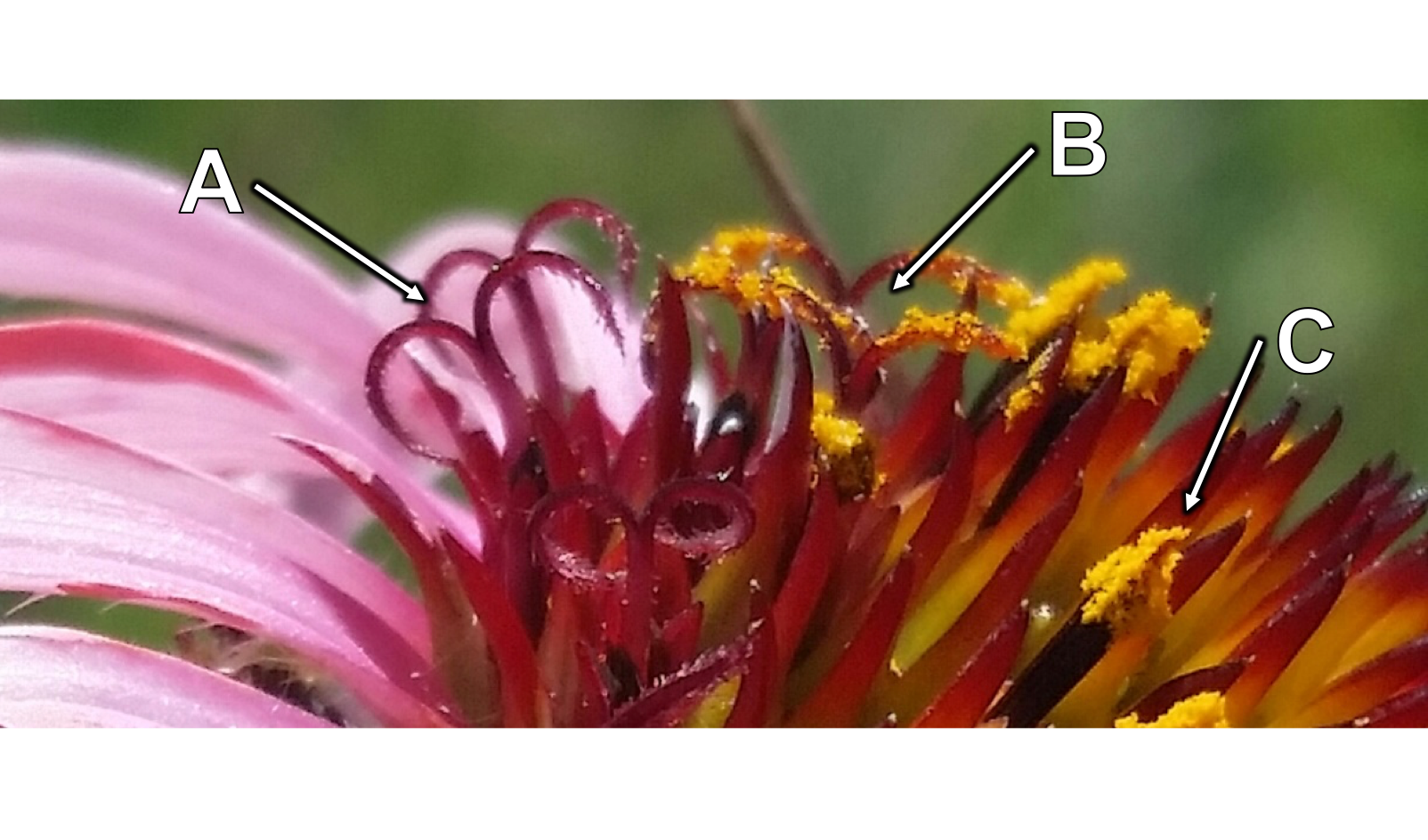
 Echinacea on its third day flowering. Within the disc florets, there are persisting styles in Row 1 (A), fresh styles in Row 2 (B), and new anthers in Row 3 (C).
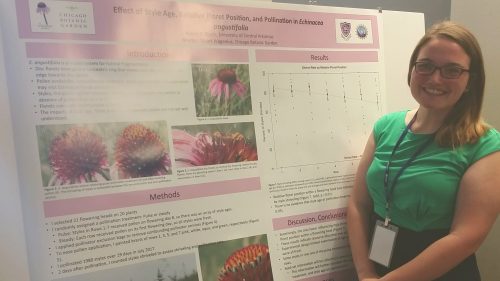
Ashley presented her work at the 2017 Arkansas INBRE Conference on October 28. Arkansas INBRE is the Arkansas Institutional Development Award’s network of biomedical research conference, and this year, it was hosted at the University of Arkansas. While this conference attracted undergraduates from many states to present on biomedical research in biology, chemistry, and physics, there were many posters like Ashley’s sharing summer research outside of the medical scope central to the conference’s theme. Ashley was able to talk about the Echinacea Project’s big picture work and how her independent REU Project fit into that larger image.
 Ashley presenting her summer REU project at the Arkansas INBRE Conference in October 2017. Start year: 2017
Location: Nice Island, prairie remnant
Physical specimens:
- 21 harvested Echinacea heads at the CBG, ready for cleaning and x-ray
Products: Here’s Ashley’s Poster of her results.
|
|