|
|
Flowering Milkweed found at East of Elk Lake Road.
Today was a phenology day for Team Echinacea. One of the things that I like best about phenology is that it allows you to visit a large array of fragments and encourages you to really get to know them as you work your way through the Echinacea maps Stuart has prepared and seek out plants. I went along the north west route today, a route I had never been on before. This route includes East Elk Lake Road, North North West of Landfill, Northwest of Landfill, and Around Landfill, among others. None of these sites, in my opinion are as stunning as the East Elk Lake Road. East Elk Lake Road isn’t a huge site, but there were a number of flowering Echinacea, including those being used by Leah in her independent project. East Elk Lake Road has both great scenery and a diversity of beautiful wildflowers. In particular, I thought the flowering milk weed was especially pretty.
After phenology, Team Echinacea convened for lunch as usual. Through the entire lunch I was on the edge of my seat. I had been expecting several packages delivering the materials I need for my independent study, and without them I really could not start.
I went with Gretel in the afternoon to GPS some plants at a few of the fragments, and after very very narrowly getting poison ivy, we returned to the Hjelm house. There, like brown treasure chests waiting to be cracked open, sat my boxes full of lab equipment. I skipped down the stairs leading to the Hjelm house basement (though not really because that’s crazy dangerous with boxes in your hands, and doubly so because I’m crazy uncoordinated). Anyways, I set up my lab space, didn’t fall down the stairs, and went out to P1 to help the crew there weed hawk weed.
After all this excitement (it was mostly just me), we all sat down to chocolate cake. I have no idea how Gretel found time to make this, as we had GPS-ed earlier and I don’t think I had been weeding for more than an hour. To put it simply, Gretel’s cake was crazy good, and we all appreciated it very very very much.
Today most of team went away to work on the Nature Conservancy project with the Western Prairie Fringed Orchid. And while I did not attend, from the group chat and an email, I deduced that a good ole’ time was had, that there was chocolate, and that it was a great year for flowering! I am looking forward to hearing about their trip and the project when they return tonight!
A select few of us, however, stayed back at camp to work on independent projects and oh, what an eventful day ensued! This day consisted of success, strife, disgruntled bumble bees, and progress!
Ah yes, I remember it like it was yesterday; however, it was only today, which really says something about today. Anyways, this morning Leah and I headed over to p2 to catch pollinators for my independent project about intra-specific pollen diversity. Leah caught a bumble bee, which unleashed a tenacious fury that Leah and I had never seen before. Who knew a bumble bee could get so angry or make itself look so large? Fortunately, it was in a vile and we observed safely from the side lines.
 Leah and the indignant bumble bee. Returning to the Hjelm house, I began painting bracts and Leah completed a lot of her pollen catalogue!
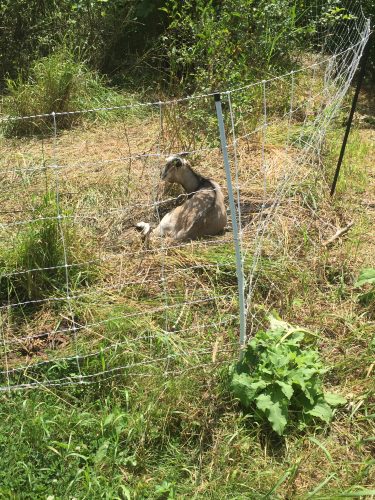
Jennifer and Alyson had already been working in the bog all morning removing buck thorn from Alyson’s plots for her independent project. Leah and I joined later to take down the relentless oppressor AKA buckthorn AKA buckthorn-(in-my-side). Ah, I kid, I kid…Much like this goat we spotted, the newest member of Team Echinacea.
I kid because it is more likely that we were a thorn in the buckthorn’s side because there are now 4 plots near the bog cleared of buckthorn!
 The newest member of Team Echinacea being camera shy… Other notable events that happened at the bog:
- Jennifer took down a goliath buckthorn with her bare hands! (and a saw)
 Jennifer vs. buckthorn. Winner: Jennifer. Every time.
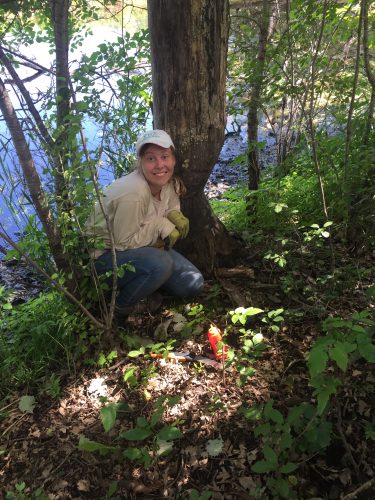
- A beaver was spotted on the edge of one of the plots! There are chewing marks on the side of this tree, but unfortunately it wasn’t buckthorn and the beaver was notified that we would no longer be outsourcing jobs to her and would rely on the robust and unyielding strength and determination of team Alyson/Jennifer/Leah/Laura.
 Just a beaver workin’ hard. Town hall with almost all of the flower children still away with the orchids was peaceful, quiet, and uneventful, allowing me to write this long flog post. The three remaining flower children were therefore able to cook in much smaller portions, to long for post-dinner conversations and shenanigans, and to take naps in everyone’s beds.
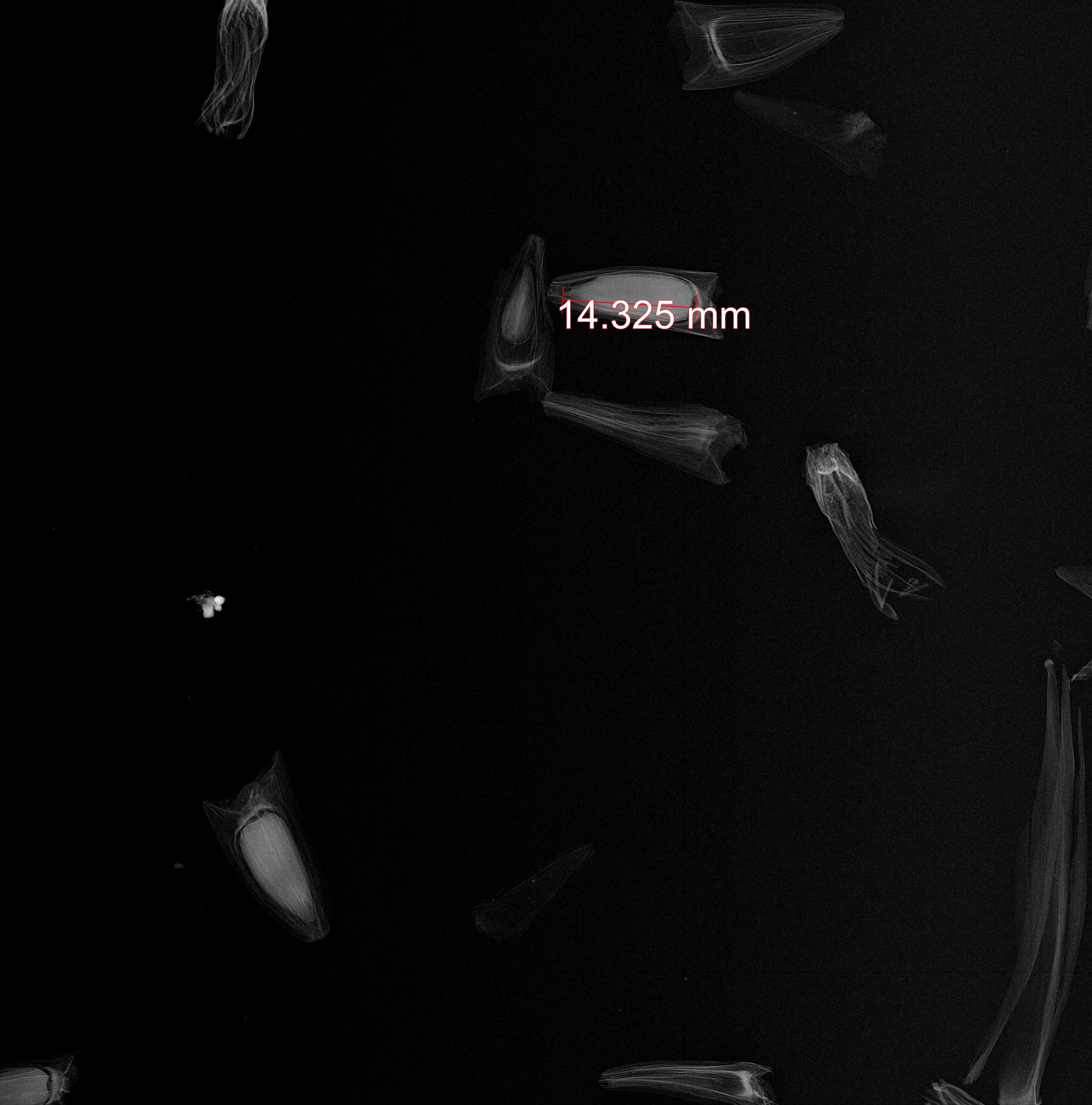
While looking for some information about the establishment of the Stipa experiment, I encountered an x-ray image of a few Stipa propagules (Hesperostipa spartea). Check it out…
 An x-ray image of a Stipa propagule (Hesperostipa spartea)
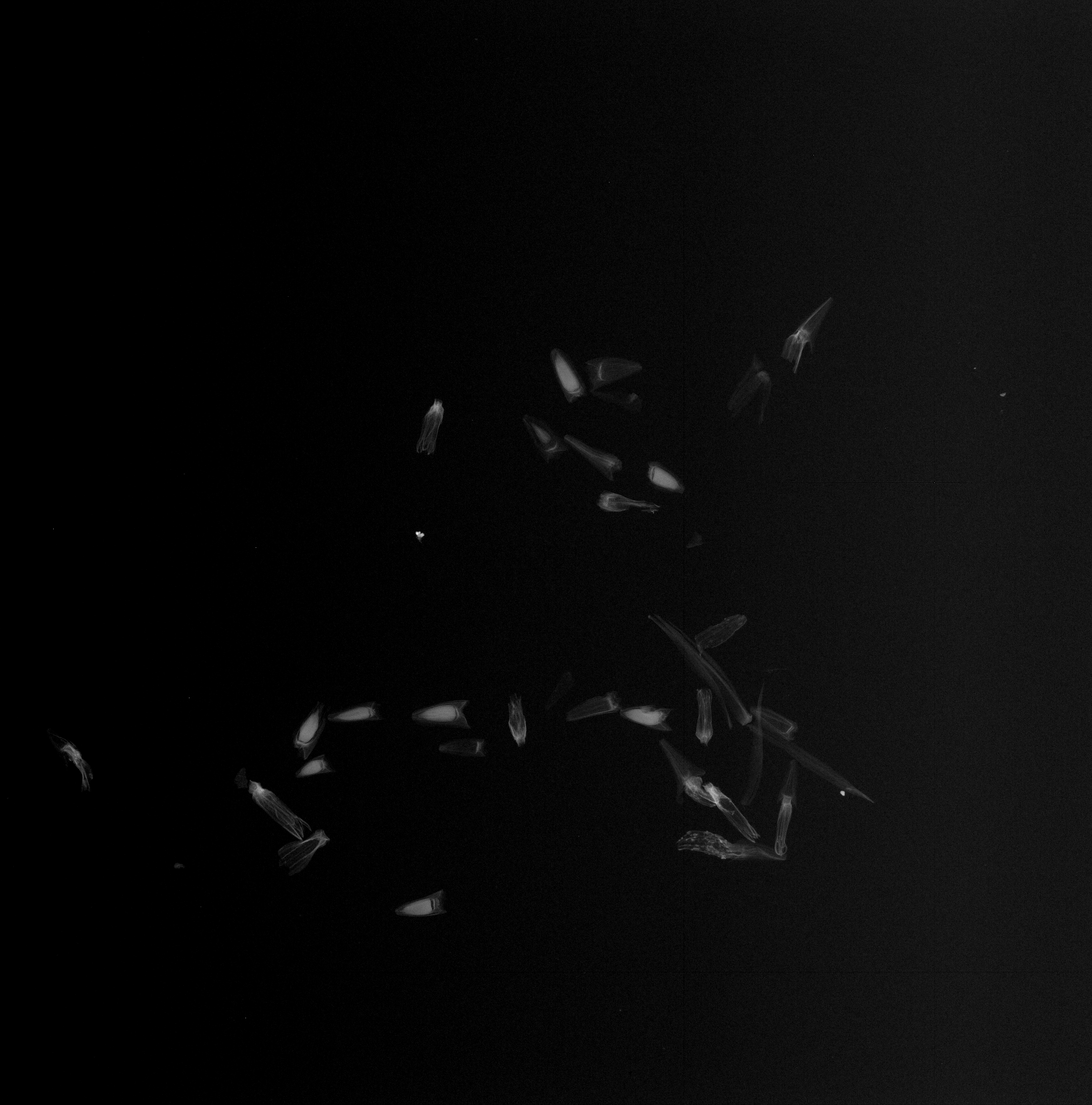
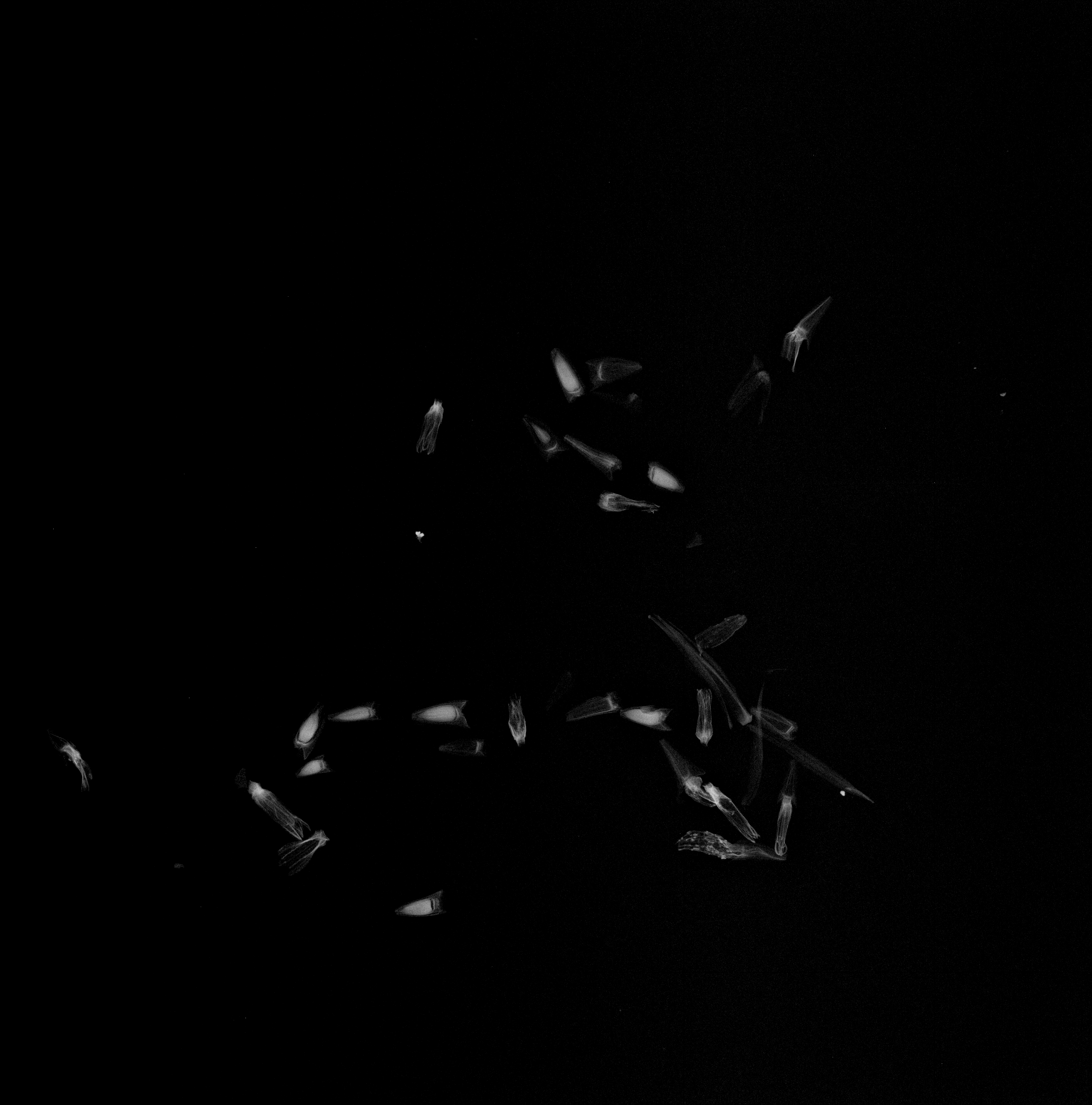
I also found some x-ray images of Echinacea angustifolia achenes. There are higher resolution images than the ones we now take for data analysis.
An x-ray image of achenes & other stuff from an Echinacea angustifolia head with higher magnification
An x-ray image of achenes & other stuff from an Echinacea angustifolia head An x-ray image of achenes & other stuff from an Echinacea angustifolia head
Hi there! My name is Ivy Klee. I live in Highland Park, IL and I will be a sophomore at the University of Michigan studying the Program in the Environment (PitE) this fall. This summer I will be working as a volunteer at the Plant Conservation Science Center at the Chicago Botanic Gardens and today was my first day on the job. My day started out with a tour of the different areas of the lab and after that I helped to clean and count the Echinacea seeds. The cleaning process involved removing and separating achenes from the flower head while the counting process involved identifying the collected achenes from a scanned image. I enjoyed every minute of my time today in the lab, all the volunteers and people working here were so nice and very friendly. I am excited to come back tomorrow! 
Happy Independence Day, flog readers! The team had the day off today, but that didn’t stop Leah, Scott, and I from doing a little fieldwork this morning. Leah and Scott caught pollinators and worked on Leah’s co-flowering study while I painted and bagged heads at Around Landfill in preparation for crossing tomorrow as part of the compatibility experiment.
We honored the holiday this evening in Alexandria, the so-called birthplace of America. After eating a traditional American meal of Chinese buffet food, we went to a concert on the lawn of the Douglas County courthouse. Here we heard many patriotic tunes such as “America the Beautiful” and “God Bless America.” We took the scenic route back to Kensington and admired the clouds the entire way. Finally, we stopped at the Kensington Runestone Park to visit the true birthplace of America, where a Viking expedition left a runestone all the way back in 1363. The runestone doesn’t say what date it was engraved so it’s tough to say whether July 4th is actually America’s birthday, but that would be quite a coincidence. Either way today was a great day!
 “Everything is awesome! The clouds are so cool!”- at the birthplace of America
The team all headed in on Saturday morning to help do phenology at all the remnants, P1, and P2. Stuart explained the maps to everyone and we were off. James and I headed out to the Rileys and Loeffler’s Corner. Many of the plants were midflowering. We finished our route in about 3 hours and headed back to the Hjelm House to begin P1 phenology. Scott wasn’t far behind and came out to help in P1. After that, everyone gathered around the porch and we worked on correcting some of the GPS/phenology mix ups so the maps can be more useful.

We all went our separate days feeling relieved that we made it through full phenology.
Is that a cone-headed grasshopper on a cone flower? This is not the pollinator we were looking for. Today was another eventful day in the great plains. We started the morning bright and early with pollinator observations, and while it wasn’t the busiest day, we still saw a number of solitary bees. Sitting and watching flowers for a few hours provides ample time for deep thoughts, such as wondering how bees can pollinate wild parsnip without getting chemically burned and why all other flowers but the flower I am observing have pollinators on them. Throughout the day, we continued to map Echinacea with GPS, and during the afternoon, our budding detectives, Lea and Will, sorted out all the inaccuracies of the GPS points. Tomorrow we plan to visit all sites to look at flowering phenology and style persistence.
After work, the town hall folks made some pizza and enjoyed some telephone pictionary. As you all know by now, we had planned to play more Farkle tonight, however during our game of telephone pictionary (a game similar to telephone, but with sentences and pictures rather than whispering), it came out that Amy “Farkle Queen” Waananen had been mind controlling us throughout the Farkle game last night. We have yet to discover how that had any effect whatsoever on the game last night, but investigations are under way. Provided is the basic photographic evidence of this event.
 Amy, top middle, mind controls us during a game of Farkle
Hi world,
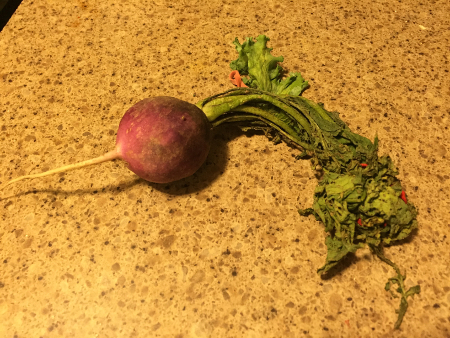
The first big issue of the day was the lone radish found in the fridge today. We tried to peddle it onto everybody on the crew, but most people thought it looked too smooshy, and nobody wanted to smoosh. Amy and I eventually split it in half and ate it before jumping in the car. Picture attached. It turned out to actually be one of our spicy radishes. I think that was appropriate because today was a spicy day.
 Spicy radish. Would you have eaten it? This day started out with distant sheets of rain that slowly crept up to base at the Hjelm House, forcing us to do indoor work. When the rain cleared around 9:30, crew members did bee observation videos. Some people were viewing bees for the first time, others were going out for their second stints. We saw some of the same patterns today that we say two days ago — Laura saw over 20 bees at Steven’s Approach, while other sites were pretty destitute. Other crew members worked on mapping and pulling hawkweed for a hawkweed eradication experiment in experimental plot 1. Also, we finished collecting our qGen2 experiment data for the year, freeing up more time and plastic toothpicks for other projects.
At lunch, to supplement our training yesterday on flower deformities, we talked about our own various human deformities, including dislocated fingers, weird moles and warts, and bruised ribs. We may make a fun little trip this weekend into Alexandria to visit an urgent care facility. From there, most of the crew split off to do phenology and GPSing. Alyson went to the bog, and Leah finished setting up plots for her own pollinator observations, and the family stayed behind to weed (including some gnarly thistles). I went up the Landfill bloc geotagging with Alex, with Abby and Lea doing phenology at the sites ahead of us and catching over 50 new buds. We GPSed over 60 flowers alone at Around Landfill and got over 80 flowers total. James and Will were able to finish mapping five sites on their own. All of this done with zero people getting electrocuted on the electric fence near the Landfill.
Alex narrowly escapes death, checking a tag for an an Echinacea under the electric fence at Around Landfill. At home, Leah and Amy made dank filafel and salad. We all discovered that mint works just as well as dill in tzatziki sauce. After that, we played Farkle well into the night, with Amy “Farkle Queen” Waananen winning two games, the first one in a wild horse race with Lea “The Farkle Hustler” Richardson. We look forward to our Friday Pizza and Farkle night tomorrow, followed by more Farlke-related activities over the long weekend.
One of my favorite activities last summer, while part of Team Echinacea 2015, was recording phenology data. We knew today was going to be the second time this week where complete phenology data would be taken for all remnant sites and experimental plots, so needless to say I was quite excited when I arrived this morning. After putting my lunch in the refrigerator, I sat at the long wooden table on the porch and looked over at the list of phenology routes. Soon teams were formed, routes decided, and after grabbing some tags, flags, and twist ties, we were on our various ways.
The list of sites to survey is extensive! I drove with Alex and Amy down to East Riley, starting at the southmost remnant site in our route. After visiting a few sites we met up with Leah and Abby at Loeffler’s Corner. I noticed Loeffler’s Corner still had many buds which weren’t yet flagged. Then the five of us headed up to Landfill to make quick work of assessing flowering day for each of the heads currently shedding pollen.
One plant that could have easily been mistaken as “Rays up 1cm” already had one anther producing pollen!
Alex working at Riley with the morning sun behind him! After lunch we had more phenology to do, and we realized that we needed to GPS the flowering plants at some more remnant sites. Experimental plot p2 still had many rows that needed to be searched for flowering plants and phenology, Alyson needed some supplies from Alexandria (for her independent project), and Alex needed to watch some of the pollinator visit videos that were recorded yesterday. We split into various teams and I ended up with James for the remainder of the afternoon. The two of us worked great together down at Loeffler’s Corner. We tried our best to find every remaining unflagged head and GPS each plant. By the end of the afternoon we were all hot and tired, but so excited about finishing the GPSing for all of Loeffler’s Corner! Back at the Hjelm house, everyone did their chores and wrapped up the long day.
While working at Loeffler’s Corner, James and I saw (and heard) four trains pass by. Needless to say we were definitely repeating back tag numbers while taking GPS points! For dinner, Alex made an amazing Ratatouille with summer vegetables and goat cheese. Many of us ended the night with showers and ice cream- perfect after a long day of phenology fun!
Today was the first day of Team Echinacea’s pollinator observations! A number of genera were tentatively identified, including a number of small black bees and Agapostemon. As I sat in the field today, I encountered a pair of mating bees (picture below) on an Echinacea head.
 Pair of unknown bees mating on an Echinacea head while the female forages. The female’s scopae were chock full of pollen, and it was a great way to start this season’s pollinator observations! I also saw a few bumblebees today, buzzing around but not visiting Echinacea heads. All around, it was a great day of observations. On my last few observations, I came across a pretty big bug. It decided to chill out on my arm for a while until I finally finished my last observation and returned to the Hjelm house for lunch.
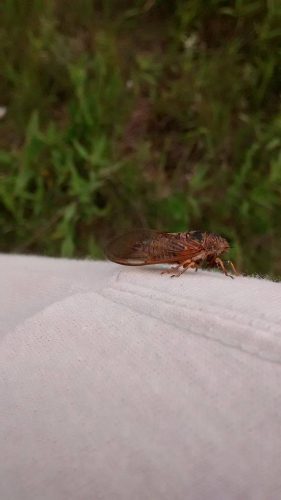
A Big ‘ol bug (of unknown species) who decided to take up residence on my arm for a while this morning. It was interesting to note that many observers noticed that as the day wore on, more and more pollen was (presumably) collected by pollinators until there was a time when little to no pollen was able to be observed on Echinacea, and after this time pollinator observations were few and far between. This seemed to happen even at Landfill (where I was located), even though there were a relatively greater number of flowering pollinators than at some smaller sites. It was also interesting that though there were relatively more flowering plants, there were fewer pollinator observations at Landfill than at some of the smaller fragments.
I can’t wait to continue pollinator observations in the near future, and to observe the changes in pollinator diversity as the Echinacea flowering season continues!
|
|