|
|
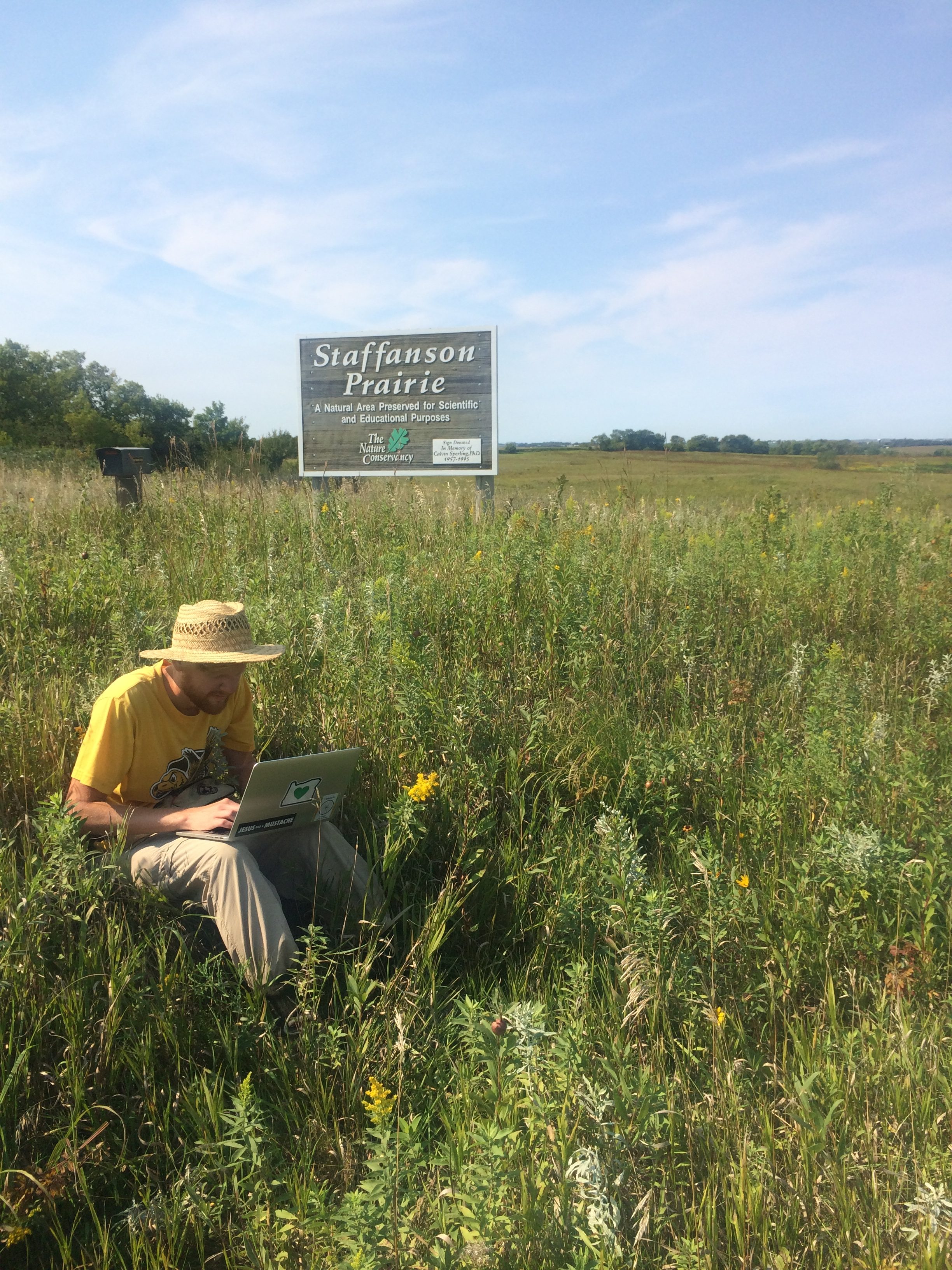
An inevitable deterioration toward uniformity. Echinacea and tags becoming one with the soil. This may be stretching the meaning of entropy, but there were a surprising number of Echinacea heads gone and many tags were nowhere to be seen. So many heads were gone in Staffanson that we began to wonder if there had been some busy rodents, deer or humans. Anyway, you may be accustomed to hearing that we did demo at Staffanson, and today was no different. We spent the entire day as demographers, but at last we finished with all 1200 some plants (500 today)! Like soldiers coming home from a war, we were both joyous and perplexed as to what more there was to be done. We had spent the coldest day of the summer, the buggiest day, one of the warmest and some of the longest days doing demo at Staffanson. We soon realized there was much more to be done. In a world without entropy, we could hope to harvest, recheck p7 and do demo at Aanenson, KJ’s and North West of Landfill. We’ll try, but stand by for updates on what we can accomplish in the next two days. After work we finished both the root beer and the ice cream, so no more floats for us. They were pretty musty (scrumptious).
 We march out of battle, victorious
Today started off with Amy and Scott going to collect phenological data on Lea’s plants at Staffanson. Jame and I went to Hegg Lake to check on some discrepancies between a list of GPS points and observed points in Amy Dykstra’s plot. After we finished at Hegg lake and Staffanson we met at Loeffler’s corner for some demo. While Sulu (one of the GRS-1 units) was being uncooperative and had to take a timeout we made it by with just Chekov (the other GRS-1 unit) for awhile. Stuart returned from his trip home to Illinois today, and he arrived just in time to help us do total demo at Loeffler’s Corner. We focused on the west side of the site because it has a history of being burned and can give us an idea of how burning affects flowering in remnant populations! We completed total demo at Loeffler’s corner which involved visiting exactly 500 locations. It felt good to finish demo at a big site, especially after spending so much time doing demo at Staffanson, which is where we will be tomorrow, so stay tuned!
P.S. if you are curious about the title it is a quote from Scott after crossing a barbed wire fence with just millimeters to spare, for more great quotes from Scott stop by tomorrow!
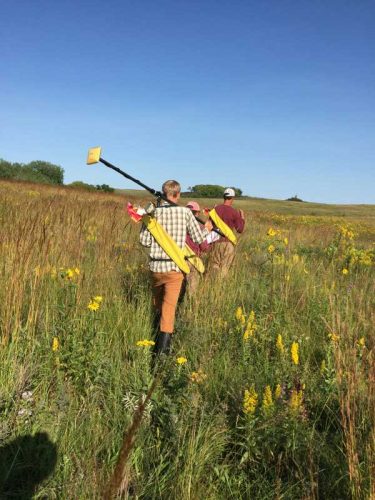
Jame waits for Sulu to start working  Jame planned an Echinacea themed party, he even decorated with lots of colored flags! But no one came : ( (Just kidding he is doing demo)
We had the smallest crew of the season yet today with Lea’s departure and Stuart still being in Chicago. Nevertheless, James, Scott, Will, and I managed to get a few things done today. We had a late start after flash flood warnings in Douglas County until 9:30. We made the best of the wet conditions and did some weeding of thistle and bird’s foot trefoil in p1. After things had dried out a little, we split up and harvested heads in the remnants. We reconvened for lunch. In the afternoon, Will and I went to Staffanson to harvest the ‘sppBonus’ plants, which are a sample of plants that have flowered in both burn and non-burn years that we harvest in addition to our regular remnant harvest. We found all of our target plants, which was a little trickier than anticipated because so many of the heads on the west unit had been toppled by weevils or grazed. Meanwhile, Scott and Jame went to Landfill and On27 to finish up harvest there. Once they finished, they met Will and I at Staffanson to work on total demo. We estimate that we are about halfway done with all demo at Staffanson. It is a big job! Fortunately, by now we are all experts and, also fortunately, the mosquitoes were not quite as bad as they were on Friday. That’s good because between the rest of demo and Lea’s phenology project we’ll be spending plenty more time there in the coming days!
Jame and friends
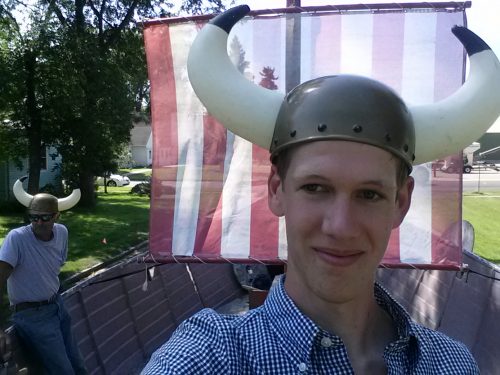
Amy and Scott started our Sunday off by continuing to monitor Lea’s transect at Staffanson. Thankfully, the mosquitoes failed to carry them away. Donnelly, a town near Morris, was having a threshing bee and parade this weekend, and I was invited by the Kensington Lions Club to become a viking for afternoon. I quickly accepted, since, given my non-Scandinavian heritage I might not have this opportunity many times. After learning much about the history of the local farms and farmers during the drive, I embarked upon the knarr for our passage through the streets of Donnelly. For those of you who may not be vikings or have not used a knarr for seafaring purposes, it is a cargo vessel used by the Norse for cross-Atlantic travel. I believe the specific knarr I was on may have been used to carry the runestone to its resting place in the true home of the runestone, Kensington. Anyway, our voyage safely completed and the candy handed out, I returned to K-town, my viking duties over. Scott, Amy and I then went swimming in Elk Lake where we met Abby and all her new college buddies. We stocked up on food and are now preparing for some of Scott’s signature Spanish omelets. Stay tuned for more musty news about death by mosquitoes at Staffanson tomorrow.
A fierce, clearly Norse, Viking warrior. Update: Can you count the number of ice creams in the fridge? We think there aren’t enough. Leave your guesses, comments, suggestions or concerns below.
I wrote this after boarding a train in St. Cloud, MN late Friday evening. Little did I know the route I was on had no wifi, so this is a belated post about my last day in Kensington.
Today was the last day of my time with Team Echinacea 2016- a second amazing summer out in Douglas County, MN. While I’m sad to be ending my field work, I’m looking forward to my impending move to Evanston, IL where I’ll be starting graduate school at Northwestern’s Plant Biology and Conservation program. Regardless, I was looking forward to my last day in the field. In the morning, I immediately left the Hjelm house for Staffanson to assess the flowering phenology of the Liatris and Solidago plants in my transect. Meanwhile, the rest of the team went to Hegg Lake for a morning of demo and harvesting in p2. Almost as soon as I arrived at Staffanson I noticed the mosquitoes were swarming worse than I had ever experienced! Luckily, Hegg wasn’t as bad, and we were able to finish harvesting at p2 before lunch. After lunch, harvest continued in p1. With just a couple remaining hours in the afternoon we headed out to Staffanson to work some more on Total Demo. Sulu and Chekhov were feeling a bit finicky, taking a good while to make an adequate data connection. By the time we actually started working, the mosquitoes were swarming again and after Amy had 20 bites on just one of her arms, we decided to call it a day and admit we had been “mosquitoed” out of field work. After tidying up the Hjelm house, my last day of 2016 field work came to a close. Back at town hall, Amy made us what might be my new favorite cake, oatmeal cake with cream cheese frosting, and James made some delicious baked mac and cheese. We enjoyed a game of Catan, took an evening walk around Kensington, then drove to St. Cloud where I boarded my Midnight Train to Spokane and settled in for a 27 hour ride.
With Lea leaving this morning, the remaining crew members Amy, James, Will and I, took the day off. There was no work to do, and thus no work was done. Kensington was cool and cloudy today, but it should be back to 80 degrees this week, when we plan to finish demo at Staffanson, continue harvesting, recheck p7, and check Lea’s Liatris and goldenrod transects.
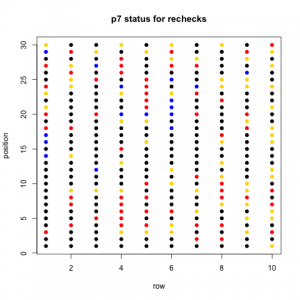
 Map I made of recheck status for all positions searched in p7 this year. Black dots represent plants found, red dots represent positions where plants were not found that will be rechecked, gold represents positions where plants haven’t been seen in three years, and blue represents plants that should be remeasured. We’ll hopefully recheck p7 this upcoming week.
Today was probably the coldest day of fieldwork we have had all summer, a cold front passed through on Wednesday and left us with a cloudy 60 degree day. For those team members who are more accustomed to hotter summers today was a little bit of a shock.
We went out to do total demography at Staffanson Praire Preserve, our goal while doing total demo is to census all of the plants that have flowered sometime in the last 20 years. It’s a big project, at Staffanson alone there are just over one thousand locations to visit. While not all of these locations still have a plant it is awesome to see a tag around a plant that was put there in 1996 or 1997.
Even the flowers are cold! We made a huge dent in the number of locations at Staffanson, of the 1054 locations we visited 435, nearly half done!
Scott stakes locations while Amy does demography on the plants at each location
Good evening floglanders,
 Computers in the prairie!! No parents no rules!! Stuart took the train back to Chicago this morning, leaving us kids in charge of fieldwork for the rest of the week. In the absence of responsible adults, we did all kinds of wild and crazy things. Lea and Scott assessed phenology for Lea’s experiment at Staffanson while Will, Jame, and I did demo at RRX and NRRX. Will and I left James to set up seedling refinds at Staffanson and went on to harvest a few remaining heads from the remnant harvest sample that we started yesterday. After lunch we did total demo on the south side of the road at Aanenson and after that we did seedling refinds at Staffanson. It was totally OC (outta control). We wrapped up the day by getting the ice cream out of the freezer and having root beer floats for the second day in a row. Woohoo!!! Don’t tell Stuart or Gretel.
Til next time,
Amy
Today was a continuation of harvesting. Instead of harvesting heads in experimental plots, we harvested Echinacea heads from many of the remnant sites. At every site we visited, we collected five randomly selected heads as well as the most and least isolated heads and the first and last to end flowering. We were surprised at the number of heads that were ready for harvesting yesterday, but today we had an even higher percentage of heads with ripe achenes. Our rough estimate was around 50% of heads harvested. We spent the afternoon rechecking P9 for any missed plants, and Scott proved himself the musty champion of searching with around 15 Echinacea found.
After work we had some great rootbeer floats, while discussing the rest of the week. Stuart is headed to Chicago, so it will just be us younger folks for the rest of the week. Thankfully, he left us with some sage advice to help us survive the week, “Work hard, but don’t forget the ice cream.” I believe this is advice by which to live.
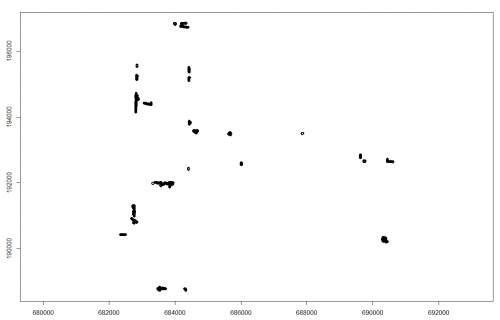
Since I can’t think of much else to write, I’ll leave you with an image generated through my independent research. I want to know if there is a relationship between the distance of a plant to the nearest habitat edge and reproductive fitness. I recently completed the first step of assigning distance to the nearest edge to each flowering plant. Below is a visual depicting the edges of all remnant sites (also included because I didn’t remember to catalogue any of today’s events with photographic evidence).
Harvest
Today, we began the harvest season — cultivating the heads of Echinacea that are soon to drop their achenes. These heads are harvested so their achenes (which may house seeds) can be counted, a way to quantify the reproductive output of individual plants. These can be used in an aster analysis to estimate fitness of individuals, but there are plenty of other ecological and morphologically interesting questions that the seeds can help answer, such as how effectively flowers have been pollinated. We harvested this morning in P1 and the 99 south garden, clipping and storing a modest total of 48 heads. But first — we spent a little bit of time herding the goats between paddocks in the backyard. For what it’s worth, we lost zero goats and endured zero shocks.
 Jame is a miner for a heart of gold… Everybody Knows This is Nowhere
We came dancing across the highway, with our clippers and our boards… This brought us to P2, where we spent most of the afternoon, and maybe a little bit of the evening. Here, like in P1, we checked the status of every single head in the plot for the signs (dead cauline leaves, brown involucral bracts) or for loose achenes. However, P2 had over four times as many heads to check as P1, making for a long afternoon. It seems like P2 was on a slightly earlier flowering schedule than P1, for we think that we had to harvest nearly half of the heads we came across. Amy and I worked for about four hours and only managed to move through 13 rows of plants, some of which we enlisted Lea to help with. I don’t remember what exactly we said, but I remember laughter — perhaps at this macabre reminder of our own mortality, or perhaps because we were carrying around a shopping bag with more than 100 crisp flower heads in it.
Old man, take a look at my life, I’m a lot like you After the Gold Rush
Lea made excellent pesto tonight with some of our leftover fennel and sunflower seeds, while Amy and I went to Morris to pick up the CSA. At dinner we went on a journey through the past, talking about Team Echinaceas from past and present, then finished off our evening with ice cream. Our aching bones and weary fingertips required rest, so we retired early and will sleep ’til the morning comes.
Regards,
Scott “Southern Man” Nordstrom
|
|