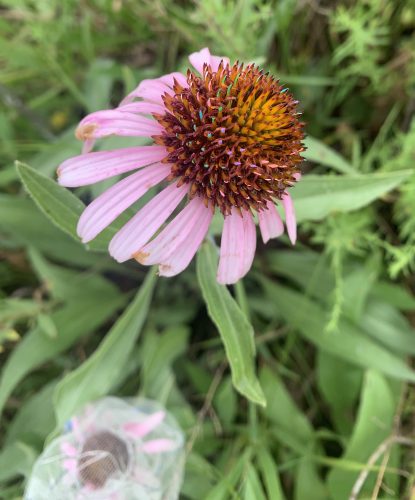
The pollen interference experiment series examines the influence of heterospecific pollen application on the shriveling of Echinacea styles. The shriveling of Echinacea styles has previously been considered a signal of compatible pollen receipt, but shriveling can also occur after the application of pollen from other, closely related species without the creation of a viable seed. The pollen interference project aims to determine which species successfully cause shrinkage of Echinacea styles and whether this interference occurs because of an interspecies match in morphology or interparental genetic compatibility.
During the 2019 summer field season, Julie Bailard performed hand-crosses with pollen isolated from individuals of either Heliopsis helianthoides or Ratibida pinnata on styles of Echinacea angustifolia. The goal of this experiment was to determine if heterospecific pollination of Echinacea with closely-related asters resulted in style shriveling. Pollen from each pollen donor was collected in separate microfuge tubes and applied to Echinacea styles the same day, using a fresh toothpick for each donor. In total, 19 Heliopsis and 8 Ratibida sires were crossed with 16 Echinacea dames for a total of 96 interspecies crosses. In 2009, Allegra Halverson applied pollen from Heliopsis helianthoides,Coreopsis, and Carduusonto Echinacea styles and observed that application of Heliopsis pollen often preceded successful style shriveling.
Data/ materials collected:The data are composed of binary outcomes (y or n) representing either successful style shriveling or style persistence for each pollinated style, recorded 24 and 48 hours after initial heterospecific pollen. Each style’s records are paired with the identity of its maternal plant and the species (application 2009 and 2019) and individual identity code (2019) of the heterospecific pollen donor. Datasheets are found in Julie Bailard’s teamEchinacea2019 Dropbox folder in.
This fall, I had the opportunity to present a poster about my recent field research on pollen interference at the Carleton College Summer Research Symposium on October 19. This poster focused on the parts of my experiment that tested whether false sunflower (Heliopsis helianthoides) pollen interferes with reproduction in Echinacea by causing styles to shrivel. My findings suggested that this style shriveling results from a cooperation between dame and sire identity, such that applying pollen from any one false sunflower might succeed in causing style shriveling on one Echinacea plant but not another. This poster summarizes some interesting and promising early results, and I am looking forward to analyzing the presented data further in the coming months. Thank you to everyone at the Echinacea Project who helped make this experiment possible!
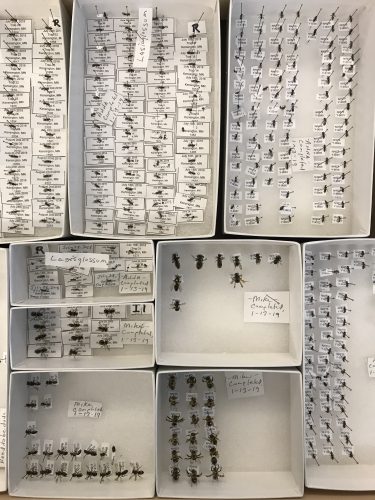
During my first week, I have learned how to perform many of the tasks involved in processing specimens and collecting data. I have particularly enjoyed working with the native bee collection. I have assigned SPID numbers and have organized some of the specimens by grouping them together based on size and other qualities such as color and marking patterns. I am beginning to develop an eye for identifying differences between bees and am becoming more familiar with the characteristics of the various genera we are classifying them into. Examining the bees under the microscope has been especially interesting. I have been interested in bees for quite a while but have never had the opportunity to see them in such detail before. The information I already knew about bee morphology became more tangible when I could see the features so closely.
Besides working with the bee collection, I have made progress on rechecking and labeling Echinacea heads. We seemed to be behind on this task, but I have been working through many heads, getting them ready to be scanned so that we can keep them moving through the data processing steps. I plan to continue working on rechecking and labeling this week, as well as randomizing. I also hope to learn several new lab skills and continue to grow my understanding of the research process.
Throughout the summer, I designed and collected
materials to establish an experiment in experimental plot 1 to study parasites
and their impact on the community of host plants they live in. Parasitic plants
are plants which absorb nutrients from neighboring plants. Parasitism is an important
part of nutrient cycling in many ecosystems and parasite scientists hypothesize
it to be an important part of prairie ecosystem maintenance.
This summer I collected seeds from five parasitic
plant species which are native to the prairie. I also collected the seeds of
over 100 species that can be commonly found in Douglas County, Minnesota and I
have begun experimental germination of them and will continue to do so in the
future. I developed a plan to plant Comandra and Pedicularis throughout exPt 1
and establish communities of 40 host species around them to address questions
about the impact native parasitic plants have on plant community members. In
late October I harvested biomass from the proposed parasite planting locations
to understand the species diversity and abundance present before planting.
Start year: 2019
Location: Douglas County, Minnesota; exPt 1
Overlaps with: Experimental plot management, Hesperostipa common garden
experiment
Materials collected: Parasitic plant seeds (Cuscuta
glomerata:18,000 across 6 individuals in 4 locations; Agalinis aspera: ~8,000
across 81 individuals in 3 locations; Agalinis tenuifolia: ~4,500 across
41 individuals in 1 location; Pedicularis canadensis: ~14,000 from 1
location; and Comandra umbellata: ~1,800 from 3 locations) and host
plant seeds (500+ seeds per host species, numbering approximately 100 species).
Seeds are stored at the Chicago Botanic Garden.
Additionally, 216 .1 x 1m strips of dried biomass are
stored at the Chicago Botanic Garden.
Data collected: Find data related to this project
including the proposed planting scheme in the cgdata repository in
~cgdata\summer2019\Hemiparasites
The diversity and abundance of bees native to the tallgrass
prairies of Minnesota are declining; one potential reason is changes in how
land is used and managed. Native bees provide vital pollination services to our
native prairie plants as well as agricultural crops. It is important to
understand the factors involved in the decline of pollinators so they can be
combatted and our plants be protected. In summer 2019, the focus of the
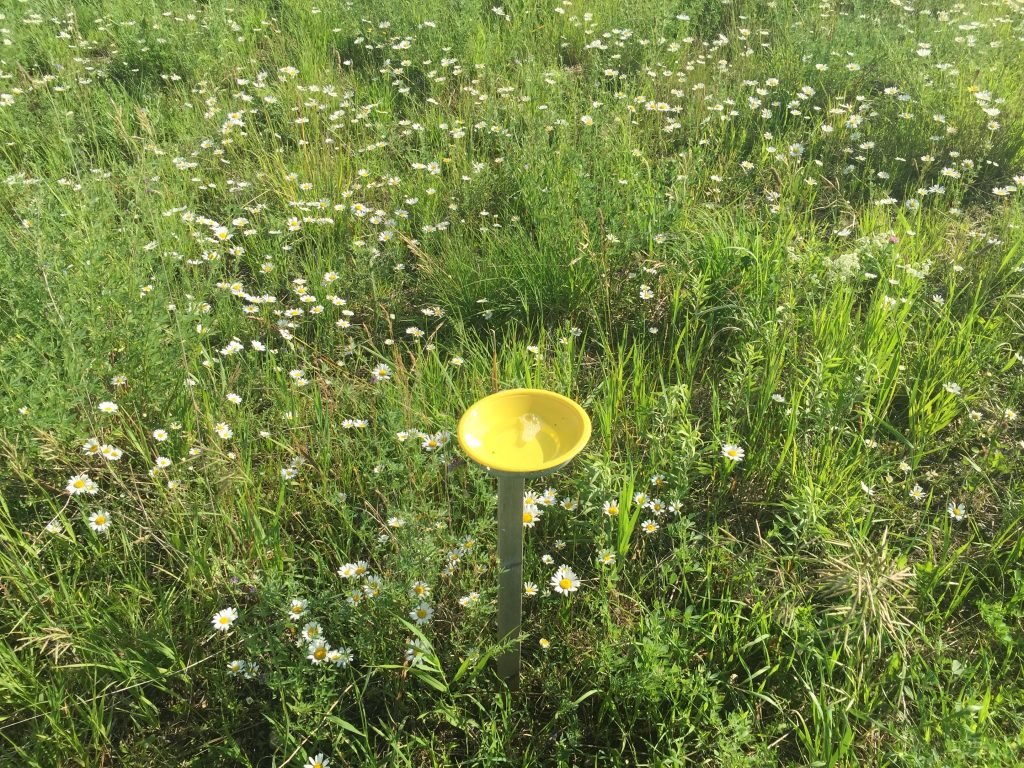
Pollinators on Roadsides project was to collect bees using yellow pan traps and
to take into account the burn history of the collection sites. We investigated
the burn history of the collection sites to compare the bee collections from
the last three years and determine if there is a relationship between burning
and pollinator community composition. Thanks to local government records,
inquiry with private land owners, and observation of recent burn evidence we discovered
which of the 38 sites had a history of prescribed burning.
In summer 2019 Shea Issendorf and John Van Kampen collected a
total of 422 bees from 38 yellow pan traps placed six times throughout the
field season (June 28, July 11, July 18, July 31, August 8 and August 19). Trap
locations include different land types such as agriculture, restored prairie
and developed land. We determined the burn history of the trap locations in the
last three years (2019, 2018 and 2017,) and whether the burns occurred in the
spring, fall or both. We stored the bees in in vials of ethanol in freezers
until they were pinned by Shea Issendorf and Mike Humphrey. We found that a
lunchbox with ice packs could comfortably hold all the vials from a collection
date for transportation from the field to the CBG.
The design and goal of this experiment is based on the original 2004 experiment by Wagenius and Lyon. They studied the relationship between characteristics of land and the abundance and diversity of pollinators. Using the data that came out of 2004, the reboot in 2017, and the continuation throughout 2018 and 2019, we observe how pollinator abundance and diversity has changed. With this valuable evidence of declining native pollinator communities, there is opportunity to change the way in which natural lands are used and how surrounding lands are treated (such as through burning, herbicide application and fragmentation).
Yellow pan traps resemble the yellow flowers of the Asteraceae family that native bees are attracted to.
Start Year: 2004, rebooted 2017
Location: Roadsides/ditches
around Solem Township. GPS coordinates for each trap are in a Google Map which
Stuart Wagenius can share as needed.
Data/Materials
Collected: 386 bee specimens collected; currently dried, pinned and stored
at the Chicago Botanic Garden. Specimens
will be classified by Mike Humphrey before being sent to the University of
Minnesota for further identification
Land uses/7 traps that have burn history
within last 3 years:
~Dropbox\teamEchinacea2019\sheaIssendorf\YPT 2019 Si\YPT
trap land uses 1.xlsx
Other files associated with the project can be found in the
folder
~Dropbox\ypt2004in2017\YPT2019
Team Members involved with this project: Shea Issendorf (2019), Mike Humphrey (2018-2019), John Van Kampen (2018-2019), Kristen Manion (2017-2018), Evan Jackson (2018), Alex Hajek (2017), and Steph Pimm Lyon (2004)
You can read more about pollinators on roadsides, as well as links to prior flog entries mentioning the experiment, on the background page for this experiment.
In the fall of 2018, the Echinacea Project scientists came to West Central Area Schools (WCA) and mapped out twelve plots to transplant E. angustifolia into the following summer. The WCA Environmental Learning Center has 35 acres of restored prairie, making it a perfect place to plant experimental plot 10. During the summer of 2019, Team Echinacea planted over 1400 E. angustifolia seedlings into the 12 subplots. Three plantings were performed: the first was a planting organized by Michael and had offspring from exPt1, the second consisted of plants from Amy W’s gene flow experiment, and the third planting had offspring from the Big Event. All plants originate from Grant or Douglas County, MN. To test how different fire regimes affect fitness in Echinacea, folks from West Central Area will apply a fall burn treatment to four plots, a spring burn treatment to four other plots, and the remaining four plots will not be burned.
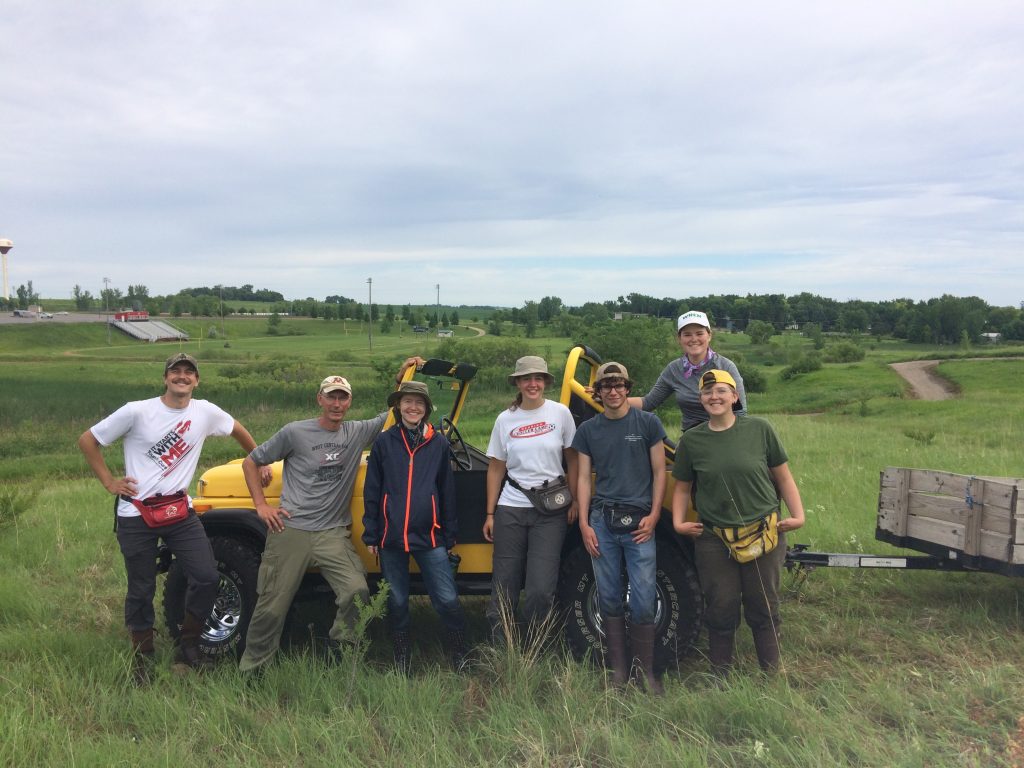
The team after planting the original cohort of Echinacea in experimental plot 10. It was a long day!
During science classes with John VanKempen, WCA high school students will assess the effects of differential burning regimes on the fitness of E. angustifolia. For the first time this fall, juniors in VanKempen’s classes used data they collected on plants to answer their own scientific inquiries. Students developed hypotheses, then measured various morphological traits on surviving Echinacea in the 12 plots. The students used the data they collected to create graphs based on their data. VanKempen plans to continually integrate these Echinacea experimental plots into his classroom lessons and hopes other teachers at WCA will utilize the experimental plots for student science projects.
Start
year: 2018
Location: West Central Area High School’s Environmental Learning Center, Barrett, MN.
Data collected: Planting and survival data for seedlings planted in summer 2019. GPS points taken for plots. Planting data is available in the Echinacea Project ~Dropbox/CGData/195_plant/. Contact John VanKempen for survival data taken by his students. GPS points are available here: ~Dropbox\geospatialDataBackup2019\planting2019\nailStakeWCA.csv
Products: High School Posters. Contact John
VanKempen for info.
Echinacea angustifolia is the only species of Echinacea native to Minnesota, but it is not the only Echinacea species that currently inhabits MN. In the Echinacea Project study area, there are actually three different Echinacea species: E. angustifolia, E. pallida, and E. purpurea. Both non-native species were introduced in restorations from seed that was not locally sourced. We know that non-natives hybridize with our native Echinacea, and we fear that introgression with hybrids may result in genetic swamping of E. angustifolia. We want to learn as much as we can about similarities and differences between Echinacea species in MN so we can assess the threat level of non-native Echinacea in Solem Township and take the proper steps to alleviate the potential threat.
There have been reports that ploidy level varies among Echinacea species (McGregor 1968; McKeown 1999). Specifically, E. pallida is reportedly tetraploid (4n) throughout most of its range, while E. angustifolia and E. purpurea are diploid (2n). There are also reports of E. angustifolia in Oklahoma and Texas being tetraploid (this is a different variety of E. angustifolia from the one we study). Nonetheless, we are interested in the ploidy of Echinacea in MN because it affects whether hybrids are able to reproduce. If a diploid mates with a tetraploid, it produces triploid (3n) offspring; triploids are generally not fertile. Thus, ploidy of non-natives greatly affects the ability of non-native Echinacea to genetically swamp E. angustifolia by creating fertile hybrids.
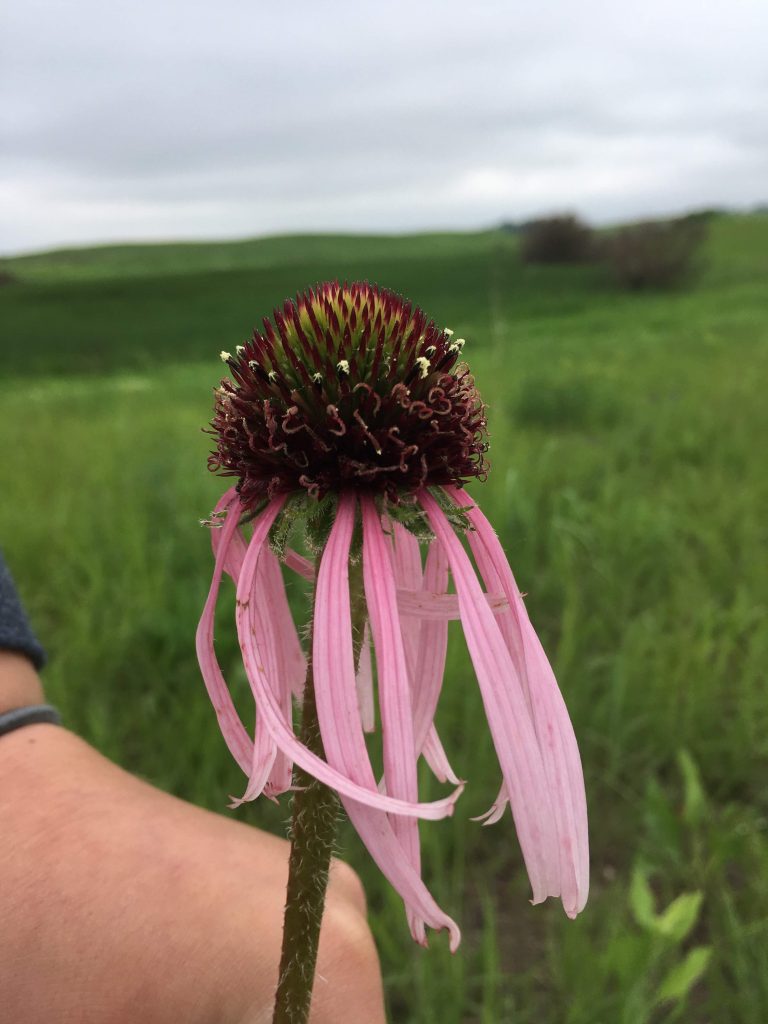
E. pallida head – the flowering heads are distinguishable by pollen color and ray floret color/length.
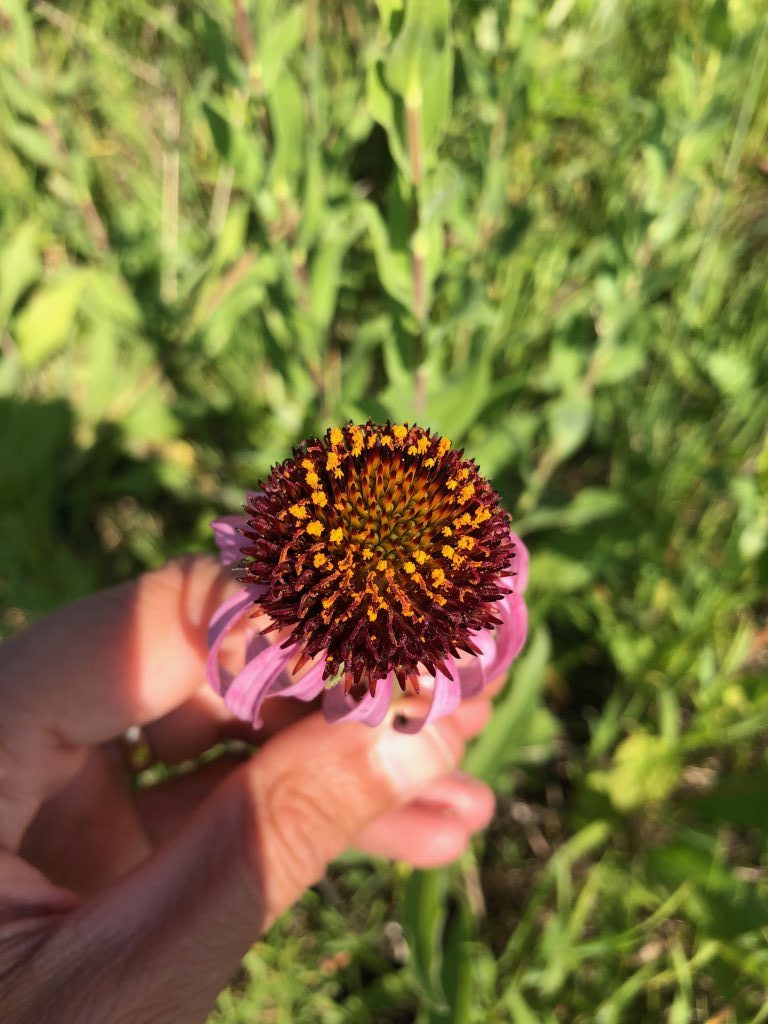
E. angustifolia head
To investigate ploidy differences between Echinacea species in Minnesota, we will collect and dry tissue from the three different Echinacea species and their hybrids and assess relative genome size using a flow cytometer at the Chicago Botanic Garden. We will also assess relative genome size in seedlings grown from seeds sourced from various latitudes in our species’ ranges to see if the individual species vary in ploidy level throughout their range.
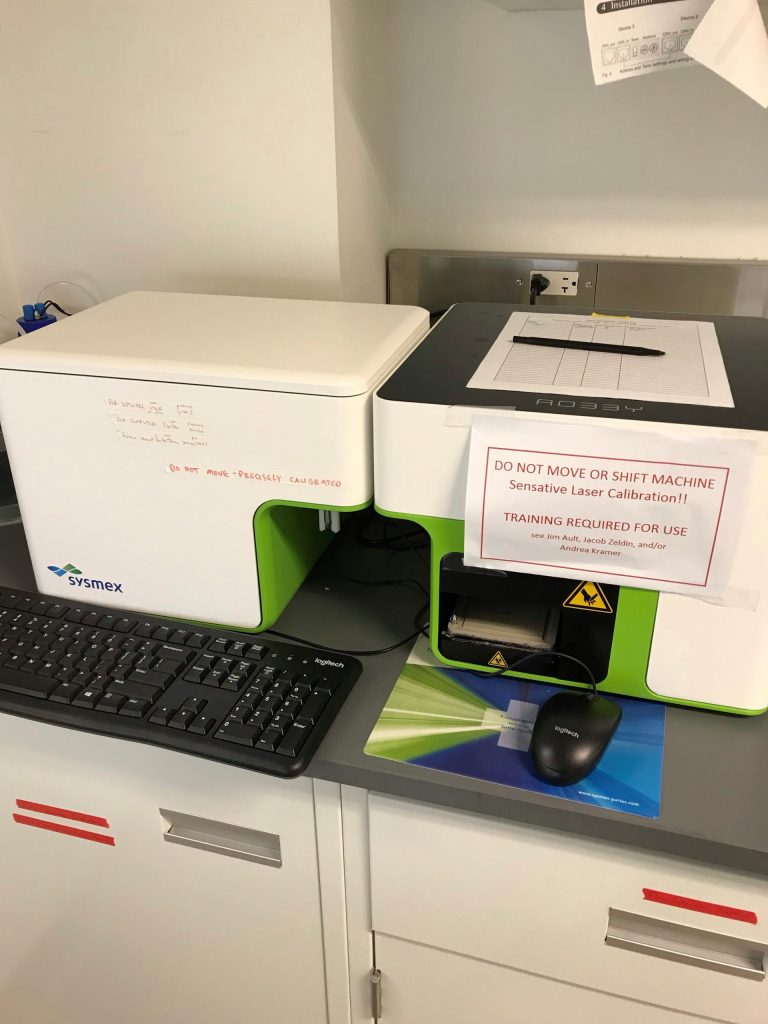
This is the flow cytometer – the machine used to assess relative genome size at the CBG.
My name is Anna Stehlik and I am participating in a short-term internship at the Chicago Botanic Garden during my school’s winter term this January. I am a senior at DePauw University studying environmental biology and am a part of the Environmental Fellows Program which is an environmentally- an sustainability-based honors program. I am also involved with the Sustainability Leadership Program and have been a campus farm intern for the past several years. On the campus farm, I have helped to establish a bee hive and deliver pollinator education programs to local school groups. I first became interested in pollinator health and habitat when my family began beekeeping about seven years ago and I focused my Girl Scout Gold Award project on creating a honey bee education program. I am also an avid hiker and spend my summers working at a backpacking ranch in the mountains of New Mexico. This past summer at the ranch, I had the opportunity to teach about the plants and wildlife in the area as well as the history of wildlife conservation.
My passion for the outdoors has driven me to pursue an education and career in environmental biology and conservation. I am very excited to explore the work done in the conservation lab here at the Chicago Botanic Garden. On my first day, I have learned about the fragmentation of prairie habitat and the work done here to learn how purple coneflower is affected. So far, I have been able to clean and process Echinacea flower heads to remove the achenes, and have also gotten to count achenes on scanned images.
On 21 Dec 2019 demap was updated to accept 2019 demography and survey records. In 2019 we took 4031 visor records in demo and 1413 GPS points in surv. The updated infiles are located in ~Dropbox\demapSupplements\demapInputFiles. Demo and surv have not yet been reconciled.
2019 should be the last year we use a GRS-1 machine, as Chekov is set to be decommissioned this spring. Thanks, Chekov! He was truly a key player while Darwin was in surgery for his busted receiver.