|
|
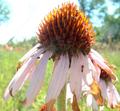
Here are some clarifications about how mfl and immfl should be filled in for heads in and past the flowering stage. Selecting status “Flowering” means that the last day of flowering is certainly 4 days away or longer. If the last day of flowering is 3 or fewer days away, then select “End of flowering.”
Status
Flowering It is not necessary to fill in mfl, ffl, or immfl. (mfl and Immfl are presumed to be well over 11).
End of flowering Fill in mfl and immfl! (Both may 11.)
Last day of flowering Fill in mfl and immfl! (immfl should be zero.)
Done flowering Fill in mfl and immfl! (mfl & immfl should be zero.)
Note 1: When the action is xxxx, then fill in a status (usually: flowering, end of flowering or done).
Note 2: When status is “Flowering,” “End of flowering,” “Last day of flowering”, or “Done flowering” then don’t fill in ffl!

Team Echinacea:
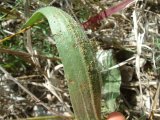
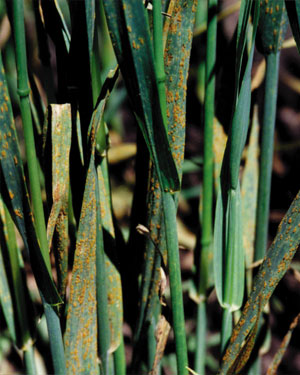
A grad student, Emme Bruns, from UMN is studying crown rust. She has been noticing heavy infections of rust on some of the Bromus and Elytrigia (Agropyron) grasses around the twin cities and was wondering if similar infections are occurring up here.
Have you seen anything that looks like a rust pathogen on either of these species?
 
If the pathogen is present, she would like to visit to survey disease incidence and collect isolates.
Let me know if you see anything like this–and make a mental note or note in your visor where you see it.
Thanks!
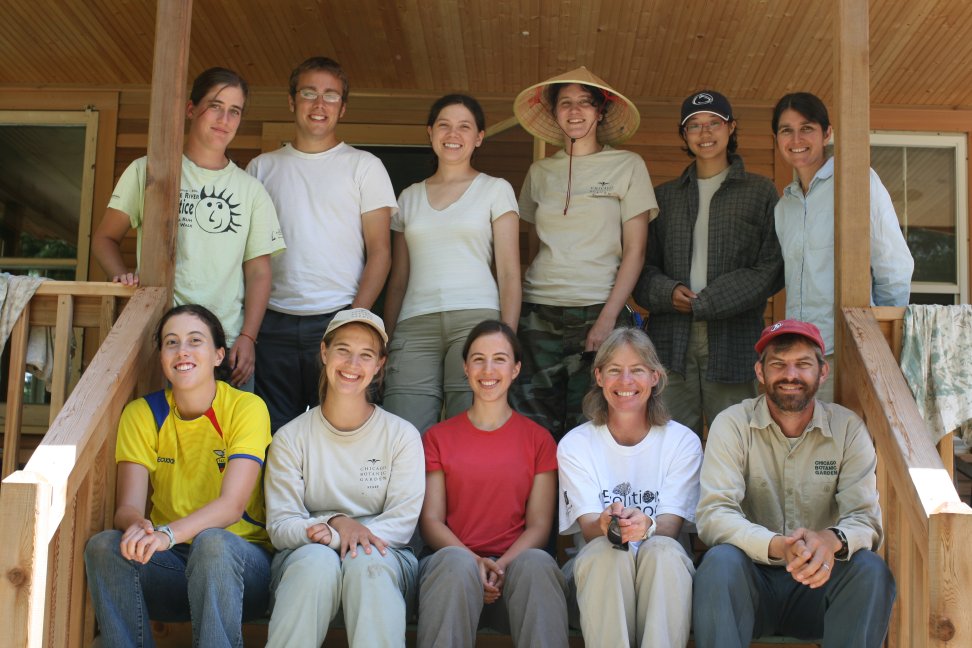
Today marks the halfway point for the summer. Five weeks down, five to go. We’ve accomplished a lot and much more remains. After a long afternoon of measuring plants, we had some watermelon and carbonated beverages to cool off, mark the 1/2way, and wish the Chicagoans well.
Three of our team members are leaving tomorrow for Chicago (Jennifer, Lani & Denise). They will keep us posted about the analysis of the bee-tracking field data and how it relates to their pollen flow study.
Here’s a photo of us on the porch of the Hjelm house today, just after lunch.

Lecia, Ben, Megan, Christine, Denise & Gretel
Julie, Jennifer, Lani. Amy & Stuart.
It was an exciting day on the prairie. After a soaking morning rain, it felt hot and steamy. Just before noon the plants started flaunting their pollen and the bees took advantage. There was plant sex and bee sex and Team Echinacea jumped into the fray trying to keep up with the frenzied activity. Every team-member broke a sweat trying to keep up with all the bees. It was a crazy scene and the excitement in the air was palpable. The bees eventually outmaneuvered and outlasted us, but we had a great time. We left around 12:50 looking forward to another exciting day.

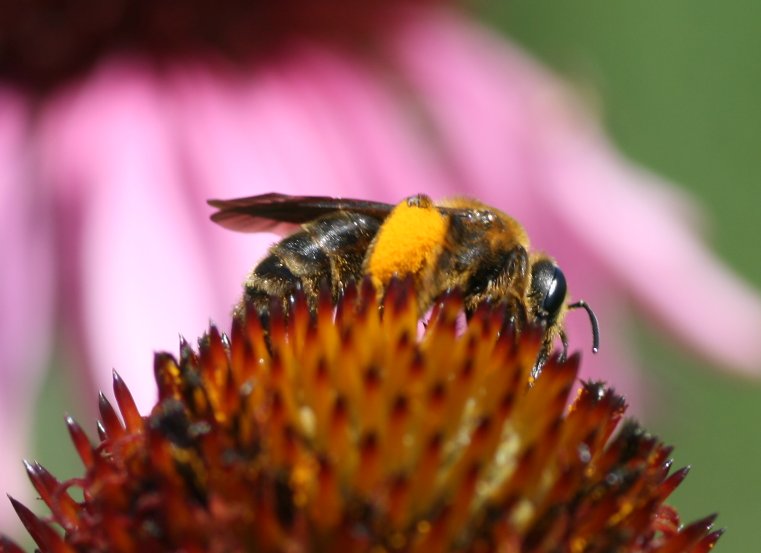
Unlike most of the shy bees, this rascal loved the cameras. She gave quite a show flying from head to head, daring us to follow. We caught her here spreading pollen all over her legs.
I just posted photos of prairie insect specimens from our collection, including many bees that pollinate Echinacea. Enjoy!
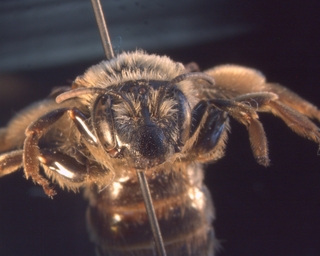
Here’s a photo of a specimen of Andrena rudbeckiae (Female). Click to enlarge.

So, there is a lot more to do to improve the web interface to these photos. Let me know your suggestions!
The pages are static html right now. Bianca, CBG science web design hero, made a dynamic version using MySQL and PHP. Her way is the way to go. However we don’t have a good permanent home for a MySQL database: UMN won’t allow phpMyAdmin, Bianca’s software of choice. And CBG doesn’t really support websites for scientists (yet).
More photos will follow and we’ll post more info for each specimen too. I hope to make these update when we have a dynamic, public site, but wanted to get something out now because I am submitting a paper that refers to these specimens.
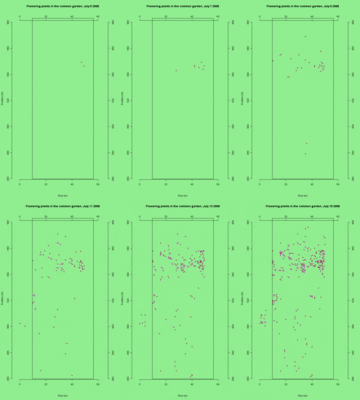
This animated GIF file is a map of all plants that flowered in the CG on each day from July 5 to July 15th. Each dot represents a plants that’s flowering on the day (see upper right corner).
 Click on the thumbnail to see a full-sized image. Click on the thumbnail to see a full-sized image.
 This legend shows plants with 3, 1, and 2 heads flowering (left to right). This legend shows plants with 3, 1, and 2 heads flowering (left to right).
We had a busy day today. Reinforcements arrived to help on all of our projects. Ruth Shaw (U of MN) helped with phenology, bee tracking, PX caging, collecting pollen and crossing. Elliott Graham (Madison, WI) helped with bee tracking and PX caging. Jack Kiefer (Wadsworth, IL) is leading the plumbing initiatives and made progress on several fronts including connecting the main water line to the Hjelm house!
Great forward progress on a sultry day. Well, in late afternoon it was still with air temp of 85 degrees F and a dewpoint of 57 degrees F.
Thanks to all for a great day!
Less than 10% of the heads that we think will flower this season had started flowering as of Sunday. Flowering is so late this year! We’ll walk through the Garden systematically tomorrow (Tuesday) to see what’s new. It’s possible one head (49.33 946.33 grn) will be done flowering tomorrow.
There’s always something new and exciting going on when Team Echinacea is in full swing. After we all pitch in to assess flowering phenology tomorrow, Amy will work on her large-scale crossing experiment that requires erecting pollinator exclusion cages, collecting pollen & hand crossing. The fun doesn’t end there. We are tiling and plumbing the Hjelm House, photographing floral development on Echinacea heads, measuring plants at the Hegg Lake CG and the main CG, taking ladder-high aerial photography of flowering plants in the prairie remnants, and chasing bee pollinators in the CG. And that’s just tomorrow!
We are very interesting in observing (and participating in) the Echinacea mating season this summer. We are still waiting for the action to begin.
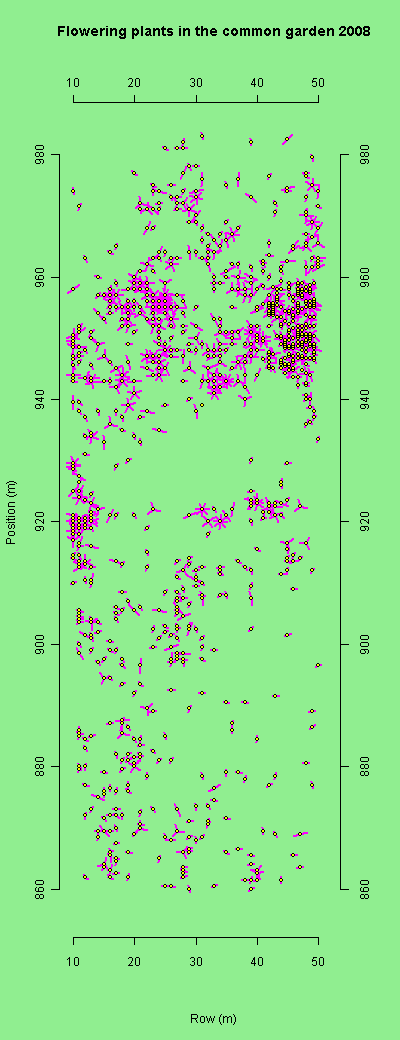
Here is a map of the flowering plants in the main garden. Each dot represents a plant with 1 or more buds (immature capitula). The short purple bar indicates a plant with one bud, a long bar indicates two, and n short bars indicates n buds. In the main garden we found 869 plants with at least one bud and a total of 1572 buds. The most buds on a plant is 11. This is a modified “sunflower plot” that was generated with R.

We are waiting for the action to begin. At this time last year, like most years, Echinacea flowering was in full swing.
We are prepared for the flowering to begin. We flagged all positions evenly divisible by 5. We mowed paths between rows so we can avoid stepping on plants. We have flagged every flowering plant. Note: don’t buy fluorescent colored pin flags. The flags tend to detach from the more frequently than non-fluorescent colors. What’s up, Forestry Suppliers? We weeded thistles and sweet clover, trapped gophers, found plants with Aster yellows, and are waiting for the action to begin.
This flog entry from last year proved valuable. I just looked it up and followed the common garden maintenance protocol.
|
|



 This legend shows plants with 3, 1, and 2 heads flowering (left to right).