|
|

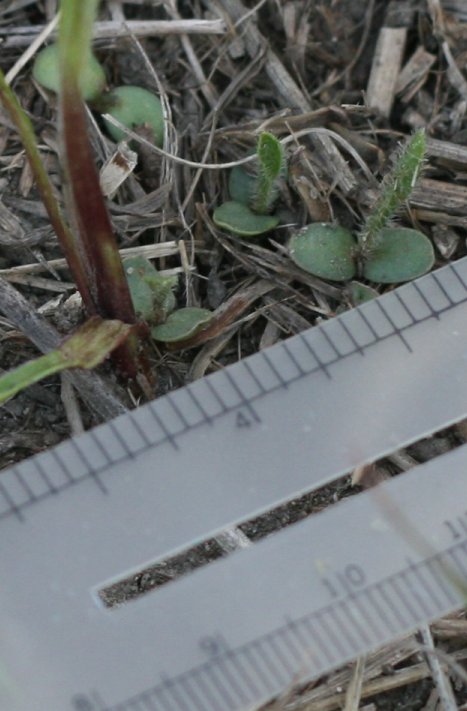
This photo by Christine shows fours seedlings near Echinacea plant 2044 at StApp on 17 June 2008. The seedlings are mapped & uniquely identified on pages 56 & 56 of “Seedling search 2008.” The ruler is marked with 16th of inches on the top and millimeters on the bottom.
Today we finished searching for seedlings for the season. We searched near about 200 plants that flowered last year in 15 sites. We found about 239 seedlings. We made maps so that we can refind all the seedlings in August–at least those that survive. In August we will make sure we can find the seedlings again next year so we will be able to follow this cohort for several years to determine their survival, growth, and eventual reproduction.
Searching for seedling is fun, but we are ready to move on to other exciting developments!

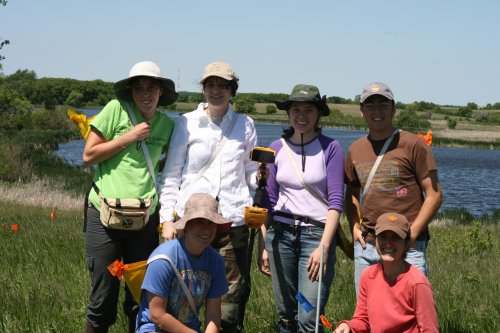
Here’s a photo of the crew from the first day of the summer (Julie, Christine, Megan, Ben, Lecia & Gretel). Echinacea hasn’t started flowering in our Common Garden yet, but it will soon. We are ready! Reinforcements from Illinois will start work tomorrow.
We’ve been working for two weeks now and we have accomplished a lot already:
searched for seedlings in remnants
mowed, weeded, and flagged the common garden
searched for juvenile plants in the “recruit” experiment
discussed and planned our group and independent projects for the summer
It’s hard to believe how much we’ve done already (and how few flog entries I’ve posted).
Here’s a list of ideas for independent or group projects that we discussed today.
1. Improve procedure for mapping seedlings in remnants.
2. Investigate new aphid biology: distribution, behavior, ant associates, et cetera.
3. Investigate biology and behavior of native bees:
flight distances in CG
find nests
pollination behavior Echinacea in CG
generalization/specialization
distribution with next boxes
bumblebee species
4. Do “Time lapse” photography of Echinacea heads to visualize floral development.
5. Pollen collection from plants to develop identification key (with pollen collection from bees to assess generalization/specialization.
6. Quantify plant species richness in remnants, experimental plots, local preserves.
7. Map distribution of Echinacea‘s co flowering species (Thistles, sweet clover, Coreopsis)
Kite or pole aerial photography
8. Collect seed of Stipa spartea or Dalea purpurea for common garden study.
9. There are many more possibilities…
Here’s an update on the main research activities this spring. The cool spring with a late snow (~15 inches -38 cm- at the end of April) delayed burning weather somewhat and we think seedling recruitment may be later than in the past few years.
Recruitment/Establishment Experiment
On May 9 I mowed burn breaks so the DNR burn crew could burn the plots. They burned the middle unit at Hegg Lake WMA on May 28. Two plots were in this unit. Here’s a photo of one plot just after the burn. Nice work! There are 3 plots to be burned at Hegg Lake WMA, two at Kensington Duck Refuge, and one a Eng Lake WMA. At the duck refuge I saw 2 Sandhill cranes and a Red-necked grebe (among the regular, awesome array of water birds).
Common Garden
Dwight, Jean, and I burned the common garden on May 22, starting just after noon. The weather was within prescription, but the wind was a bit strong and the fire jumped the gravel road and started some corn stubble. The fire worked its way to some reed canary grass and we managed to put it out there. If it had gone a little longer it would have torched the cattails and burned the whole slough west of the common garden. Whew!
The running fire was great in the 99S garden, but there were quite a few unburned spots in the main garden. We burn the CG every other year and we mow paths annually, so we don’t have quite enough fuel for really complete burns. Maybe in 2010 we should augment the fuel load with some prairie hay.
A big tree just east of the CG caught on fire. It was hollow, but quite strong. It finally broke and fell over around 7 pm. To put it out we scraped all the embers and coal from the trunk with an axe and shovel. We couldn’t reach a spot of punky wood 8 – 9 feet (2.5 m) off the ground. So I climbed up the trunk and used a 5 lb. pick mattock to scrape out the embers and punky wood. Then Dwight lifted the smith Indian backpack sprayer over his head and I sprayed and sprayed and sprayed. We put it out by around 10 pm. Exciting! We need to cut up the part of the tree that fell on the CG.
An adult bald eagle flew over the CG just as we started to burn and then again around 8 pm — great!
On 24 May, Gretel and I broadcast seed over the CG. We seeded Galium boreale, Bouteloua curtipendula, and Schizacharium scoparium. Gretel, Per, and I seeded the ditch with many species of seed, including Stipa spartea and Spartina pectinata. We forgot to seed the 99S garden.
Seedling Search
On 27 & 28 May Ruth, Amy, Julie, and I searched for Echinacea seedlings in five remnant prairies. We searched about 75 circles with 41 or 50 cm radius and found 17 seedlings. Several had only cotyledons and the tallest first leaf was 24 mm. We got rained out yesterday (29 May). It was also cold and windy.
Hjelm house
Last weekend Pete, Dwight, Gretel, and Stuart cleaned out all the sheetrock and insulation (yuck) in the house. That was a job. We got the house all ready to have the floors sanded. We have a lot left to do to get the house ready for the main field season. The highest priorities are bathroom and computer network.
I just found out that there is video footage of the house being moved on YouTube.
Here are the 3 links:
part 1
part 2
part 3
Enjoy!
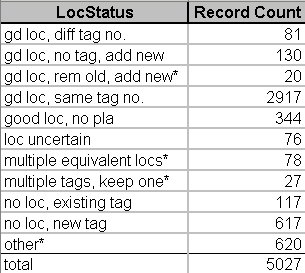
Here’s a quick tally of the demography data that we took in the natural remnants this summer. I think we did a lot! We took a total of 5027 records. Here they are broken down by loc status…

This is just the first rough pass through the dataset. There is a lot of clean-up to do and mysteries to figure out. For example, of the 81 “good loc, diff tag no” records, 12 have no loc and 1 has no tag (gulp).
Flowering rates seemed to be high this year. 1700 records list one or more normal flowering heads and another 223 records had only non-normal heads. There were some big plants too: two plants had 11 flowering heads and two had ten! The greatest number of rosettes was 47 (that’s good ol’ plant #1540 at NGC.) We counted 9276 total rosettes.
The summer field season is done for me. We drove back to Illinois on Saturday. I’ll try to post reviews of the datasets occasionally and maybe some photos too.
Jennifer is the only one still in the field. She is harvesting seedheads today & tomorrow, then returning to IL.
Today was the last day of a great field season. We finished the the demography census of flowering plants. We surveyed all sites that needed it. We refound the last of the seedlings that we mapped this spring. And we organized our gear and put it away.
Here’s a photo of Ian, Rachel, and Amy sorting flags…

The heavy equipment in the photo was used to fill in the 2m deep trench that ran through the yard and driveway for the past few days. In the past few weeks, moving the new “storage shed”/office and the associated construction and landscaping has introduced additional chaos into our fun-filled field activities!
I’m heading back to IL tomorrow (oops, Saturday is already today). I’ll keep you posted with summaries of datasets as they come out and I hope to add some more photos to the flog. It’s been a great summer. Thanks to everyone for all your great work!
Here’s a map (pdf format) of plants in the common garden. A purple asterisk indicates a plant that flowered this year. The size of the asterisk is proportional to the number of heads produced. Download file
We harvested a lot of heads today & yesterday. It’s early for us to be harvesting.
The most recent Echinacea project paper was recently published in Biometrika. I posted the pdf reprint on the Echinacea resources webpage. Here’s the citation:
Geyer, C., S. Wagenius, and R.G. Shaw. 2007. Aster models for life history analysis. Biometrika 94: 415-426; doi:10.1093/biomet/asm030.
You can find all the Echinacea project papers on the resource page. For convenience here are direct links to three key papers about pollination:
Wagenius, S., E. Lonsdorf, and C. Neuhauser. 2007. Patch aging and the S-Allee effect: breeding system effects on the demographic response of plants to habitat fragmentation. American Naturalist 169:383-397.
Wagenius, S. 2006. Scale dependence of reproductive failure in fragmented Echinacea populations. Ecology 87:931-941.
Wagenius, S. 2004. Style persistence, pollen limitation, and seed set in the common prairie plant Echinacea angustifolia (Asteraceae). International Journal of Plant Sciences 165:595-603.
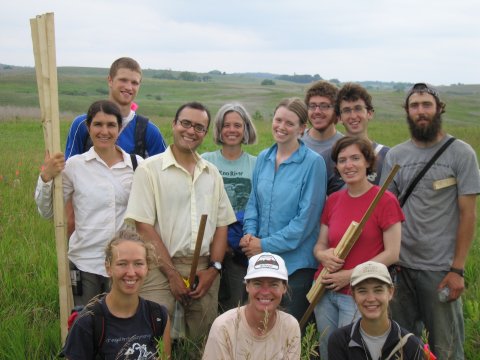
Here’s a photo of the measurers and datatakers at the Hegg Lake common Garden on July 26th.

(L to R) Kneeling: Amy, Amy, Jennifer. Standing: Gretel, Ian, Andy, Ruth, Julie, Josh, Rachel, Colin, Jameson. Photo by Stuart–he measured too.
The weather for measuring turned out to be much nicer than predicted: Temp 85 degrees F; dewpoint: 70 degrees F; mostly cloudy with a W wind at 13 mph. It started raining, so we packed up to leave. As we were walking out the rain stopped, so we paused to take this photo. After the photo, it started to rain again.
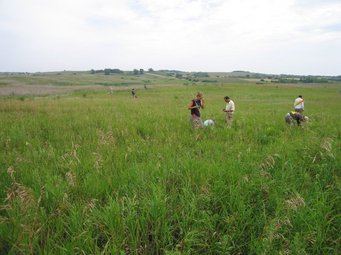
We measured plants efficiently. Most plants have two leaves and the longest is 8-19 cm tall. It can be very difficult to find a plant because the thick grass is about 50 cm high. The only way to find it is to measure from another Echinacea plant. The ~4000 plants are spaced on 1m apart on a 80m x 50m grid. That can seem like a vast distance between plants. Jennifer made measuring sticks 2 meters long to help us stay on line and find the plants. After finding two plants you could keep on line fairly well and go fast. If there was a missing plant or a particularly sneaky plant, then it was very easy to get disoriented. Some folks worked in pairs (one measuring, one taking data); others solo. Here’s a photos of folks at work…

|
|