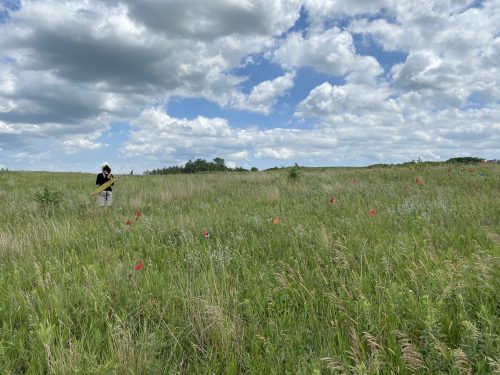
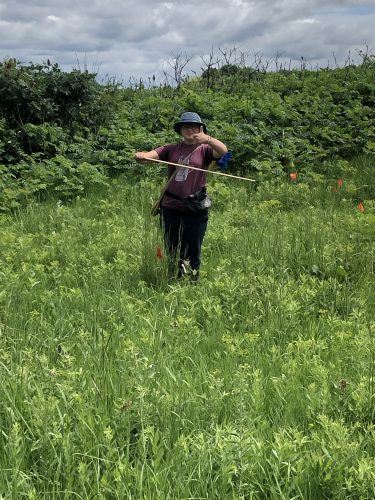
This week we began gearing up for staked demo, where we use Darwin to search locations in the remnants where mature Echinacea have been found in the past. The team has tackled lots of flowering demo this summer, but now it’s time to take on new challenges like no tag no pl and equivloc records.
Anna M. and Emma contemplate the maps and scenery at EELR
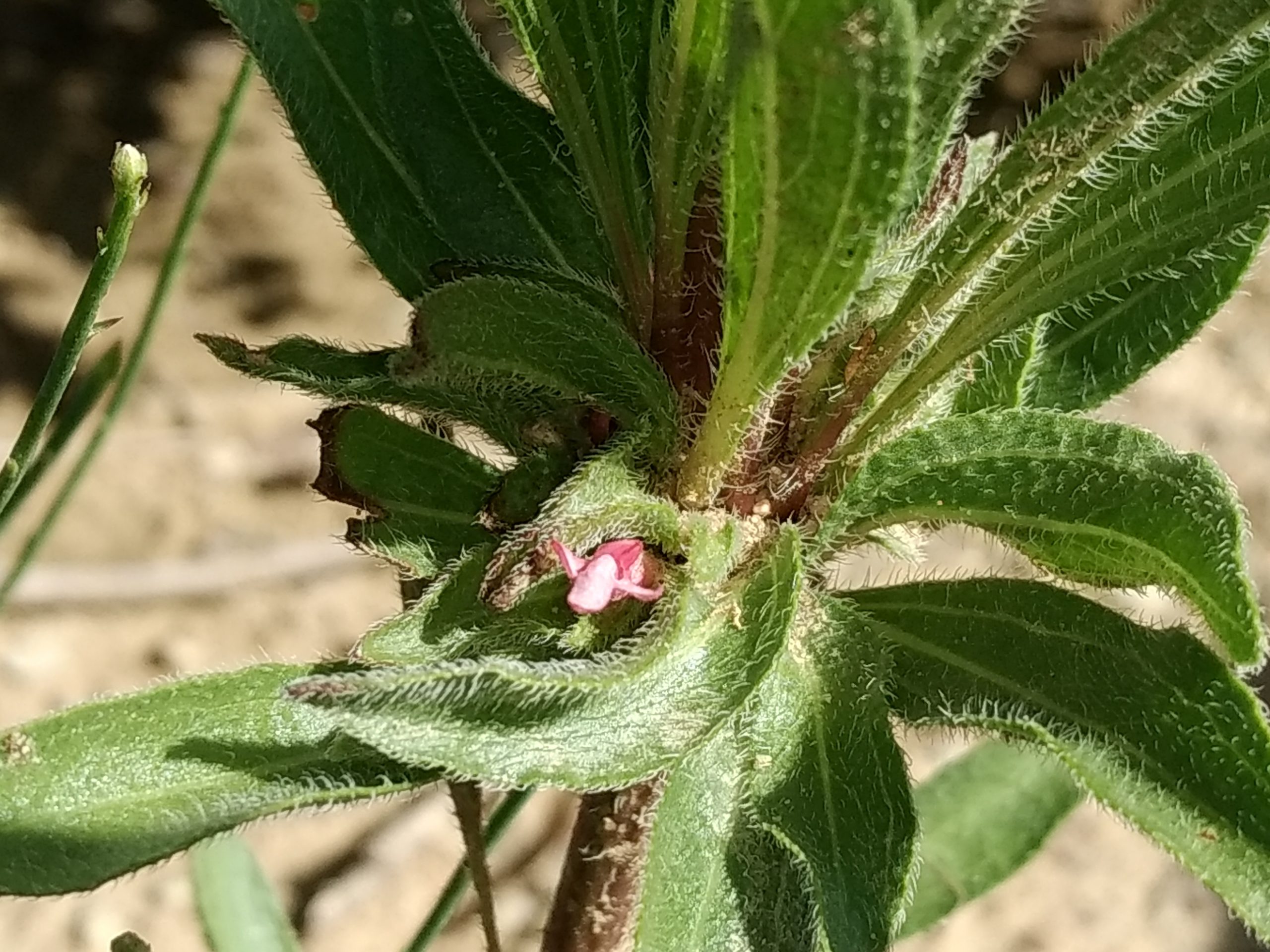
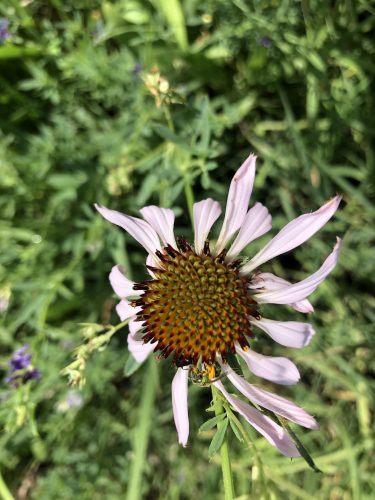
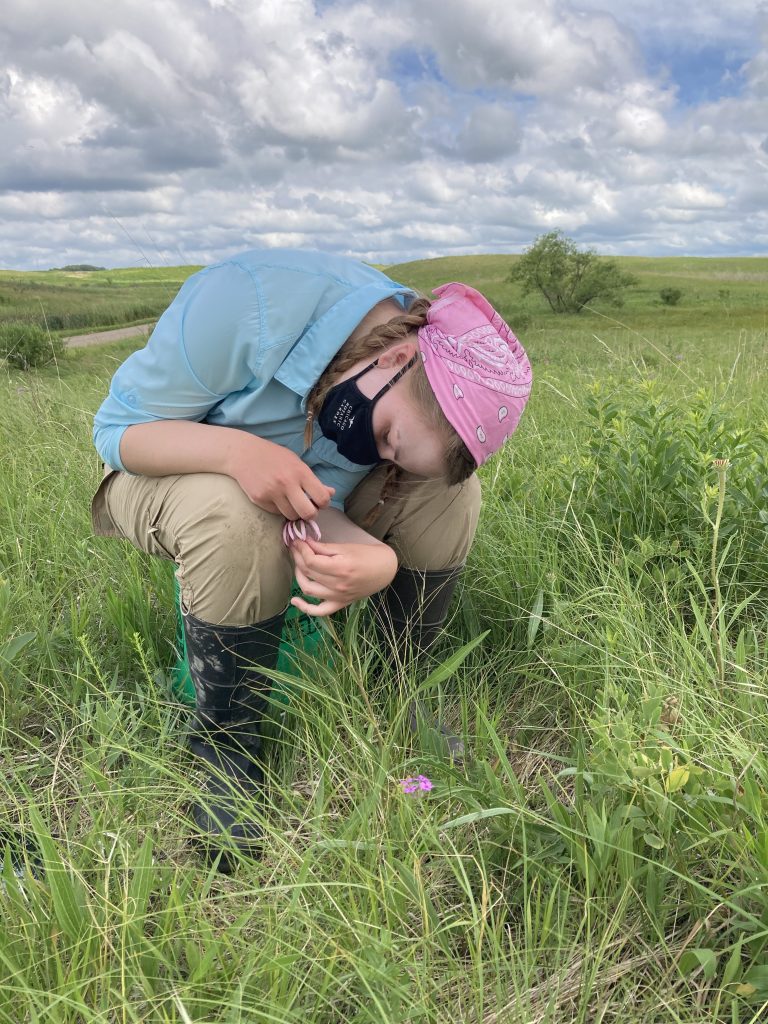
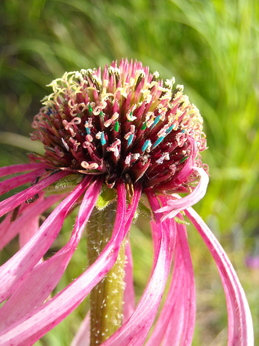
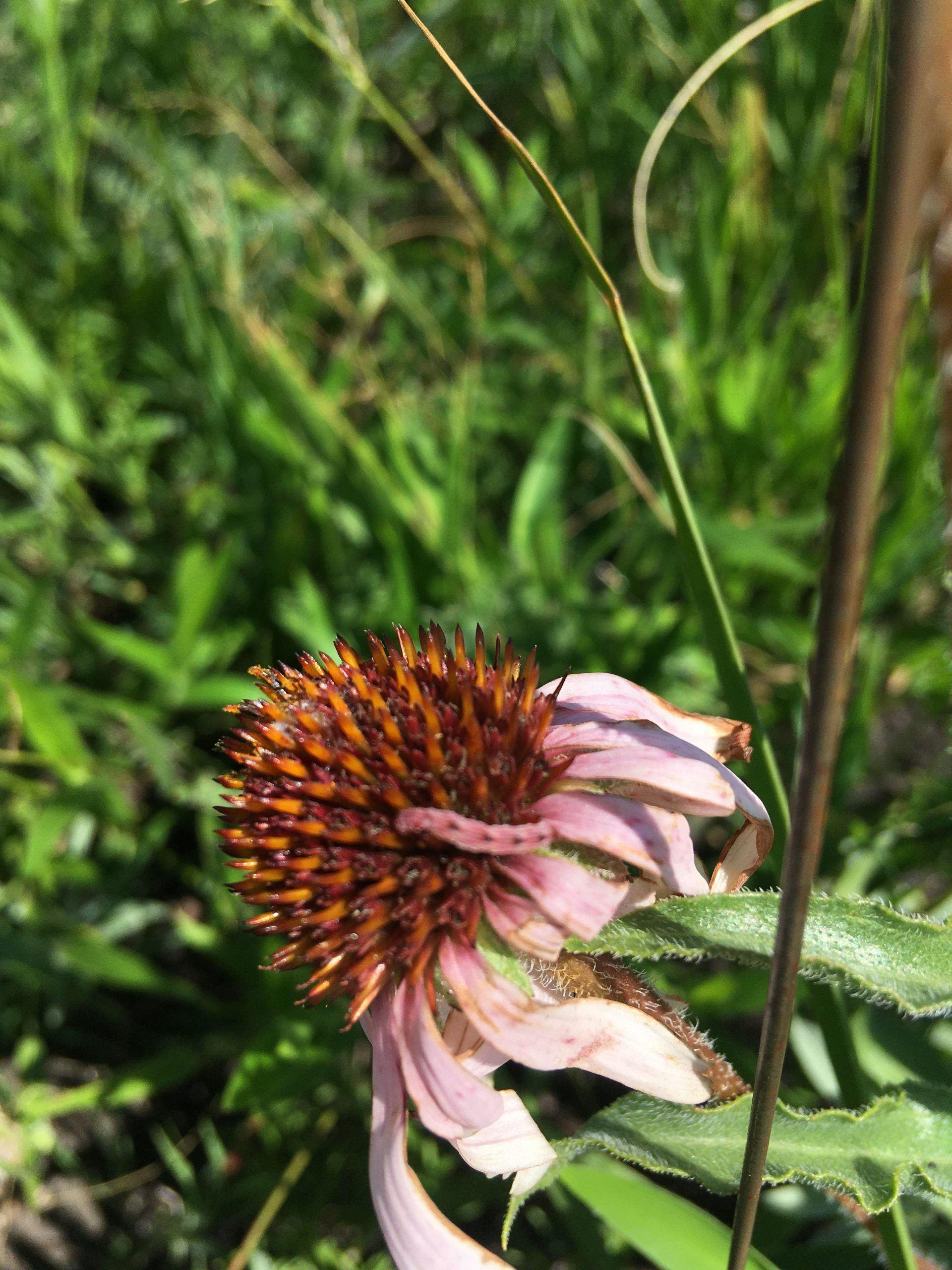
Emma and I were challenged in a different way when we found this monstrosity of a plant at South of Golf Course. It’s newly flowering this year, though we kind of wish it wasn’t, since its bushy leaves and rogue “armpit tooth” florets are uncomfortable to behold. It seems to have a cousin at Loeffler’s Corner with a similarly demented growth habit.
Fearful asymmetry
After all the lake excitement on Friday afternoon, we had a comparatively quiet Saturday. Gooseberry is in town, so Allie and I took her for a walk to the park where she drank puddles and sniffed everything within reach. In return, Goose kept me company as I worked on reconciling demap.
In the evening we enjoyed takeout from Mi Mexico and a rousing discussion of what the world would be like if society was reorganized into five sects, each with their own physical limitations, like having clams for hands or being perpetually confined to an Olive Garden. Goose did not contribute much to the discussion but did partake in some heavy belly rubbing action.
On Friday The Echinacea Project saw the end of an era. Long-time team member Riley Thoen had his last day working for the project after 3 summers spent in the field.
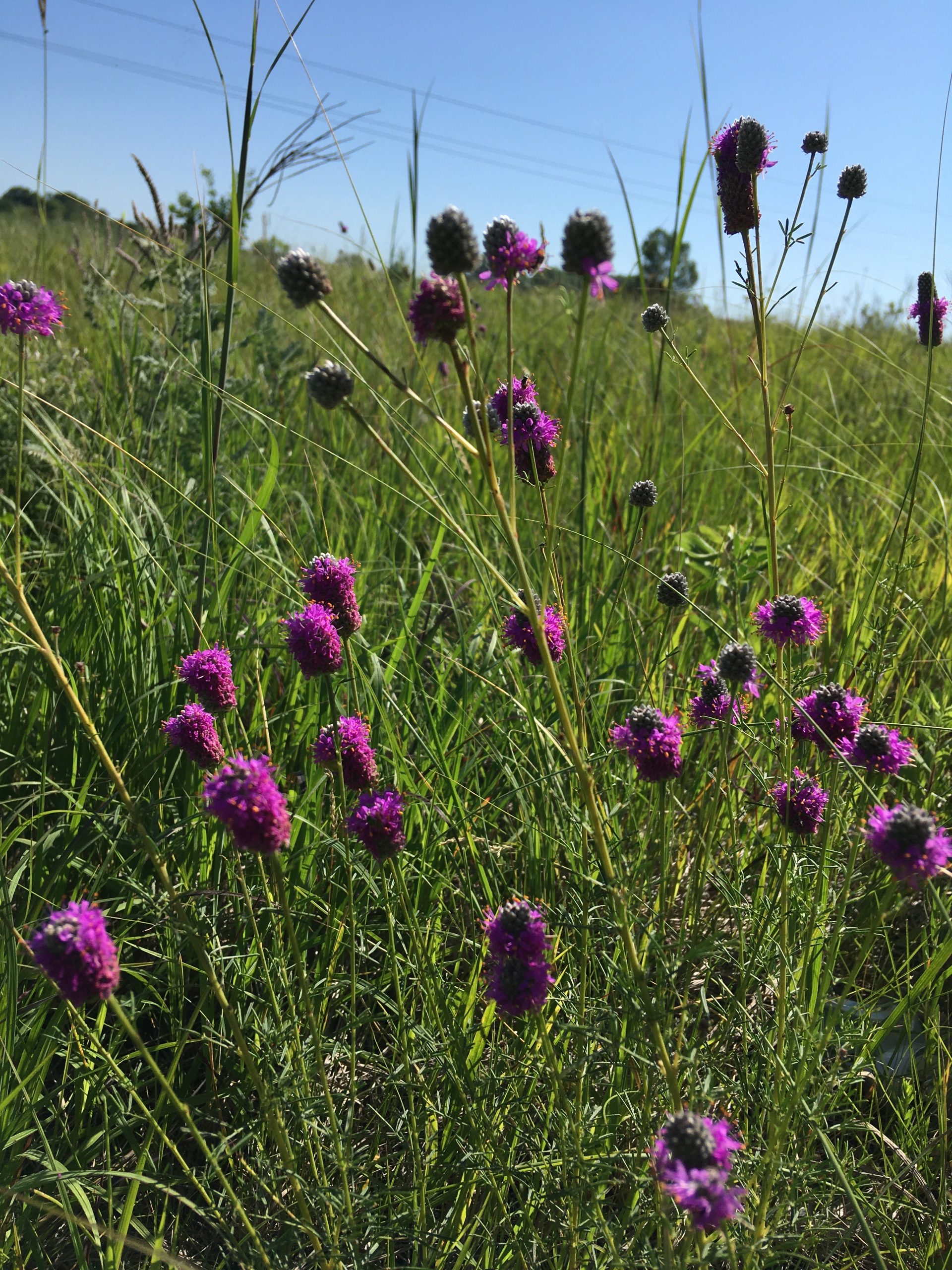
We started off the morning with phenology in the remnants, with the added goal of looking for purple prairie clover at each of our sites.
Purple prairie clover, or Dalea purpurea, at Loeffler’s Corner
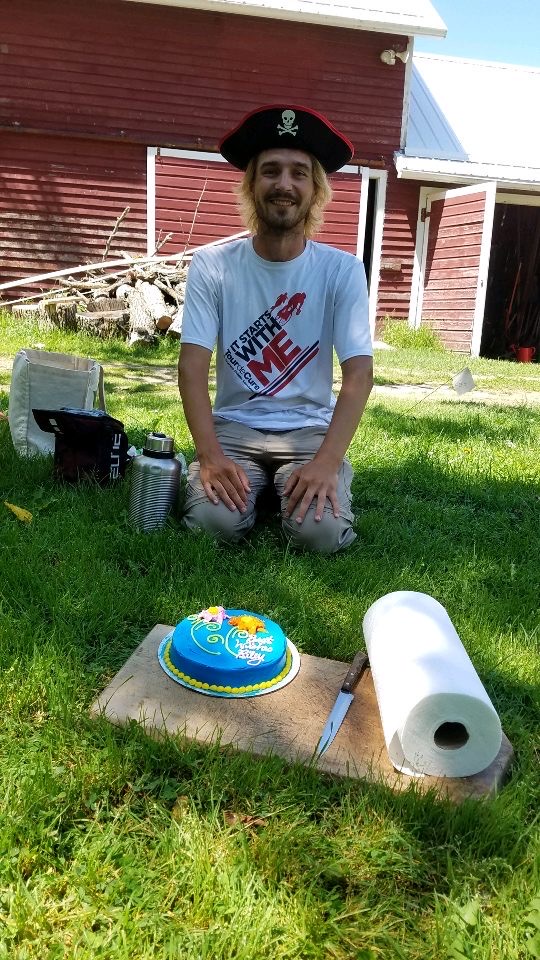
During lunch break, we celebrated Riley’s time here with some cake and an eyepatch.
Riley, featuring his cake (eye patch not pictured)
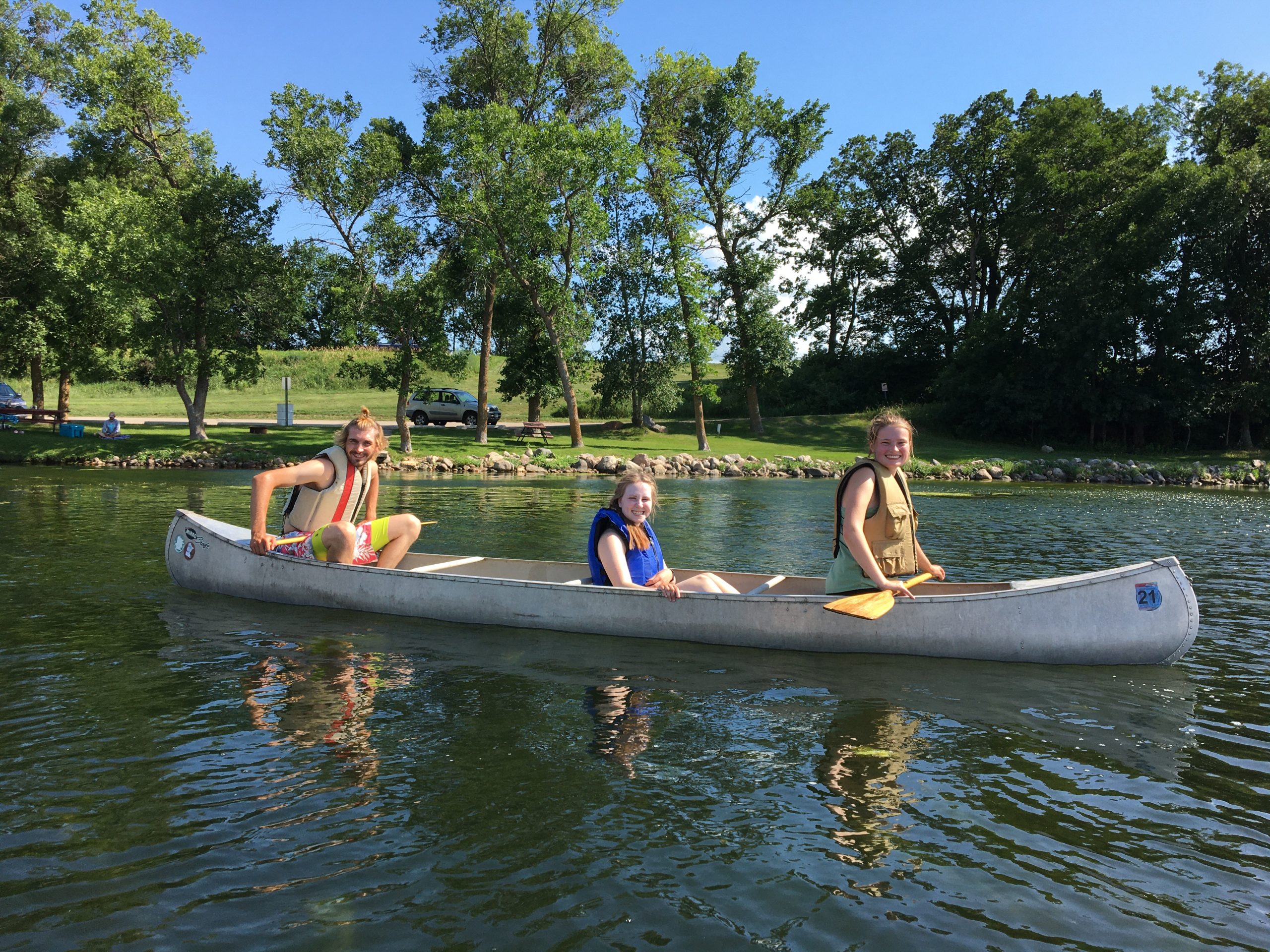
After lunch, we finished measuring all of the inbreeding 2 experiment plants and had an early end to the day. We spent some time eating ice cream bars provided by John and then headed to Elk Lake with some canoes for end-of-work-week and end-of-Riley-working-here activities.
Best wishes to Riley as he heads off to grad school!
Emma, Erin, and I enjoying some time in one of the canoesThe other canoe crew, with Riley, Anna M. and Mia
Unfortunately today started off raining. Some of us went to WCA to work on our indented project and some stayed at Hjelm. My project is the aphid exclusion and addition project but unfortunately we can’t find any aphids in P1 yet so my project is on halt until we find some aphids.
After the rain cleared up, 3 of use went to P2 to do some phenology, or should I say phonology.
Hey star children, last night Amy, Allie and I adventured out at 11PM to check out NEOWISE, the once-every-6000-years comet currently zooming within naked eye spotting distance of the Earth. Out here in the field we have the advantages of few trees and limited light pollution to aid in spectacular views of NEOWISE! The comet is visible in the northwest sky, under the Big Dipper. Here are the resources we used to plan our trip– we found them super useful and we learned a lot about amateur astronomy!
The Clear Dark Sky website houses clear sky charts which include forecasts for weather, darkness and other factors influencing celestial body visibility.
The Clear Dark Sky website also has a light pollution overlay that you can use to determine areas of high light pollution to avoid during stargazing. You can adjust this in the map view of all clear sky charts in an area using the light pollution slider just over the map. Check out how dark the intersection of 27 and 54 is, 10 miles west of Hoffman– that’s where we went last night!
We also used Stellarium to determine when and where the comet would appear over the horizon.
We began the day doing phenology in P1, assessing the flowering status for each plant in the plot. Soon after we began phenology, the rain started so we regrouped at the Hjelm House and made an alternative plan. We split up into groups because we weren’t sure the Hjelm House could handle maintaining social distancing and the wifi for a Zoom meeting. We took turns discussing several articles posted in Dropbox having to do with racism. A few phrases that have kept me thinking were: ” Status quo is the problem,” ” We are blind to what we don’t know” “everyone is racist, but not everyone is antiracist” “my white privledge is having not to have to think about race”.
We also thought it may be a good idea to instead of only discussing racisim, but that we do an activity in the future.
After lunch, we returned to the plots, finishing phenology in P1 and the ’99 gardens.
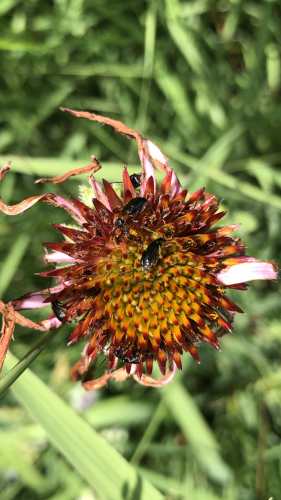
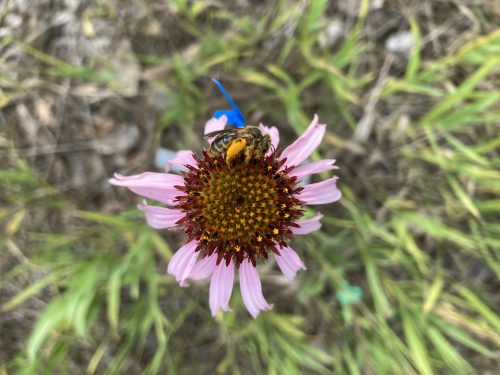
A bee foraging on the freshly emerged pollen. Several flowers had these beetles on them in P1 .Anna A doing phenology after the rain.
Completing that task left us with finishing up the measuring being done in P8, assessing the Echin plants in each row and position. A very satisfying day as we were able to check off everything as completed for the day. We’ve got a great team with great attitudes. We could have just as easily packed it in after P1 phenology but several team members wanted to cross measuring P8 off the list.
I wanted to make a post detailing my experiment this summer with hybrid Echinacea plants at Hegg Lake. As a student, it was my goal to design, execute, and analyze an experiment with Team Echinacea this summer. Because I’m interested in genetics, I wanted to create something that would connect inheritance with population control among Echinacea. With the help of some seasoned Team Echinacea members (Riley T and Mia S), I was able to construct an experiment that would study the reproduction potential of hybrid Echinacea, crossed between E. angustifolia and E. pallida.
In the history of experimental plot 7, two Echinacea plants have flowered. Most recently, a hybrid Echinacea flowered this spring. This allowed us to cross the hybrid’s pollen with a variety of E. angustifolia and E. pallida in the Hegg Lake area. In order to assess reproduction potential, styles were painted, pollinated, and later observed to look for shriveling. Although styles may shrivel for a variety of reasons, shriveling usually indicates reproduction. In the winter, we will assess the seed-set of these individuals to determine reproductive fitness.
When new species from non-prairie remnants are introduced to new areas, the risk of hybridization among plants of the same genus arises. E. pallida, which has shown to out-compete E. angustifolia in our experimental plots, therefore has the ability to pass on its genes through hybrids. If hybrids are able to reproduce, and continue to pass on E. pallida genes, the risks of genetic swamping increase. Therefore, over time, hybridization could eventually exterminate E. angustifolia from its native prairie.
A picture of me painting bracts for our hybrid crosses. Photo credit to Mia S!
In order to assess reproduction, we hand-crossed a variety of sample pollen with E. angustifolia, E. pallida, and hybrid Echinacea. In this experiment, a shriveled style is a sign of successful reproduction. Because Echinacea plants are not self-compatible, the reasons for a style not to shrivel could vary. Reasons could be that the hybrid was not compatible with this type of Echinacea, or because the specific Echinacea plants were incompatible due to inheritance patterns.
An example of hand-crosses from Shona Sanford-Long, 2012
Our sample size was also effected because only one hybrid Echinacea flowered this summer. In the end, we cross-pollinated our hybrid plant with three E. angustifolia plants, and three E. pallida plants. If more hybrids flower in the future, we will be able to expand our sample size and cross variety. For this reason, we hope to continue this experiment in the following summers if hybrids continue to flower.
Overall, we saw that hybrids were more compatible with E. angustifolia rather than E. pallida. While hybrid reproduction passes on E. pallida genes, a greater chance of reproduction with E. angustifolia keeps native genes (and hopefully, native traits) in the prairie gene pool.
In the future, I will share more updates as we continue to analyze and reassess the data.
Thanks for joining me on this exciting, new experiment!
Friday morning was a delayed start so that the orchid trip team could try to catch up on sleep and get the visors synced and ready to go for the day. Erin and I had an even more delayed start after we locked ourselves out of the Hoff House while putting on sunscreen in the morning. Luckily, Erin had her phone, so we radioed the rest of the Hoffman House who had already left and Amy came to let us in. If Erin didn’t have her phone, it would have been a long walk to Hjelm with no shoes.
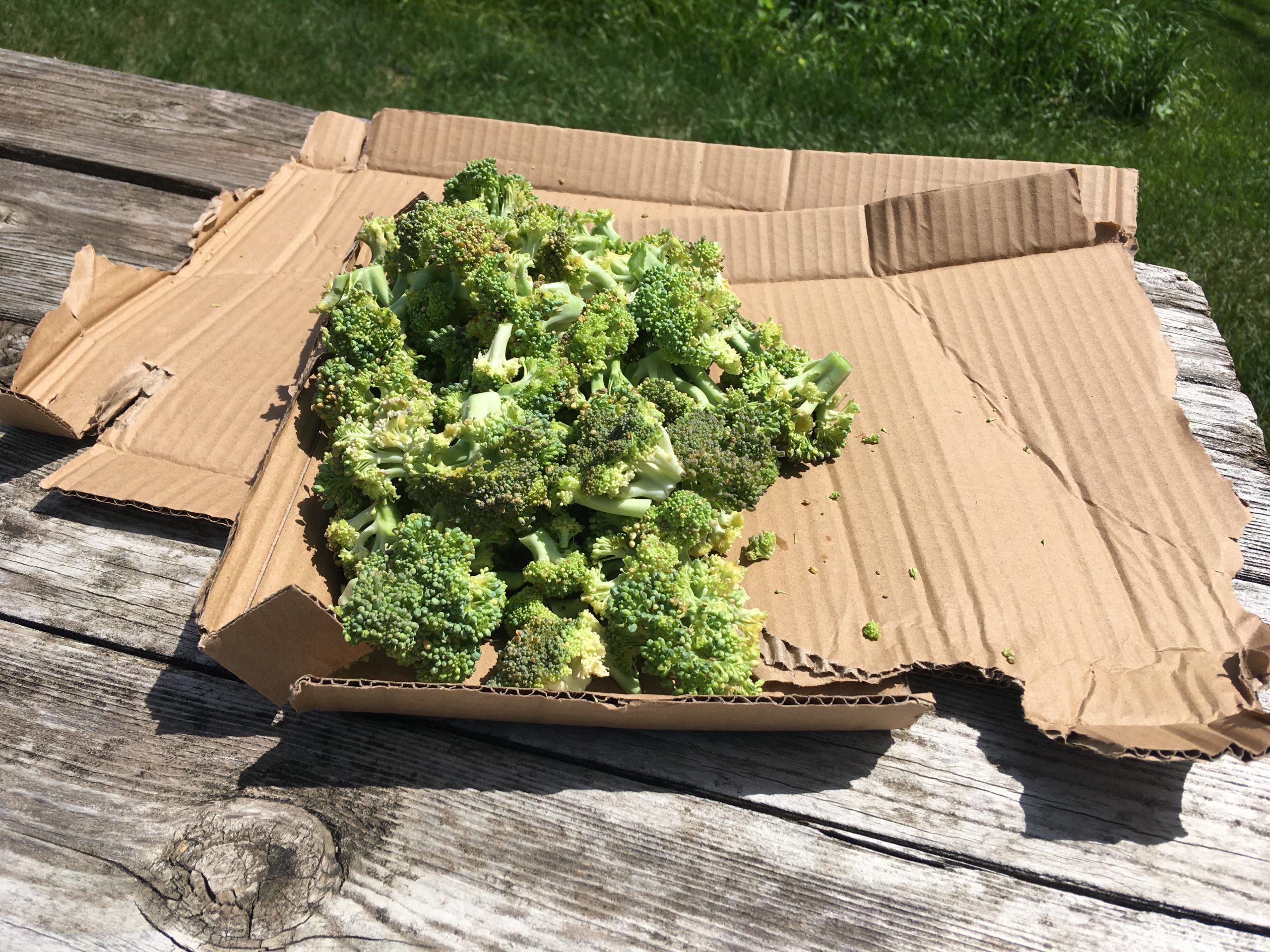
We spent the morning in the prairie remnants taking phenology. Many flowers are now reaching end flowering. John and Anna M. were gifted some broccoli during the morning, which we had for lunch.
Fresh broccoli for the team
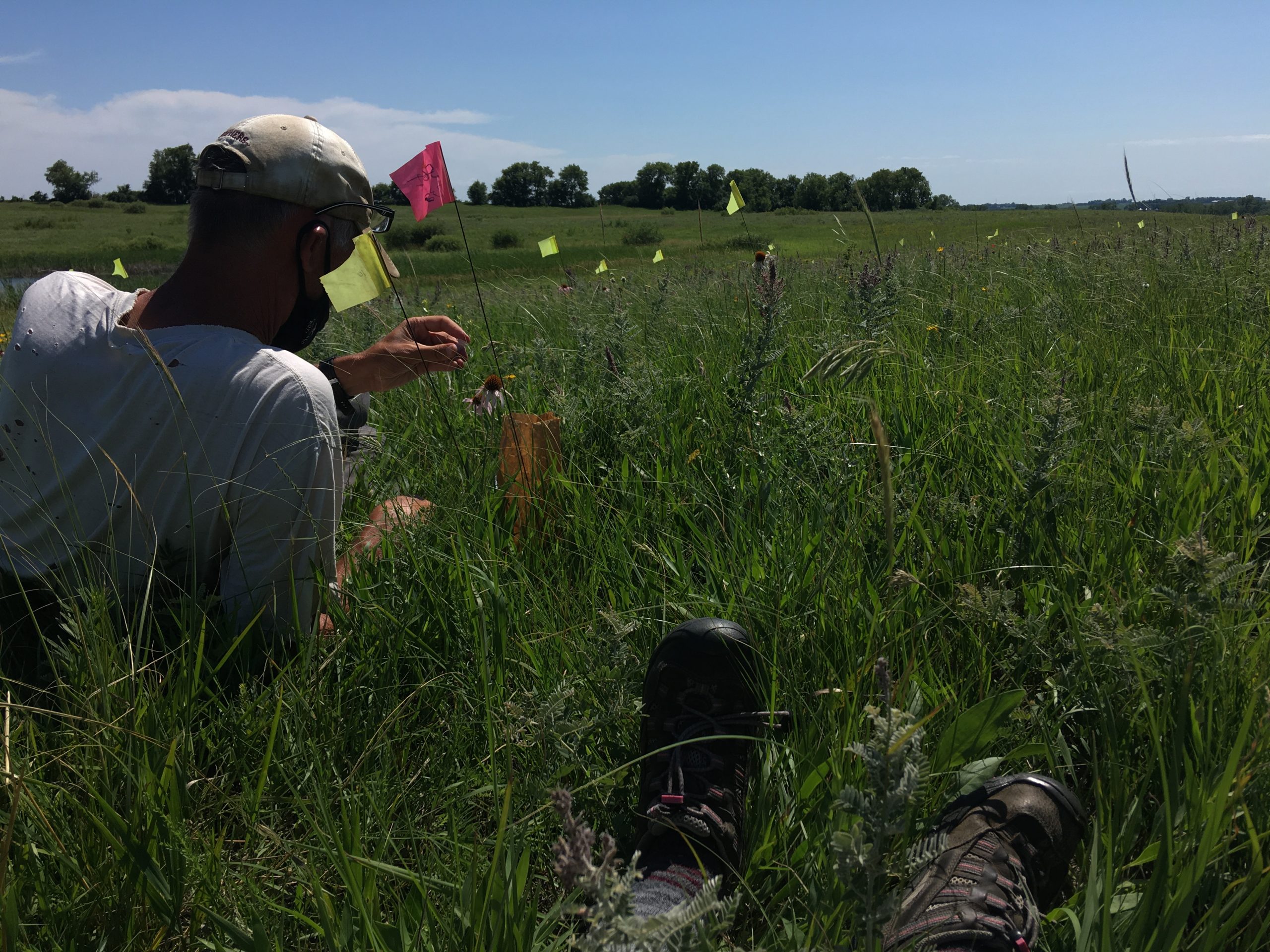
In the afternoon, everyone scattered to do various projects. John and I headed to Staffanson to collect pollen for Amy. We visited about half the plants before we had to head back for a Zoom meeting.
John and I collecting pollenAn Echinacea head with a tiny pink inchworm
We heard from Anna M. and Devon about their projects for this year. Kristen, a former team member, also gave a presentation on the project she did while she was here in 2018.
Yesterday the team took its biannual trip up to Pembina nature preserve and surveyed western fringed prairie orchid. There was many wildlife sightings including a few prairie chickens, a magpie, a deer and even a snipe!
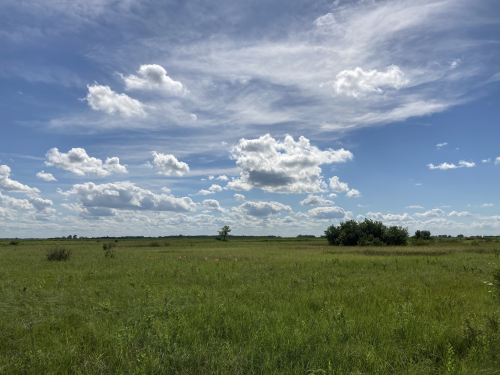
The beautiful scenery of the wet prairie
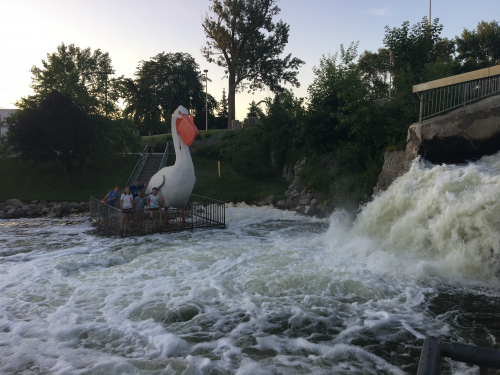
After finding around 300 orchids we headed to Pelican Rapids to have dinner with our new friend Pelican Pete!
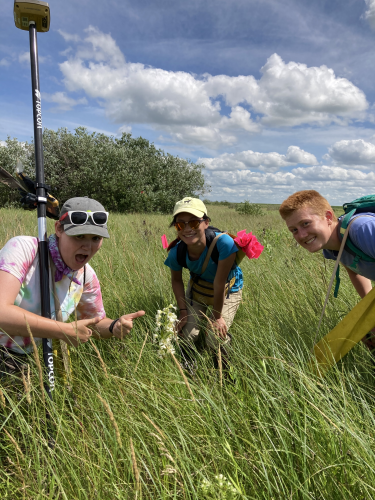
Darwin, Erin, Allie, and Emma posing with an orchid with 18 flowers!The team with our new friend Pete
All in all it was a good day and we had a good day but Gretel was truly missed.
Bur bye
Mia
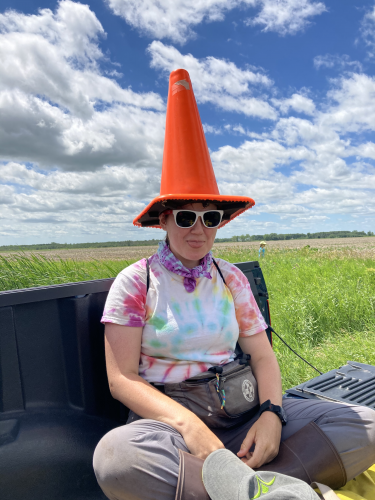
Erin showing off part of her new fashion line that will drop in the fall
Today was a wild ride, to say the least. Our morning started off with an intense thunderstorm. Some Team Echinacea members reported strong thunder as early as 2 AM, which persisted into the early morning. Although it left the remnants wet and muddy, we were lucky to start at our usual time.
I spent the majority of the day working with Riley T. as we conquered the phenology route we affectionately call “Choo-Choo Corner.” This path inculdes remnants such as Loefflers’ Corner and Railroad Crossing. Thankfully, Stuart was there to take care of Yellow Orchid Hill and North Railroad Crossing.
Some happy Echinacea are thriving in their flowering state at Loeffler’s Corner West!
While at Loeffler’s Corner, Riley had a strange encounter with a baby deer. The surprise was well justified, as the fawn was alone and near a highway. Unfortunately, the deer left before Riley could take a picture, but he reports the experience as “shocking” and “unusual”.
We ended the morning with some flowers in our on-site experimental plot, “P8.” After a much needed lunch, we returned to the site to conduct measuring. If you’re a seasoned flog-reader, you’ll know that measuring is the process we use to assess the Echinacea planted in our experimental plots. By measuring, we’re able to keep track of plants that survived, were lost, and their physical fitness over time. P8, one of our largest plots, is notorious for its heat and humidity. However, we persisted, and made great progress!
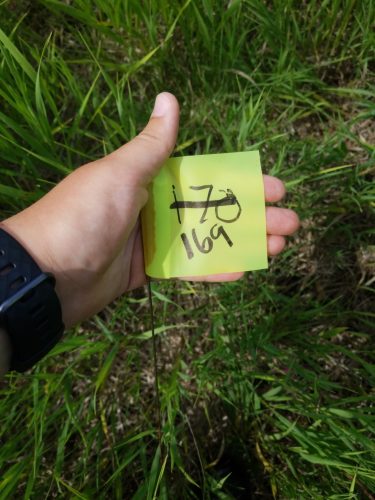
Half-way through our P8 excursion, Riley and I had another wacky experience. One of the rows we were assigned to measure had a constant rate of lost plants and toothpicks, our universal seed-identifying material. During burns and harsh winters, toothpicks (and often plants) tend to go missing. However, row 169 was unusually bare. This is when we realized we had made a dire mistake.
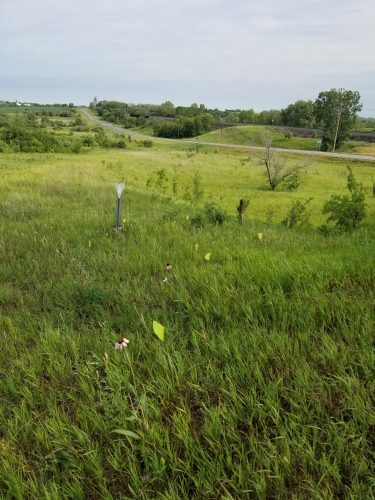
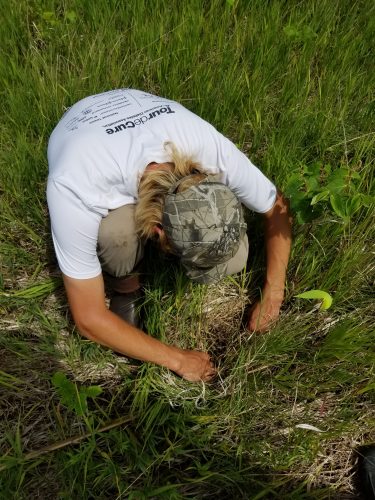
Images taken moments before disaster, featuring Riley T.
To our demise, we discovered that the unusual row was mislabeled. Because of this, we had compared visor records to a completely irrelevant row. Although it was somewhat disappointing, we were glad to know that our mortality rate was much lower than we thought. It was also a good experience that taught me it’s okay to make mistakes, and that we must learn in order to improve. Even with our minor setback, it was an extremely successful day for the team, and a great kick-off to our P8 studies!
All mistakes are “happy accidents” if you learn and grow!
We concluded the afternoon with some Wednesday Watermelon, and a rhine-throwing contest. Watermelon is a team-favorite treat on hot days!
Hopefully you’ve enjoyed our “Wacky Wednesday” as much as we did. It’s always great to have a little excitement at work, and a bit of “phun” with phenology!
Today I only heard about what the team was up to from Mia after her epic day that started at 7:15 and ended around 6:30. Sounds like a lot happened in the field today! I heard about phenology, and how their were a few critical visor malfunctions, although it seems we were still able to get the data we need!
I also heard that people started adding and excluding aphids from Echinacea plants in p1, and that some hand crosses happened with hybrid Echinacea in p7!
All in all it seemed like a good day for the team. Back home at Alpha Tango Hotel, I worked on getting the FNC manuscript ready to resubmit. Over the weekend many Team Echinacea members current and past read the draft and gave me valuable feedback. Today I polished everything up and clicked “Submit”! The study examines how heterospecific co-flowering plants and isolation from conspecific mates affects pollination. Specifically, we quantify how these aspects of the floral neighborhood influence four stages of the pollination process: 1) probability of pollinator visitation, 2) pollen on pollinators that visit Echinacea, 3) pollen on Echinacea styles, and 4) style persistence (pollination success). We are excited to submit this manuscript and are hoping for favorable reviews this second time around!