|
|
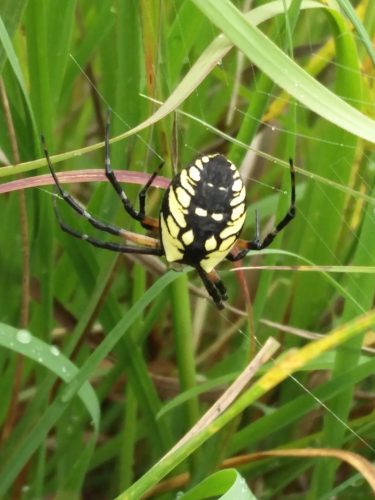
In the morning everyone split up and did separate projects. Tracie and I worked on aphid addition and exclusion. Alex did phenology. Ashley and Anna did demography at Railroad Crossing. Leah and Kristen went to Staffanson. Eventually, everyone came back and we all worked on putting in staples in experimental plot 1 to mark plants that haven’t been found in the last three years. While doing that, Alex found this awesome Black and Yellow Garden Spider (Argiope aurantia).
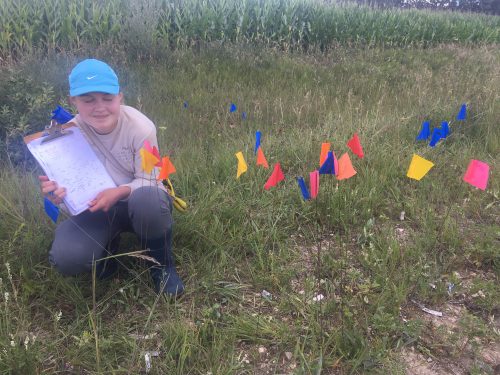
 Argipe aurantia in P1 After lunch, everyone went back to P1 for an hour of placing staples. Then Leah and Tracie went out to work on their plant community analysis and Ashely, Will, Kristen, and I went to do demography at Railroad Crossing again. We finished staking all of the plants known to have flowered in the past and then had time to flag all of the new flowering plants. We just need to GPS the new flowering plants before we are done at Railroad Crossing.
Happy Monday!
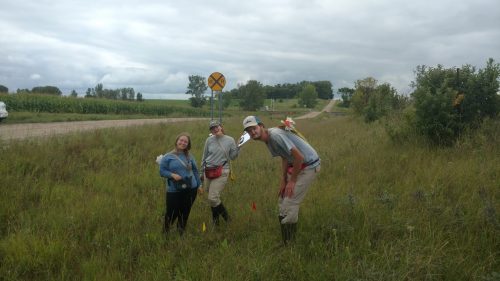
 Kristen, Ashley, and Will doing total demography
Today was a nice cool and rainy day in Minnesota. I spent the day cooking and hanging out with the dogs while people went out and did various chores for the weekend. Wes played in a very rainy parade, too! We also got Andes all cleaned up and ready for Kristen! Kristen arrived around dinner time and we are all very excited that she’s joining the team this week! It will be nice to have a new team-member for the last third of the summer. All in all it was a nice relaxing weekend day, and the weather was beautiful even though it was very wet.
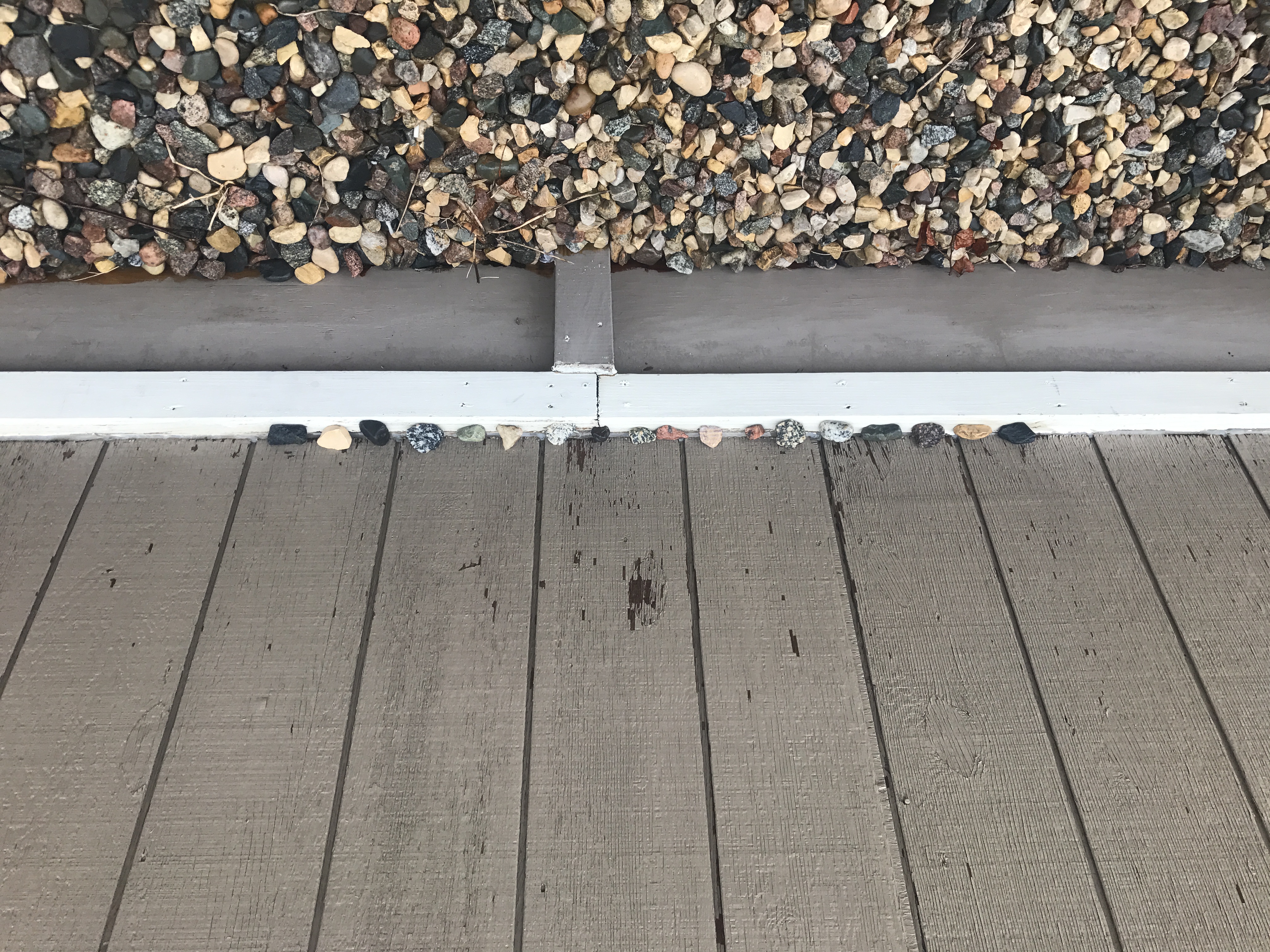
 Rocks in the rain at Andes
My time here as a 2017 summer team member of the Echinacea Project is nearing its end. During my REU internship, I have had the opportunity to work under great mentors and with some great peers, and I’m sad I only have one week left. Nonetheless, I hope to make the most of my last week, and the data analysis part of that week continued today. This morning, I worked on my generalized linear model of my shrivel rate data in R using a model problem Stuart gave me. Lea helped me work through some errors returned to me while creating my models, and she used her Solidago figures to help explain the difference in additive and multiplicative interactions. Tomorrow, I hope to find what is significant in my study using the
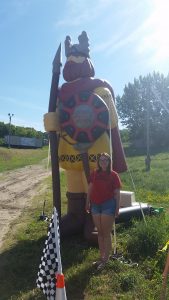
 Viking set-up at Andes GLM!
While I worked on my analysis, there was a mountain bike race at Andes, and part of the set-up included a 3 meter viking near the finish line. Taking a picture with it was somethings I definitely could not pass up.
In the afternoon, Lea, Tracie, and I enjoyed a evening celebrating a great summer. Since it’s my last weekend before returning to my university in Arkansas, we wanted to have a great evening, so we enjoyed a night out in Alexandria!
Tracie, Lea, and I in Alexandria We are excited to welcome our new roommate, Kristen, tomorrow!
This Thursday was pleasant with cloud cover and low temps, but the unexpected rain patches left most of the day to computer work. This morning started off wet and most of the team worked on projects. Mid- morning, Ashley and I headed out to P9 to finish measuring. Luckily we finished just before the rain! During this same time, Gretel, Alex, and Wes worked on Demo at Railroad Crossing.
While eating lunch we were almost going to make plans, but then guess what happened? It rained… and then it began to pour… So, instead we spent the afternoon doing some individual project work. A few of us worked on our computers, Alex pinned pollinators, and Lea and Tracie went out complete more of their sites. Overall it was a pretty good day!
And just an update on Plexipus the caterpillar- he has made his chrysalis and is beginning to form into a butterfly!
The coming days will include lots of demo and soon harvesting!

This summer, I’ve been working on an experiment examining style age, pollination treatment, and row position. For future members of Team Echinacea, I wanted to share my data with them. 🙂
To this post, I’ve attached two .csv files. “HeadData_081017” includes data applicable to each head as a unit, and “RowData_081017” includes data applicable to each row. I’ve also attached a .txt file titled “PlantRowShrivelData_MetaData_081017,” which gives an overview of my experiment and explains each column in my .csv files.
.csv files:
HeadData_081017
RowData_081017
.txt file:
PlantRowShrivelData_MetaData_081017
To read the .csv files, copy this script into R:
HeadData<-read.csv(url("https://echinaceaproject.org/wp-content/uploads/2017/08/HeadData_081017.csv"))
RowData<-read.csv(url("https://echinaceaproject.org/wp-content/uploads/2017/08/RowData_081017.csv"))
Have you ever had one of those days you can just feel rain coming? Yesterday was one of those days. When I stepped outside in the morning, my immediate thought was “I wonder when it will start raining?”. The sky was ominous, and pretty much by the time we arrived at the Hjelm House it was coming down.
We spent the first part of the morning updating Stuart and Gretel on our individual projects, measuring, and demo. My yellow pan trap project is going well; I have the contents of approximately 120 traps in the Hjelm House freezer right now waiting to be pinned, and I tried to use the rainy weather yesterday to make a dent in all of that. My pinning is getting faster each day, and the pinned specimens are looking better and better. Soon I will begin identifying these specimens and analyzing my data.
It amazes me, when I think about phenology, how long it used to take to complete. I was able to do the whole of the Around Landfill loop in about half an hour yesterday, a task that would have taken two people a morning to complete only a few weeks ago. It amazes me how much time has gone by this summer already.
This brings us to the pivotal event yesterday: the great coaxial cable conundrum. In short, we need a new cable for the GPS, but the brand-name replacement is far too expensive. We spent some time discussing our options, and a decision has yet to be made. More updates to come?
The afternoon brought a little more rain, which for me meant more pinning. After the rain cleared, Wes, Ashley, Anna, and I embarked to Hegg Lake to measure at the Hybrid plot there. Unfortunately, we were unable to finish the plot, having only two or three rows remaining, but I’m sure they will be finished soon.
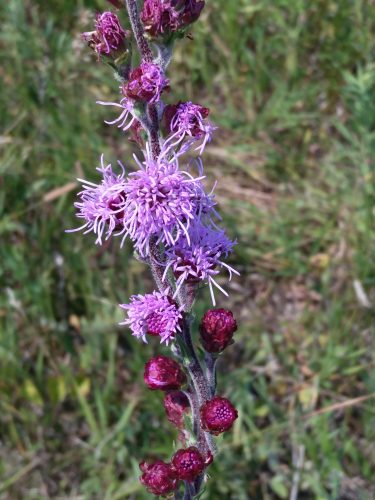
An old image, flowering Liatris at Hegg Lake; 31? July 2017.
Today was a day full of demo. Everyone headed out to East Riley in the morning while Lea went to take data on her floral resource plots along roadsides. East Riley might not be the most exciting remnant for demo at this point in the summer, as most of the “flowering” plants we were finding were designated with an M1 or an M2 or even an M5… meaning we were just finding mowed heads that perhaps once had great potential. All of the mowing also seemed to make tons of small basal rosettes pop up, so our visor forms were reaching their max with nearby neighbors. At one point in the afternoon when we were finishing up East Riley, Lea staked around 20 plants within a .5 x .5 meter area. And there were tiny Echinacea everywhere! It was quite a puzzle.
Anna with some high density PBORY at East Riley. Many small basal Echinacea plants and lots of locs at East Riley. Lea and I also spent some time back at Staffanson today working on our neighborhood richness vegetation project (aka RichHood). We got through 5 of our 2 x 2 meter plots today, so we are making progress! 8/100, only 92 to go! We are pretty sure our plots at Staffanson will take the longest since there is such high diversity, and therefore a lot of plants we have to spend time figuring out. It’s really fun work though.
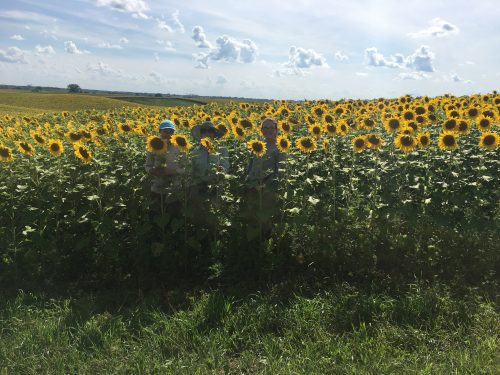
To finish off the day we did flowering demo at Yellow Orchid Hill and KJ’s, two nice roadside remnants. When we were staking the plants at Yellow Orchid Hill, the GPS went to float for a bit. However, calling on the space weather gods seemed to work quite well. In the few seconds after me calling out to them, the GPS went from Auto to Fixed! Then, we got to hang out among the sunflowers at KJ’s before heading back to the Hjelm House.
Anna, Lea, and Ashley hanging out in the sunflowers across from KJ’s! Until next time, flog!
Today was our second full day of Team Echinacea minus Stuart and Gretel. They will be back Wednesday! We managed to have a productive day anyway, though we did have less inspiring lunch conversations.
We started our morning off with a few people going on quick phenology routes. The Nessman and Around Landfill loops and p2 take less than an hour now, and I went to Staffanson just to visit 2 plants! One of those plants is now done flowering, and we’re just left with a single mid-flowering head among the ash trees. I will admit, all of these done flowering Echinacea can make me a little sad, BUT there are still plenty of other plants flowering…
While others spent the rest of morning working on demo at East Riley or working on aphids, I helped Lea with her Liatris phenology/seed set experiment (Aster Phen). We headed out to her transect along the south part of Staffanson and finished flagging the transect, flagged Liatris aspera, and continued taking phenology data. This usually involved just counting the heads that might potentially flower and then identifying the position of the topmost flowering head and the lowermost flowering head. Most of them were still in their immature stage, just starting to get tinges of pink on the white buds. Liatris is a beautiful plant, so I will share a few of the many photos I took today while getting very excited.
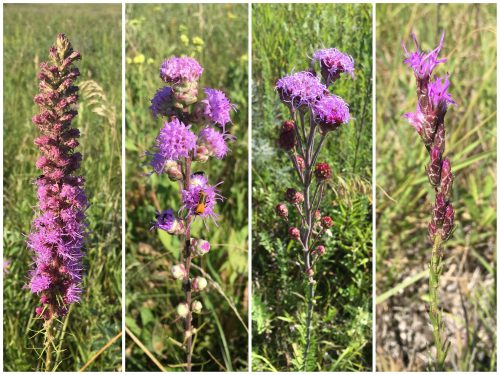
There are four species of Liatris at Staffanson. Lea studies Liatris aspera, but there are a lot of Liatris ligulistylis in and around her transect as well.
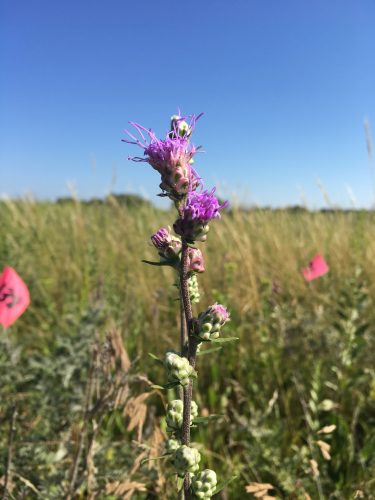
The four species of Liatris at Staffanson. From left to right: Liatris pycnostachya, Liatris aspera, Liatris ligulistylis, Liatris punctata. Collage by MOLDIV. A Liatris aspera in Lea’s transect. The Liatrus ligulistylis have lengthier branches holding the heads.
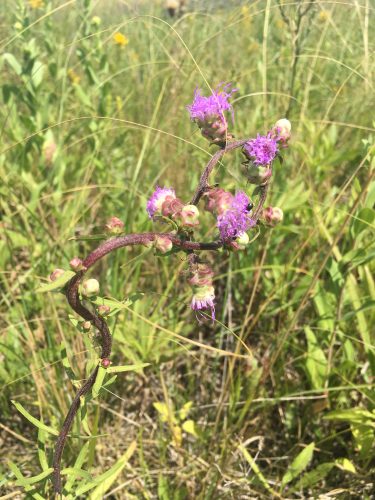
 Liatris ligulistylis with its branching heads. Some of the Liatris even get into strange shapes.
A figure-8 Liatris aspera. You can see the way the heads swirl down the stem when looking at them from above.
 A Liatris aspera with the top head barely flowering, from above. After lunch I spent more time with the Liatris and Lea before we went to help start measuring p4 and p9. Another good day.
See you tomorrow, flog!
I spent my Sunday preparing for the week and relaxing.
Lea and I went grocery shopping in the morning, and when I returned to Andes, I started Swirl in R. Between lessons, I tinkered with my pulse and steady pollination data. By Tuesday, I hope to have some basic descriptive statistics to share with the team.
So far, using the range function, I was able to see my experimental plants’ styles emerged between July 8th and July 26th, and were pollinated within the same range. I was also able to see the sum of all the styles I pollinated: 1980! Hopefully, tomorrow I can work on finding the overall average style shrivel rate on day 1 and day 2 considering both treatments, and eventually, I hope to be able to find the shrivel rate by treatment in R. While I can find these things within the spreadsheet itself, I think R is a valuable tool I can use for my data analysis for this project, and it is a skill I need to develop as a young ecologist.
Other than working in R, I enjoyed listening to the cool rain that poured over Andes, and I savored Lea’s Beaufort stew dinner. A few of us also gathered around to stream some silly shows and share a laugh.
That’s all for this relaxing and somewhat productive Sunday.
Until next time, I’ll be sharpening my R skills!
Saturday!!!! Woohoo!!!
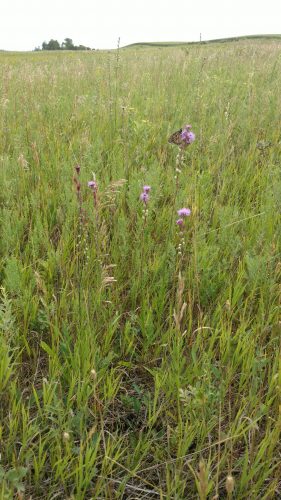
The Andes crew took a break with many of us going in to Alexandria to do laundry, do grocery shopping, and drink coffee. I spent my late morning and afternoon out at Hegg Lake looking for candidates for seed collection. There were many flowers that were blooming, including the Rough Blazing Star (Liatris aspera).
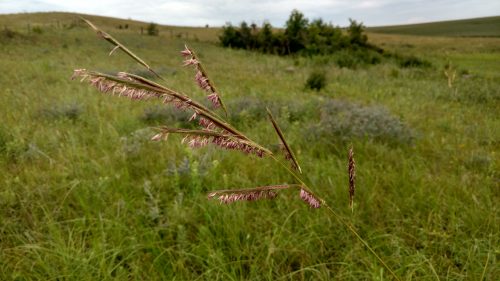
 Liatris aspera in full bloom with a monarch. A new flowering individual for me was the Prairie Cord Grass (Spartina Pectinata).
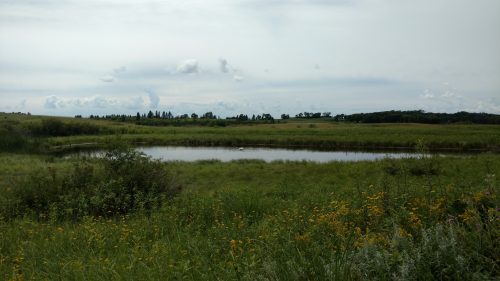
Spartina pectinata blooming. Along with pretty plants, I had the opportunity to watch a Northern Harrier hunt and successfully catch dinner. There was also a pelican checking out a small pond.
A pelican on a pond at Hegg Lake.
|
|