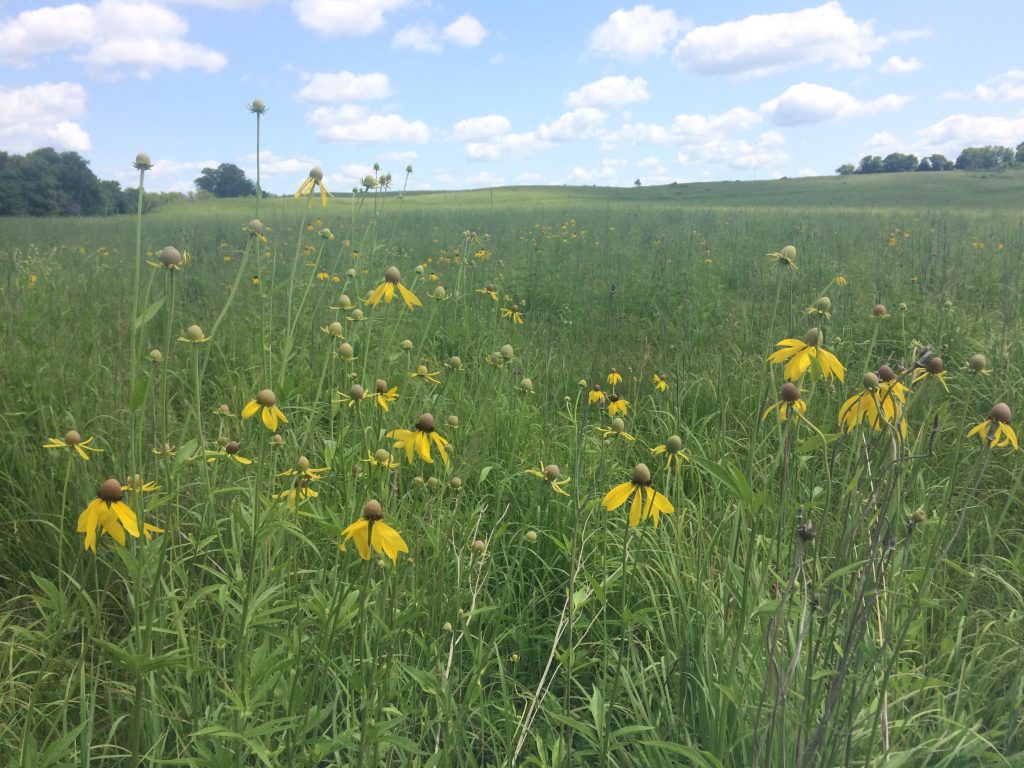
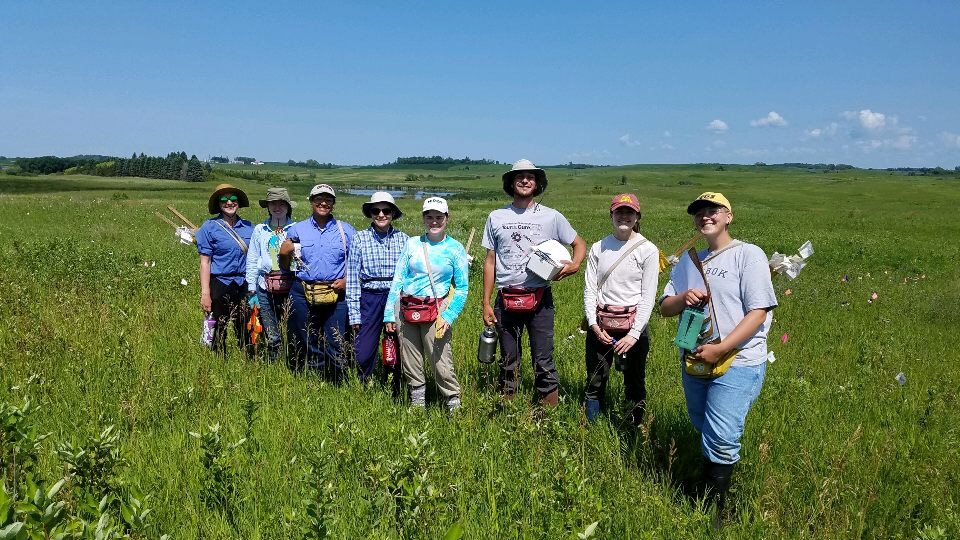
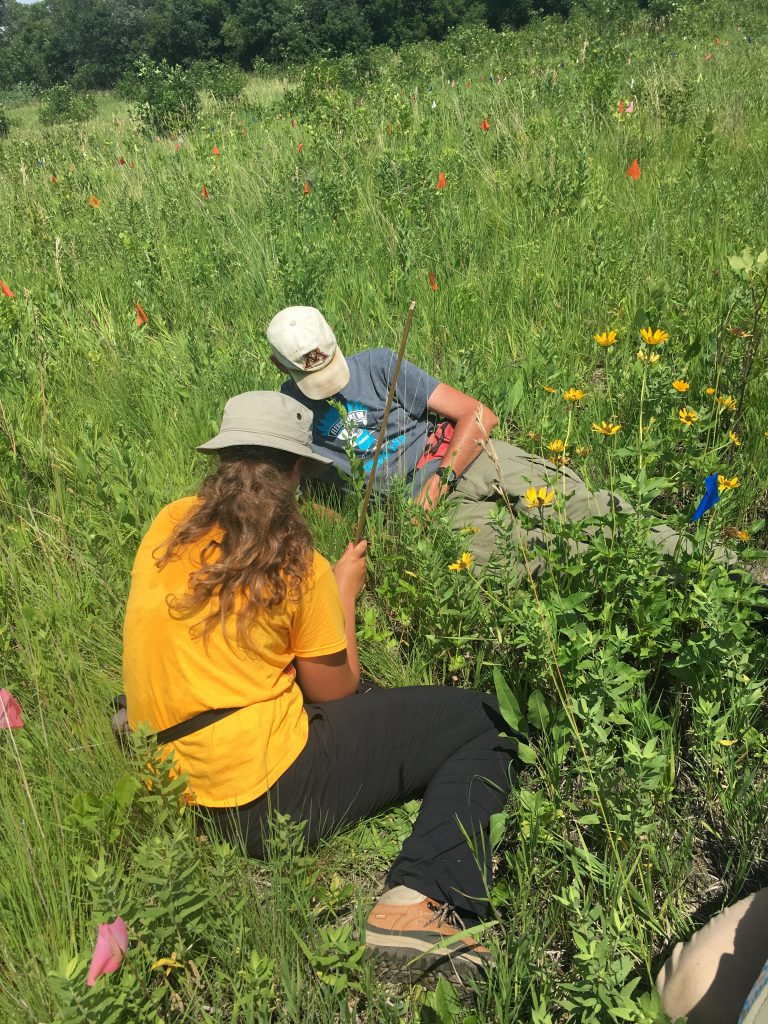
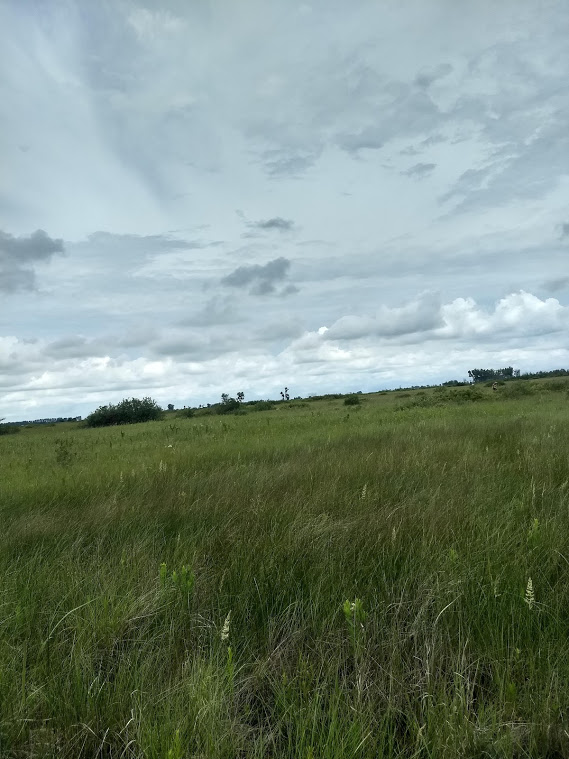
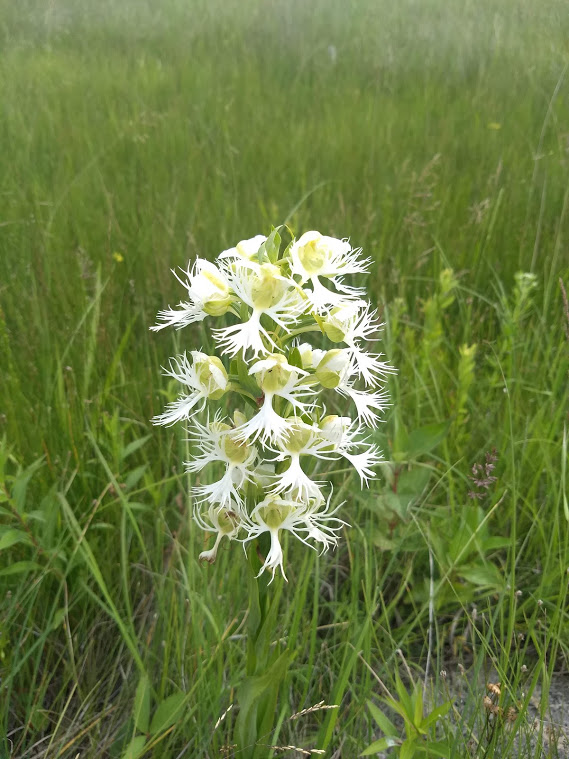
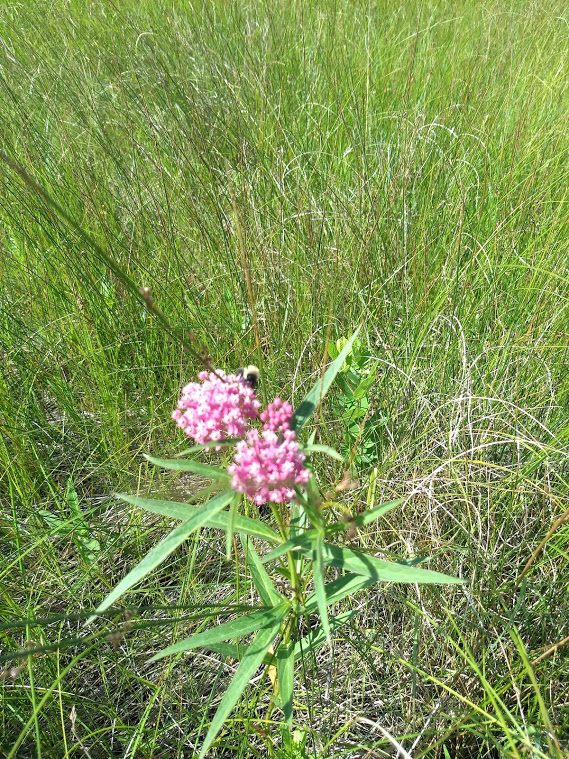
The Echin Team members divided and conquered today with some of the crew (Julie, Stuart, Gretel, Riley and Drake) migrating to northern MN to access the reproduction of the Prairie Orchid. A biannual trip the team makes with Gretel leading the way.
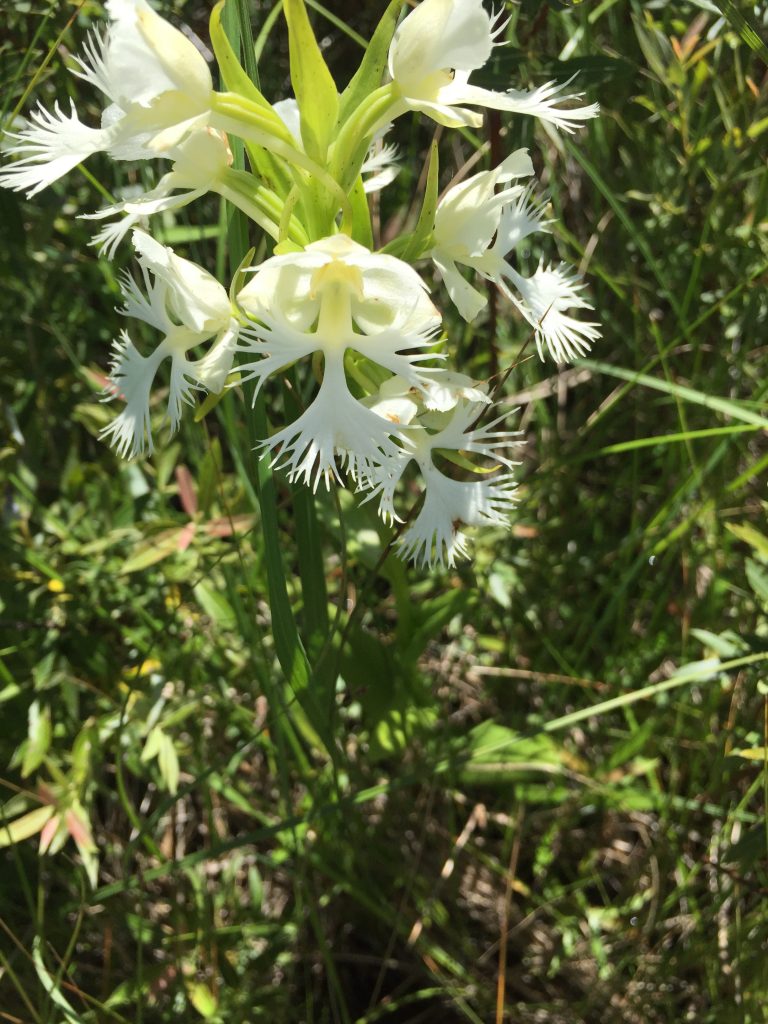
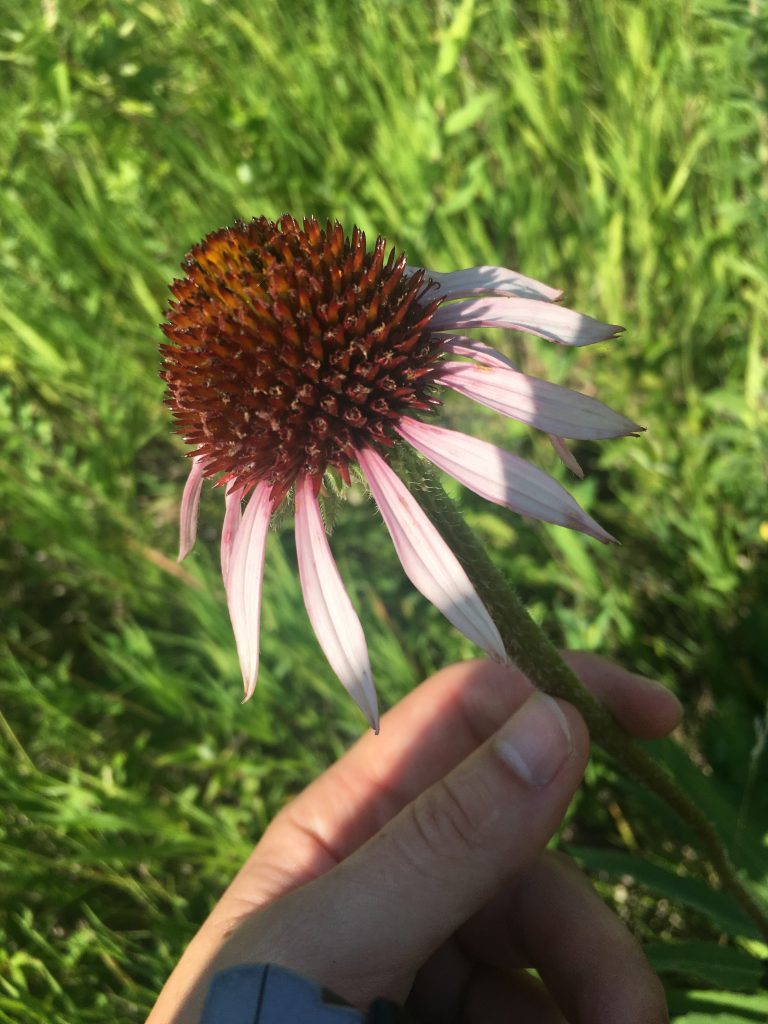
ThePrairie Orchid
The leftovers consisted of Erin, Shea and John working out of headquarters. Shea and I did phenology at P2, while Erin did phenology in the remnants and P1. The aphid addition/exclusion experiment then proceeded at P2. After lunch, we began measuring P2 and finished a whopping 3% of the total area.
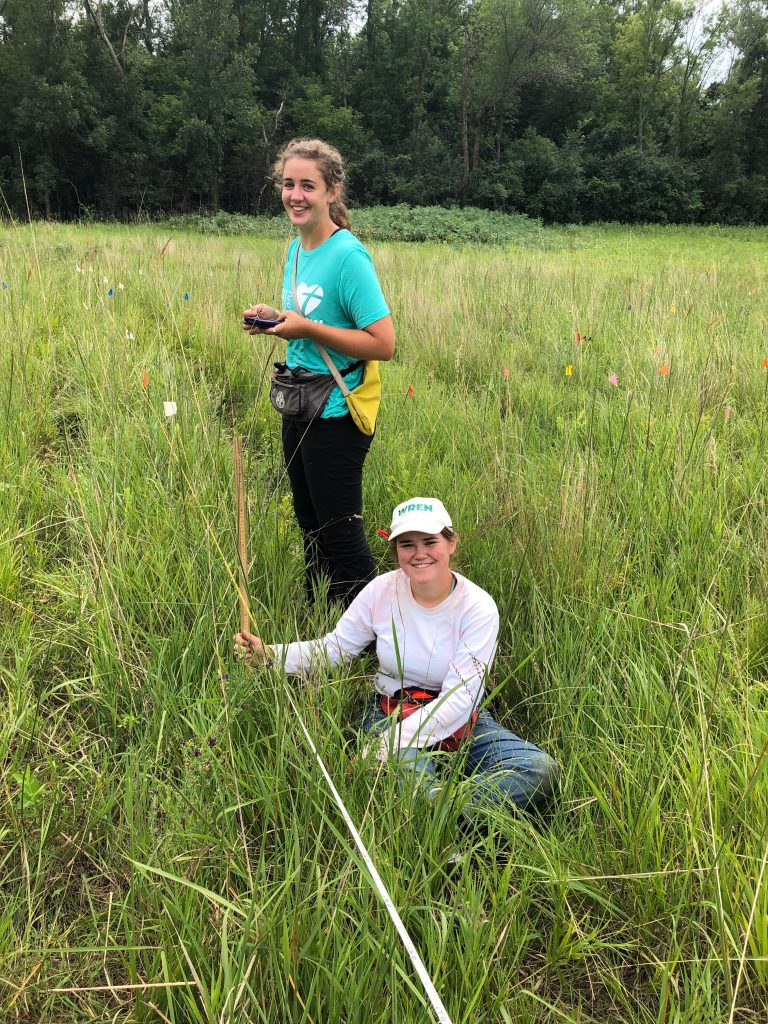
Erin and Shea measuring P2 and fighting off pesky chiggers. Erin (Chipmunk Whisperer) charms a rodent to feed from her hand.
With about a month left for many of the participants on the Echinacea Team, the flowers keep on flowering, the weeds keep on growing and seed collecting ramps up for many of the prairie species. And for the animals on the Echinacea Team: Shea soon starts her senior year of HS; Riley, Drake and Erin make arrangements to move to Chicago; Julie and Jay begin their senior year of college; and John prepares for his 31st year of teaching. And Amy continues her research on bees with the University of Minnesota, spending much of her time on the praire in midwest Minnesota.
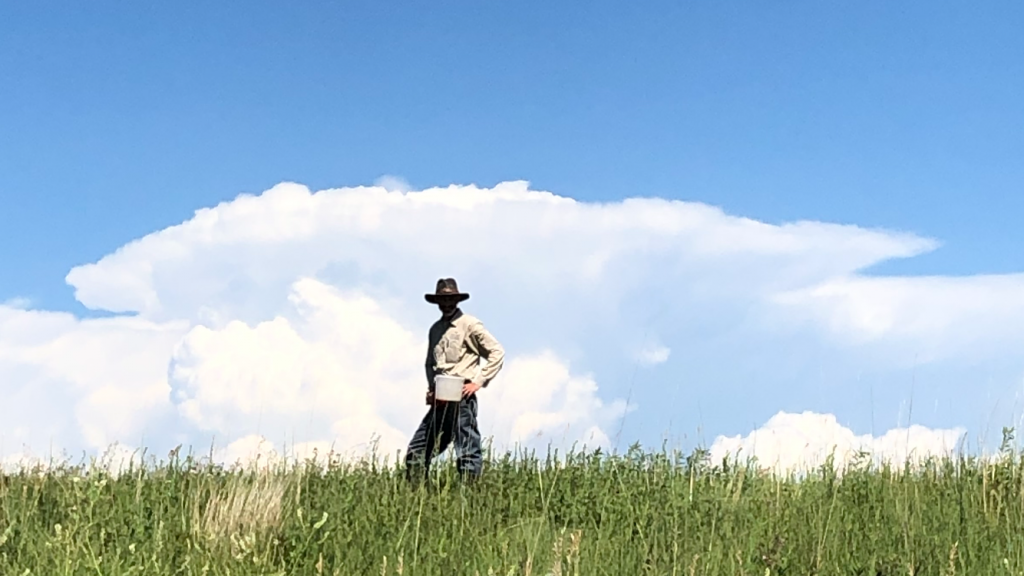
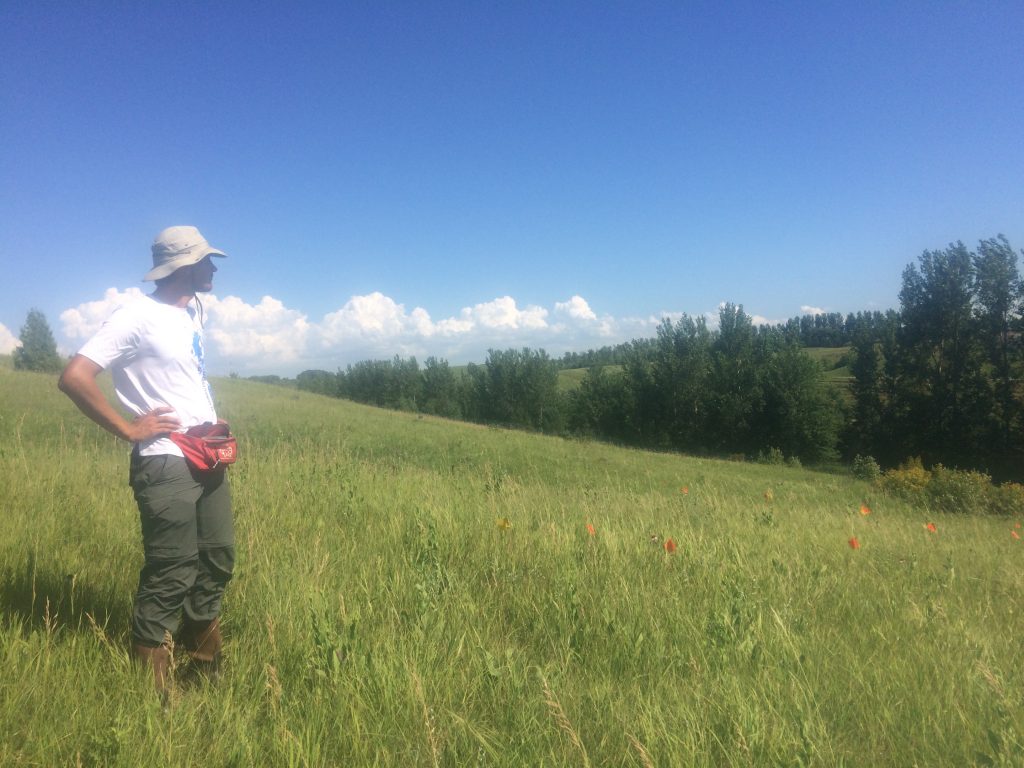
Stuart looks for seeds in Douglas County to be collected for Drake as the a cumulonimbus cloud begins to build behind him.Amy W (pictured left – Echin Team Member 2015-2019) wins her 4th consecutive Flekkefest 5K. Amy pictured here with Echin Team Member Alum Abby VK (2015 -2016) and the previous two time winner of Flekke 5K. The Echinacea Project Women have created a dynasty of 5K winners.
Today started off on a slightly less than auspicious footing, as the team’s morning plans of pollinating were largely rained out, as anthers don’t present transferable pollen until they dry. When the morning storms and damp stretched into the early afternoon, we began to realized that our hopes of performing the day’s pollen collection for our pulse/steady pollination experiment were likely to be dashed. Instead, we waited wistfully at the Hjelm House for the stormy weather to pass, working on indoor tasks like data frame cleaning or surv file arranging until the rain subsided enough for phenology data collection.
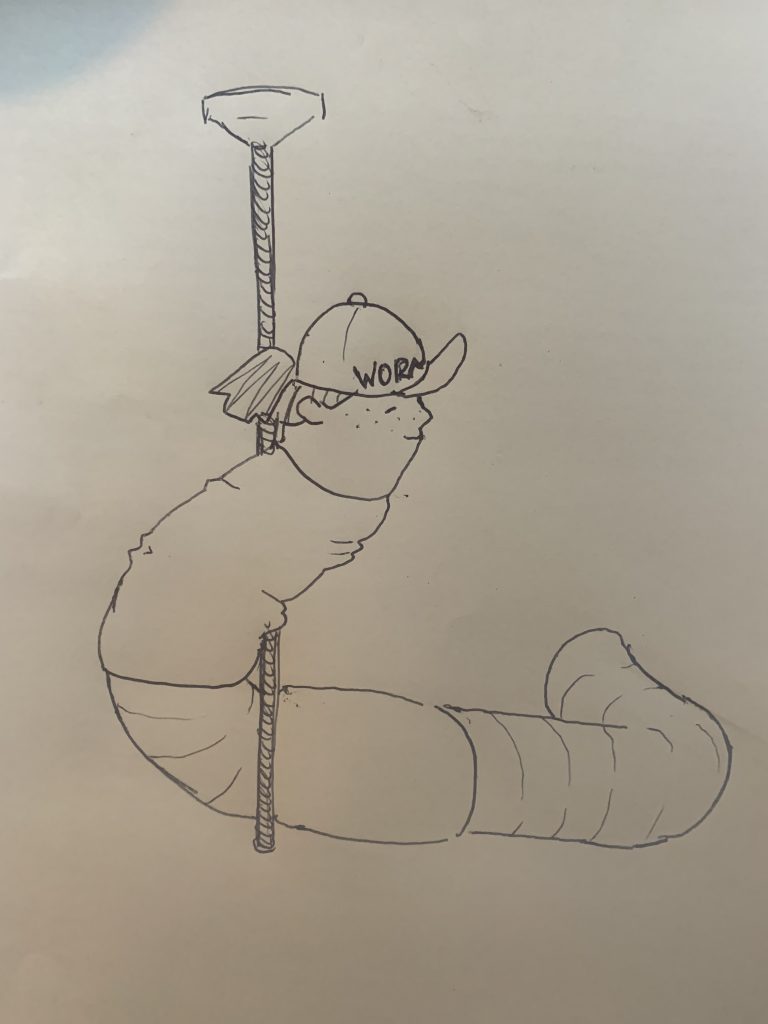
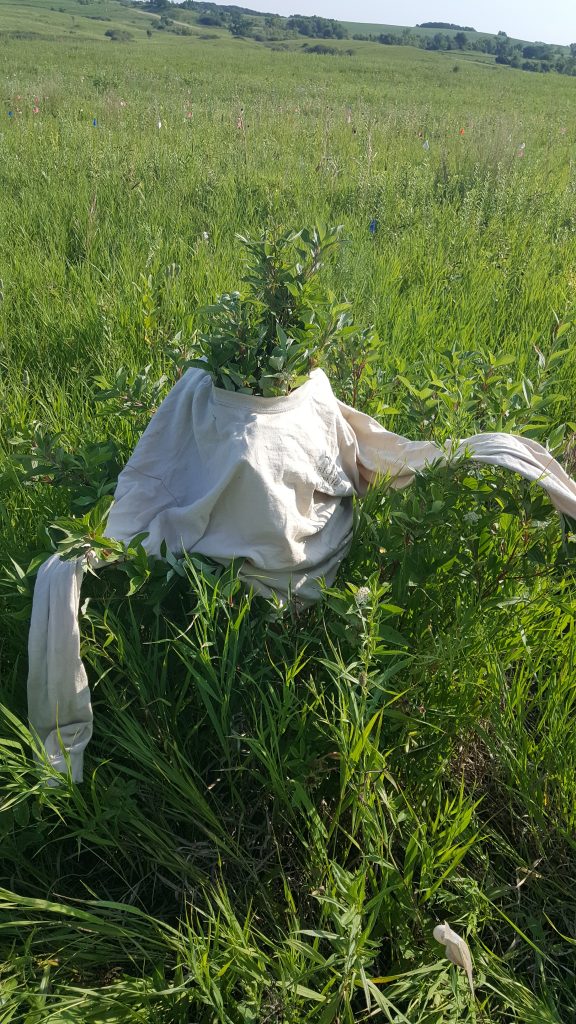
Over lunch, our discussion naturally turned to the age-old question of how a worm would wear a shirt, if shirts were made with worms in mind. Would they have small, empty sleeves, or would they disavow superfluous appendage coverings in their garments altogether? To aid us in our visualization, Erin handily mustered up her artistic skills and demonstrated exactly how a worm ought to properly attire itself with a tasteful tube top. To properly illustrate her point, she began composing perfect likenesses of the team members’ field outfits, like Jay’s signature flannels and JEGS hat, once adapted to the annelid form.
Lumbricus terrestris Jayicus in its conventional garbEven Darwin, our handy GPS point shooting unit, got in on the wormy fun!
Finally, the rain cleared! We scampered out to P2 to do phenology, and though our pollinating fears from the morning came true when pollen refused to present, the team kept up the momentum by remeasuring and rechecking some of P2’s most interesting and bizarre plants. We circled back to basal plants with leaves half a meter long, flowering plants with four heads on one stalk, and plants with more than 10 rosettes and 50 basal leaves (a rarity when most plants have only two or three rosettes with less than 10 leaves total). With half of P2’s 80 rows triple-checked, we shifted gears to remnant population demography, as Erin and Shea trained Jay and me in the system of PBORY flag ordering and surv file code naming. As we identified and recorded flowering plants, we started adapting the lyrics of AC/DC’s T.N.T. on the fly to fit our demography PBORY protocol (pronounced P-Bor-Ee). Our chorus went something like the following:
Cuz it’s PBORY Gotta stake it right PBORY Then flag the flowers in white PBORY Count rosettes and heads PBORY See how a population spreads!
Today was a fun and productive day. This morning, I went to the NW remnant sites to monitor phenology. I also collected leaf tissue from some sneaky flowering plants that I’ve found since the last time I collected tissue in June. Meanwhile, Julie, Jay, Riley, Erin, and John headed out to P2 to monitor phenology, crosses for the pulse/steady experiment, assess crosses from Julie’s heterospecific crossing experiment, and measure the final rows of P2. Stuart joined them later in the morning and they completed measuring the plot! Wow!
Does Ratibida pollen induce style shriveling in Echinacea? Julie is finding out!
This afternoon the team split up into three teams: Jay and Julie formed Team “Kick Ash” for Jay’s experiment looking at different management treatments on ash. They described the experience as “walking on a treadmill of trees,” but made great progress in metaphorically kicking back the advance of ash in ExPt 8 by applying herbicide treatments to leaves of plants. Team “Smoking Plants” consisted of Riley and me. We went to a spot that is north of landfill, south of around landfill, and south-southeast of north of northwest of landfill to identify plants for an experiment looking at the effects of liquid smoke on flowering. We found 100 plants that were flowering this year, counted each plant’s number of rosettes, and shot a point at each plant so that we can revisit them later. This fall or spring we’ll apply different liquid smoke and mowing treatments to assess just what it is about fire that induces flowering in Echinacea. Stay tuned for when we actually smoke the plants this fall! Finally, Team “Seed Collection” collected seeds for Drake while he is away at a family reunion.
Riley gazes at south-southeast of north of northwest of landfill
We wrapped up the day with watermelon and very impressive, definitely NBA/WNBA-worthy tosses of watermelon rinds into a five gallon bucket. That’s all for now!
This is our stand in team member George H.W. Bush who helped us with phenology today.
Team Echinacea was feeling a little small today with 7 people, but we took advantage of the beautiful weather and got a lot done! In the morning we took phenolgy data and worked on a pollination experiment. In the afternoon, Julie and I worked on our personal projects and the rest of the team went out to take demography data in the remnant plots.
Today’s flog is a bittersweet one, as it marks Team
Echinacea East’s last update from here in Minnesota. After what has been a
wonderful field experience with some truly amazing people, Miyauna, Ren, and I
begin our journey home to the great state of Ohio tomorrow. Though we are sad
to be leaving, we have had some great times while we’ve been out here, including
times from our last day of field work!
We started the day off by making the drive out to P2 to tackle some more measuring and make some more progress on the pulse/steady experiment. Though we had been making steady progress through the measuring, the team really surged ahead today, and now are over halfway done!
All smiles for P2 measuring!!
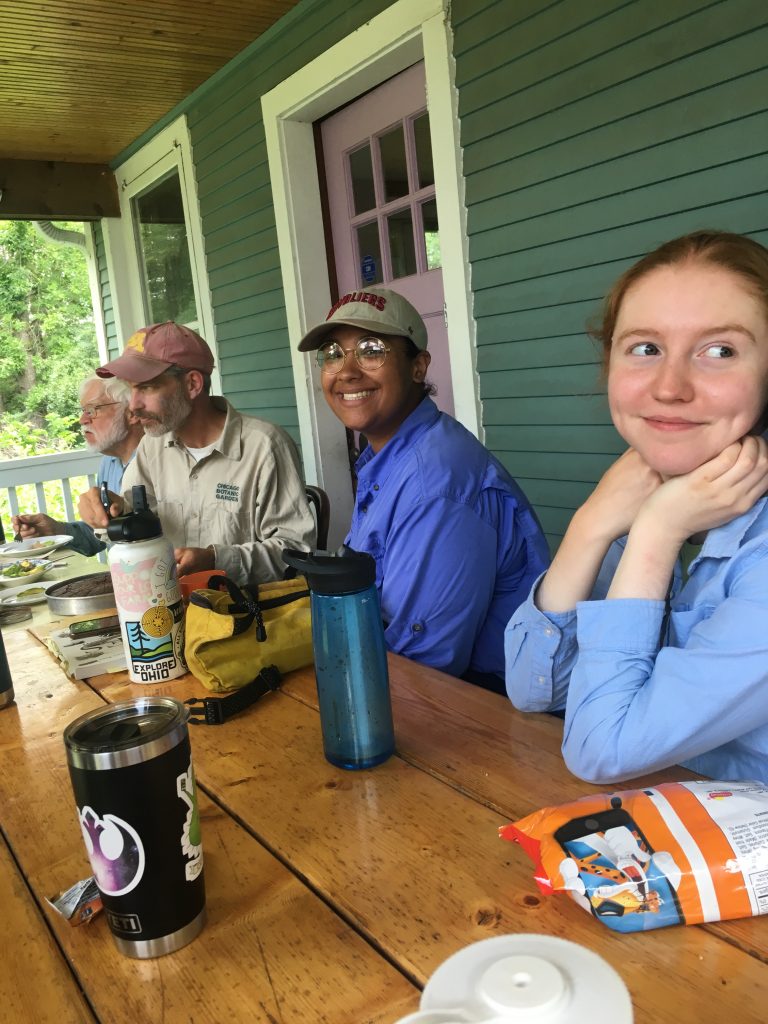
After wrapping up with the morning tasks, the team trekked back to Hjelm House for lunch, where we were joined with a few special guests – Stuart’s parents and Steve Ellis (a local beekeeper) and his wife, Karen. Steve gave a talk about his experience raising honeybees, how his bees have been affected by neonicotinoids, and his experiences going up against the state and federal governments to get them to restrict/ban the use of these harmful chemicals. Though we usually focus on our own native solitary bees here at the Echinacea Project, I think we all found it well worthwhile to take this short break to discuss the nonnative honeybee and the plight of pollinators all across the world.
We love bees! (and Stuart’s world-famous cake!)
After the conclusion of Steve’s talk and a brief flossing tutorial by Ren, the team prepped to head back out for the afternoon. This mostly included people working on their independent projects – Julie checking her crossed plants, Jay killing some more ash, and Riley and Erin honing their computer wizardry skills a bit more. Miyauna, Ren, Amy, and I were in for a special treat though, as we got to ride with John in the famous Bombus Mobile to go water the baby plants in John’s restoration plots at the school.
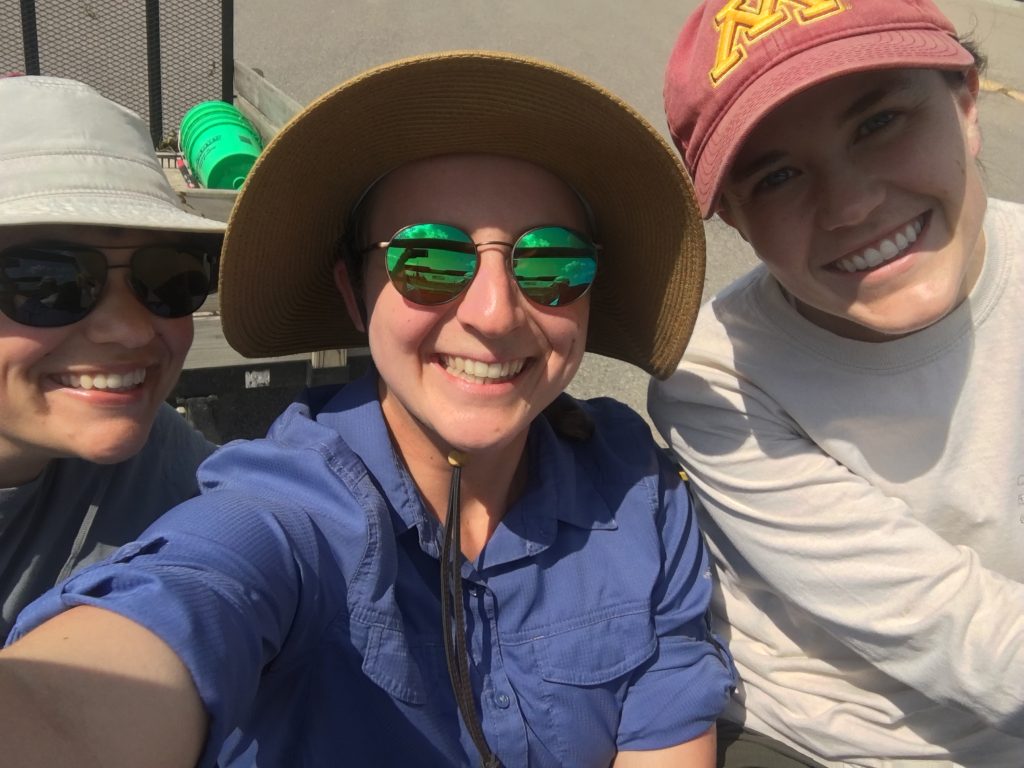
Bombus Mobile selfies!
And that was it! Our final day of field work concluded. It’s been a terrific two and a half weeks, and we wish the team all the luck in the world with the rest of their field season – we will miss you all!
Today’s flog will address a serious illness taking over the occupants of Town Hall. Mad Snail Disease (MSD) has been introduced to members of the Echinacea Project through direct contact with Avery Pearson, who carried the disease to Minnesota from her home in Ohio.
Those infected by the debilitating disease appear to be unable to make rational decisions and have been seen getting up to all kinds of shenanigans.
We hope for the speedy recovery of these individuals who have been infected. Sadly, there is no treatment for Mad Snail Disease; prevention is the only cure. If you are experiencing MSD-like symptoms, do not hesitate to talk to your doctor.
This has been a public health report by Ren Johnson.
I’m writing from Sacramento, CA, where I am staying for the 2019 International Pollinator Conference at UC Davis. Today I heard talks about new quantitative methods for studying pollinator ecology and I also learned a whole bunch about pollinator disease ecology. Tomorrow will be full of more pollinator-themed talks and I will present my poster in the afternoon. I’ll post a copy of my poster below. I’m looking forward to learning more tomorrow! That’s all for now,
After returning from our long day of grit-cultivation in the wet prairie for the orchid-hunting excursion, the team started back with a hard day’s work here in Kensington. The morning included phenology for several different plots, including P2. As the plants progress through the process of flowering, some of them are already beginning to approach end flowering, or have even finished flowering completely! It’s crazy to see how fast they progress!
Almost done flowering!
After a lunch break, the afternoon included a contingent who trekked out to P8 to (finally) finish up measuring for the plot. Despite the grueling conditions of 90+ degree heat, the team pushed through to finally finish off the last few sections, which made for a satisfying end to the day.
Shea and John, powering through the last few sections of P8!
Team Echinacea had an exciting weekend when Stuart, Riley, Julie, Amy, Avery, Miyauna, Jay, Erin, and I joined Gretel, who works at the Chicago Botanic Gardens, to monitor orchids at the wet prairie near Fertile, MN. We had a great time working with some new plants and learning about an ecosystem different from the ones we typically work with.
It was a long day, but we cultivated a lot of grit and were glad to help Gretel. We’re grateful that she gave us this opportunity and we’d be happy to help again!