|
|
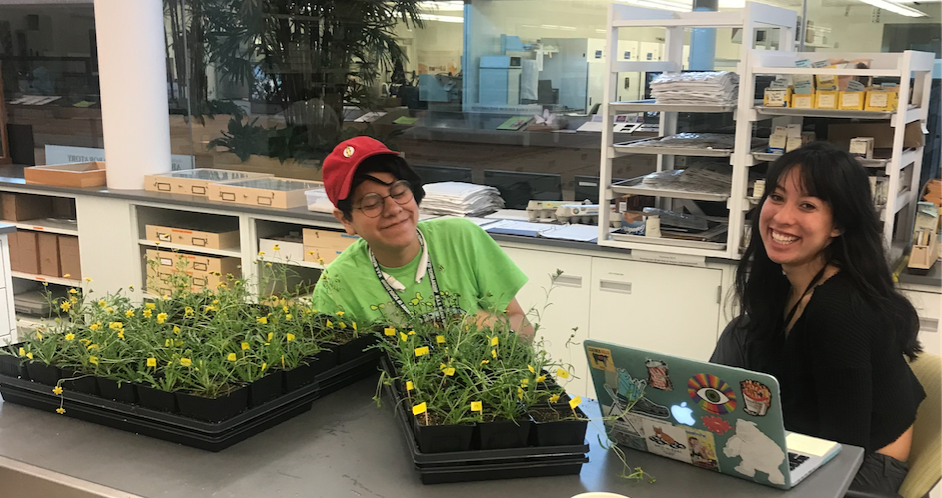
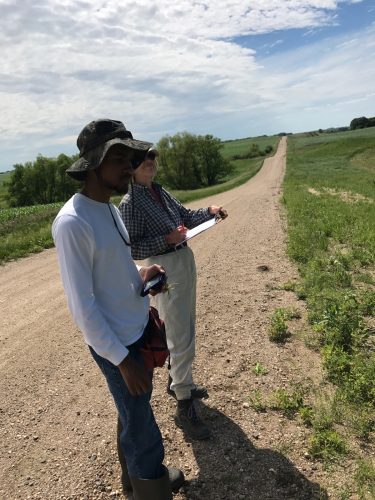
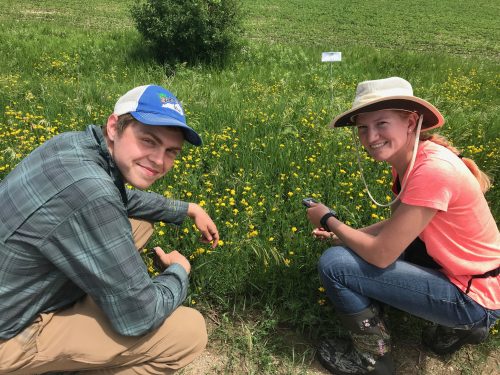
Hi, I am Selena a fourth year undergraduate at the University of California, Santa Cruz! GO BANANA SLUGS!!!! I am here at CBG doing a summer internship in the Echinacea lab! I am looking at intraspecific competition between two California Asteraceae species Layia platyglossa and Lasthenia californica!
I also have a mentee, his name is Steve…
I go to Little Village Lawndale high school in the South Side of Chicago. I am entering my Senior year of high school. I am also studying two California species and testing intraspecific competition with varying water treatments. I am helping Selena collect data, so I am here to help! 
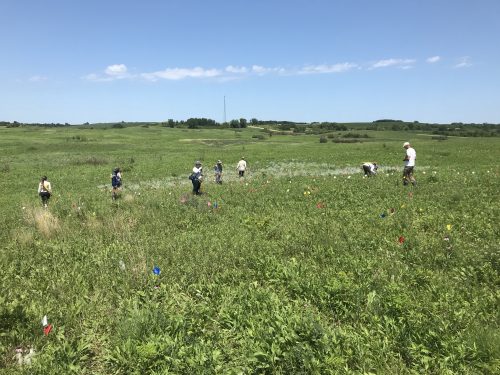
Today was the historic Big Event 2: Electric Boogaloo and while the rain may have tried to thwart our attempts to quantify how different pollinator taxa affect male fitness, Team Echinacea overcame and we had a great time watching pollinators in experimental plot 2 once the rain cleared. We saw lots of bees visiting Echinacea and spent lots of time running between plants to shoo away bees. We also played some fun games during downtime (in between the rushes of bee visits). Andy taught us Contact, which is a fun game where you try and guess the word the other person is thinking of.
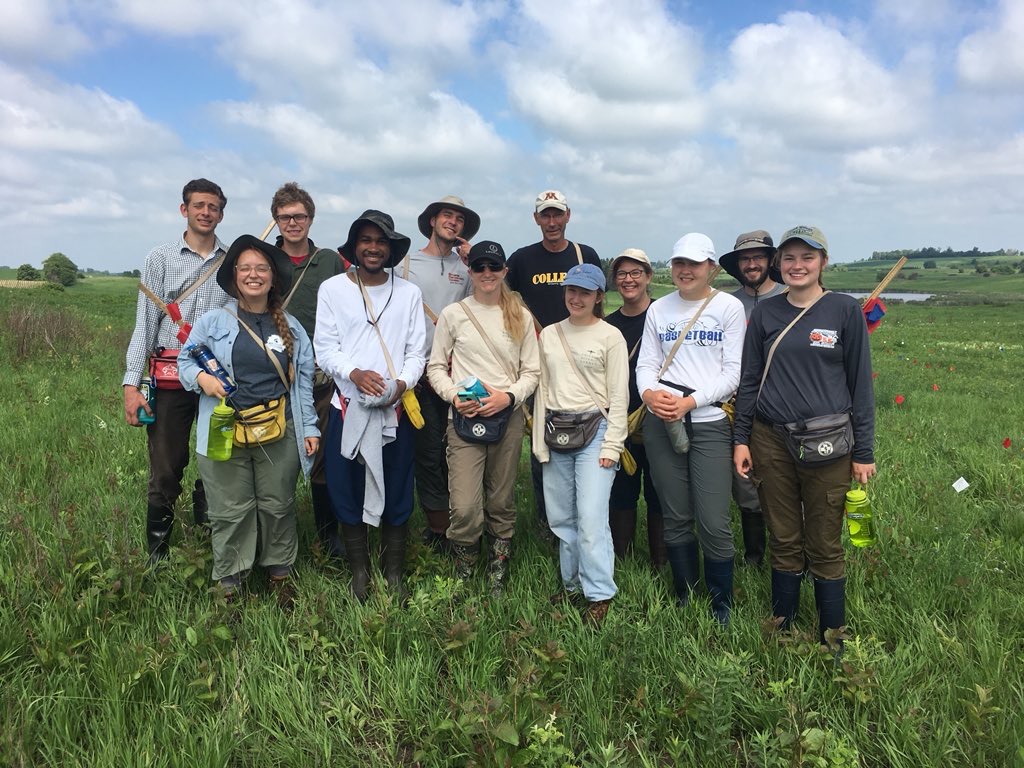
 The Team watching and shooing bees in P2
After we finished with TBE2EB (The Big Event 2: Electric Boogaloo) We had just a little bit of time to work on miscellaneous tasks. I worked on preparing some information to assist with planning for the big demography project and others visited Hegg Lake to decapitate any traitorous Echinacea pallida that might be lurking around.
We are looking forward to a hot day tomorrow, stay tuned for updates on The Big Event 3: Return of the Bees (Although my vote for naming #3 was The Big Event 2: Electric Boogaloo 2: Electric Boogaloo, much more systematic in my opinion).
Have a great night Flog!
Will
Today, Team Echinacea took a significant detour from our normal routine. Not only did we leave Solem Township on an adventure to Glacial Ridge National Wildlife Refuge, but we didn’t even study Echinacea while we were there. No, instead we studied a member of the orchid family, the endangered western prairie fringed orchid.
Our trip north started early in the morning, with us leaving the comforts of Alexandria at 6:00 AM, in order to arrive at the site by 9:00 AM. Of course, a much-needed donut stop was had along the way. Once we arrived in the first of the two experimental sites, we got to work finding the prairie orchids.
Gretel teaching the team how to count flowers on an orchid
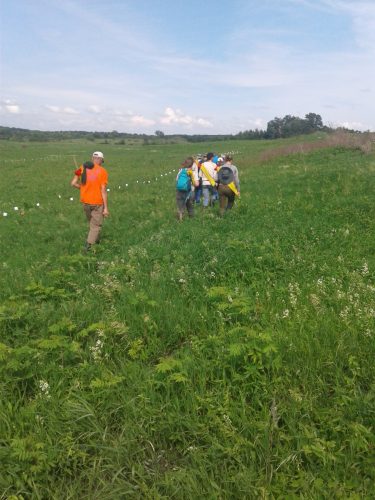
We do a full census of the prairie orchids that are on the experimental plots, which means we need to find every orchid that is within the boundaries of the study. And therein lies the challenge. The plants themselves aren’t necessarily too hard to find: big ostentations flowers, often with 5+ flowers on a plant. No, what is challenging is figuring out where one is within the experimental plots. The corner of every 10 meter by 10-meter plot is marked with a short wooden post, which, in tall grass and ankle height waters, at times, can be quite difficult to find. Of course, we learned to use our extreme geometry skills to locate the locations of where posts should be (as some posts simply weren’t there).
Little can one tell there are many plot marking posts within this picture
The ankle-deep water was much nicer that the occasion knee-deep water that criss-crossed the plots
All things considered, Team Echinacea had a very successful day as Team Orchid (or Team Platanthera, if you prefer). we found 584 plants within the experimental plots and got to see many new plants and birds that are not present in our Echinacea plots, like the showy milkweed and the upland sandpiper.
Get ready for tomorrow to hear all about the Big Event!
Michael
The day began with 2 rain delays before work began. Kristin moved her insect tents and Jennifer, Zeke, Mia, Evan and John finished the phenology at P2 and cut randomly selected Echin heads. It was a very short work day followed by the annual Independence Day picnic moved from Elk Lake to the farmhouse with members of Stuart’s family and Team Echinacea. Since the workday was short, here’s a little diddy:
A Day in the Life of Team Echin
(disclaimer – some words and names may have been spelled incorrectly but intentionally)
I’m leaving for work wife says “wow you smell purdy”
I say “thank you dear its sunscreen, SPF 30”
The Hjelm House, P8 and P2 and P1,
The Farmhouse, G3 and G2 and G1
Ticks, Chiggers, and mosquitoes
and Jalapeno Cheddar Cheetos
Evan, Anna, Brigid, Kristin and Morgan,
Citrus lanatus we love Stuart’s watermelon
Hydrate with water, put on your sunscreen and boots
What’s for supper tonight and who’s cooking at the roost
Visors, toothpicks, Twist Ties and Flags,
Proposals, projects, task forces and flogs
Wagenius, Reed, Dykstra and Shaw
Angustifolia, Purpea and Pallidaw
College of Wooster in Ohio with Zeke
Groupme, Dropbox, Twitter and Tweeks
Hegg Lake, Staffanson, Stevens and Landfill
PB and mustard sandwiches at lunch with Michaill
Team norms, teamwork, go team and efficiency,
Before you go please sync the visors Ryley
Jennifer, Amy, Evan, Andy, John VK and Mia
You see now Stuart “its not about Echina Cia”
This flog will be written in verse;
I hope you won’t think it’s the worst.
Rather than prose
In limericks I compose,
The daily events from the Roost.
On Friday the 29th of June,
We celebrated Kristen’s birthday at noon,
By eating some cake,
And later, listening to Drake,
After eating some Mexican food.
 Kristen & Cake
On Saturday day we relaxed;
But adventure our night didn’t lack.
To a concert we went;
It was quite an event;
The custodian from my school played the sax.
 Evan, Zeke, and Mia making hats for Echinacea flowers
^Mike Kreitzer: custodian at Saint John’s University by day, rockstar by night.
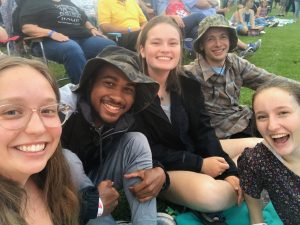
Kristen, Evan, Mia, Zeke, Brigid (looks way too excited) at the Melrose Riverfest Concert
After a week of skeeters and ticks and horse flies,
Being outside seemed unwise.
But after a day,
Of bugs being away,
Now we miss those we all once despised.
Hi floggers! It’s me, Kristen, your resident prairie plant astrologist. The alignment of the stars and planets has captivated humans for centuries. In times of confusion humans have looked to the sky for answers. Many think that how these celestial bodies move throughout the sky determine the course of our lives. Do you struggle with finding the thread of greater meaning among the events of your life? Do you suffer from a constant internal battle between the head and the heart? Astrology may have answers to some of these questions for you, human. But did you know that just like people, prairie plants ALSO have their own horoscopes?
In times of confusion, like loss of habitat, lack of essential nutrients, threats from pollution and other anthropogenic forces – our astrological bodies can provide plant communities with guidance towards higher survival and reproductive success. Many weeks ago on my Instagram story (@kristenmanion) I did a similar reading of the signs as prairie plants. This time I have used plants exclusively found in Echinacea Project field sites.Below I provide characteristics for the signs in the form of prairie plants based on my interpretation of their alignment with the stars. For simplicity, I have decided only to use Sun signs in this analysis.

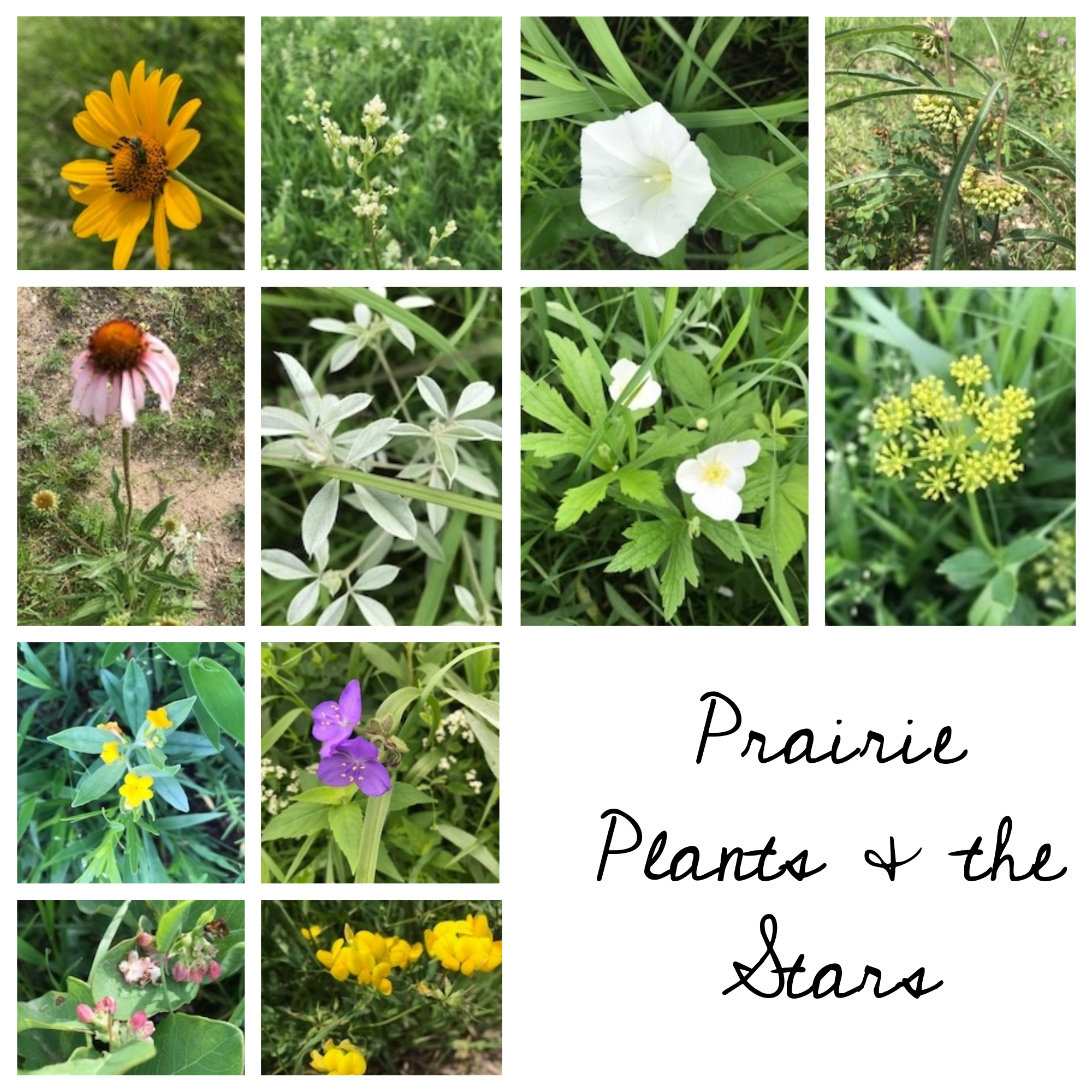
Below from left to right:
Capricorn. Heliopsis helianthoides. – Wow False sunflower. You work hard to attract those pollinators. Remember that hard work can take you far, but it’s important to remember your roots and appreciate the pollen donors and stigma receptors who got you there.
Aquarius. Capsella pursa-pastoris. – Shephard’s purse you intellectual! Don’t forget that sometimes matters of the heart are important along with the head. Life’s emotions can be complex, consider your roots.
Pisces. Convolvulis arvensis. – Classic field bindweed producing a gorgeous and showy white flower. Your creative side is your strength but can also be your weakness. Consider that inspiration can come from unlikely places!
Taurus. Asclepias viridifloris. – Spider milkweed, you’re almost ready to attract those butterflies! As a Taurus you never seem to forget to relax and kick back. It’s okay to work hard sometimes – more milky latex the better!
Gemini. Echinacea angustifolia. – Oh, my dear Echinacea! Why of course you would be a Gemini. Your beauty illicits feelings of great joy, yet why do you also seem to provide us with our greatest challenges? Perhaps it is because there are two sides to you. We love to see you blooming, yet we don’t want to harvest 1800 heads in P2!
Cancer. Pediomelum argophyllum. – Just like you Cancer, silver leaf scurf pea is soft around the edges. Remember that just because you might be a little sensitive you are still important. Fixing nitrogen is so important to the prairie! You’re value is never underrated.
Leo. Anemone canadensis. – I know you Leos like to be proud, and boy are anemones a proud bunch. Don’t forget that just because you like to show off doesn’t mean you can’t step out of the limelight for a less popular floral neighbor. It’s okay to be okay with not always performing!
Virgo. Zizea aurea – The prim and proper golden alexander knows that order is key to a productive life. Sometimes though, you may find yourself overwhelmed by your blooms. Take a step back and reevaluate when things get tough.
Libra. Lithospermum canescens. – Just like you, hoary puccoon, is an interesting plant! We know that you like to be balanced Libra but that you also don’t like to move away from your comfort zone. Consider thinking outside the box. It may reward you!
Scorpio. Tradescantia occidentalis. – Spiderworts are very mysterious, just like sun sign Scorpio. We know you have a meaning behind the madness but don’t forget that transparency is okay too. The team wants to know what you’re thinking inside your head!
Aries. Symphoricarpos albus. – You can be tough sometimes (especially given your woody habit)! Consider other points of view. You thrive when other people help you out, don’t forget that you can be someone to lean on too.
Sagittarius. Lotus corniculatus. – The only non-native in this list, but you don’t care, Birdsfoot trefoil, because you love to travel. Sometimes it’s okay to not spread so much. When there’s too much of you, it can force others to feel like they can’t shine.
This has been the first edition of “The Signs as Prairie Plants.” Consider ways in which the stars can guide your life and remember sage advice from plants in the prairie: always remember your roots!
As we learn from our struggles of today (whether it be setting up emergence tents at EELR, checking twist ties at p2, or learning how to be an efficient team member there is always something to be learned about oneself. Sometimes the struggle is worth it! Consider this as we lean into this next few weeks.
Love Your Prairie Plant Astrologer,
Kristen
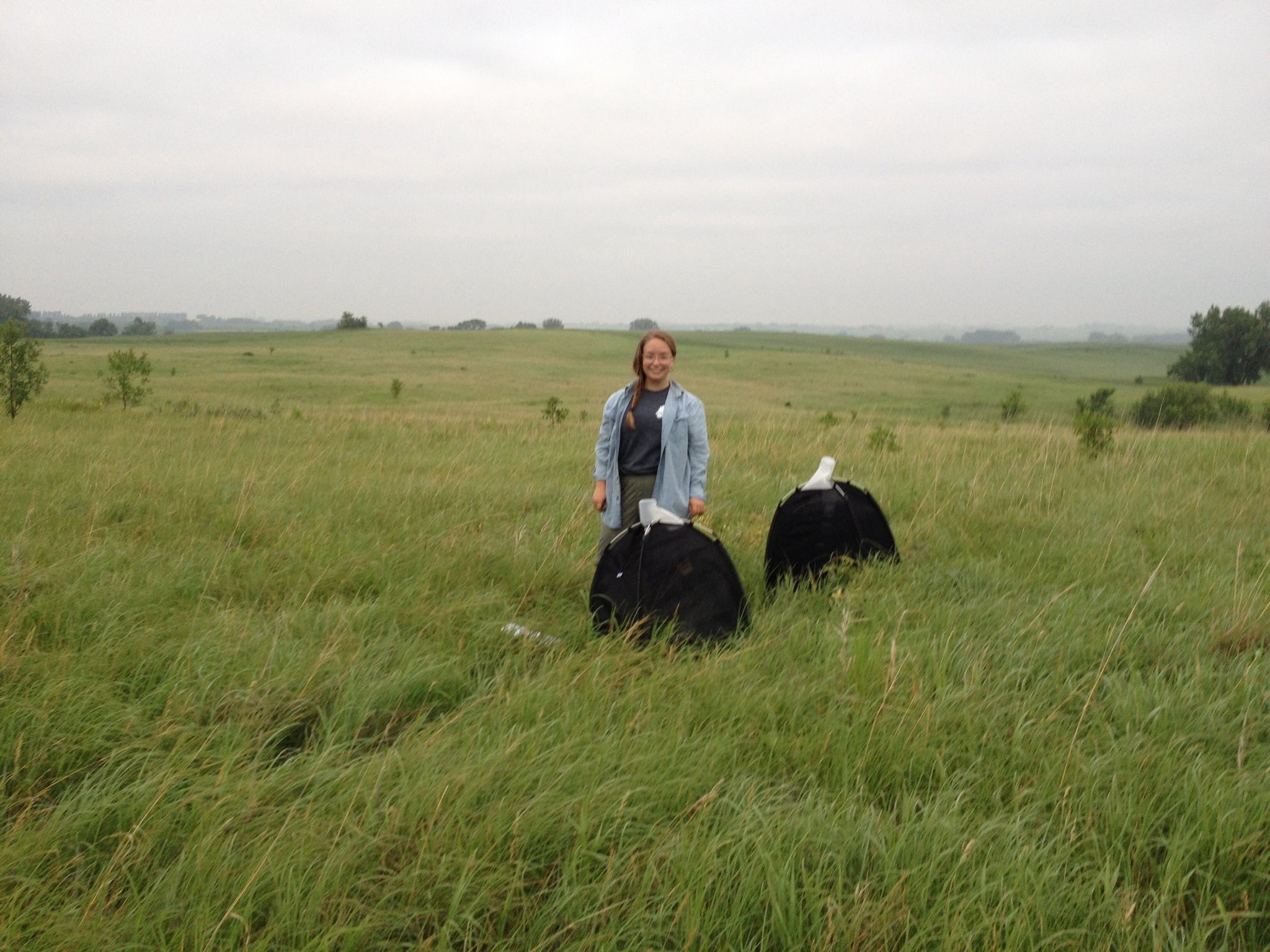
Kristen setting up emergence tents for the first time. The team after surviving the onslaught of mosquitoes at p2.
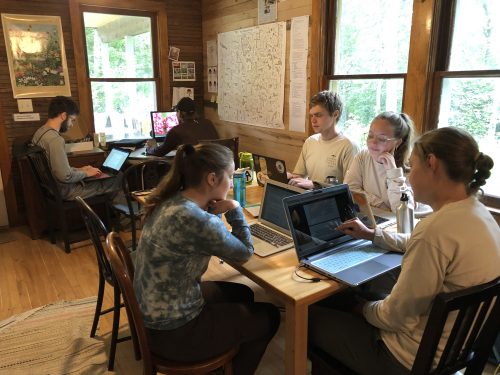
Hello Echinacea Project! Yesterday was a very productive day. It had rained the night before, so we all brought our laptops and started on our project proposals! We were very concentrated and hard workers 🙂
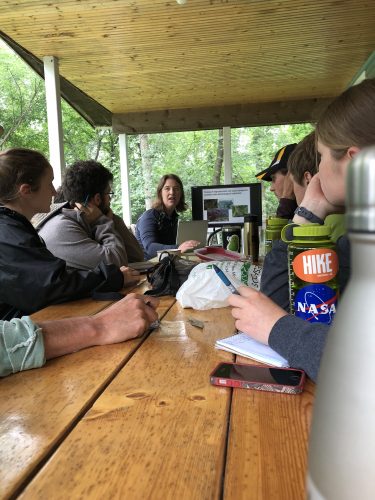
Team being very productive During lunch, Jennifer gave a very informative presentation about bees and plant flowering times.

After lunch, we split up into task forces. Some people worked with the bees, some people did plant data at the P2 experimental plot, and some people went out to P1 to start the aphids and spittlebug projects. The unfortunate part about the afternoon was there was no wind, therefore every member of Team Echinacea was very itchy that evening from all the mosquito bites we got.
Andy bundled up to avoid mosquitos while taking spittlebug data
As of late the Roost has been obsessed with pirates thanks to Riley’s love for chanties. Because of this I decided to write a flog post as if Team Echinacea were as a pirate crew. Enjoy!
June 25th, 2018. A storm is brewing. As the crew traveled to the docks where the S.S. Hjelm was stationed we sang some of our favorite chanties like Boys by Charli XCX. Once we arrived at the docks we broke into smaller groups. A group of us, led by Captain Stuart, marked out where our precious purple coneflower treasure was in p1. (Not all of this can be paralleled into a pirate based theme, but I’m trying my best).
 Andy standing stoically as the storm approaches. Knowing that the worst is inevitable, but still hoping for the best The storm that was brewing passed over as we headed in for meal time. We were meet with a new crew member named Amy who quickly won us over with brownies (Not sure if pirates ate brownies, but couldn’t think of the equivalent of brownies for pirates). Once our meal was finished, Captain Jennifer took us out to p2 where we also marked where our precious purple coneflower treasure was buried. As the day came to an end, the crew members who lived in the Roost (and Kristen) returned home where we ate a meal prepared by Andy and talked about tales of native bees (Didn’t know how to incorporate our scientific reading club into the story smoothly, but I think that’ll work). Amy also joined us as we shared tales about native bees.
As dusk began to fall upon the sky, I recorded the events of the day in the captain’s log (The pirate version of the flog) before retiring to my quarters and resting for the tasks that tomorrow holds.
 After risking their lives to mark the precious purple conflower treasure, crew members began the long journey from p2 back to the docks where the S.S. Hjelm was stationed. The work for the day may be over, but more challenges lie ahead. However, with the camaraderie among the members, there is nothing the crew can’t overcome.
Evan-
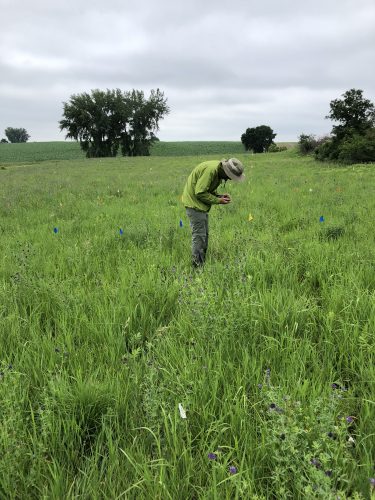
The first thing that comes to me when I think about East Riley is definitely the poison ivy. The notorious three leafed plant made me hesitant to get any closer to investigate the site. Fortunately, there were a few Echinacea plants present closer to the side of the road. Both sides of the field were bordered by agricultural fields. The agricultural field facing north was growing soybean while the field facing south was growing corn. When out at the site I didn’t notice any solitary bees flying around, but next time I’m at East Riley I would want to observe how frequently they fly to this specific site even with the large amount of poison ivy present.
Riley-
Nothing is more exciting than arriving to a site that shares one’s name. That being said, I had high expectations for a locale sharing my alias; I anticipated a diverse array of species as well as a slew of budding Echinacea heads. Unfortunately, my wish for high species richness did not come true, but I was lucky enough to spot 8 Echinacea heads. Although the exact land use history of the site was unknown to myself, I could only speculate (with the help of Ruth) that the land was previously used for agriculture due to low plant diversity and a lack of remnant prairie indicator species. My experience at East Riley as one of my first impressions of a non-remnant prairie will leave a lasting impact on me because the difference in plant community composition between it and remnant prairie is so immense. It is amazing to me how years of land use can be summarized by a plant layer on topsoil and how much we can learn from this green blanket.
Ruth –
As the member of our team who had been to East Riley quite a few times, I noted its usual great extent of bare ground from which numerous Echinacea with nicely developing flowering stems were emerging. Here, there is a rather wide (over a meter, I’d say) road edge that is level with the road surface. This edge is frequently scraped by snow plows and other road maintenance equipment. The mature Echinacea, with their deep taproots, tolerate this remarkably well, resprouting over many years. Other species typical of unbroken prairie, like leadplant, are not abundant here and may be less tolerant of the scraping. At this site, we have found many seedlings of Echinacea each year for a decade and have relocated them in subsequent years to monitor their survival and (eventual) flowering. Amy Dykstra led this seedling project and has been working on this dataset this year. I don’t remember such vigorous poison ivy in the past. Important to beware of that patch!!
Ruth draws a map of East Riley while Evan enters site data onto his Visor.
The year is 1300 CE. Steven, a viking explorer, has just landed on the shores of the land that would one day become Kensington, Minnesota. Steven and his crew pull their longship ashore on the banks of the vast Southern Canadian Sea, weary from their long journey. Although Steven would never see how dairy, corn, and soybeans would feed the world of his progeny, Steven saw in this landscape the potential for a land of vast prosperity. In the first few months, Steven lost most of his crew to a frog-borne parasite, now known exclusively for its adverse health effects in dogs. Steven learned the lay of this new land but often struggled. He was drawn back to his homeland after many years of documenting the landscape. Steven took with him a new appreciation for the beauty of discovery, and respect for new lands. Though most traces of Steven’s visit are lost, the Kensington runestone documents Steven’s journey into the unknown.
In the years following Steven’s journey, this majestic Southern Canadian Sea receded further to the north, eventually becoming what we know today as the boundary waters. As the soil dried, the sea floor served as a mineral-rich substrate for the colonization of new seeds. This new community of plants (dominated by grasses, forbs, and legumes) became the tallgrass prairies we know and love. Many people and animals have come to appreciate the prosperity of this verdant land. The spot on which Steven first stepped foot on North American shores is known today as Steven’s Approach.
Today, Steven’s Approach provides scientists associated with the Echinacea Project an opportunity to study how small plant populations persist in fragmented habitats. The site is comprised of two small remnant prairie patches located along Wolly Lake Road near Kensington, Minnesota. Most of the site is dominated by non-native plants. Invasive plants like these often make it difficult for native plants to compete for resources and space. This ecological consequence of small habitat sizes may impact the native plants at this site. Steven’s Approach only had one flowering Echinacea individual. What are the chances for reproduction and survival when your population is 1? This single plant is dependent upon pollinators for spreading its genetic material. How close is the nearest Echinacea individual? Will this individual plant at Steven’s Approach be able to spread its genes onto the next generation? This plant may struggle to survive and reproduce in the coming years.
Perhaps Steven existed, perhaps he did not; regardless, we hope that you were able to see the value of Steven’s journey. Discovery, growth, and a willingness to live with an open mind were key to his success. Our own growth this summer will be a lot like Steven’s. Like Steven, we will approach this new experience with a willingness to grow. We will learn more about ecology and evolution in fragmented habitats. We will take the knowledge we gain from this summer back with us to our own institutions in the fall. While we seek knowledge about the world around us, we will really come to know ourselves.
|
|