|
|
Trevor here! And for, sadly, what is the last time. I can’t believe time flew by so fast! Alas, Nina and I began writing our research papers as we near the end of our externship experience. Our “mini-papers” will be available on the flog and our broken down into four sections: introduction, methodology, results, and discussion. Make sure to check them out! Nina’s will be about diversity of plant species and its affect on Echinacea seed-set, while mine will concern how the burning of certain sides of a field-site affect the seed-set Liatris and Solidago species. Nina and I also had our “dissertation defense” sessions with Stuart, which both were very enjoyable and left us with lots of answers, but also plenty of questions to consider as we move forward as both students and researchers.

We also got to attend Dr. Kelly Ksiazek Mikenas public dissertation defense discussing her research on green roofs in both Chicago and Germany. In fact, the green roof pictured above is quite famous and is located on top of Chicago’s very own City Hall! Her talk was extremely enlightening and taught me a lot about promoting biodiversity in an urban setting. She defended the use of prairie species on green roofs in cities. She also had a wonderful array of snacks and her resume was quite inspiring and left me lots to think about when it comes to my future.
Thanks for everything Team Echinacea,
Trevor
Nina here! Today, Trevor and I continued analyzing the data that we collected during the first two weeks of our externship. We both kept working in R, perfecting our papers, and analyzing our results.

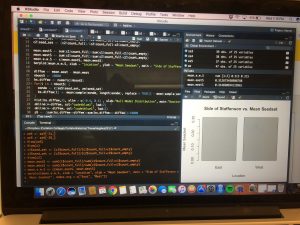
Trevor found the confidence intervals for mean seed-set for Liatris and was very excited to see that the two intervals didn’t overlap, strengthening his confidence in his previous findings. Next, he aggregated and merged Solidago data before repeating the analysis he did for Liatris on the Solidago data, but with very different results. It seems as if Solidago was not effected by the burn that occurred in the site (as you can see from the photo on the left), but stay tuned for more updates!

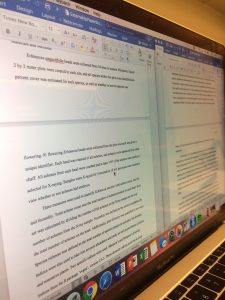
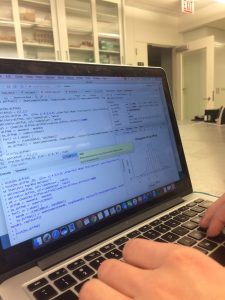
Meanwhile, I looked the diversity function within R’s ‘vegan’ package to use Shannon’s and Simpson’s Diversity Indices on my plant community from each plot. I plotted seed-set, fecundity, and achene count against each index and found the highest correlation when looking at achene count. Next, I calculated species richness as well as the Shannon’s and Simpson’s Diversity Indices including only flowering plants. More updates to follow! After finishing up my actual analysis, I got back to working on my paper (which you can see a preview of on the right) and started thinking about which portions of my results and which graphs I might want to include in my paper.
Hey! Trevor here! Today, Nina and I continued our work on the R platform, aggregating data and creating figures to be included in our final reports, which (spoiler alert!), will be available on the Flog starting Friday! So if you’re interested in checking out our work, feel free to look at those to get a sense of our projects.
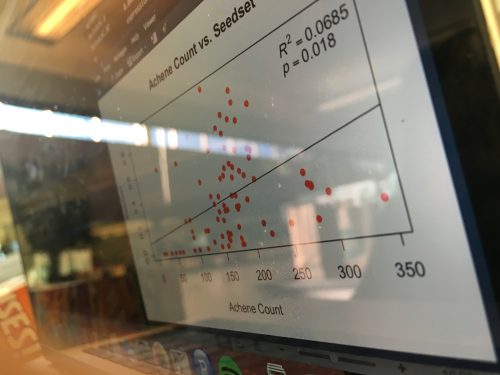
 Nina calculated the percent of invasive species for each of her plots using data from the United States Department of Agriculture (USDA) website. She used these percentages to create various graphs to attempt to predict the success of echinacea based on the number of invasive species. However, she found that this was not an effective way of predicting echinacea success. Aside from these quantitative activities, Nina also worked on “beautifying” her graphs, which includes adding R-squared and p values. Look at the red graph to the left, isn’t it beautiful?! Nina calculated the percent of invasive species for each of her plots using data from the United States Department of Agriculture (USDA) website. She used these percentages to create various graphs to attempt to predict the success of echinacea based on the number of invasive species. However, she found that this was not an effective way of predicting echinacea success. Aside from these quantitative activities, Nina also worked on “beautifying” her graphs, which includes adding R-squared and p values. Look at the red graph to the left, isn’t it beautiful?!
I finished up my work on the top/middle/bottom data and progressed onto the seed counts and cleaning data from the Liatris and Solidago species, which meant that I learned how to merge two different “csv” files together; a challenge, but a challenge I accepted. Afterwards, I worked through some obstacles to effectively calculate the mean seed-set for the East and West sides for the Staffenson site. East had a higher mean seed set at 0.34, compared to west’s 0.20. In the realm of ecology, that’s a big difference! Currently, I am working on calculating the p value for these findings; it’s a process.

Nina and I hope to finish up working in R tomorrow (we’re almost there!) and begin writing our papers.
Until next time,
Trevor 🙂
Nina here! To start off the third week of our externship, Trevor and I got back to work in R. We started making our own scripts to try to visualize our data and understand our results. I found a strong correlation between seed-set and fecundity and a correlation between seed-set and achene count (although the R squared value was small). I downloaded a database of plants of Minnesota from the USDA database that included information on whether or not the plants were native, threatened, or endangered as well as their fire tolerance and growth habit. I merged this database with the diversity data collected in the field in order to provide more data about each species. Next, I tried to calculate the percent of invasive and nonnative species for each plot. Meanwhile, Trevor calculated the means for the numbers of achenes in the top, middle, and bottom samples and determined whether or not there was statistical significance between pairwise comparisons of the findings. Next, he looked at confidence intervals for his findings. We both continued our work on our papers, writing up our methods sections specifically. As Trevor meant to say, there’s nowhere to go from here but up!
Trevor here! Today, Nina and I finished our work in “R” and diverged paths. I recounted Solidago to ensure that my initial counts were accurate. Nina began aggregating her data in “R” and created five extremely beautiful and effective graphs to display her data efficiently. Then, we progressed to the lab meeting, stuffing our faces with salami, cheese, and crackers as we learned about different management methods used with western prairie fringe orchids in Northwest Minnesota. Whilst attempting to answer questions, it seems as if these meetings yield more questions then answers as the intense discussion amongst fellow researchers brings up perspectives not previously contemplated, providing opportunities for future research. Stuffing our faces at lab meeting progressed into stuffing our faces at the holiday party as we joined everyone in the festivities. Highlights include chocolate covered strawberries, mac and cheese, and meatballs. Nina and I, on the recommendation of Leslie and Marty, then proceeded to walk off our meal with a stroll through the garden, visiting the amazing green houses in the Regenstein center. It’s super surreal to be inside a tropical-esque greenhouse in the middle of December! Ending our Friday, we began researching and writing the background information for our future research papers and are excited to continue our writing next week.

Nina here! Today, Trevor and I downloaded R and RStudio and started familiarizing ourselves with R by using the tutorial package ‘swirl’ and completing several of the lessons about the basic building blocks, vectors, matrices, data frames, logic, functions, and much more! Thanks in part to Trevor’s donut holes and Tracy and Lea’s support, we powered through and completed the swirl tutorials. Next, I got started with looking at my own data by reading in some of the csv data files into R and trying to get started on viewing them and writing a script to determine species richness. Also, just for fun, here’s a counting timelapse from a couple days ago of an evaluating empty, partially empty, and full achenes!
Hi! Trevor here, reporting on today’s events. Today I finished up my counting and classification of my achenes for both the Liatris and Solidago species. Better yet, Nina also finished her counting of the Echinacea species. Oh my! With our data collection finished, we are moving up the “corporate ladder,” and had our workday filled with enlightening meetings. We began by meeting with Jessa, a lovely 5th year Northwestern grad student. She told us everything from her educational background to her potential future jobs (including the possibility of teaching at the undergraduate level or possibly government work?!). She also explained the realities of being both accepted and working in a graduate environment, specifically at the Chicago Botanic Garden, which was a narrative we had not heard before. After brainstorming potential inquiries and hypotheses that emerged through our research, Nina and I also had a meeting with Stuart, Lea, and Tracie to discuss analyzing these hypotheses.

As you can see, we were hard at work (I was taking in the picture, but I promise I was there!). The meeting left us with lots of questions answered, but also lots of other questions to ponder was we begin our data analysis with two preliminary hypotheses we came up with. Tomorrow begins the start of “R.”
Wish us luck!
Nina here! Trevor and I were hard at work today, getting our achenes ready to be X-rayed and counted. I finished randomizing achenes in preparation for X-raying them later, and started counting the achenes in each of my samples. Trevor finished cleaning his achenes, placed them all on X-ray sheets, and X-rayed all his samples. Now he has to count which of the achenes in each of his samples were full and which do not havean embryo. An image of one of his X-ray sheets is below.
Trevor here and reporting that me and Nina are very “hatisfied” with our progress from the day. As we sat alongside each other, working on our various tasks, we invented a new word in the english dictionary: “hatisfied.” It translates to, roughly, being satisfied with being at or around halfway done. I am around halfway done cleaning my solidago samples and will most likely finish tomorrow. After that, I will move on to arranging my baggies on x-ray sheets and then x-raying them to discern if there is an actual embryo in the achene. How exciting!
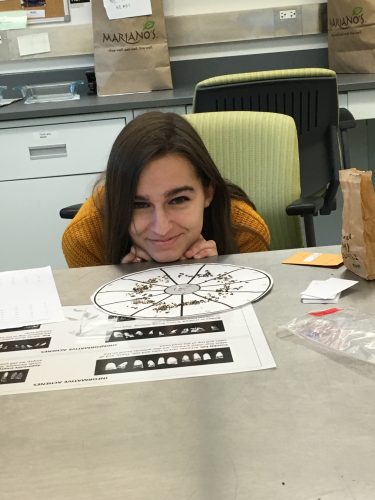
 On the other hand, Nina moved on to randomizing today to prepare her samples for x-raying, which she admits was a more tedious task than she had initially anticipated. But she is very enamored with her randomization wheel that she has so much that it makes up for the meticulous task it is (see exhibit A to the left). She finished about half of her bags and reports feeling “hatisfied” with her progress. She hopes to be done by tomorrow so she can prepare het sheets for x-raying for Wednesday. She also reports that she is looking forward to counting because it is a beautiful, non thought-provoking task. On the other hand, Nina moved on to randomizing today to prepare her samples for x-raying, which she admits was a more tedious task than she had initially anticipated. But she is very enamored with her randomization wheel that she has so much that it makes up for the meticulous task it is (see exhibit A to the left). She finished about half of her bags and reports feeling “hatisfied” with her progress. She hopes to be done by tomorrow so she can prepare het sheets for x-raying for Wednesday. She also reports that she is looking forward to counting because it is a beautiful, non thought-provoking task.
It seems as if we are nearing the end of phase one for both of our projects and both Nina and I are so excited to see what comes next! See you soon—and remember to stay “hatisfied!”
Nina here! Today, Trevor continued cleaning his Solidago heads, which have very small and delicate achenes. However, because his achenes are so small and fluffy, they tend to fly everywhere, including onto the bread that Trevor was eating! He cleaned 28 heads today, which was very impressive. Meanwhile, I finished re-checking my Echinacea heads for any stray achenes that were stubbornly clinging to the heads and proceeded to scanning the achenes for counting. While I was re-checking, I found quite a few miscellaneous bees and spiders, some of which are pictured below. Also, a picture of one of my scans below – for this site, the achenes needed to be separated according the the location that they came from on the head, so ‘top,’ ‘mid,’ ‘bot,’ and ‘other’ achenes were segregated. Next week, I hope to start randomizing my samples for X-raying and counting the scans that I took. Trevor hopes to finish counting and move on to X-raying next week as well.
We also had a lab meeting today to discuss a draft of a paper on Echinacea pollination, specifically analyzing the number of pollinators over the course of the season as well as type of pollinator and quality of pollination. The paper had some interesting (and confusing!) results, so it was nice to discuss the draft with others from the lab and look at the feedback that the draft received from reviewers.

|
|


 Nina calculated the percent of invasive species for each of her plots using data from the United States Department of Agriculture (USDA) website. She used these percentages to create various graphs to attempt to predict the success of echinacea based on the number of invasive species. However, she found that this was not an effective way of predicting echinacea success. Aside from these quantitative activities, Nina also worked on “beautifying” her graphs, which includes adding R-squared and p values. Look at the red graph to the left, isn’t it beautiful?!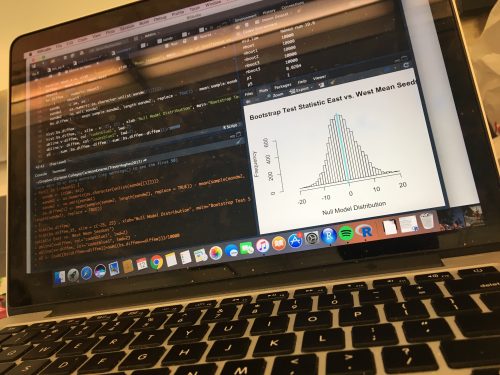


 On the other hand, Nina moved on to randomizing today to prepare her samples for x-raying, which she admits was a more tedious task than she had initially anticipated. But she is very enamored with her randomization wheel that she has so much that it makes up for the meticulous task it is (see exhibit A to the left). She finished about half of her bags and reports feeling “hatisfied” with her progress. She hopes to be done by tomorrow so she can prepare het sheets for x-raying for Wednesday. She also reports that she is looking forward to counting because it is a beautiful, non thought-provoking task.
