|
|
Hello all! A lot has happened since my last post, so here is a brief update!
After returning to school with my phenology data and experimental seed heads in the fall of 2011, I began work on my senior thesis using that data as a foundation. In April of this year I defended my thesis, “Flowering Phenology and Seed Set in Fragmented Populations of the Prairie Plant Echinacea angustifolia” and was awarded Distinction by my committee! Stuart and I continued to work on my data after my defense and are planning to continue the project and potentially incorporate data from this summer in the hopes of publishing it! Here are some of the very interesting results that we’ve gotten so far:
> aggregate(ss ~ nndist + pdtime, data = mm, mean)
nndist pdtime ss
1 far early 0.1637403
2 near early 0.2690535
3 far late 0.2947009
4 near late 0.1802392
We found that there’s a relationship between seed set (ss), peak flowering date (pdtime), AND distance to the 6th nearest neighbor (nndist). Seed set was higher in plants that had a combination of close 6th nearest neighbor (near) and early peak flowering date or far 6th nearest neighbor (far) and late flowering date. Very interesting!
(table is categorical and matches glm model which looks at pd & nn6 as continuous)
If anyone has any questions, is interested in continuing this exciting project this summer, or would like a copy of my thesis, feel free to contact me! (Amber Zahler at ambermzahler@gmail.com)
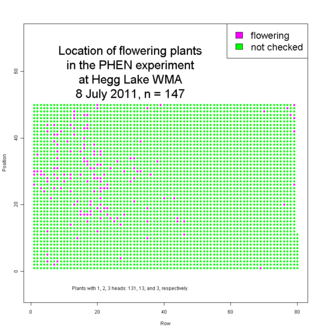
We found 147 flowering plants in Jennifer’s Phenology Experiment during a thorough, but not exhaustive, search on Friday. Most of these plants have buds only and will start shedding pollen later. I posted a map of locations of all plants to flower this year.
 Click on thumbnail to see a larger map. Click on thumbnail to see a larger map.
Jennifer planted this experiment to investigate heritability of flowering timing (phenology) in spring 2006.
Last year eight plants flowered and about 2700 plants were alive. Read about measuring last year.
Assuming that almost all of those plants are still alive and that we didn’t find all the flowering plants, then about 6% of surviving plants will flower this year (>147/2700).
For kicks, I made maps of the paths of data enterers. We usually worked in pairs and used one person’s PDA to enter data. Here are the paths…
Josh D’s visor, Amber E’s, Nicholas G’s visor, Gretel K’s visor, Lee R’s visor, Callin S’s, Stuart W’s visor, Maria W’s visor, Amber Z’s visor. For the record Katherine M’s visor had only one record and we didn’t use Karen T’s visor.
Hi everyone, Maria here again. Today was a particularly happening day in my opinion. Everyone had something to do. Amber E. is back from Alaska with Ruth! Karen arrived from Evanston in the afternoon!
In the morning those of us who hadn’t finished our Stipa searches in the common garden finished that! (So Stipa is done! – we scaled back though and only searched for the 2011(?) cohort). After that Gretel, Ruth, Amber E and I put Position/Row signs in the common garden and made the signs face East/Westwards so now it’s so much easier to read the signs while you are walking in the common garden. Then we got started on looking at the phenology of Echinacea in the common garden. We systematically walked through each row, looking out for flowering Echinacea with emerged anthers and pollen, twist-tying the heads and recording them in our visors. Josh joined us when he finished his Stipa searches. We found quite a few flowering heads – bet there’ll be more soon.
While we were looking for flowering Echinacea, we saw Stuart, Callin, Amber Z and Nicholas crowded around ‘Joe’ – the pet name given to the prominently flowering Echinacea at row 28, position 860. As described by Callin in the previous post, they were practicing bract-painting for their independent projects on Joe.
When we finished looking at all the rows, it was time for lunch and short presentations of our projects. It was good to hear about everyone’s projects and talk about my own projects and get feedback. After lunch, we got started on our independent projects or worked on the New Media Initiative.
Gretel and I headed to Hegg Lake to look for Dichanthelium (Panic Grass) seeds for my second project. This summer I will be collecting seeds from Dichanthelium plants from different remnants, including Hegg Lake and Loettler’s Corner (I might not have spelt that right – sorry). My plan is to collect seeds from 30 individuals from each “site”, as there are several places at Hegg Lake that seem to have a lot of Dichanthelium. After collecting the seeds, I will be bringing them back to Chicago Botanic Garden and do more work on them in the fall/later.
Click here for the
Google doc of my summer project proposals
I am super super indebted/thankful/grateful for Gretel. Without her guidance, I’d probably be in a big mess/not knowing what to do/still be at Hegg Lake as this is my first time doing independent field work.
When we reached the place at Hegg Lake (it was near the road, area with ditch, south of the parking lot), a lot fo the Dichanthelium seeds had already fallen off the culms. It was quite disheartening. We walked a little north and found a patch of Dichanthelium with most of their seeds intact, then we laid out the tape measure for 20m in a roughly north-south direction (I kept thinking it was 2m while Gretel patiently corrected me ^^;;). Initial plan was to do every plant within arm’s length from transect, or every other plant if population was dense. However, that was not quite possible given the circumstances. After Gretel and I collected seed from the first plant and did all the measurements, she continued measuring/collecting while I picked ~30 plants near the transect (more than my arm’s length) that had at least one culm with 8 or more seeds to collect from and flagged them with a blank flag. I started measuring/collecting after I finished flagging. Around 4pm, Lee called – reinforcements were coming! Ruth and Lee arrived with Karen and they helped us finished the rest of the plants (by that time Gretel had completed 17 plants (!!) and I was on my 6th plant). It turned out that we had 31 flags so 31 envelopes with data and samples! We also collected some “random” samples – ie seeds from various random plants away from transect. Finished around 5pm – thanks to Gretel, Lee, Ruth and Karen! Really excited to get the first 30 done!
Take a look at the simple data entry for today’s collection for more technical details if you’re interested. I might also do the seed count for today’s samples just to see how many seeds we can get from 30 plants using the ‘8 or more’ rule. (I just need to be rreally careful not to lose any seed >.<)
Dichant_DE-HL1001-31.xlsx
We left 11 flags (labelled with sample number) at the site that we will return to later to collect more seeds from.
Now that I have more experience, I’ll definitely be more systematic+efficient about it.
Notes to self for tomorrow/next time:
– “just-in-case” extras (extra equipment, envelopes, pens, sharpies, flags) do come in handy! Meter sticks are probably more efficient than tape measures. More flags would be good. Maybe use a different color for “done” or for extras.
– Extra samples are good too. Maybe do 32 plants per site?
– Bring a plastic bag/something to put a plant specimen in – I need to get a sample of the other Dichanthelium species (“hairy leaved”) to press and identify.
– Equipment list would be useful esp when I have more than 5 things to remember.
Lesson of the Day: Having an experienced person around and helpers is always always always helpful! =D
Thanks again to Gretel and everyone who helped!
We finished measuring plants in Jennifer’s Phenology plot at Hegg Lake WMA this Friday.

We measured many plants.
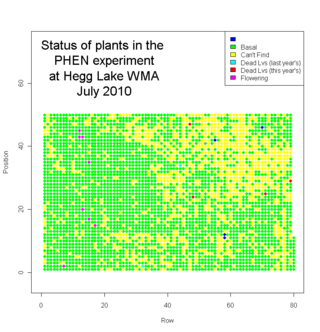
We measured about 2700 plants. Eight plants flowered this year. We visited another 1300 locations where we couldn’t find a plant (mostly because they had died). Here’s a map of the plot with the status of each location (click to see a bigger version)…
In addition to Echinacea angustifolia, we saw some good prairie plants in the plot, including lead plant (Amorpha canescens), yellow lady-slipper (Cypripedium calceolus), prairie rose (Rosa arkansana), Missouri goldenrod (Solidago missouriensis), silver leaf scurf pea (Psoralea argophylla), and many others.
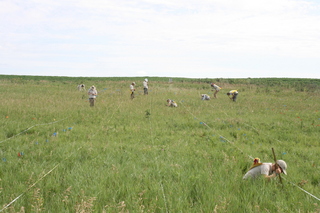
It was a big job, but we were quite efficient. We laid out 50m tapes on every other row to help guide us. Four of us went out on Wednesday to flag positions 1 and 50 for all rows. That took ~2h. We started flagging positions 10, 20, but that was unnecessary. On Thursday we all went out and measured from 2-4 pm. On Friday we did two shifts: 10 -12 and 2:30 -5.
We were happy to be done.
On the way out we removed a weed that we had noticed the day before–spotted knapweed. We were careful not to touch it because it can be a skin irritant. I’d never seen this plant in the study area before.
Heading home.
What a great way to end the week. It was Katie and Laura’s last day. They are heading back to the Chicago Botanic Garden to prepare their posters and talks.
This afternoon we are going to measure plants in Jennifer’s Phenology plot at Hegg Lake WMA. Here is a script that makes a datasheet that assigns us rows to measure. The order is approximately 1 – 80, but they are slightly mixed up (just to keep us on our toes): measurePHENatHeggLakeRows.r
This graph summarizes the First and Last Day of Flowering for Echinacea plants in the common garden. It looks like peak flowering was July 8, 2010.


June 21, 2010 marked the start of Echinacea flowering in the common garden this year. As of June 28, 2010 113 plants had started producing pollen. Approximately 775 plants will flower this season with a total of 1062 heads. We will be busy keeping track of the first and last day of pollen production per plant. As you can see from the pictures above, the pollinators are back at work, too!
Thank you all for your hard work when we measured my Hegg Lake common garden a week back. It was by far the fastest the Hegg garden was ever measured and there were no rechecks besides can’t finds! Below is some information regarding the Hegg garden.
Total plants planted in May 2006: 3,945
Number alive in August 2006: 3,699 (94%)
Number alive in August 2007: 3,320 (84%)
Number alive in August 2008: 3,008 (76%)
Number alive in August 2009: 2,834 (72%)


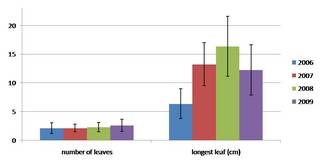
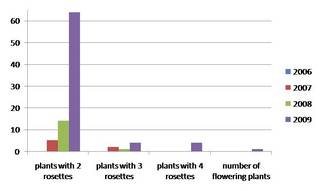
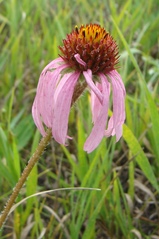
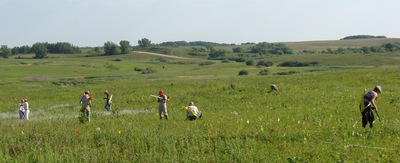
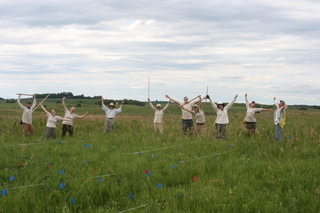
As you can see the length of the longest leaf actually decreases from 2008 to 2009. However, there were way more plants with multiple rosettes this year than in years past. I think the leaf length decreased because last year there was so much duff on the ground that the petioles of the leaves grew really long. The plants definitely looked healthy this year after the spring burn than they did last year. What was really exciting was I had my first flowering plant this year in row 7 position 44! Below is a picture of that flowering plant, and one of everyone measuring at Hegg.


Also, thank you to everyone in the town hall for being so hospitable to my dad, Oscar, and me. We had a great week and except my weird heat rash (it eventually went away) it was a lot of fun. Best of luck with the final push at the end of the season!
Regards,
Jennifer, Oscar, and John

This week we are going to make big dents in CG measurements and our independent projects. We will measure the CG MWF morning and TTH afternoon. We’ll start T & Th morning with Phenology assessments and end off each morning with time to work on independent projects. Afternoons on MWF will be devoted to independent projects.
Be ready 8:30 Monday morning–with sunscreen on & visors synced–for a pep talk (it’ll be about efficiency & the well-oiled machine)!
day        AM                PM
Monday     measure CG        ind. proj.
Tuesday    phenology & i.p.  measure CG
Wednesday  measure CG        ind. proj.
Thursday   phenology & i.p.  measure CG
Friday     measure CG        ind. proj.
Saturday   phenology & off   off
The common garden hit peak flowering status on July 13, 2009. The graph below shows how many heads have started and ended flowering each day. Approx. 197 heads have yet to shed pollen of the 1,614 found.

|
|


-thumb-320x242-50642.jpg)