|
|
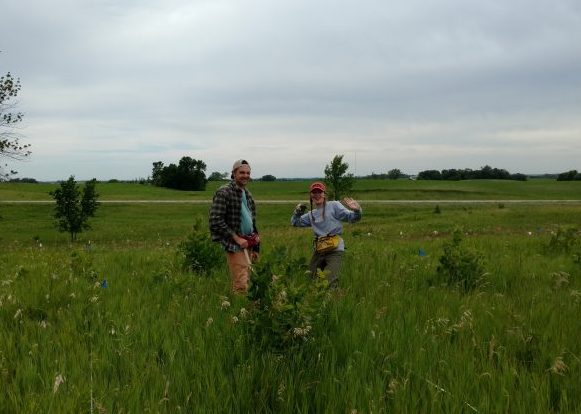
 Alex and Tracie search for juvenile Echinacea plants in experiments qGen2 & qGen3. In 2017, we found 1006 three-year-old plants out of the 2526 original seedlings found in 2014 (we found 1724 plants in 2016) in the qGen2 cohort. In the qGen3 cohort we found 248 of the 644 seedlings.
The main goal of the qGen2 and qGen3 experiments is to quantify the evolutionary potential of two remnant prairie populations of Echinacea angustifolia by estimating the additive genetic variance of fitness. We make estimates for two mating scenarios. The first scenario is an experimental crossing design with all matings among plants from two “core” sites: SPP and LF (core x core). The second design uses sires (pollen donors) from the core and dams from sites peripheral to the core. The crosses performed (core x core, core x periphery) in this experiment will quantify additive genetic variance for fitness in each site and each experimental group. Additionally, we will test for differentiation among families; do progeny from sires differ after accounting for maternal (dam) effects?
Comparing germination and first year survival between the qGen2 & qGen3 cohorts:
| exp |
approxFullAcheneCt |
totalAcheneCt |
seedlingCt |
germination |
firstYrSurvival |
| qGen2 |
6300 |
26144 |
2581 |
41% |
84% |
| qGen3 |
6200 |
19777 |
644 |
10% |
38% |
Start year qGen3: 2015
Start year qGen2: 2013
Location: The sires (pollen donors) are in the remnants Landfill and Staffanson. The dams (seed plants) are in exPt 1 and they originate from remnants. Specifically, the grand-dams (seed plants of dams) are from remnants Landfill (core) & around Landfill (peripheral) and remnants Staffanson (core) & railroad crossing sites (peripheral). All progeny are in exPt 8.
Overlaps with: Heritability of fitness–qGen1
Data collected: We used handheld computers to collect data on juvenile plants.
You can find more information about Heritability of fitness–qGen2 & qGen3 and links to previous flog posts regarding this experiment at the background page for the experiment.
 Team Echinacea measuring plants in big batch In 2017 we assessed survival and fitness measures of the qGen1 plants. 1,991 plants in qGen1 were alive in 2017. Of those, 3% flowered in 2017 and 46% have yet to flower ever. All were planted in 2003.
The qGen1 (quantitative genetics) experiment is designed to quantify the heritability of traits in Echinacea angustifolia. We are especially interested in Darwinian fitness. Could fitness be heritable? During the summer of 2002 we crossed plants from the 1996 & 1997 cohorts of exPt1. We harvested heads, dissected achenes, and germinated seeds over the winter. In the Spring of 2003 we planted the resulting 4468 seedlings (this great number gave rise to this experiment’s nickname “big batch”).
Start year: 2003
Location: Experimental plot 1
Overlaps with: qGen2 & qGen3
Physical specimens: We harvested 46 heads from qGen1 in 2017. These heads will be processed in the lab to determine achene counts and seed set.
Data collected: We collected fitness measures using handheld computers.
Products: We have an awesome dataset that we will share once the paper is published. Ruth Shaw is working on an analysis of the qGen1 dataset.
You can find more information about Heritability of fitness–qGen1 and links to previous flog posts regarding this experiment at the background page for the experiment.
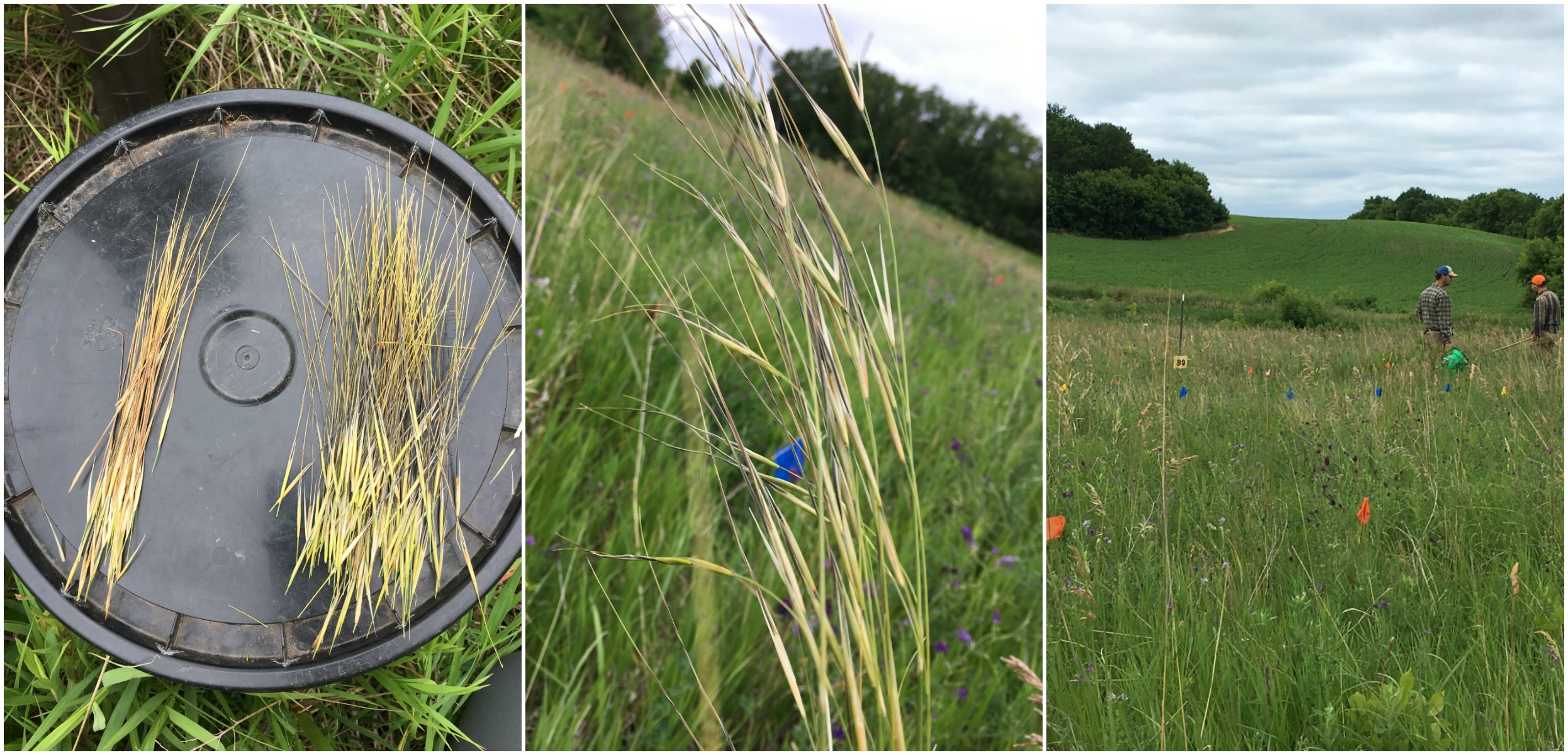
This summer we found 52 basal Stipa plants and 209 flowering plants! The flowering Stipa plants had a median of 15 fruit per plant. Our largest flowering Stipa plant had 301 fruits and 31 culms. We harvested around 5000 fruits from experimental plot 1! These Stipa plants, or porcupine grass (Hesperostipa spartea) were planted as seeds in 2009 and 2010.
 A Stipa collage created by Anna with collected fruits, a flowering plant, and Will and Wes searching for stipa. Start year: 2009
Location: Experimental plot 1
Physical specimens: Fruits from the 209 flowering plants were broadcasted in experimental plot 2.
Data collected: There are currently 3 datasets in the Stipa folder in CGData (~Dropbox/CGData/Stipa/225_measure/measure2017/)
- 20170628StipaSearchData.csv: 50 records from 28 June 2017. We searched for basal and flowering Stipa and recorded row and position, culm count, fruit count, aborted fruit count, missing fruit count, and notes.
- exPt1StipaSearch20170705.csv: 200 records from 28-29 June 2017. This csv includes rows with position 859 and status “Other (Note)”, indicating the row was searched but no stipa was found. When Stipa was found, status, row, position, culm count, fruit count, aborted fruit count, missing fruit count, and notes were recorded.
- 20171109StipaSearchData.csv: 69 records from 2 August 2017 and 9 August 2017. In this csv, predetermined rows and positions (where Stipa were found in previous years) were searched and the same information was collected as the other csvs. Since this was later in the season, all fruits had already dropped–but they could still be counted.
Products:
- Josh Drizin’s MS thesis included a section on the hygroscopicity (reaction to humidity) of Stipa awns. View his presentation or watch his short video.
- Joseph Campagna and Jamie Sauer (Lake Forest College) did a report on variation in Stipa’s physical traits within and among families in 2009
You can find out more about Stipa in the common garden and links to previous flog posts about this project on the background page for this experiment.
We had a big year for censusing plants in natural remnant populations. In 2017 we did both total demo, visiting all plants, and flowering demo, visiting just plants that flowered this year. Check out the chart below to see what we focused on at each site:
| Total Demo |
Aanenson, Around LF (partial), Common Garden, East of Town Hall, East Riley, Hegg Lake, Landfill West, Loeffler Corner East, NRRX, recruit he, recruit hp, recruit hs, Riley, RRX, South of Golf Course, Steven’s Approach, transplant plot |
| Flowering Demo |
Around LF, BTG, DOG, Elk Lake Road East, Golf Course, KJs, Krusemark, Landfill East, Liatris Hill, Loeffler Corner West, Near Town Hall, Nessman, NNWLF, North of Golf Course, NWLF, On 27, recruit el, recruit hw, recruit ke, recruit kw, RRXDC, Staffanson East Unit, Staffanson West Unit, Tower, Town Hall, West of Aanenson, Woody’s, Yellow Orchid Hill East, Yellow Orchid Hill West |
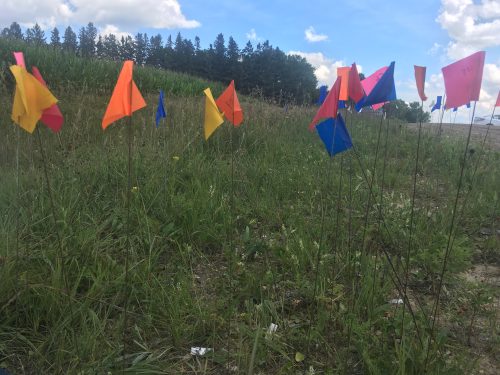
 We stake to locations where flowering plants have been found in the past and place a flag there. This is the East Riley roadside remnant, an area with a lot of Echinacea close together and a high chance of getting mowed. When we find a new flowering Echinacea plant, we give it a tag and get its location with a survey-grade GPS (better than 6 cm precision). Then, we can revisit this plant for years to come and monitor its survival and reproduction.
This season we added 5945 demo records and about 1375 survey records to our database. After over 20 years of this method, we now have a very rich longitudinal dataset of life histories including thousands of plants. REU Will Reed was a huge help organizing demo tasks for Team Echinacea over the summer and helping out with demap (the demographic census database) during the year.
Year started: 1996
Location: Roadsides, railroad rights of way, and nature preserves in and near Solem Township, Minnesota.
Overlaps with: Flowering phenology in remnants, fire and flowering at SPP
Data collected: demo records include Flowering status, number of rosettes, number of heads, neighbors within a 12 cm radius of plants found. These are all taken with PDAs that sync with an MS Access database. They are all transferred to the demap R repository in bitbucket with git version control.
GPS points shot: Points for each flowering plant this year shot mostly in SURV records, stored in surv.csv. Each location should be either associated with a loc from prior years or a point shot this year.
Products:
- Amy Dykstra’s dissertation included matrix projection modeling using demographic data
- Project “demap” merges phenological, spatial and demographic data for remnant plants
You can find out more about the demographic census in the remnants and links to previous posts regarding it on the background page for this experiment.
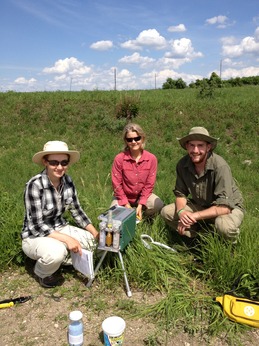
 Reina, Pamela, and Mike with the photosynthesis machine used in Kittelson et al. (2015) In 2017, of the original 1,470 plants in INB2, 473 were still alive. Of the plants that were alive this year, only 4 were flowering (0.8%) and 71% have never flowered. Interestingly, there are differences in survival for each cross level. 31% of the most inbred plants were living in 2017, compared to 39% of the plants in the between-remnant cross level. All individuals were planted in 2006.
The INB2 experiment investigates the relationship between inbreeding level and fitness in Echinacea angustifolia. Each plant in experiment INB2 originates from one of three cross types, depending on the relatedness of the parents: between maternal half siblings; between plants from the same remnant, but not sharing a maternal or paternal parent; and between individuals from different remnants. We continued to measure fitness and flowering phenology in these plants.
Read previous posts about this experiment.
Start year: 2006
Location: Experimental plot 1
Overlaps with: Phenology and fitness in P1, Inbreeding experiment–INB1
Physical specimens: We harvested 2 heads from INB2 that will be processed in the lab with other heads harvested from P1.
Data collected: We used handheld computers to collect fitness data on all plants in INB2.
Products: The below papers were published in summer 2015:
Kittelson, P., S. Wagenius, R. Nielsen, S. Qazi, M. Howe, G. Kiefer, and R. G. Shaw. 2015. Leaf functional traits, herbivory, and genetic diversity in Echinacea: Implications for fragmented populations. Ecology 96:1877–1886. PDF
Shaw, R. G., S. Wagenius and C. J. Geyer. 2015. The susceptibility of Echinacea angustifolia to a specialist aphid: eco-evolutionary perspective on genotypic variation and demographic consequences. Journal of Ecology 103:809-818. PDF
You can find more information about the Inbreeding experiment–INB2 and links to previous flog posts regarding this experiment at the background page for the experiment.
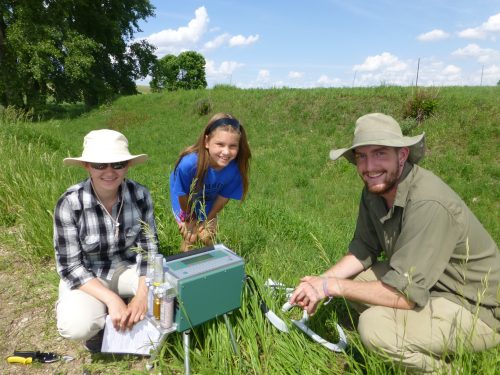
 Reina, Hattie, and Mike with the instrument used to measure photosynthesis in 2013. In 2017, of the original 557 plants in INB1, 180 were still alive. Of the plants that were alive this year, 7 (4%) were flowering and 23% have never flowered. Interestingly, there are differences in survival for each cross level. 21% of the most inbred plants were living in 2017, compared to 39% of the plants in the between remnant cross level. All individuals were planted in 2001.
The INB1 experiment investigates the relationship between inbreeding level and fitness in Echinacea angustifolia. Each plant in experiment INB1 originates from one of three cross types, depending on the relatedness of the parents: between maternal half siblings; between plants from the same remnant, but not sharing a maternal or paternal parent; and between individuals from different remnants. We continued to measure fitness and flowering phenology in these plants.
Read previous posts about this experiment.
Start year: 2001
Location: Experimental plot 1
Overlaps with: Phenology and fitness in P1
Physical specimens: We harvested 6 heads from INB1 that will be processed in the lab with other heads harvested from P1.
Data collected: We used handheld computers to collect fitness data on all plants in INB1.
Products: The below papers were published in summer 2015:
Kittelson, P., S. Wagenius, R. Nielsen, S. Qazi, M. Howe, G. Kiefer, and R. G. Shaw. 2015. Leaf functional traits, herbivory, and genetic diversity in Echinacea: Implications for fragmented populations. Ecology 96:1877–1886. PDF
Shaw, R. G., S. Wagenius and C. J. Geyer. 2015. The susceptibility of Echinacea angustifolia to a specialist aphid: eco-evolutionary perspective on genotypic variation and demographic consequences. Journal of Ecology 103:809-818. PDF
You can find more information about the Inbreeding experiment–INB1 and links to previous flog posts regarding this experiment at the background page for the experiment.
In 2017, we searched in 7 recruitment plots for flowering Echinacea angustifolia plants. For each flowering plant, we took demographic data- counting the number of rosettes, counting the number of flowering heads, and shooting a GPS point of the exact location of the plant. Four plots had no flowering plants, but three of the plots had a total of 43 flowering Echinacea plants. Of the plots with flowering plants, two plots (with 35 of the flowering plants) are located at Hegg Lake, a site managed by the Minnesota DNR, and one plots (with 8 flowering plants) is located at Eng Lake.
This recruitment experiment was originally established in 2000 to quantify seedling emergence and juvenile survival of Echinacea angustifolia during its reintroduction to sites with varying land-use history and burn schedules. Before 2014, detailed data was collected on each plant in the plots. Since 2014, we’ve censused each plot yearly to collect demographic data for every flowering plant.

Echinacea at Hegg Lake, photo by Wes Braker
Year started: Plantings in 2000-2002
Location: Ten study plots on state land with different land use histories: old-field and restored grassland.
Overlaps with: Demographic census in remnants
Data collected: Status, rosette count, flowering head count, GPS point for each flowering plant in each recruitment plot
Products:A paper (Wagenius et al. 2012) published in Restoration Ecology.
You can find more information about the effects of fire on seedling recruitment of Echinacea angustifolia on the background page for the experiment.
This summer, Amy and members of Team Echinacea continued to monitor the progress of Echinacea plants in her local adaptation plots. We found 221 basal plants, but no flowering plants this year. Amy has 3 sites: Western South Dakota, Central South Dakota, and West Central Minnesota. At each site achenes from all sites have been sowed. Team Echinacea is able to help with the assessment of survival and fitness traits of the individuals in the Minnesota plot.
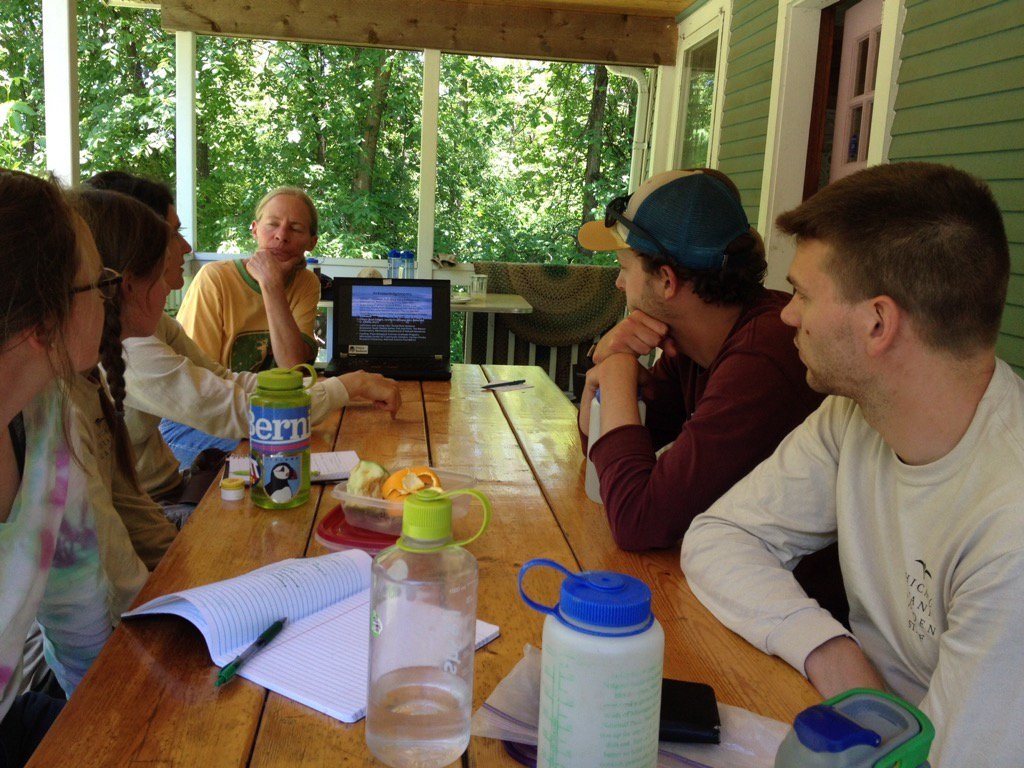
 Amy presents her local adaptation research so far at lunch this summer. Start year: 2008
Location: Grand River National Grassland (Western South Dakota), Samuel H. Ordway Prairie (Central South Dakota), Staffanson Prairie Preserve (West Central Minnesota), and Hegg Lake WMA (West Central Minnesota).
Overlaps with: Dykstra’s interpopulation crosses
Data collected: Plant fitness measurements (plant status, number of rosettes, number of leaves, and length of longest leaf)
You can find more information about Amy’s local adaptation experiment and links to previous flog posts regarding this experiment at the background page for the experiment.
This summer, we found 68 basal plants in the crossing experiment. None of these plants have ever flowered, but maybe next year! We measured plant status, number of rosettes, number of leaves, and length of the longest leaf of the individuals. We also noted damage (herbivory) to the leaves.
These data will allow Amy to test how mating with individuals from other populations affects Echinacea fitness. She planted 15,491 achenes, the offspring of crosses from six of the largest remnant populations. Populations might either benefit or suffer from crossing with plants from another population.
Hegg Lake WMA Start year: 2008
Location: Hegg Lake WMA
Overlaps with: Dykstra’s local adaptation
Data collected: Plant fitness measurements (plant status, number of rosettes, number of leaves, and length of longest leaf)
Products: Read about Amy’s analysis of the interpopulation crossing experiment in her flog post.
You can find more information about Amy’s experiment and links to previous flog posts regarding this experiment at the background page for the experiment.
 In 2017 only 2% of the surviving members of the 1996 cohort flowered! In 2017 only 7 plants flowered of the surviving 284 plants in the 1996 cohort. That means that 44% of the original plants are surviving and only 2% of the living individuals flowered! Five percent of living individuals flowered in 2016. In contrast, 45% of living plants flowered in 2015, followed by 37%, 34%, and 40% from 2014 back to 2012. We found that of the original 646 individuals, 284 were alive in 2017, only 7 fewer than last year. We are not sure why so few plants flowered this year. It’s possible that lack of fire in the plot influenced flowering rates. This plot was due for a prescribed burn in spring 2017, but weather and scheduling conflicts kept us from burning.
The 1996 cohort has the oldest Echinacea plants in experimental plot 1; they are 21 years old. They are part of a common garden experiment designed to study differences in fitness and life history characteristics among remnant populations. Every year, members of Team Echinacea assess survival and measure plant growth and fitness traits including plant status (i.e. if it is flowering or basal), plant height, leaf count, and number of flowering heads. We harvest all flowering heads in the fall, count all achenes, and estimate seed set for each head in the lab.
Start year: 1996
Location: Experimental plot 1
Overlaps with: phenology in experimental plots, qGen3, pollen addition/exclusion
Physical specimens:
- We harvested 8 heads. At present, they await processing in the lab to find their achene count and seed set.
Data collected:
- We used Visors to collect plant growth and fitness traits—plant status, height, leaf count, number of flowering heads, presence of insects—these data have been added to the database
- We used Visors to collect flowering phenology data—start and end date of flowering for all individual heads—which is ready to be added to the exPt1 phenology dataset
- Eventually, we will have achene count and seed set data for all flowering plants (stay tuned)
Products:
You can find more information about the 1996 cohort and links to previous flog posts regarding this experiment at the background page for the experiment.
|
|