Categories

plants flagged at lf site for seedling search

I flagged 20 spots at the landfill site last Saturday. 18 are centered on Echinacea plants that flowered last year (blue flags). 2 are random locations (orange flags). Amy and Caroline are going there tomorrow to search for seedlings.

I noted other plants that were flowering on the east hill:
Zizia aurea
Lithospermum canescens
Sisyrinchium (1 pla)
Viola pedatifida
Astragalus sp.
Pediomelum esculentum – just about to start
Geum triflorum – done
Commandra umbellata – mostly done

On the west hill I noted these:
Senecio (1 pla)
Taraxacum officinale
Antennaria neglecta – done

seedlings found!

We searched for Echinacea seedlings in six prairie remnants last week. We found some! Over 2+ days eight of us found 57 seedlings.

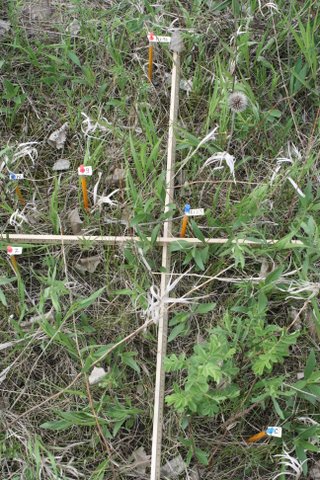
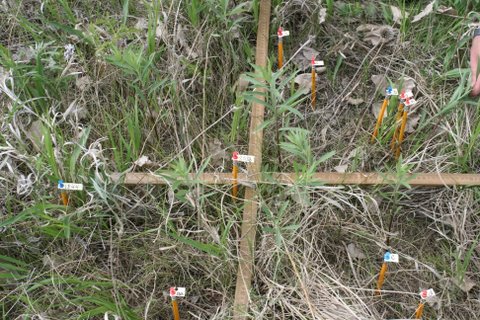
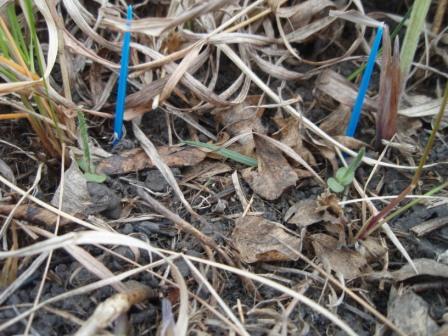
Ruth and Georgiana found 5 seedlings in this circle (41 cm radius) centered on plant 12034 at Steven’s approach.

We visited 87 circles. Ten of the circles were centered on random points in the remnants and the rest were centered on plants that flowered last year. The random points were all at least 1.5 m from every plants that flowered last year and within 4 m of one or more plants that flowered last year. The radii were 41 cm in 4 remnants and 50 cm in the other two. The total area searched was 51.3 square meters.

We also noted that there were about a gross other Echinacea plants in these circles. Some were tagged from previous year, others not.

We changed our protocol from last year and pairs differed in data they recorded and map notations. When we go back to the remaining nine sites in two weeks we should follow this protocol:

we must have at least two measurements to every seedling noted on the map
we must have at least one measurements to every basal plant noted on the map
make a map for every circle where any plant is found
note the style of every toothpick placed (round, square, colored, striped, etc)
note all plants that are determined to be just outside the circle on the map
We need consistent map notation for seedlings, basal plants, focal plants, flowering plants, tagged plants, nails

Also we need to get more pencils, thumbtacks, and cards with containers to hold it all.

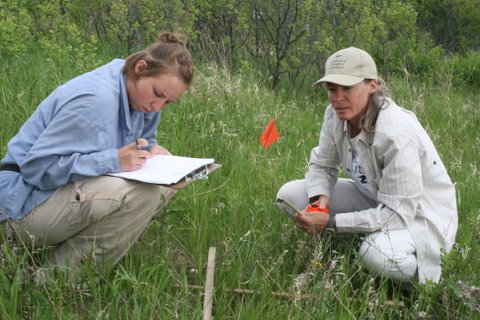
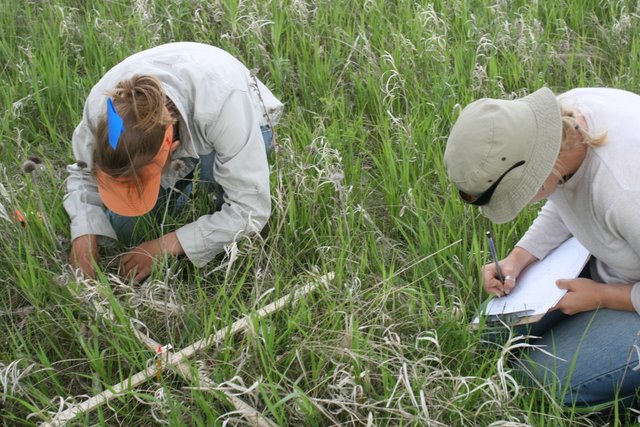
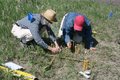
Here are some photos of us searching and photos of places where we found some seedlings…

IMG_8844.JPG

IMG_8853.JPG

IMG_8857.JPG

IMG_8867.JPG

IMG_8870.JPG

There were eight of us searching, Amber Eule-Nashoba, Ruth Shaw, and Stuart Wagenius searched Thursday & Friday. Georgiana May searched on Thursday. Gina Quiram searched on Friday. Caroline Ridley, Amy Dykstra, and Kate B searched on Friday (after driving across South Dakota to search for seedlings there earlier in the week). [Note to SW: Kate B is KD on datasheets.]

On Thursday we found one circle at SGC that was overrun by poison ivy. Lacking protection, Amber and I decided not to venture in. On Saturday I went back to the circle with neoprene gloves. I removed some poison ivy and then searched the circle. Alas, I found none.

Burns of recruitment plots

One of our long-term experiments evaluates the effects of burn treatments on seedling recruitment and survival (see abstract here:http://echinacea.umn.edu/bib/echinacea_abstracts.htm#wagenius_et_shaw_RE). Here are some photos documenting how we prepare plots for burning…

P5051278smaller.JPG
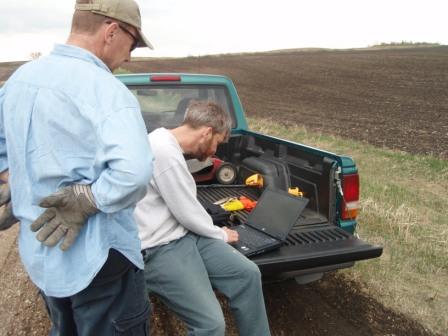
Figuring out which plots need to be burned.

P5051282smaller.JPG
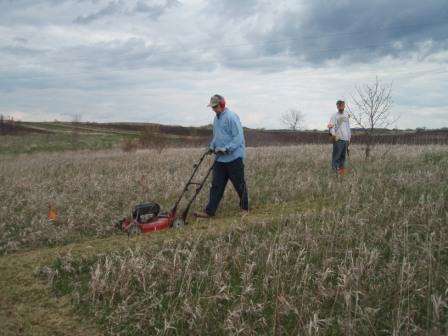
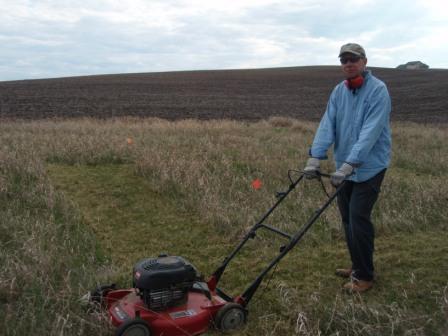
Mowing burn breaks.

P5051285smaller.JPG
Nice job, Brad.

P5191289smaller.JPG
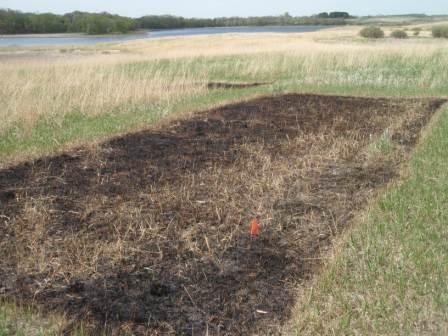
Successfully burned plots.

P5191310smaller.JPG
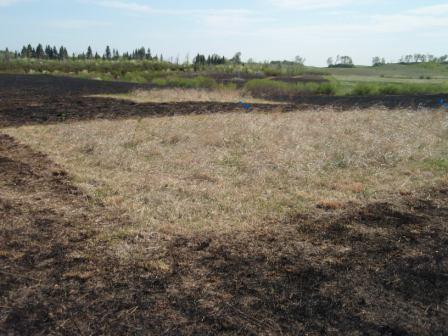
The east half of Hegg Lake WMA was burned by the DNR. For our recruitment plots located within the burned region, we mowed burn breaks around plots we did NOT want to have burned.

Seedling searches at Hegg Lake

P5211314smaller.JPG
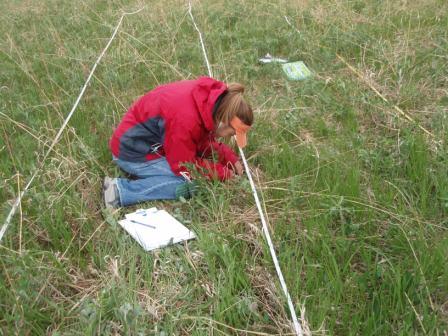
The classic seedling search position.

P5191294smaller.JPG
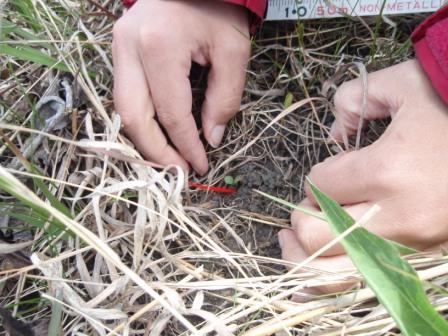
Young Echinacea seedling–cotyledons only.

P5191298smaller.JPG
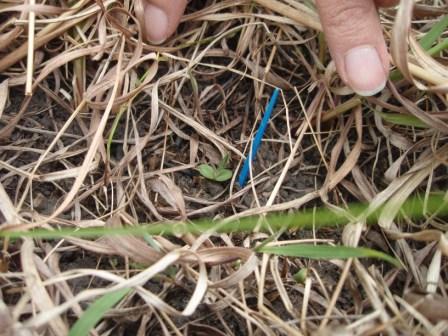
Larger seedling with a true leaf.

P5211312smaller.JPG
We marked seedlings with colored toothpicks, so we can re-find them in August, and again next summer. I hope to be able to learn about initial seedling establishment as well as seedling survival through the first two seasons.

Seedling search at Hegg Lake

Amy and I have been out at Hegg Lake since Tuesday afternoon, searching low and lower for Echinacea seedlings in my small “next generation genetic rescue” experiment and Amy’s crossing and local adaptation experiments. We’re finding quite a few seedlings- they’re mostly just cotyledons (some amazingly with their little seed coats still attached) and about a quarter have put out their first true, very fuzzy leaf. Without the true leaves, the seedlings can be tricky to tell apart from the seedlings of one or two other species, but we’ve developed a fairly good search image and are making notes of questionable identifications.
Mode number of seedlings for each “position,” that is a batch of 5-40 achenes sown: 0
Maximum seedlings found in a position in my experiment: 12
Maximum seedlings found in a position in Amy’s experiment: 10
I’ll also brag and mention that today I found the seedling with the longest true leaf so far at 42 mm. Looked to me like the plucky guy was flipping the bird. Ah, Amy and I certainly do succeed at keeping ourselves and each other entertained.
We completed searches for my experiment on Tuesday, made it through the crossing experiment Wednesday and today and plan to finish up with the local adaptation experiment tomorrow. Photos are forthcoming.

last day of flowering? take two

One last floret on head ‘yel’ of plant 40-943.5 shed pollen on September 1st. I imagine the plant exclaiming “better late than never.”

Six heads in the garden might still flower. They all look like duds or early buds. I don’t suspect they will flower, but I have been wrong before!

last day of flowering?

I suspect the last day of flowering (pollen shedding) in the common garden was yesterday. I won’t be totally certain until the snow falls, but here’s the full story… Dwight observed eight heads on Friday the 29th. Two of them were shedding pollen and each had two immature florets. Today, I observed them all again. Neither of the of the two normal heads shed pollen. One head was obviously done and the other (40-943.5-yel) has one immature floret. I suspect that that one immature floret will not mature, but I may be wrong.

Six heads are still in the bud/dud stage. They haven’t yet started to flower and they don’t look like they will. But, I may be wrong.

I will report on the flowering status and post a complete flowering schedule within a few days. I will also recap the final week of team Echinacea–we had an awesome finale. But first I need to catch up on sleep and harvest some heads tomorrow. The forecast is for winds 25 – 30 mph and gusts to 41 mph.

Demography

This is the last week with Team Echinacea this summer. We still have some plants to measure in the common garden experiment and there are still some plants flowering. We’ll get this done! Our main plan this week is to visit plants in the prairie remnants to see if they are alive. Last week we made a good start, but got rained out on Friday and the previous Monday (over 3″ of rain).

We’ve been to 4 remnant Echinacea populations and refound the seedlings that we identified & mapped in May or June. We have 8 remnants to visit this week. Our maps have worked quite well–we have found almost all of the locations and the majority of seedlings were still alive.

We also have to map the new flowering plants in our remnants and note which old plants are flowering this year. That’s a big job and we are making progress. We won’t finish all the sites, so we’ll have to come back this fall. But I hope we can finish up all of the big sites.

Assessing the survival and reproduction of Echinacea plants is important for understanding the population dynamics of these remnant populations. We want to know if the populations are growing (and perhaps expanding), holding their own, or shrinking (and perhaps heading toward local extinction).

We call our visits to remnants to find and refind plants “demography,” or demo for short. We call mapping the plants surveying because we use a survey station.

Click here to read our equipment list:

DEMO/SURV Equipment list

each person
pen
compass
8-m tape
radio
visor
tags
flag bag
flags–two colors

all
clipboards
binders
safety triangle
metal detector
reel tapes & pins

Survey station
station
battery
2 poles
tripod
box:
prisms
data collector
power cord/transformer
data cord

Common Garden Phenology Update: The end is near

10Augflowering.JPG

late in ’08 — phenology status

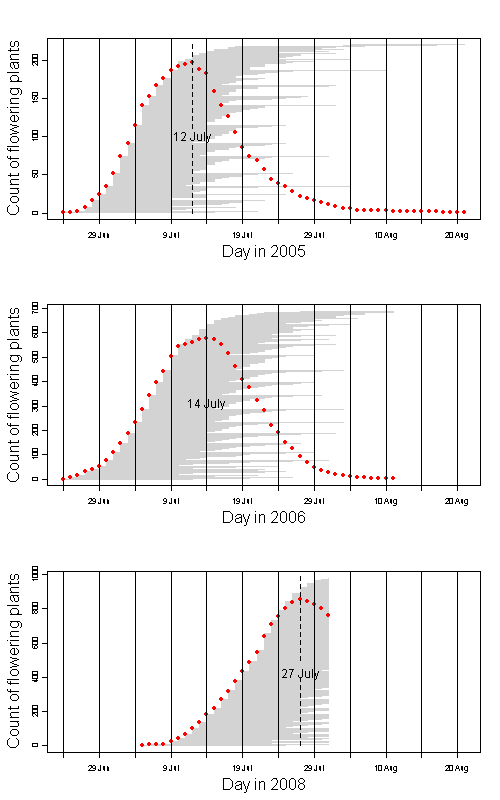
Echinacea angustifolia is flowering late this year.

Peak flowering this year was 27 July. Peak was 12 July and 14 July in 2005 and 2006 respectively. Here’s a rough graph that shows flowering phenology in these years. Red dots are the count of fl plants on each day. Horizontal gray lines indicate days that each plant shed pollen.

CGphen08.png

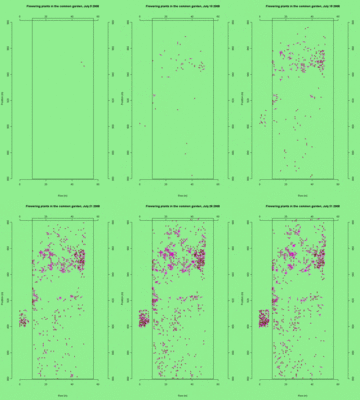
See the updated animation of flowering in the common garden experimental plot.

This animated GIF file is a map of all plants that flowered in the CG on each day from July 5 to July 30th. Each dot represents a plants that’s flowering on the day (see upper right corner).

Click on the thumbnail to see a full-sized image.

heads312.png This legend shows plants with 3, 1, and 2 heads flowering (left to right).