|
|
We’re done! Yesterday Emma and I finished up our poster with mere minutes to spare and some timely help from Stuart (the man knows concise language). I thought of about five other tests that we should run (to characterize interactions between explanatory variables, etc) while wrapping up our last section, but defeated the urge. We’re both very proud of the poster and the work we did these past three weeks.
Thanks to everyone in the Echinacea Project for your guidance, help, and companionship! This externship has been an awesome experience and has definitely helped us to grow as scientists.
Here’s a link to our final poster:
Kropp_Stewart_Poster
After two grueling days and one exceptionally grueling one (during which we had to solve an issue with our tinies–what even is a confounding variable??), we’ve finally finished analyzing our data.
Our models fit, and our p-values are significant (sometimes), but the best takeaway from this week is definitely what we’ve learned about statistics and R. Prior to this Emma had never seen R before and I had only a rudimentary knowledge, but yesterday we wrote some code and solved a few problems without even consulting the internet! A HUGE shout-out to Stuart, Scott, and Amy for teaching us about generalized linear models, backwards step-wise regression, logistic transformations and all of the R syntax we didn’t know we needed, and for being patient with our sometimes-constant questions. I indubitably feel like I understand much more than I did coming into this week.
Stay tuned for our poster, which will include all the juicy juicy results that Emma and I have been slaving over. How has time passed this quickly?
Mikaela
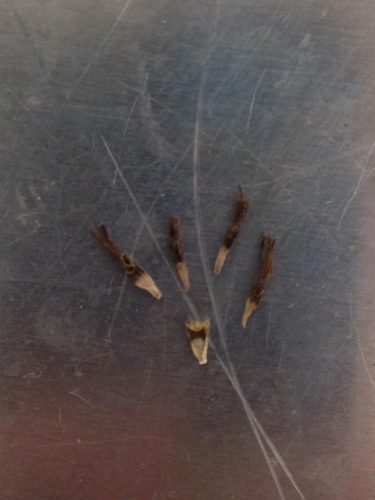
At the end of last week Mikaela and I officially finished data collection and entry. With a few hours left until the weekend, we came up with a handy dandy poster that can be used in the future when randomizing achenes. A similar guide existed for volunteers, but it had actual achenes glued to it and most had fallen off. We picked through the achenes we had sorted and put together pictures detailing the differences between informatives and uninformatives.

This week we started statistical analysis using R. Our hypotheses are currently being put to the test! With our limited stats and R knowledge, our progress is slow, but we’re getting the hang of things. Hopefully by the end of this week we’ll have some conclusive results; stay tuned!
PS: Here’s a link to the pdf of our poster acheneidentificationposter
Classifying x-rays stopped being fun very quickly today. Emma and I had divided the slides randomly and were each doing half, and I finished mine first so I decided to classify a handful of hers and see how the numbers matched up. They didn’t. Around 50% of the slides I recounted had new numbers. All of the discrepancies were because achenes were in between being full and partial or partial and empty (partial achenes were fertilized, but the embryo either did not develop normally or was destroyed). Together we went back to go over the discrepancies, and we came up with a few rules to make things clearer in the future. We were already working with a few rules that Danny had set out for defining partials:
- The embryo is fragmented
- The embryo has concave (curved inward) or irregular edges
- The width of the embryo is less than half the width of the achene at its widest pointThis was a good start, but we still found plenty of ambiguous achenes. Our new definitions for “partial” are:
- Both the top and bottom of the embryo is rounded, and there is plenty of space not filled within the achene. Looking for space along the sides of the achene can help identify this one.
 (71top)
- A strong, bright line inside an achene indicates a partial achene, whether it curves or not. Make sure this is distinct from the edges of the achene.
 (59bot)
- If the achene is bright, but not as bright as regular full achenes, the achene is partial (this can be described as cloudiness).
We also came up with a few hints (learned the hard way):
- Be careful of florets–they can show up as brightly as embryos, but don’t count them! The florets at top left of this image are almost as bright as the embryos bottom-right, and could be mistaken for partial achenes.
 (93top)
- If a bright spot has no outline of an achene around it and no band near it, and it isn’t a recognizable shape, assume it is chaff and let it alone.
- The “band” is the little bright line at the top of x-rayed achenes.
- When there is less contrast in an image and the brightness of embryos is hard to see, look at the bands at the tops of each achene. These are usually about as bright as embryos, so you can set a standard by that shade.
 (70bot) (70bot)
It is also worth noting that we decided to count achenes as full when the embryos don’t fill the entire outline: a space between the embryo and the achene is definitely permissible, and even smaller embryos count when they still maintain the proper shape (flat/convex top, pointed bottom) and aren’t smaller than half the width of the achene.
It was a long day of checking and rechecking classifications, but we’re finally happy with our counts. Now we’re working on a poster to help recruits learn the difference between informative and uninformative achenes, and Amy is helping us compile data. We’re officially out of the collection phase!
Always tired,
Mikaela
Whew! This week has been BUSY–and it’s only Wednesday! Here’s a run-down of our milestones:
Monday: FINISHED CLEANING SEED HEADS. For good. For ever. Cleaning is definitely the most time consuming step of our process, and having it over with is a dream. We also learned how to x-ray our seeds, and my feelings on it are pretty confused. On the one hand, radiation is scary; on the other, using x-rays for botany is pretty darn cool. On the third hand, there is a lot of waiting involved in the process. All in all, definitely glad I learned how to do it.
Tuesday: We finished scanning on Tuesday morning (all 110 scans!) so we’re feeling pretty good going into the rest of the week. In the afternoon we got a start on randomizing and met with a PhD student here, Jessa. She was really cool–we talked about grad school, biology and our names, which are all fun and interesting things to talk about (note that neither Emma nor I have gotten started on thinking about grad school yet–it’s only fun to talk about for now).
Wednesday: We finished randomizing! And then we finished assembling! And then we finished x-raying!! Then we did some data entry…and then we finished counting! Because we already processed 2/3 of our samples last week, this final pull has been a breeze. (Which Scott and Amy are blown away by. Apparently we’re pretty quick!)
My head is whirling a bit from everything we’ve accomplished this week, but we still have a lot to do. Our next steps will be:
- Finish classifying the x-rayed seeds (we got a start on this today and I love it; it could make a pretty good video game)
- Compile our data for analysis
- Analysis!
We’ve decided to focus our analysis on the uninformatives. Are smaller seed heads more likely to have tiny uninformatives? Are seed heads from dense populations more likely than isolated heads to have larval holes in their achenes? These and many questions are waiting to be answered…I’d better get back on that!
Mikaela
 These yellow coin envelopes contain the products of cleaning: achenes sorted into top, middle, and bottom for each seed head. The pink and blue cards at the front of each box show our progress. These white coin envelopes contain the products of randomization: the uninformative achenes from each yellow envelope. The informative achenes are in the clear baggies in the next image! Sheets prepared for x-ray. Each of the little baggies contains informative achenes from either the top, middle or bottom of a seed head.
As of this afternoon Mikaela and I have cleaned, scanned, and randomized 72 out of the 110 seed heads from the regular remnant populations. Two-thirds of the way done! We just learned how to count the scanned achenes and will get started on that and xraying soon. Hopefully we can be totally done with cleaning, scanning, randomizing, counting, and xraying the remaining third of the seed heads by the end of next week.
We’ve learned so much this past week and have met a lot of cool people. Today we sat in on a lab meeting where we got to see what the draft process is like for scientific papers. I thought it was really interesting; I’ve read a lot of published studies for different classes, but it always seemed like an out-of-reach process. Seeing a bit of the development up close and meeting the people involved made it seem not so distant after all.
In other news, all of our larvae have passed on to a better place. It seems the petri dish full of yummy food (old achenes) wasn’t enough to keep them going. Without their further development, the identity of the larvae may remain a mystery forever…
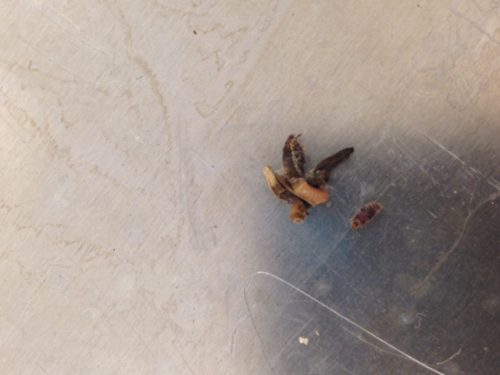
This morning I was devastated to find that our larva had died overnight–as we said in the previous post, we were hoping to raise them, and I had also become a little attached. My grief didn’t last very long, though, because I found two larva wreaking havoc in my second head of the day! Emma and I quickly repopulated our petri dish with wriggly pink bugs.
When a seed head has a larva, we can expect a good number of the achenes to have holes burrowed in their sides. Today, we finally caught a larva in the act! This little guy was found with the front half of its body inside an achene. It’s good to have conclusive evidence for what precisely is going on around these seeds…
Other exciting updates: we’ve officially passed the half-way point on cleaning our 110 seed heads. At closing, we’re working on #61. Woo for progress!
Ta ta for now,
Mikaela
 The perpetrator (image quality fuzzy to better convey shadiness)
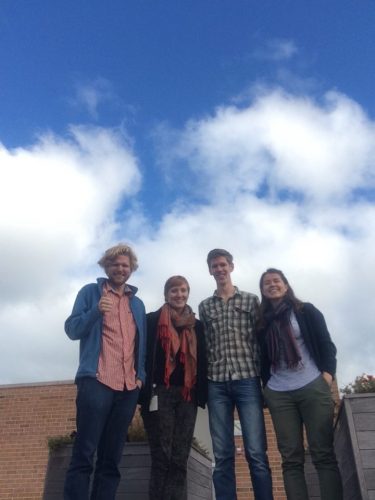
So it begins! Two new externs have joined Team Echinacea from Carleton College. We (Mikaela and Emma) will be here every day for the next three weeks, and are excited to discover new revelations for the Asynchrony, Isolation and Incompatibility experiment.
So far, most of what we’ve discovered is that cleaning Echinacea seed heads is tedious. Two days in, we have cleaned 36 seed heads; scanning them was a nice relief from the monotony. We think we could get through all 110 by the end of this week.
Although yesterday was quiet, there was a little bit of commotion: Mikaela’s second seed head had a rare deformity. Many of the achenes were uninformative. This means they were aborted part of the way through formation, so it cannot be determined whether they were fertilized. After minutes of puzzled deliberation, Stuart, Amy and Scott decided to keep them in the sample.
 Four uninformative achenes compared to one normal, small-to-mid-size achene. Because of their immaturity, the florets are still firmly attached. In contrast to yesterday, today there were quite a few volunteers and a couple of students who we got to meet. It was nice to talk to other people who were involved in and excited about this project. We also got to hear about other experiments going on in the lab besides our own.
Today’s seed cleaning also presented an exciting moment: just moments after Amy told us about last year’s larval discoveries, we each found a live larva residing in the heads we were cleaning. We’re thinking about raising these mystery larva so we can finally learn just what they are. Hopefully we’ll have more success than last year’s effort!
Our two larva. Emma’s is the tiny brown one on the right, and Mikaela’s is the pink one hanging out on a makeshift habitat of chaff. We are grateful for this opportunity to contribute to and learn from the project, and are looking forward to the next three weeks!
Thanks for the warm welcome,
Mikaela and Emma
Dear Flog,
Last time I mentioned in passing that Stuart, Amy, Scott, and I had been discussing papers about fire and its potential impact on the reproductive fitness on Echinacea plants. This week I will go into greater detail about what I’ve learned about fire and what our data can teach us about how it impacts prairie health.
Some of our studies taken from previous years have shown us that, even when there are enough bees to carry pollen from plant to plant, Echinacea plants can have difficulties receiving pollen from potential mates. There are a few reasons for this. In our fragmented prairie remnants, Echinacea plants are often far enough apart that pollen collected by a bee will often fall off before it can reach another Echinacea flower. Echinacea plants may also flower in different years, or at different times in the season. This can prevent mating even between close flowers. This mate availability problem is compounded by the fact that Echinacea is self-incompatible, meaning a plant cannot pollinate itself or its close relatives. This means that if a plant flowers and fails to find mates, all the energy it expends to flower and fruit results in no offspring. This is an extraordinary energy cost for no payoff.
Data we have collected seems to suggest that fires may help perennial prairie plants like Echinacea find other mates. Explosive flowering after a large burn is typical for prairie plants. There is some evidence that increased availability of nutrients from burned organic matter and the increased availability of sunlight provide resources for a plant to invest in a costly reproductive structure like a flower. This is probably no different for Echinacea. However, as an added bonus, some of our data seems to show that this explosive flowering may reduce the reproductive isolation of Echinacea plants by increasing the number of synchronous flowering plants. Thus, fire helps Echinacea successfully seed by increasing the number of available mates. Really cool!
The tendency of Echinacea to flower synchronously after a fire could be the result of natural selection, or simply a byproduct of the excellent growing conditions created by fire. In either case, this knowledge affirms how important fires are to prairie ecosystems. The Echinacea Project, through projects like SppBonus, hopes to further elucidate these mechanisms through which fire improves prairie health.
Until next time!
Sam
Citations:
Wagenius, S. and Lyon, S. P. (2010), Reproduction of Echinacea angustifolia in fragmented prairie is pollen-limited but not pollinator-limited. Ecology, 91: 733–742. doi:10.1890/08-1375.1
https://echinaceaproject.org/pub/wageniusAndLyon2010.pdf
Ison, J.L., S. Wagenius, D. Reitz., M.V. Ashley. 2014. Mating between Echinacea angustifolia (Asteraceae) individuals increases with their flowering synchrony and spatial proximity. American Journal of Botany 101: 180-189.
https://echinaceaproject.org/pub/isonEtAl2014.pdf
Part 1. I couldn’t stay away from the Echinacea Project too long. As I’m positive you want to hear both about my poster that I will be presenting at MCMS tomorrow at the University of Chicago and my adventures in Chicago, I will share both. As I arrived at the airport to fly to Chicago, I realized I had forgotten my cell phone. I thought to myself, I lived most of my life without a cell phone, I can do it another day. After arriving in Chicago, I had thankfully packed a dollar in quarters, so I was able to use a pay phone (yes, those still exist) to call a cab. While I did struggle to understand the technology, I was finally able, after spending my only dollar in quarters, to procure transportation to the Chicago Botanic Gardens. I was left penniless, phoneless, and with only a laptop and my knowledge of Chicago (this, by the way, was absolutely nil). After making a successful rendezvous with the team, I enjoyed a lunch and tour of the lab. It was great to see everyone again.
Part 2. After figuring out the best way to get to my destination at the University of Chicago, I jumped on the purple line, confident that, after a quick jaunt on the green line, all I’d have to do was walk a block or two to the hotel, where dinner awaited me. I hopped off the train, and quickly realized that the area had been highly developed since the last google street image had been taken, unless my memory of the picture failed me. Ah well, I thought, I wrote down the street that will get me to my hotel, it’s just east of here. The street just east was not the correct street. Maybe the map I saw was just wrong. By the next street, I knew I was in the wrong place. Thankfully a friendly man suggested a bus that would take me five miles to the east, where I thought I was getting off. Yes, I had taken the wrong train. All was well and good until I hopped on the bus and realized that I was penniless, with no money for a fare. Again, the bus driver was a greatly friendly man, and I rode the bus without a fare. Sailing was smooth from there on out.
Tomorrow I will present my findings on how edge effects play a role in the style persistence and pollen limitation of Echinacea at the Midstates Consortium for Math and Science. Style persistence decreased as plants were farther from habitat edges, demonstrating a spatial pattern in pollination. Attached is my poster. stylepersistenceedgeposter
Off to share a room with someone I haven’t met yet. Day in the life.
No explanation needed. Great to see y’all again.
|
|



 (70bot)