|
|

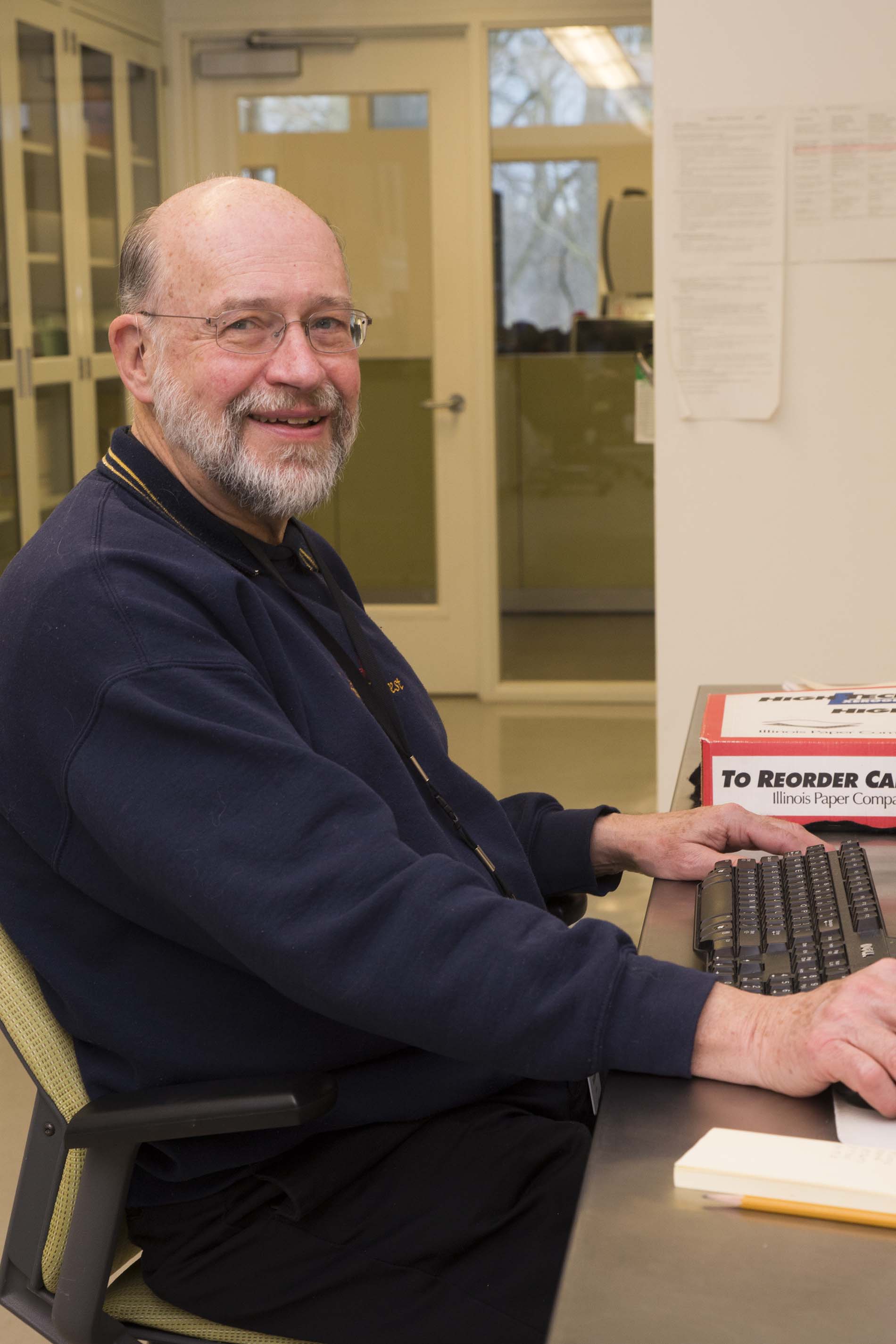
Team Echinacea lost one of our longtime members, Bill Wallin. Last week Bill went to the hospital for pain associated with cancer and his health deteriorated quickly. He died on Monday surrounded by his family.
We will miss Bill a lot. He volunteered on Thursday mornings and has been an integral part of our team for over a decade. He was a hard working and dedicated citizen scientist and a great person to have in the lab. He was thoughtful and considerate and contributed to the ongoing discussions in the lab on wide-ranging topics. Bill was usually soft spoken and quick to smile. He would share stories of his adventures with pianos and more recently of his cancer. Through thick and thin, we could count on Bill to be a positive influence on the Team.
Bill contributed to all aspects of lab work with the Echinacea Project. In the past several years, Bill focused on counting achenes. We appreciated Bill for his speed and accuracy when counting. Since we moved to our online seed counting system in 2011, Bill has counted over 413,430 Echinacea achenes. Before joining the Echinacea project, Bill pulled weeds in natural areas at the Garden and monitored threatened plants for the Plants of Concern Program.
We will miss Bill, but we are grateful that we got to work with him and enjoy camaraderie while making contributions to plant science and conservation. We will forever have great memories.
Here is Bill’s profile from 2015 and some more posts with photos of the team and of Bill.
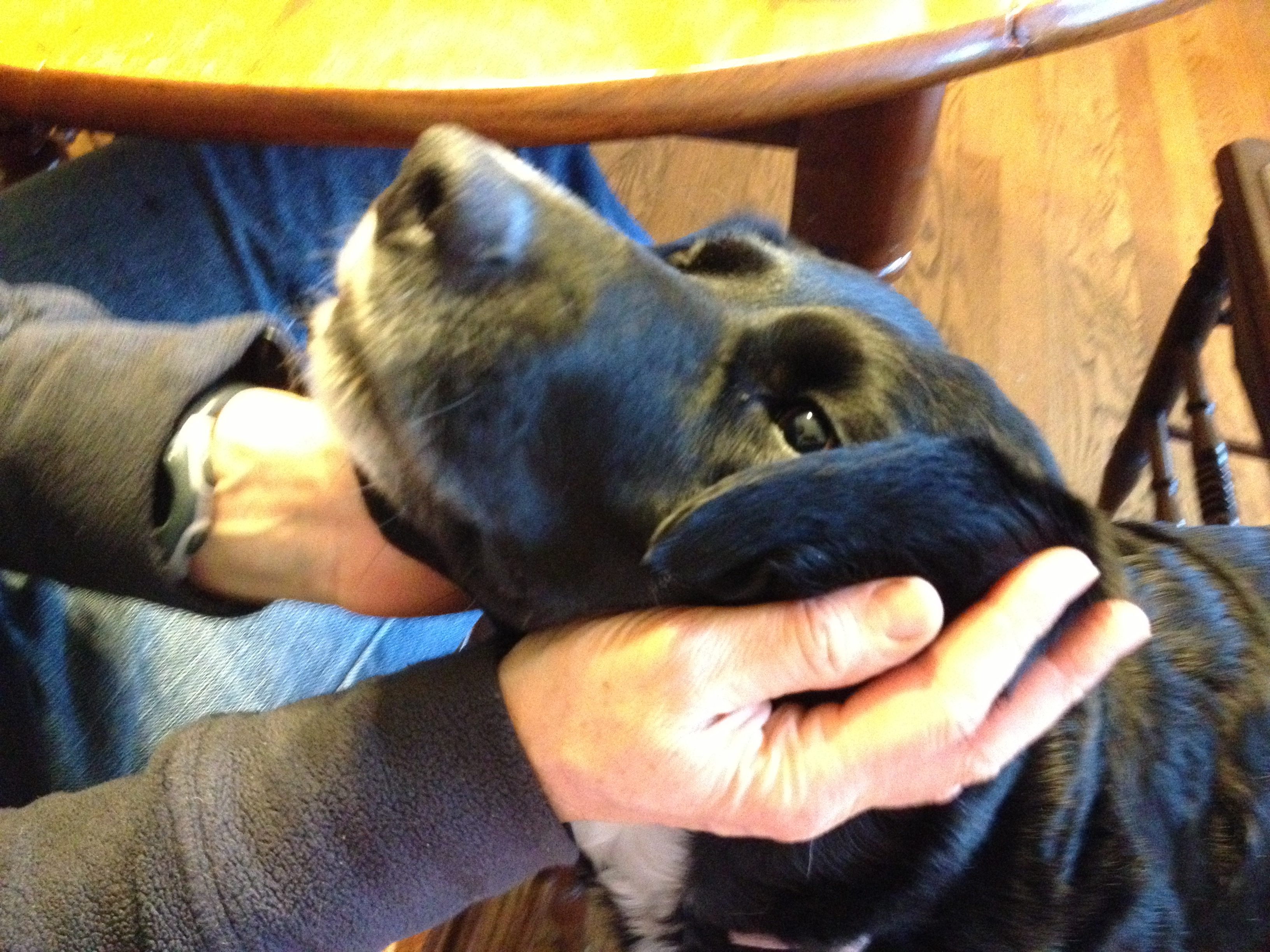
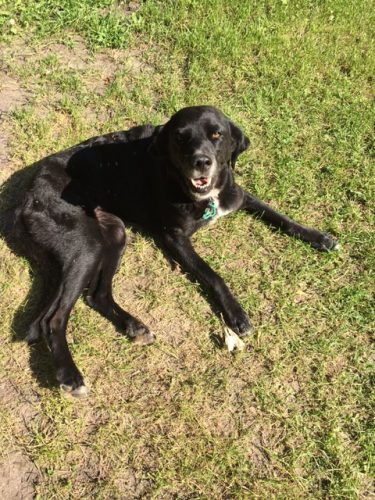
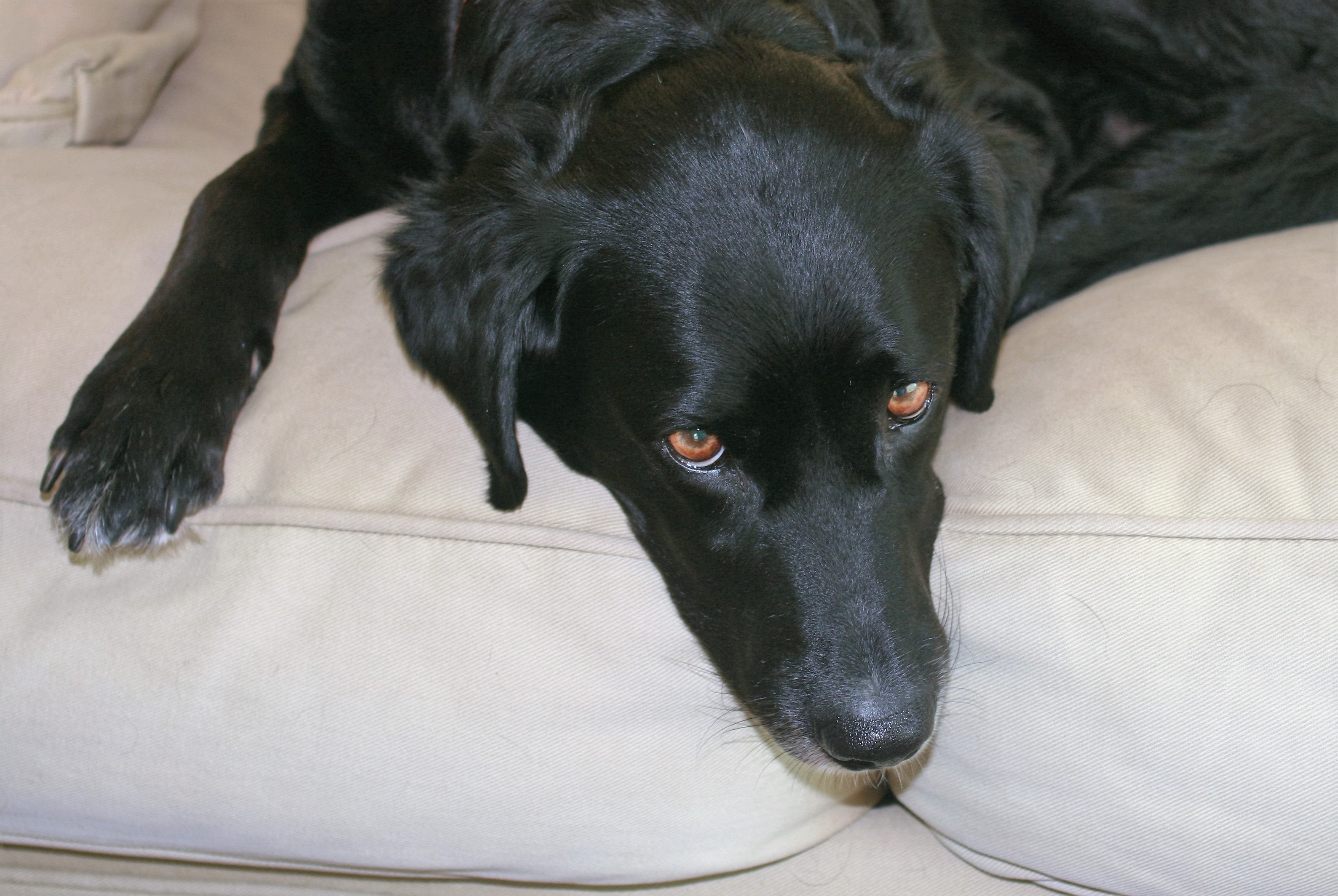
 Roxy, a loyal companion to Team Echinacea during our summers in Minnesota, died today. She led a long and full life: running, digging holes & trenches, enjoying the companionship of people, eating smelly things, licking skunky gravel, basking in the sun, and chasing many critters, including chipmunks, 13-lined ground squirrels, rabbits, gray squirrels, fox squirrels, raccoons, ducklings, mice, red squirrels, and pocket gophers. She will be greatly missed. Roxy, a loyal companion to Team Echinacea during our summers in Minnesota, died today. She led a long and full life: running, digging holes & trenches, enjoying the companionship of people, eating smelly things, licking skunky gravel, basking in the sun, and chasing many critters, including chipmunks, 13-lined ground squirrels, rabbits, gray squirrels, fox squirrels, raccoons, ducklings, mice, red squirrels, and pocket gophers. She will be greatly missed.


Hey again Flog,
My name is Sam Hamilton and this is my second post on the Flog. In my first post, I focused on the experimental goals of the SppBonus project, the kind of data we are measuring, and the project’s relevance to understanding reproductive success in fragmented prairie remnants. Today, I will talk about the progress I’ve made, and the methods I’ve used to move this project from seed head to data set.
The first step of this project was to extract the achenes from the seed heads. Flowers of the Aster family, including Echinacea, are compound flowers, many flowers that grow together to look like one large flower. In Echinacea, each of these flowers, regardless of whether it is pollinated or not, produces a fruit called an achene. By measuring how many achenes contain seeds, we can estimate how well a flower was pollinated in a given year. Thus, in a project like SppBonus, the first step is to extract the seeds from the seed head. The SppBonus data set contained 32 different seed heads, which took me roughly a month to completely clean and organize into samples taken from the top, middle, and bottom of each flower.
The second step is to scan all the gathered achenes so that we can count the total number of achenes. This is an important metric to measure the reproductive fitness of each Echinacea plant. This was a fairly fast process and it only took me three days to scan the achenes from each seed head.
The third step is randomization. We ultimately determine whether or not an achene contains a seed by X-ray. However, there are simply too many seeds to X-ray them all efficiently. Thus, we take a sample from our seeds, X-ray those, and then use that data to make assumptions about the seed set as a whole. We randomize our samples, to ensure our samples are representative of their populations. Without this step, we risk choosing achenes that are the easiest to count, or best fit our expectations of what the data will look like. Our randomization procedure involves pouring the seeds onto a grid where each cell is assigned a letter and a number. A second sheet has these letter and number combinations in a random order and we go down the list selecting from each cell until we’ve collected thirty achenes total. This is the part of the project I’m working on now!
When not working on SppBonus, I am spending my time reading and discussing papers about fire and its effects on pollination and germination with Stuart, Amy, and Scott. I learn a lot from listening, and it’s always interesting to hear their insights into the merits and flaws of each paper, as well as to watch them design new experiments from the ground up.
Hopefully I didn’t bore you, until next time!
Sam
Stuart recommends the below books as a good place to start thinking about time management. If you aim to manage time to better reflect your values, these books can help you develop strategies. The locations refer to NU libraries.
Mindset : the new psychology of success / Carol S. Dweck.
Dweck, Carol S., 1946-
New York : Random House, ©2006, 1st ed..
Checked out from Main Library Stacks (153.8 D989m )
Thinking, fast and slow / Daniel Kahneman.
Kahneman, Daniel, 1934-
New York : Farrar, Straus and Giroux, 2011, 1st ed..
Available at Qatar Library Stacks (BF441 .K238 2011 ) and other locations
Getting things done : the art of stress-free productivity / David Allen.
Allen, David, 1945 December 28-
New York : Viking, 2001
Available at Main Library Stacks (646.7 A425g ) and other locations
Succeed : how we can reach our goals / Heidi Grant Halvorson ; foreword by Carol S. Dweck.
Halvorson, Heidi Grant-, 1973-
New York : Hudson Street Press, ©2010
Available at Main Library Stacks (153.8 G762s )
Power of habit : why we do what we do in life and business / Charles Duhigg.
Duhigg, Charles, author.
New York : Random House Trade Paperbacks, 2014, Random House Trade Paperback edition..
Checked out from Main Library Lending Resource Sharing Requests (BF335 .D78 2014 )
Willpower : the rediscovery of humans’ greatest strength / Roy F. Baumeister and John Tierney.
Baumeister, Roy F.
New York : Penguin Press, 2011
Checked out from Main Library Stacks (153.8 B347w )
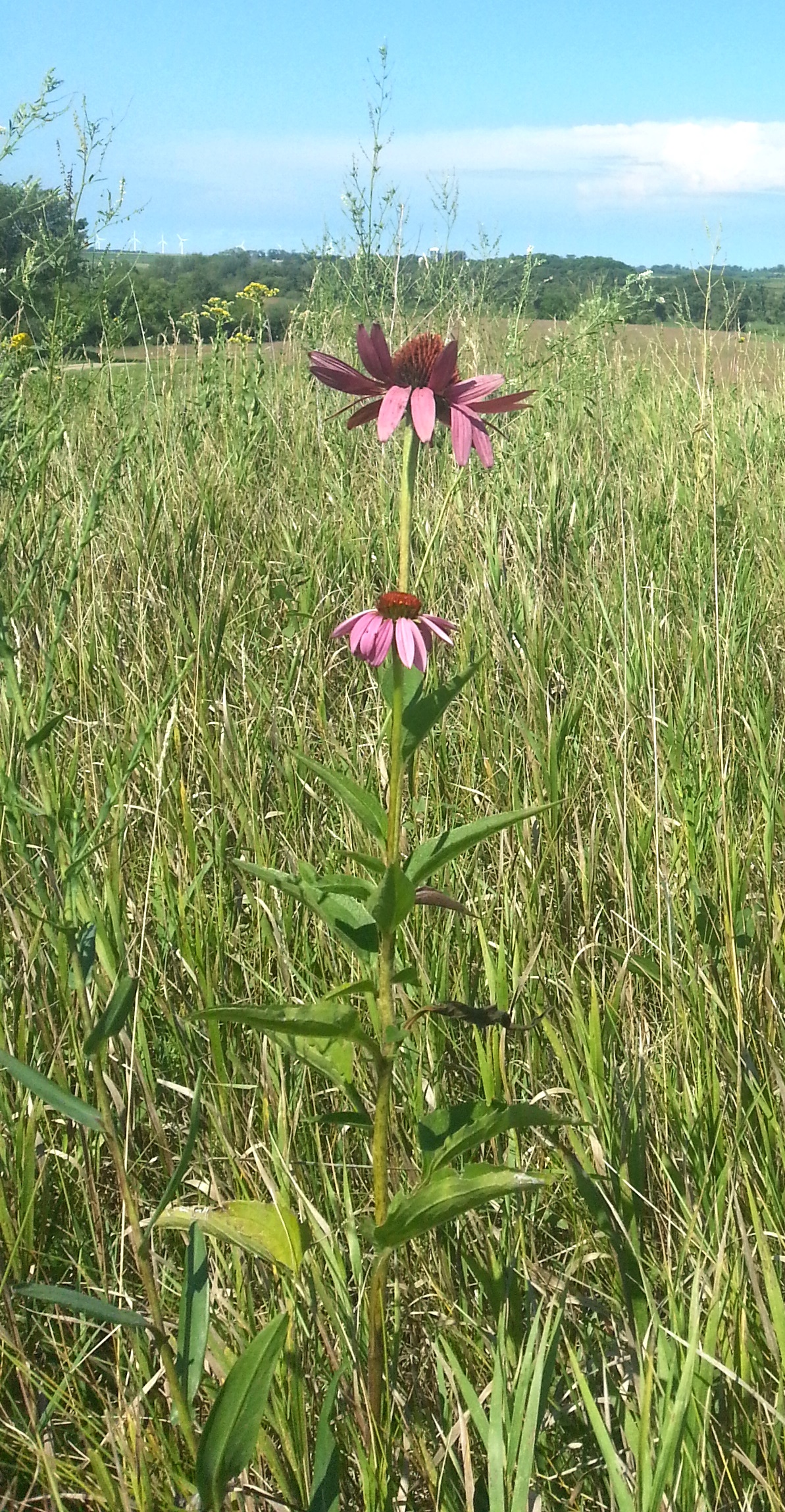
 Echinacea purpurea at Yellow Orchid Hill Non-native and invasive species are present in many of our study sites and may compete with native species for resources, such as light, space, or pollinators. Some invasive species, such as brome (Bromus inermis) and sweet clover (Melitotus officinalis), are already so widespread and abundant that we don’t keep track of where they are. However, this summer we noticed new appearances of several other non-native species, Echinacea purpurea and Rudbeckia hirta*, that could become more dominant in years to come. We documented their presence by taking photos and shooting GPS points. Most of the places where we saw these species were nearby or part of a restoration where the non-native species was introduced as part of the seed mix. Going forward, we will return to the locations where these species were found in 2016 and monitor the expansion of their populations.
Year: 2016
Location: RRX (Rudbeckia hirta), north of WAA (Rudbeckia hirta), RLR (Rudbeckia hirta and Echinacea purpurea), YOHW (Echinacea purpurea), and the corner of Tower Rd and 27 (Rudbeckia hirta)
Data collected: The photos we took are stored in Dropbox (summer2016pics/invasives)
GPS points shot: We shot GPS points at: RRX (1 pt), RLR (approximately 10 pts), YOH (1 pt). The restoration near WAA had too many plants to shoot individually, so we just took pictures. We couldn’t find the Rudbeckia at the corner of Tower Rd because the area where it had been was disturbed by electrical work. These points are stored in the job ‘ECHPURP_RUDBHIRT_20160914_SULU.tsj’.
*You might be thinking, “Isn’t Rudbeckia native?” and the answer is yes, in other parts of Minnesota. However it is not present in any of the high-quality remnant prairies in our study area and so we consider it to be non-native to our sites.
Hello Flog,
Long time, no flog. Guess where I am?!?
“Chicago”
good guess.
Yes, I ventured to Chicago for an extended weekend of fun and work in the Chicago Botanic Garden lab for the next step of my project about intra-specific pollen diversity (see proposal posted many moons ago).
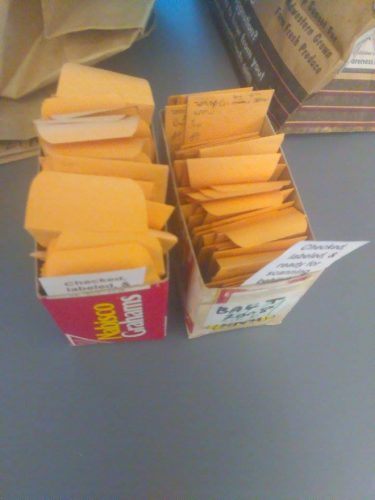
I was greeted on Thursday night by Lea, Amy, and Scott with pizza! It was awesome and tasty, though I am more of a thin crust person myself. On Friday, I went to the lab with Amy and Lea and began dissecting the heads that I crossed this summer. Amy developed an ingenious system for separating my achenes and getting them x-ray ready that involved the sticky side of a post-it note.
 Achenes prepped for x-raying. Later, Stuart, Gretel, Lea, Amy and I explored some of the gardens on the way to lunch in the café. After a few more hours of dissection, we went home and upon Stuart’s orders, painted the town red, so to speak. After giving Lea’s dogs lots of love and attention, Amy, Lea, and I explored downtown Evanston and stumbled into a pie shop where we ate four different types of pie. Much like an ice cream shop, this pie shop begrudgingly gave us samples of their pie, so we all made very informed decision as there were a lot of choices. We all shared a expresso cream, pear fig, “Fat Elvis” (chocolate, peanut butter banana), and a curry lamb pie. Decadent, I know! Consensus: pie is delicious. Then we returned to the abode and watch Portlandia and went to sleep at promptly 9:30.
 Amy and Betsy workin’ hard. This morning, Amy, Betsy (Amy’s visiting friend, feat. in photo and also shoutout for the help in lab), and I went to the gardens while Lea hit the lib hard. With their help, I finally dissected all my heads and got them ready for pre-germination treatment.
Shortly, we will be off to Lou Malnati’s Pizza to eat more pie (the central theme of my trip).
Toodaloo,
Laura
Hey Flog!
My name is Sam Hamilton, and I am a Northwestern senior doing research in the Echinacea Project lab this quarter. My project specifically seeks to understand the relationship between prairie fires and reproductive success of flowering plants using our model organism A. Echinacea. This is an important relationship to understand because, while historically fires were an integral part of the prairie life cycle, today’s isolated prairie remnants are often never burned. This could have a large impact on the success of shorter plants that rely on the extra sunlight and nutrients that a burn year supplies to flower and germinate. This quarter, I will be collecting the data from seed heads collected this year and analyzing it along with data collected in previous years to draw my conclusions.
I am also looking at the reproductive success of Echinacea flowers collected from the bottom, middle, and top of each head. In Echinacea, flowers mature first at the bottom and slowly develop towards the top over time. This allows us us to deduce when a plant was pollinated best during the season. I’ve been hard at work the past month cleaning seed heads and separating their achenes into top, middle, and bottom sections for later analysis. It’s been a lot of work, but the great company has kept it fun!
Until next time!
-Sam
Myself with Susie, Char, Aldo, and Scott. (Left to Right)
One month of cleaned and organized achenes.
Hi flog,
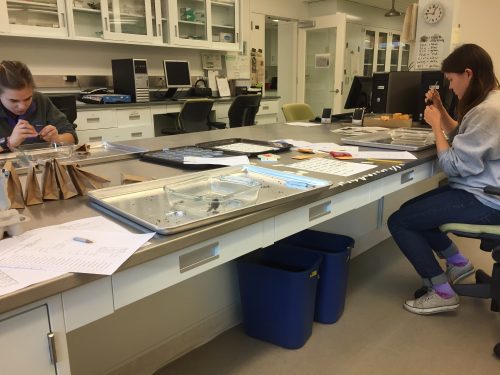
Instead of posting from Kensington, I’m posting today from the lab computer at the Plant Conservation Science Center at the Chicago Botanic Garden. This morning, I met up with Lea (who devoted flog readers will remember from the summer) and Sam, an undergraduate Biology student at Northwestern who will be working at the Garden this Fall. Sam and I were able to bond over how the bike ride from Evanston was longer than we both expected. I also got to meet Chris and several of our excellent and expert volunteers for the first time. They taught me how to dissect heads and separate the achenes from other flower-parts (the “chaff”) and gave some helpful advice from years of their own experiences. After that, Sam and Stuart brainstormed some cool projects that Sam could get involved with. I then looked at some materials for counting and classifying achenes as full, empty, or partially-full in x-ray images using an informative tutorial that Danny wrote last year. These classifications are used to estimate seed-set size, an important part of quantifying Darwinian fitness, as well as assessing the amount (or quality) of pollen these flowers are receiving.
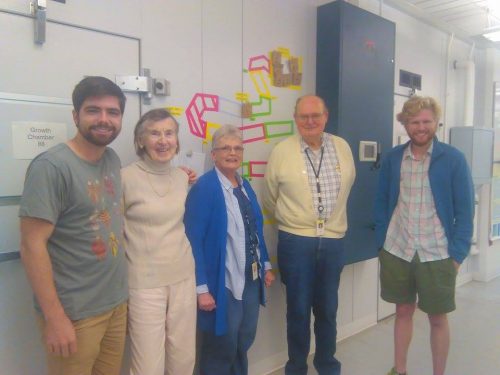
Volunteers show Sam, Lea and me how to dissect heads and count achenes. From left, Suzanne, Bill (in back), Char, me, Art, Aldo, Sam, Lea, Susie.
We’re reaching our final days at the House of Hjelm. Amy and I have a list of things to wrap up here in the last few days before we go to Chicago. The biggest task by far is harvesting Indiangrass (Sorghastrum) in P1. Those who saw P1 a month ago may remember the red tint that the stems and seeds of this tall grass gave to the plot. Amy and I spent much of yesterday afternoon and this morning harvesting the seeds (some of which are not quite ready yet) to broadcast in the area where the goats have been feeding on buckthorn. Stuart is hoping that this will stop the buckthorn from reestablishing and will also provide a source of fuel for burns. In addition to harvesting buckthorn, Amy assessed senescence in plants involved in the aphid experiment, then helped me out in mapping out the positions of gopher mounds in the plot. We also pulled out a lot of flags. The plot looks different than it did even two days ago. We also have been following the scout creed of “leave no trace” by removing twist ties from the heads of plants in some our remnant plots the last couple of days.
Amy made lasagna tonight while I picked up our final CSA in Morris. We’re overwhelmed by the vegetables we have here, and there’s no way we can eat all of them in the next three days. Amy made some tomato sauce and we’re hoping to freeze a few more things, but if you have any ideas on how to creatively use up or preserve (and travel with) cabbage, peppers, tomatoes, eggplant, or chard, please let us know in the comments.
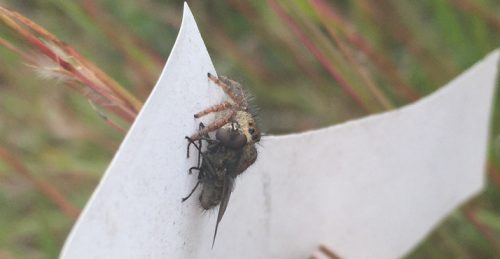
 Spider on a flag in p1 munching on a fly.
This morning, Amy, Will and I found ourselves in Alexandria without coffee. To remedy this, Amy and I went to Perkins, the restaurant sponsor of Team Echinacea (Will did not come because he was too busy — he had to get a haircut). We actually quite enjoyed the food at Perkins (also known as the restaurant equivalent of a farkle), but our visit was truly noteworthy because we sat a couple of tables over from our favorite cashier who works at Cub Grocery. We were too shy to actually talk to him, but we had fun talking about what we would have talked about with him if we weren’t so shy. From there, we went to Goodwill. There, Amy bought a pepper grinder, and I bought some tape cassettes that sounded like they were recorded inside the engine of a moving car. We also visited Alex High School and watched what we thought at first was a football game, but was actually turned out to only be a practice. The afternoon was mainly spent in abject sadness because Will did not come to Town Hall to play Settlers of Catan with us. For dinner, Amy and I ate some roasted vegetables over coos coos, while talking about death, and some other things. To deal with this anxiety over our own mortality, we ate ice cream and watched Arrested Development clips. On and on, sun rise and sun set, ad infinitum.
Today was our last true weekend-day of the summer — we’re going to do a full day of work tomorrow so we can get ahead on our list of things to do for the week. The living up here has been good — there is something very calming and freeing about days off in Kensington. Soon we will be in Chicago, a place as frantic and stimulating as Kensington is simple and charming. But for the time being, we have plenty of things to do here.
|
|